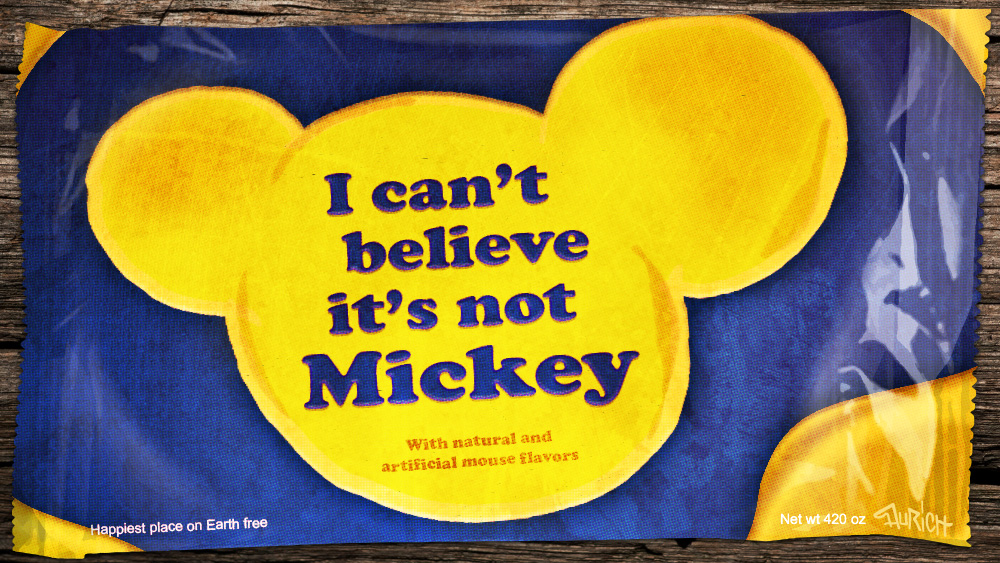
Why Mickey Mouse’s 1998 copyright extension probably won’t happen again
Copyrights from the 1920s will start expiring next year if Congress doesn’t act.
Ars Technica
188 points · by rbanffy · 8y ago · 187 comments
The article makes some really good points. The political landscape really has changed since 1998. The content industry may still have more resources overall, but it's definitely going to get ugly if they try again. Hollywood does not want the public turning against them, that'll just make it worse.
Honestly I wish there were a way to compromise. Let companies pay for perpetual copyright. They want to hold onto Steamboat Willie forever, let them. Just don't drag everybody else with you. We just need to make it an economic decision for them, so that the public's interests are served eventually.
We want a thriving ecosystem in which apex predators like Disney and the caribou can thrive.
Start with Disney and all that they made from the works of The Brothers Grimm. Hint at all that could be done, if it were not for greed pulling the ladder up behind them.
Then point to the endless reboots.
RAMBO 35 COMING TO THAT THEATRE NEAR YOU NOBODY CARES ABOUT.
A long time ago, I got one of the Lessig FREE THE MOUSE bumper stickers. It has been the most effective one I ever used.
I tell the story about once per month. People wonder about "THE MOUSE" and why it must be freed.
Some lesson in there somewhere.
All I know is that phrase works.
Would there really be that much fuss over it?
> Even if Mickey’s copyright does expire in 2023, Disney has no less than 19 trademarks on the words “Mickey Mouse” [...]
> According a precedent set in a 1979 court case, a trademark can protect a character in the public domain as long as that character has obtained what is called “secondary meaning.” This means that the character and the company are virtually inseparable: upon seeing it, one will immediately identify it with a brand. [...]
> In other words, Disney has ingrained Mickey Mouse so deeply in its corporate identity that the character is essentially afforded legal protection for eternity, so long as Disney protects him (trademarks last indefinitely, so long as they are renewed).
As it stands, copyright serves little positive social purpose. The overwhelming majority of creators get paid little if anything for their work, and still there is a glut of content. So there should be no fear of the world losing lots of great content if there was no copyright.
Most of the benefit of copyright is reaped by the middle men, who profit off the work when the creatives that made it have long ceased to do so (if they ever did). Abolishing copyright will thus mostly affect these middle men, and have little effect on content creation itself.
Those creatives that still want to get paid in a copyright-free era can find business models that don't rely on copyright, like performances, donations, or kickstarter-like models where one is paid for future work.
> Without copyright, anyone can purchase it once and give it away for free or sell each copy for $0.01 and undercut all competition.
That's not a problem if the creators were paid to make the movie.
The parent mentioned several mechanisms to do this. It's not hard: after all, that's how basically all industries have worked since forever.
Anecdotally: half of the jobs I've had were producing private, in-house software; I got a regular wage for doing this, since the companies found such software useful. No need for copyright. The other half were paying me to produce FOSS which, once it was written, we wanted people to copy and spread for free, since that would gain us more attention (and potential customers for our related services). Again, no need for copyright (although some were strong copyleft, with network-use clauses)
Media is a much different story, and transforming creators into beggars (as suggested) is not a solution. At that point, creators are competing with their ability to beg, and not their ability to create. Any person with a reasonable amount of self-respect and pride in their work would not tolerate that kind of existence.
Where do you think the money to pay the creators comes from? Movies, games, and most other modern forms of mass art are incredibly expensive to produce. If the content creators can't recoup their expenses, they produce less of the content.
How would they enforce their (exclusive) right to resell it? The first person to whom they sell a copy could then give away more copies for free.
6/10 highest-grossing movies last year were not comic book movies: Dunkirk - Original property Fast & Furious 8 - non-comic franchise based on original property Despicable Me - non-comic franchise based on original property It - remake Beauty and the Beast - remake Get Out - original property Star Wars Episode 8 - non-comic franchise based on original property
The most profitable movie of 2017, Get Out, was an original franchise. This follows on the heels of 2016s most profitable movie, Split, a sequel to an original property (The Sixth Sense/Unbreakable universe).
To be fair, I think copyright has its place as a minimal safeguard for artists' work, but in its current form it is entirely too aggressive and lasts way beyond its scope should cover. Copyright should not be reason to send SWAT raids to people's homes, just as much as it should not cover 70 years after the artists' death.
I am certain that if we seriously rolled back copyright, our art would still thrive, albeit perhaps less AAA content.
The thing is: absolutely nothing is preventing people from creating content without copyright. So what exactly is the problem? AAA content gets produced and monetized using copyright protection. People are free to use copyleft for their indie content. And at the end of the day, the market speaks and AAA content is what people want. Saying that “getting rid of copyright would be fine except we’d probably get less AAA content” this is completely unresponsive.
The “SWAT team” issue is a red herring. I don’t think we should have SWAT teams responding if my neighbor’s fence encroaches onto my land, but that doesn’t say anything about whether I should have an enforceable property right in the boundaries of my yard.
Is there a source you can link, or were you just exaggerating for rhetorical effect?
Not quite to the level of actual SWAT operations, but far more common are Anton Piller orders. These orders are still used with decent frequency in IP cases because the evidence in question is often easily destroyed and the cases are often existential-crisis-level disputes for one or both parties.
RIAA SWAT Raid in Atlanta - http://www.nytimes.com/2007/02/18/magazine/18djdrama.t.html
Those are the two biggest ones I can think of, but both are examples of literal deadly force used for copyright violations.
Unless we're talking about in theaters? Because it doesn't show up there.
Enforced by none else than the FBI.
For some creators though, it's different. I heard George RR Martin comment on this once. Tolkien's family (according to GRRM) did a great job guarding and protecting his works. He's horrified at the thought of a descendent making selling Targaryan cream buns or allowing shitty derivative novels. That isn't a money concern, but it is a property rights concern of sorts.
In any case, I think the sorts of right GRRM feels are his could still be preserved, without keeping all copyright the same.
I get the desire to rule from beyond the grave, but do not believe it is a legitimate property right.
Would you feel good if under your system, the donations or other alternate payments ended up in the author’s rewards being cut? What if they were cut in half? Or even became negligible, because I don’t see any guarantees prescribed.
This is not just about Taylor Swift (no offense if you are a fan). We’re talking about works that can change lives, inspire people to do great things, even change the course of history.
The system has been abused and distorted. However I don’t see how that can make us sure the best solution is to throw the baby out with the bath water.
Copyleft licenses could be potentially be replaced by viral contracts... but frankly, I'd take the tradeoff of no copyright and no copyleft over the hellish system of copyright we have now.
As it stands, capitalism serves little positive social purpose. The overwhelming majority of laborers get paid little if anything for their work, and still there is a glut of production. So there should be no fear of the world losing lots of great production if there was no capitalism.
Most of the benefit of capitalism is reaped by the middle men, who profit off the work when the laborers that made it have long ceased to do so (if they ever did). Abolishing capitalism will thus mostly affect these middle men, and have little effect on labor itself.
Those laborers that still want to get paid in a capitalism-free era can find business models that don't rely on capitalism, like the military, collective farming, or secret police-like models where one is paid for future work.
The thing about copyright is that it’s existenxe isn’t preventing the alternative models you’re talking about. Unlike any other form of property, copyright covers an individual’s own creations. Owning land is staking claim to something that existed for eons before you were born and will exist for eons after you’re dead. But copyright is over something unique you brought into the universe. With recording and distribution being so cheap, nothing prevents creatives from giving away their work and making money on their own unique contributions with performances or Kickstarter. But people want AAA production values. Just like how Kickstarter can’t raise enough capital to design and build something with mass market appeal like a MacBook Pro, it’s not suitable for making something like the new Star Wars movie. (Which I refuse to watch because blockbuster movies are dreck, but the public wants what it wants.)
Really? They make license agreements with the content/copywright owners in order to stream it. It does break apart the idea of using a single copy and lending it to someone though. I thought they were investing in their own content in order to attract more users, and improve the overall offering.
I'm hoping to get more creative after I die. Don't have the time for it now.
Oh, that's why it's "life plus" so many years...
Yes, it's sarcasm
Tangible goods are finite on this planet, intangible goods (like IP) are not, so they are the perfect tool for keeping this "perpetual growth machine" aka world economy going, even if actual resources become scarce, we will never run out of ideas to "monetize".
In that regard, I don't think it's a coincidence that most of the developed economies have moved from manufacturing industries, dealing with actual goods and finite resources, to "service industries", where most of the value is generated through "ideas" which are infinite.
It's easy to put a value on something tangible, you can calculate the resources that go in there, the man-hours needed to manufacture it, the costs of the manufacturing facilities. The same does not apply to most intellectual property, its whole value is pretty much an arbitrary estimation with no limiting factors in terms of real-world resources, as such there are no rational limits to how much one could charge for them.
Make 4 year extensions for copyright to cost $1,000,000 per item. Increase the fee to account for inflation.
Micky Mouse and Sherlock Holmes (2nd Half) will stay locked up but the 99.9% of the other works are freed.
It isn't perfect but it will release the rest into public domain.
We have lost the vast majority of silent era films and more historical films will follow since it's illegal for you to save them to digital format without the explicit consent from the content creator. We won't lose Casablanca or The Seventh Seal since they're preserved by historical archives and companies can still make money screening them but TV-movies like Star Wars the Holiday Special is only being preserved by illegal means because nobody bothers enforcing its copyright. Sure, that movie is an abomination, but film historians 100 years from now would presumably want some proof that Lucas made it and that it really was the first appearance of Boba Fett.
But if the creator is dead and nobody is making any money off their work, then put it in the public domain so it doesn't get lost in time.
https://www.eff.org/deeplinks/2016/01/well-probably-never-fr...
In 2018, the copyright on those early Mickey cartoons will end (if Congress doesn't repeat the sins of '76 and '98, that is—and you can bet we'll be pulling out all the stops to prevent that). What happens then?
Almost nothing, if Disney and friends get their way.
title card for Steamboat Willie Those Mickey cartoons are almost certainly in the public domain anyway. In the late 1920s, copyright wasn't automatic: rightsholders had to undertake certain "formalities"—registering with the Copyright Office and displaying correctly formatted notices—and then renew those formalities periodically. Scholars who've looked into the matter make a very good case that the early Disney organization flubbed its registration, notice and renewal, and there are probably cartoons that are in the public domain today.
Which is not to say that Disney wouldn't sue you if you tried to remix them, upload them to the Internet Archive, or sell them in on a compilation DVD of other public domain cartoons from the period. They almost certainly would, and it would cost you an unthinkable sum of money to defend yourself. Emerging victorious but impoverished, you would have won a small victory.
But at that point, we expect that Disney will try to use another body of law to suppress creativity and commerce involving Mickey Mouse, whether or not "Steamboat Willie" and "Plane Crazy" are in the public domain: trademark law. If you sell something Mickeyish—including its public domain cartoons—Disney might ask a court to stop you because people who buy the cartoons from you may think they're buying from Disney. Back to court with you!
This is confusing to me. If copyright is up on Steamboat Willie, producing derivative works based on Steamboat Willie has to be allowed, so original content that remixes and adds to Steamboat Willie to make a new cartoon must be OK.
And there is such a thing as fair use in a trademark. Being descriptive is fair use of a trademark. You can market your breadbox as being compatible with Acme Bread. And you can describe your Sherlock Holmes book as containing Sherlock Holmes and as an extension to the public domain canon.
I don't see why Mickey Mouse gets special treatment just because he's also on logos and such. Disney, at the least, is forcing a conflict between trademark law and public domain law to see what it can get away with.
https://upload.wikimedia.org/wikipedia/en/d/d4/Mickey_Mouse....
https://images-na.ssl-images-amazon.com/images/M/MV5BODZhY2E...
Honestly, I think the clickbait "why" does the article a disservice: it is a more in depth work than the 150 word bullet point with gifs that the "why" advertises.
The founders idea of patent and copyright as being meant to last as long as a working lifetime (20 years) died a long time ago. This is just one more evidence of the democracy moving to plutocracy.
Let's watch it get renewed. Then, up-vote my comment.
Yes, though be careful not to infringe on Disney's trademarks while doing so.
> Would copyright still be in place for subsequent Mickey Mouse productions?
Yes.
False. Here's some of their animated features based on copyrighted works (as best as I can tell):
Dumbo
Bambi
Peter Pan
Lady and the Tramp
One Hundred and One Dalmatians
The Sword in the Stone
The Many Adventures of Winnie the Pooh
The Rescuers
The Fox and the Hound
The Black Cauldron
The Great Mouse Detective
Treasure Planet (partially based on the 1987 TV miniseries Treasure Island in Outer Space)
Meet the Robinsons
The Princess and the Frog
Big Hero 6
(I'm using the list in https://en.wikipedia.org/wiki/List_of_Walt_Disney_Animation_..., and picking out the “based on” or ”inspired by” credits that look recent enough.)
Disney itself benefited greatly from the Grimm Brothers and other fairy tales, they should let new generations benefit from theirs.
Edit: https://en.wikipedia.org/wiki/List_of_Disney_animated_films_...
and, most importantly:
https://www.eff.org/deeplinks/2016/01/well-probably-never-fr...