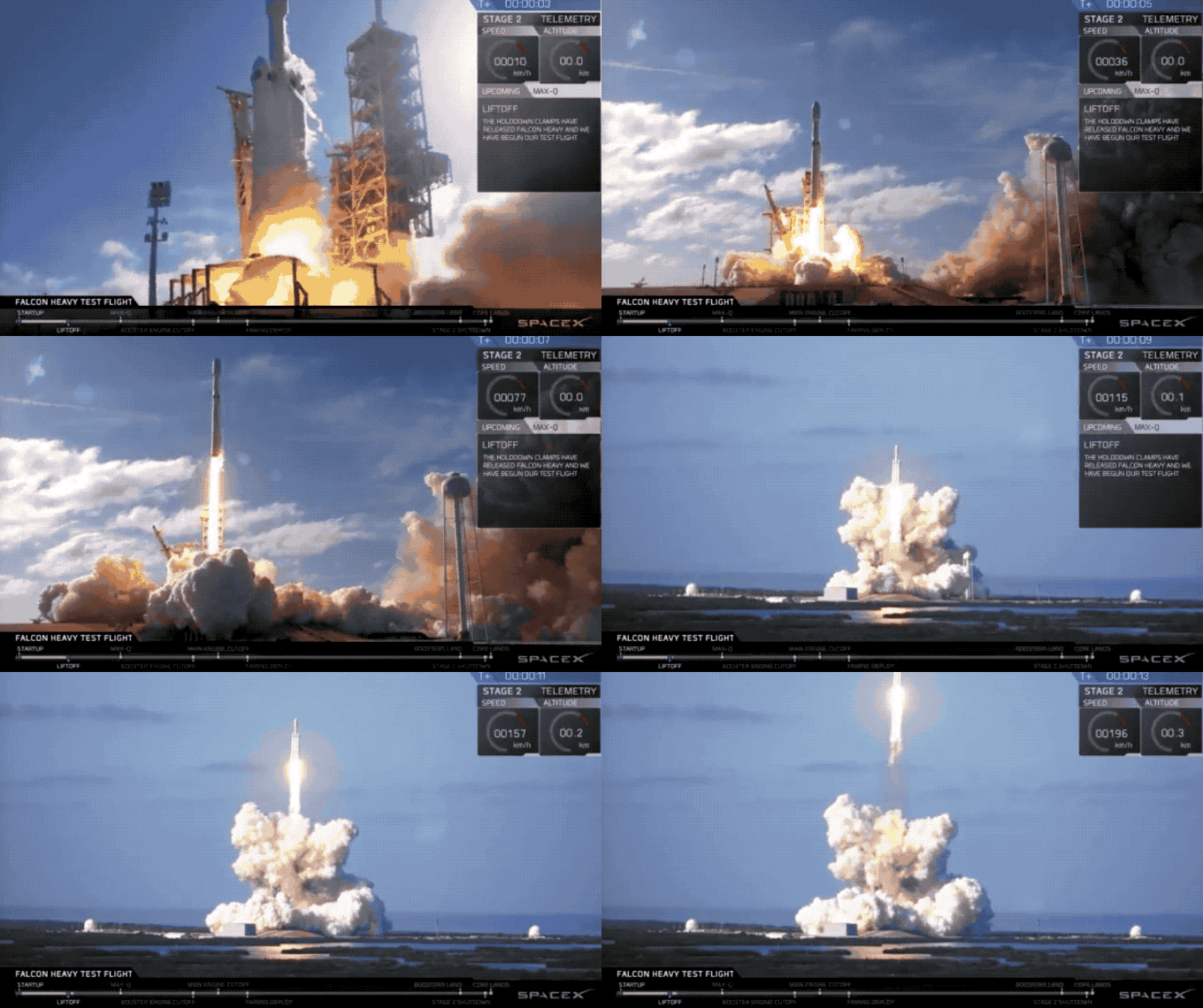
SpaceX's historic Falcon Heavy successfully launches | TechCrunch
SpaceX has had a very good first test of its Falcon Heavy rocket, the heavy-lift orbital vehicle that can carry twice the weight of its closest
TechCrunch
2968 points · by mpweiher · 8y ago · 871 comments
https://techcrunch.com/2018/02/06/spacex-landed-two-of-its-t...
I've seen the much-touted $90M price-tag for the FH launch, but does that take into account loss of the core or boosters?
The core actually had older ablative grid fins made of aluminium so no great loss there[0].
They are however interested in recovering the grid fins on the side boosters, which were redesigned to accommodate for the nose cones now sitting on top of them.
Perhaps some piece of metal is showing more fatigue than they'd like to see, or a wire had damage to the insulation from a vibration. I'm sure that's the sort of thing they'll be looking at.
That seems to imply they were trying to do a 3-engine landing, which they tested recently in the 'failed to expend the rocket' incident. This might explain why they miscalculated the igniter requirement since they don't have much experience with 3-engine landings.
“Of Course I Still Love You” is the name of a spacecraft in The Culture, a series of novels that inspired Elon Musk when he was young.
When I saw the first successful booster landing on a drone ship I realized I was again watching history.
My non tech interested wife was cheering for both boosters to land safely. “What world am I in!?”
Thanks SpaceX for making us excited about space again.
The original Star Wars was made in 1977, and based heavily on World War 2 combat films (much of the space combat and the trench run on the Death Star was lifted - sometimes shot for shot - from a film called "The Dam Busters.") For reasons of continuity and tone, that mechanical aesthetic can't ever change much throughout the franchise, or else it wouldn't "look" like Star Wars.
But the point is that it's exciting, it's visceral, the archetypes of the fighter pilot and joystick and of buttons that do important things make sense to the audience, and as a result those scenes can convey emotion though the use of familiar visual language.
Sci-fi was never "connected" to the future, and it was never (or at least, never explicitly) about attempting to accurately describe or predict the future. Yes, you could have replaced the ships and pilots in Star Wars with remote or AI controlled drones, not colored in the blasters, etc, and it might be more realistic, but no one would enjoy watching it.
People do enjoy dogfights (and spaceships that bank when they turn) and space wizards with laser swords doing flippy shit and punching each other with telekinesis, though.
Also, 2001: A Space Odyssey is a great movie about a great example why you do not pilot your ships with computers all the time.
Also, you do not know what the future holds. You are living in the present, not the future, where we very well may have pilots piloting ships.
Star Wars is not science fiction and it does not take place in the future. We are not living in the future either.
I've almost lost hope around the end of the Space Shuttle program. I thought it will be only satellites, ISS and occasional science probe launches. SpaceX single-handedly restored my faith in the future of space activities again, and with other player on the scene, we now have realistic hope of seeing an actual industry in space within our lifetimes.
And the landing shots are just damn cool.
I'm not trying to be negative, just trying to understand how you came to the conclusion you did.
In a theoretical world where we could just beam anything into earth orbit, unmanned interplanetary spaceflight would likely be an expensive hobby instead of something only governments attempt.
When I saw that, all I could think about was seeing hundreds of those and that scene being as mundane as a plane landing.
The live (uncorrected) version for comparison: https://www.youtube.com/watch?v=j8wxV-lUsZg
I think you're right.
So, whats to stop them attaching an additional two (or more) to the existing rocket now that they have the basic synchronization worked out.
Might be a naive thought, but for a few minutes, you forget everything else. There were millions of people from every nation live-watching the broadcast and everyone was cheering and hoping for the best.
The world seemed at peace during that moment and this is what I love about space exploration and all these great human achievements.
Landing these things will become the standard. mmillion dollar fireworks will not. Anyways, still very impressed.
Perfect takeoff, 2 simultaneous landings (still waiting for confirmation on the droneship landing), the car is in orbit.
I don't remember being so nervous watching a launch video since... Space Shuttle missions, I think.
Great job, SpaceX!
https://www.youtube.com/watch?v=aBr2kKAHN6M
e.g. https://i.imgur.com/Yu6gRar.jpg
This is all I'm watching for the rest of the day https://imgur.com/oKWTAQk
Might I suggest pairing it with Pink Floyd's _Echoes_[0]?
I've had the same running all day, to be honest. Having the 2001 a Space Odyssey soundtrack and Interstellar's soundtrack in the background is quite pleasant.
Obviously JWST does not fall into that category. I imagine if it blows up, it is just done forever?
I know where I'm putting my money.
http://spaceflight101.com/ariane-5-va241/ariane-5-va241-anom...
landing of the mars mission was pretty big in the spectacle sense.
That is correct...but NOT in orbit of our home planet!
Do we know the fate of the centre core yet?
I might be reading into something that's not there, but the presenters (I didn't get their names) acted like they received surprising news in thier monitors at 39:03[1] just as they were about to report on the drone ship landing.
Dude: "We've just gotten confirmation..."
Lady: "oh!"
Dude: "Oh"
Lady: "[laughs] We are waiting to hear what happens..."
https://youtu.be/wbSwFU6tY1c?t=38m20s
... and then back to the presenters. As someone said to me, "That's their lying face!" :)
Can't fault them for wanting to dwell on the positives though, was an amazing moment to watch.
Edit: You can switch cameras on the above youtube video to the countdown net; you can clearly hear them saying "We lost the centre core" at 38m30s - not sure if that means "lost signal of" or otherwise. The people in the control room appear to become more muted at that point, though they still seem composed. It's really not clear.
Edit: On the countdown net you can hear some minutes later "suspected loss of signal": https://youtu.be/-B_tWbjFIGI?t=42m21s
Doubly so when the "failure" isn't part of the primary mission.
If they delay the core announcement by a couple of hours or so, the headlines are all "SPACEX SENDS CAR TO MARS", with a minor note appended later to say, "A SpaceX spokesperson later confirmed the landing of the spacecraft's central core did not succeed and it has been lost." Like it or not, issues of timing like this makes a big difference to how the exact same events are reported and perceived.
Watching the countdown net it seemed plausible that they didn't know whether it had successfully landed either.
It is a bit odd they haven't announced that it was lost yet, but I agree that seems very likely.
Just speculation, but it makes sense to me...
Although there hasn't been an official statement by SpaceX yet, and whoever said "we lost the center core" could have just been referring to the video feed from the drone ship.
For those like me unfamiliar with the terminology used in this context, is this wording reserved for situations where the rocket is destroyed or could it also mean they lost contact/video feed with the center core?
We already dig other nice videos on youtube with rocket launches and the like. "How it's made" and so on. Some manufacturing videos have, believe it or not, caught her attention for half an hour! I think it was especially a video from manufacturing the Mini (car), lots of robots and automation.
You can hear "Centre core defect on shutdown". Definitely didn't make it.
I am pretty sure that SpaceX was able to achieve what they did today also because they studied the Soviet N1 rocket and learned from what the engineers at that time had to figure out from scratch.
The other thing is that the N1 Moon rocket was a very different design - a single booster with many small engines, so incredibly difficult system to control, especially given the state of technology 50 years ago. Falcon Heavy is more similar to the successful Energia booster - core + strap on boosters - that was originally designed for the Russian shuttle. Or the Angara series.
Also, something nobody has talked about yet. Falcon Heavy is capable of something no other US rocket is really able to do yet, launch new space station modules (or new space stations period).
I'm pretty sure one can launch space station modules on regular Falcon-9 as well. Russians launch some on Soyuz rocket.
Surely FH is more convenient for big stations.
SpaceX's Falcon project is the first major progress we've made in the field of human spaceflight since the Apollo program.
Marginal at best. The Space Shuttle lofted 833 astronauts at a cost of $209 billion [1]. In 2013, NASA was paying Russia $70 million per astronaut for a Soyuz lift [2]. That comes to $58 billion in 2013 dollars. That leaves $151+ billion, ignoring inflation, to justify everything else the Shuttle did. $150+ billion is 10x SpaceX's lifetime capital expenditures. (It's about what NASA expects it will cost to put humans on Mars.)
At first, the Space Shuttle (conceived as a shuttle to an American space station, the latter never built) was an expensive way to low-earth orbit. After the ISS, the Space Shuttle became an expensive way to the ISS. It pioneered virtually nothing and nowhere and was better at nothing than any other craft.
It was not worthless. But for the cost we could have achieved vastly more. Opportunity cost is real; the Space Shuttle set spaceflight back at least a generation.
It's not fun to trash these programs. But over time, I've realized it's necessary. We cannot correct failures we refuse to recognize. The Space Shuttle's dismal ROI was a motivating factor behind the Bush administration's support of COTS [3]. Without that programme, SpaceX wouldn't be what it is today.
[1] https://www.space.com/12376-nasa-space-shuttle-program-facts...
[2] https://www.space.com/20897-nasa-russia-astronaut-launches-2...
[3] https://www.nasa.gov/commercial-orbital-transportation-servi...
That's nuts.
Also love seeing machinists side by side cheering with software engineers, standing by a mission control which is placed feet from where engines are assembled on the shop floor.
Open company culture well-executed.
Congratulations to all there!
Why in the world would someone agree to be a reference and then bad mouth afterwards? Some folks...
Depending on what this company wanted, it's entirely possible that something I said during that call would've influenced the company's hiring decision, though I was obviously trying to portray my friend in the best light possible given the context.
I don't know if BlueOrigin has a similar process or not, but it's not necessarily that the reference was intentionally giving a negative report; they could've just picked up on something the reference said and felt it didn't mesh with the position.
Spoiler: my friend got the job, supposedly in part due to my good reference. Phew! I would've hated to be the one that got blamed for "bad mouthing" him.
The other hosts are great, but if you told me they were hired actors or PR people I'd believe it.
It also does not mean people will actually change in such a way that they won't think someone 'looks like an engineer' or 'looks live a TV star', they just won't say it out loud. Instead they'll say it among friends they know they can trust, more vehemently than they'd have done if this type of speech were not taboo.
I can only hope that the hyper-sensitivity currently found in the public sphere will pass when enough people from enough parts of society speak up against it. If it doesn't we're in for troubled times as it touches something which lies at the core of the enlightened western society, freedom of speech and expression. Those are precious things, too precious to squander.
I would never want to censor anyone. I'm just asking people to think about what kind of effect their words can have. I have the right to say that just as much as someone has the right to comment on who does or does not look like a rocket scientist.
You yourself are being quite hypersensitive about someone having the temerity to raise the issue of harmful stereotyping, and you’re appearing to attempt to stifle the speech of those who would do that. The irony meter is pegged off the scale. I believe the comment that kicked off the long discussion was pretty measured and backed up by experience. So perhaps it’s OK to chill a bit and just let the views be aired in a relaxed way, without adding drama to the non-drama.
That's become the standard of public conversations in the past 10-15 years. Unfortunately, I don't think it is likely to change anytime soon, since there's more and more involvement from politicians as well to make "saying the wrong thing" in public something worth being sued for. I see this happen in many different countries that claim to be "democracies" even though they have free speech as part of their principles.
Social Media enabled out rage mobs and a perpetual victim class has lead to more censorship than any government could ever hope for. If you are guilty of wrong think today you will be jobless, homeless, and a social outcast.
How far have we come from the days of "I disagree with you but I respect your right to say it" to "I disagree with you now I will boycott your employer, get you fired, get you kicked out of your home, and ensure all organizations/clubs/companies ban you from their events and platforms"
Sad days indeed
And he's beautiful...
Some people have all the luck.
Because they are young and good looking and good at public speaking?
Sorry to call you out like this, but these kinds of prejudices about who is the "correct" kind of person for tech jobs are harmful and discouraging to the people who don't fit the stereotypes, and helps contribute to keeping them out of the field.
Maybe parent was referring to their mannerisms, rather than their appearance. It's not fair to jump to the assumption that parent was showing a bias against any of those variations in the human species.
Let me phrase it a different and rude (sorry) way. "You know they're including real engineers because there is at least one person in the spotlight that would never be employed by a PR firm."
Isn't it rather biased of you to assume that being an engineer is somehow superior to being a professional actor, spokesperson, or hostess?
Some companies might have only let the people who look like them host the live stream. SpaceX put out their top people- young, old, white, black, male, female- and let them all be the faces of the launch. I don't know that my own company would be so brave.
> The other hosts are great, but if you told me they were hired actors or PR people I'd believe it.
Is 100% consistent with your statement and even implies it, since GP clearly knows that:
> They aren't PR people.
If anything, GP was insulting Innsprucker by saying he is lacking the suaveness or good-looks to be hired in PR, while the others have it all.
I think this is a good opportunity to examine where (implicit) malice was attributed but was undeserved.
yet another thread completely derailed by a meaningless and frankly irrelevant comment to the topic at hand, such as the one you made here.
perhaps if we were not hypersensitive to every little detail, engineering would be a more welcoming discipline.
I came here to read comments about this amazing achievement . so how about we focus on discussing the actual topic for a change ?
I hope I'm not the only one feeling frustrated by this trend..
Actually, you're the one who introduced these features as being relevant, and thus the only one perpetuating these features as being stereotypes right now is you.
Lastly, suppressing the opinion of an individual with the power of appealing to various underrepresented group identities...can you see what type of appearance this person has through a screen? I think you're showing your "biases" here.
Thoughts can be diverse too :)
He said John doesn't look like an actor/PR person (which, I think you'll agree, have appearance job requirements).
> The other hosts are great, but if you told me they were hired actors or PR people I'd believe it.
Lots of people don't marry for money. And if someone marries a poor person, it pretty obvious they're not doing it for money. (Naturally, that doesn't mean they're the only one.)
EDIT: Of course she's also involved in FIRST :P
Which is funny because, reading the job titles given to the SpaceX announcers, my first thought is always "wow, SpaceX hires some really attractive engineers."
But I couldn't help but laugh at the fact that they can launch a massive rocket on the first try and land (at least) 2 cores, but the camera STILL cuts out on the drone ship.
Edit: inside the pod is fairly high-gain directional antenna mounted on motorized positioner, but it is designed to track the satellite from slow (ie. ship) or predictably moving (ie. truck) platforms and certainly cannot cope with vibrations from the landing reliably. Man-portable BGAN terminals usually have fixed antenna and officially require quite lengthly positioning process (on the other hand it will work for some value of "work" when you just throw it into car trunk and park with trunk vaguely pointing to south, but you will be lucky to get reliable phone connection, not to mention video stream, in that case).
The safety reasons don't hold, you can easily shoot from several kms away (there are people on land several kms away from the launch pad). In the worst case, you can pilot a drone from several kms away, close enough to the barge.
> any ship that far out is going to be using a commercial satellite data feed
The footage from the droneship always appears perfect seconds before the landings. So it's not simply the fact of being at sea.
To your second question, how about a camera on a boat closer in with a hard line to a boat farther out with the satellite connection? You act as if sending a video feed is an unsolvable problem despite them beaming living video through the rest of the mission when they are in space.
They're not interested in the extra hassle of continuity for the sake of putting on a live show. The droneship has tons of cameras, the booster has tons of telemetry, that's all they're interested in.
(if you must spin a conspiracy, the one where they deliberately don't upgrade to keep their fans guessing is more credible - it's zero effort)
Someone noticed there was a camera feed on the mission control wall that shows the Center Core's drone ship, after the smoke clears no ship can be seen: https://twitter.com/Darkphibre/status/960990105581240321
9:00 into the feed, it's likely the core either missed or failed to land properly. Although the screen is partially out of view. So this is still speculative.
At approx t-minus four minutes and counting. Elon Musk tweeted the "Holy Mouse Click" had returned "true". That moment when control is transferred to the onboard modules. And the Autonomous Flight Safety System takes control.
Its truly awesome to see that silky smooth burn. that perfect parabolic arc. And think upon the twenty-seven Merlin engines all firing in synchrony. Equipped with an intelligent decision making capability. And what the implications might be for future human spaceflight.
Here is an ancient link. But back around the mid-noughties. NASA published some details on the architecture of an AFSS:
An Autonomous Flight Safety System
https://ntrs.nasa.gov/archive/nasa/casi.ntrs.nasa.gov/200800...
Considering the Falcon Heavy includes reusable side boosters and central shaft. The complexity multiplies. As an example, take a peek at an implementation for expendable missions. that still use ground or satellite tracking and control.
Range Safety Algorithm Software Module for an Autonomous Flight Safety System
https://software.nasa.gov/software/GSC-15594-1
Darpa contributed tool for low level verification of onboard AFSS software.
SeaHorn: A fully automated analysis framework for LLVM-based languages
And of course, once your computers make it into space. They will need a place to store all the mountains of data generated ;)
SpaceBelt: space-based cloud storage network
But 2/3 is impressive! Seeing the simultaneous landings had me in tears!
I thought this was impressive: "With a total of 27 first-stage engines, Falcon Heavy has engine-out capability that no other launch vehicle can match—under most payload scenarios, it can sustain more than one unplanned engine shutdown at any point in flight and still successfully complete its mission." http://www.spacex.com/falcon-heavy
Falcon Heavy Side Booster Separation - 61km, 6,881 km/hr
Falcon Heavy Core 1st Stage Separation - 92.5km, 9,474 km/hr
Also a link to screen caps of speeds/altitudes of previous Falcon 9 separations
http://www.planetary.org/multimedia/space-images/charts/falc...
This is innovation. This is the future. This, and Tesla, are the biggest technological breakthroughs since the iPhone.
Well played Mr. Musk. Well Played.
"SpaceX also attempted a recovery of all three of the first stage boosters it used during the launch. It has recovered two of those thus far, and we’re waiting to hear back from SpaceX on the official status of the final, third booster, which was landing at sea."
Am I the only one that find it quite disturbing that a private corporation taking over more public space?
In the long run this stuff will bite humanity at large in the butt.
Compare that with how long it's been since Yuri Gagarin's first flight, and we're just now getting to where we can imagine passenger flights to space in the next few years.
Of course aviation may be easier than spaceflight, but I think a large part of the difference is that aviation was developed by companies trying to make a buck, while spaceflight until recently was dominated by governments who were in it for political purposes.
Myself, I'll take the faster progress you get from the profit motive.
I truly believe that if spaceflight had developed under private enterprise like aviation did, you and I would have been able to buy tickets years ago.
You can bet that when and if a lunar, astroid, or any other colony burgeons beyond a sizable hotel that a local government will form and begin to assert its own regulations, not unlike towns of the American west or trading posts operating underneath a larger national trading company. Under what form that occurs has yet to be seen.
Did you think the future as a space fairing civilization would be all run by one government agency?
Do you think NASA would fly tourist to moon and the mars?
That seems absurd to me. We don't have government building cars, or airplanes, or trains or anything like that. Why should rockets be built by government?
If government wants to do something in space, they have a wealth of private options.
Suggest spending taxes on this to the average joe and they’ll grumble “sort out the problems on earth first” or similar instead
As for space launches - well, the US Gov did a "great job" at saving what they learned from building the Saturn V, can't imagine them being better at space exploration, either.
Besides, all of the planes and ships are built by private companies, and it's worked OK-ish so far.
I would claim they are expanding the market and generally that is beneficial for all stakeholders.
We are not discussing a finite resource like forests, here.
https://www.theverge.com/2018/2/6/16971200/spacex-falcon-hea...
Would Musk focusing only on it make any difference?
edit: This is not a complaint, just a question, why the downvotes? I'm used to getting downvoted for no reason, but this is basic a question, with great answers. Come on HN! We can't ask questions?
One, this is his baby. I believe he spends more time at SpaceX than his other companies. Two, B2B. The public only sees breathtaking videos. The contract negotiations, sales process, pricing, support, insurance, et cetera happen behind the scenes. Finally, nothing has been on time. Years' delays don't feel that bad because (a) space is hard, (b) space is awesome and (c) everyone else going to space is even worse at keeping to timetables.
Landing and reusing the Falcon 9 cores is probably a much bigger benefit to their bottom line overall.
Tesla on the other hand has to be able to deliver tons of reliable cars to people all over the place in a competitive market. Delays to the Model 3 mean they're burning money they can't afford to lose while their competitors are rapidly catching up to them.
While SpaceX could continue their successful Falcon 9 launches during the 5 year delay on Falcon Heavy, Tesla will likely be gone in 5 years if Model 3 delays are even close to that long.
I don't mean they look similar. I mean they look like they came from the same video feed. When completing the touchdown, they both seem to land at the same pad -- you can see the flame of the other booster and the pad the other booster is landing at in both videos, except they aren't rotated 180 degrees from one-another because the rest of the landscape is identical. Also, watch the moment when the boosters do their initial burn to slow down from freefall. The flames in both videos look virtually identical.
Here's a few samples: https://imgur.com/a/Xpbu8
Did they acknowledge that the videos weren't actually taken from both rockets during the stream and I just missed it? Or is there some other explanation?
https://www.reddit.com/r/spacex/comments/7vg63x/rspacex_falc...
Even if the droneship didn't work out...
You need an advanced robot, reliable, highly tested, constructed by the best rover engineers on the planet. You need to spend years designing the overall program. You need to deliver the robot safely to the surface of Mars. You need to operate the program at non-trivial cost for an extended period of time to then look for water etc.
Add a few billion dollars to the cost, basically.
Then, there are other costs. Cost of launch could have been absorbed by Tesla. Cost of developing a mars-capable payload would be extra. Who would pay for it, on a completely new and experimental rocket?
Nope.
What can happen ? Did a payload already exploded passing through the Van Allen belt ? Are batteries a problem ?
Can’t see what would make it not “make it through” but I could see how we might never I find out.
Elon over there going to Mars, I can't even get this dang app to build.
Might be time to move....
>To conform to U.S. Government space technology export regulations, applicant must be a U.S. citizen, lawful permanent resident of the U.S., protected individual as defined by 8 U.S.C. 1324b(a)(3), or eligible to obtain the required authorizations from the U.S. Department of State.
I mean, I understand, but it still puts a damper on the "Team Humanity" vibe. :/ Same as when the SpaceX team were chanting "U!S!A!" at one of the Falcon launches.
(Hope this doesn't come across as petty.)
People outside the US want to feel part of the accomplishment, which is understandable as there are only a few nations that are likely to ever have the resources to do something like this. So the USA cheering feels exclusionary, naturally. I chalk it up to them being proud of the immense work they've done to get the US back into space properly again.
Great job Elon and team SpaceX!
Anyone knows what happened to the core booster?
Any idea what that was?
EDIT: I think it's a replay of the capsule opening that initially contained the car, just spliced in at a weird part of the video.
Do they turn off the camera if its about to fly by something that would rather not be seen?
So Heavy is about 1/2 as lift capable...at a tiny fraction of the $/kg.
Screen shots from live feed: https://imgur.com/a/gh410
"The core stage, meanwhile, burned slightly longer before separating from the upper stage, performed a flip maneuver and landed on SpaceX's Of Course I Still Love You drone ship."
Not sure it's true.
https://www.usatoday.com/story/tech/nation-now/2018/02/06/sp...
They still want it back for data.
Mission continues on an experimental long coast and third stage two burn to target a precessing Earth-Mars elliptical orbit around the sun
… which I can't completely decode.
Update: SpaceX says "Upper stage restart nominal, apogee raised to 7000 km. Will spend 5 hours getting zapped in Van Allen belts & then attempt final burn for Mars."
The closest point to the sun will be about 1AU (Earth-Sun distance). The furthest point from the sun will be something like 1.5AU (Mars-Sun distance).
This orbit will precess, meaning that it will slowly rotate its axis around the sun, rather than staying locked into the exact same path.
TL;DR: Elliptical solar orbit.
But I have this one observation on watching the launch, and landing and I hope someone can explain the discrepancy to me:
How come the two boosters when they stick-landed have different colors than when they were launched - so soon? I mean, they were all real shinny white when blasting upwards from the launch pad. Are those the same ones that stick-landed to perfectly?
Falcon Heavy is, on the other hand, nominally a $90 million launch cost. That's cheaper than the typical launch cost for a Falcon 9, Atlas V, or Ariane 5 class vehicle, so that's crazy cheap. A lot of that is down to the fact that 90% of the hardware cost of the Falcon Heavy stack comes from reusable rocket stages (the 3 main cores). On top of that, the Falcon Heavy side boosters are just regular Falcon 9 cores, so as SpaceX gets better at reusing Falcon 9 rockets it'll also become easier to launch Falcon Heavy rockets because there will just always be a stack of appropriate components sitting around in inventory ready to go. Meaning that the potential flight rate on Heavy launches could be quite high. The Delta IV Heavy launches maybe around once every year or every other year or so. The Falcon Heavy could potentially fly many times per year.
Together that's kind of a "big deal". It'll crack open the heavy lift market to a lot of people who previously lacked the means or the access to launch big payloads. If launching 20 tonnes to LEO is something that costs 10 figures and happens literally less often than every blue moon then you tend to only launch things like multi-billion dollar spy satellites. But if launching much more than that mass costs less than a traditional comsat launch and can happen every other month or perhaps more often if there's the demand, then you're going to get a lot of folks coming out of the woodwork to take advantage of that capability (and, as well, that'll still include NRO and US national defense folks as well, they won't miss out either).
So, what are some things that become more possible with Falcon Heavy?
* Space station components. After the Shuttle program ended there was much less capacity for launching station components, it was restricted to small bits and pieces (a docking adapter here, a small inflatable module there) and Russian components launched via Proton. With Falcon Heavy in the mix it becomes more practical to launch new space stations and new station components. So that's more of an option now.
* Deep space missions. Falcon Heavy is capable of launching reasonable payloads on interplanetary trajectories to the outer planets. So that means it could make new missions to asteroids, comets, the gas and ice giant planets (or their moons), as well as KBOs and TNOs much more cost effective. NASA, ESA, etc. could look to using Falcon Heavy for those sorts of missions in the near future. It also makes things like "ordinary" Mars rover missions cheaper, of course, and allows them to be larger and more capable.
* Space telescopes. Launching big space telescopes like Hubble and its successors will become much cheaper. So instead of having just one or two or even a handful of big top tier observatory class space telescopes we could have many of them.
* Crewed interplanetary missions. In theory you could do something like a crewed cislunar mission similar to Apollo 8 using a single Falcon Heavy launch. More realistically if you wanted to do a "proper" interplanetary mission you'd assemble something in low Earth orbit. You'd put up separate boost stages as well as the crewed spacecraft component and the return vehicle on separate flights and bring them together then set off somewhere. If you're, say, NASA and you have a paltry $2 billion or something to pull off a crewed mission to an asteroid, perhaps, then being able to buy a half-dozen Falcon Heavy flights and put up a crap-ton of payload into LEO with only a quarter of your budget is hugely advantageous.
* And, of course, all the standard stuff like spysats and big national defense payloads. This isn't such a huge deal for "the future" but it'll be a substantial revenue stream for SpaceX.
As for sending humans to Mars, SpaceX won't be using Falcon Heavy for that. They have a next generation launch architecture planned that is more or less specifically designed for mars colonization (the BFR/BFS). That system will be much larger and able to put about 150 tonnes into LEO in a single (reusable) launch. It'll be fully reusable, including the 2nd stage (the BFS). It'll use LOX/Methane instead of LOX/Kerosene because of the superior performance, significantly improved longevity of engine components (less soot and coking in piping) to enhance reusability, and compatability with a Mars exploration architecture that includes utilization of the Martian atmosphere to produce propellant for return trips (which is actually surprisingly easy). They will begin the first stages of manufacturing that rocket sometime this year but it will be a few years before it even has a test flight.
Edit: referring to the Starman live feed: https://www.youtube.com/watch?v=aBr2kKAHN6M
And yes, it will have attitude control in order to ensure that the three burns (two complete, interplanetary insertion to come) all happen in the correct orientation
That was seriously impressive to watch. Congratulations to all the SpaceX engineers who made this a reality.
https://www.youtube.com/watch?v=-B_tWbjFIGI&feature=youtu.be...
Love that pic of the dummy astronaut in the Tesla looking back at Earth.
https://twitter.com/FalconMainCore/status/960992022575374336
Were the two falcons landing at the same moment synchronized to look good for the cameras, or was it just how it happened because they travelled together?
:-(
Still a tremendous accomplishment.
Like, remove any fluids, remove any parts that might explode in the hot or cold of space, deflate the tires, etc.
Note: I'm more interested in a scientific answer, as opposed to casual conjectures. Preferably from an engineer knowledgeable of such things. And specifically, the materials sciences aspect of how materials will survive in a vacuum.
Space is only -1 atmosphere and even then, it only affects sealed systems. For the rest, they'd equalise. Also, cooling in in space is actually fairly gradual as there's only radiation, not convection or conduction. Let's go through the systems and evaluate what that means:
For structural components, nothing will really change. After all, we built spacecraft out of aluminium before. The ISS has to cope with this more, as it goes in and out of sunlight every 90 mins, so it gets something like 15 cycles of high/low temperature a day. The thermal shock of going from darkness to sunlight is the main issue, but this won't be passing through the earth's shadow constantly since it'll be orbiting the sun, so changes will be far more gradual.
Bigger issues come from different materials joined together, such as steel to aluminium, since they expand at different rates, but that's not really a problem here and even if it is, it'll just crack a bit at the seam. That's not going to cause the car to explode into little fragments.
For unsealed systems with fluids, they'd just boil away in the vacuum before desubliminating into little frozen droplets and bounce around or whatnot.
The only sealed systems with fluids in them that I can think of are tyres and brake lines. Tyres tend to sit at about 30-35 PSI, which is ~2 atmospheres. They then have to endure significant heating/cooling, dynamic pressures of spinning, etc. so an extra atmosphere wouldn't cause issue from a pressure point of view. Ditto brake lines - you stomp on them with a mechanical advantage and they never rupture.
I think you'll find the worst damage will be to the paint over time, which will fade more aggressively since it's not protected from UV sunlight any more.
edit: I forgot the batteries, which I believe are a sealed unit. They might have just dropped the battery pack from the car. Not sure what a vacuum would do to them as I don't know enough about Li-Ion battery design to comment.
"We didn't really test any of those materials [...] it's just literally a normal car in space"
After all, where it's going it won't need roads.
The glass will eventually become clouded and discoloured due to radiation damage and scoring by micrometeorites. Some plastics can rapidly deteriorate in sunlight.
Erosion from micrometeoroids (dust) and larger impacts is also a factor over timescales of thousands of years.
I doubt it will last the millions of years that is suggested.
id imagine a 360-camera is projected onto the inside of the sphere/case the car is actually inside of.
Or, imagine we hit a dark age and bounce back, and this event is lost to history. Five hundred years later we manage to get some people to Mars orbit and they find a fucking car in a capsule with a little mannequin stuffed into it flinging around the planet at hundreds of kph.
All while it's blasting David Bowie over their radios.
If it gets to be a problem in the future, it will have so much historical value that someone will launch a mission to go fetch the Roadster and bring it home to Mars.
Anyway I wouldn't normally consider it to be space trash, but in this case it's pretty much just a big Tesla ad billboard orbiting the planet so I agree with you sentiment
It probably does not add a measurable amount of junk to hit than is already up there in the form of natural rocks.
Though if in the future human population hits the quadrillions and we are living on all 8 planets we should probably start worrying about our space trash.
Also, there is not any danger of stuff "crowding" out there because the amount of space between Earth and Mars is really quite extremely huge.
> Following launch, Falcon Heavy’s second stage will attempt to place the Roadster into a precessing Earth-Mars elliptical orbit around the sun.
Opposition to non-bipedal forms of transport?
Or is it opposition to the type of urban planning that is centered around the car more than the pedestrian?
I posted more screen shots of launch: https://imgur.com/a/gh410
Source: http://m.dw.com/en/what-you-need-to-know-about-the-falcon-he...
Also, space is big once you leave low earth orbit. It's really hard to actually understand how big it is. Putting a roadster out there isn't exactly junking up the place.
In fact, you may think it's a long way down the road to the chemist's, but that's just peanuts to space.
Because if all you can think of is utility then all art should go as well. After all, it's all just a waste of resources. /s
The amount of coverage both Tesla & SpaceX got from launching the Roadster equates to advertising costing considerably more than the cost of the car.
This is what Pirelli used to say about their calendar. It costs so much to get a front page ad in a newspaper, it's worth all the costs of the calendar.
Who cares though, it's just so fucking amazing that there exists a geek with enough cash and gumption to get a car flying through space with h2g2 in the glove box.
Also "Space is big. Really big. You just won't believe how vastly, hugely, mind-bogglingly big it is. I mean, you may think it's a long way down the road to the chemist, but that's just peanuts to space"
Awesome work by spacex. They are peerless, except if you want to count massive superpower governments as peers.
If you wonder why all of the shareholders of Apple aren't plowing their money into spaceflight, well it's probably because they're a retirement fund, or just aren't rich.
Other people invest in making this world a better place, see Bill Gates, or other worthwhile causes, of which spaceflight is just one.
Not everyone can be Elon Musk, nor should they try. There is much to do with our feet on the ground.
Less snarkily, the pitch of Elon Musk is surprisingly selfish--he's basically doing this as much so he can get to Mars as anyone can. By contrast, people like Rockefeller and Carnegie in the past are largely responsible for endowing public culture in the form of museums, concert halls, public libraries and the like, and the modern day equivalents like Gates and Buffett are attempting to eradicate malaria from the world.
Nevertheless, you should reserve ire for those who have the ability to do philanthropy and fail to engage in it in any form as opposed to those whose philanthropy isn't in the areas you'd prefer.
"Elon kind of money?"
Heard of government subsidies?
https://ideapod.com/elon-musks-business-empire-fueled-4-9-bi...
Edit: not taking sides and adding my subjective point to the article; just merely stating fact that Mr. Musk projects are in large part government-funded.
That amount is for Tesla and SolarCity combined. To put things into perspective, GM received a $50B bailout, Ford got almost $6B for “energy-efficient” cars, as did Nissan with $1.6B.
Finally, almost all of those are loans, tax credits and incentives, not money 'out of pocket'. The goal is always to generate more wealth than was “spent”.
THEY'RE MADE OUT OF MEAT by TERRY BISSON
http://www.terrybisson.com/page6/page6.html
GREYLORN by KEITH LAUMER
Also human space travel is just the answer to none of our current and urgent earthly problems. I don't get why people are so unreasonably hyped about it.
In this model, it's all about idiosyncrasies: the Voyager record had the Vitruvian Man, this has an astronaut on a sports car and largely-irrelevant sci-fi stories.
Of course, private space probably means the whole timeline comes faster and private associations are soon launching Dostoyevski and Pollock too. Still, this payload is culturally cringeworthy, as much as the sheer engineer accomplishment must be lauded.
They were both done, principally, for fun. If practical value is constrained to the non-ET, I'll argue for the latter any day. It promotes an electric car; presents space as a fun--instead of austere--place; and gives everyone a laugh. Given the times, I think we need a laugh more than sober awe.
But I think you might also be imagining how the golden record was created. It was spearheaded by Carl Sagan but there wasn't time to consult "with the great minds" [emphasis mine], whatever that might be. I'm sure Sagan worked with 'great minds', but it definitely wasn't some kind of Grand Committee of Earth.
According to whose culture though? I suggest the culture of the people who built it is the most relevant one.
Then of course Martin Shkreli (or someone like him) will send something outrageous into space.