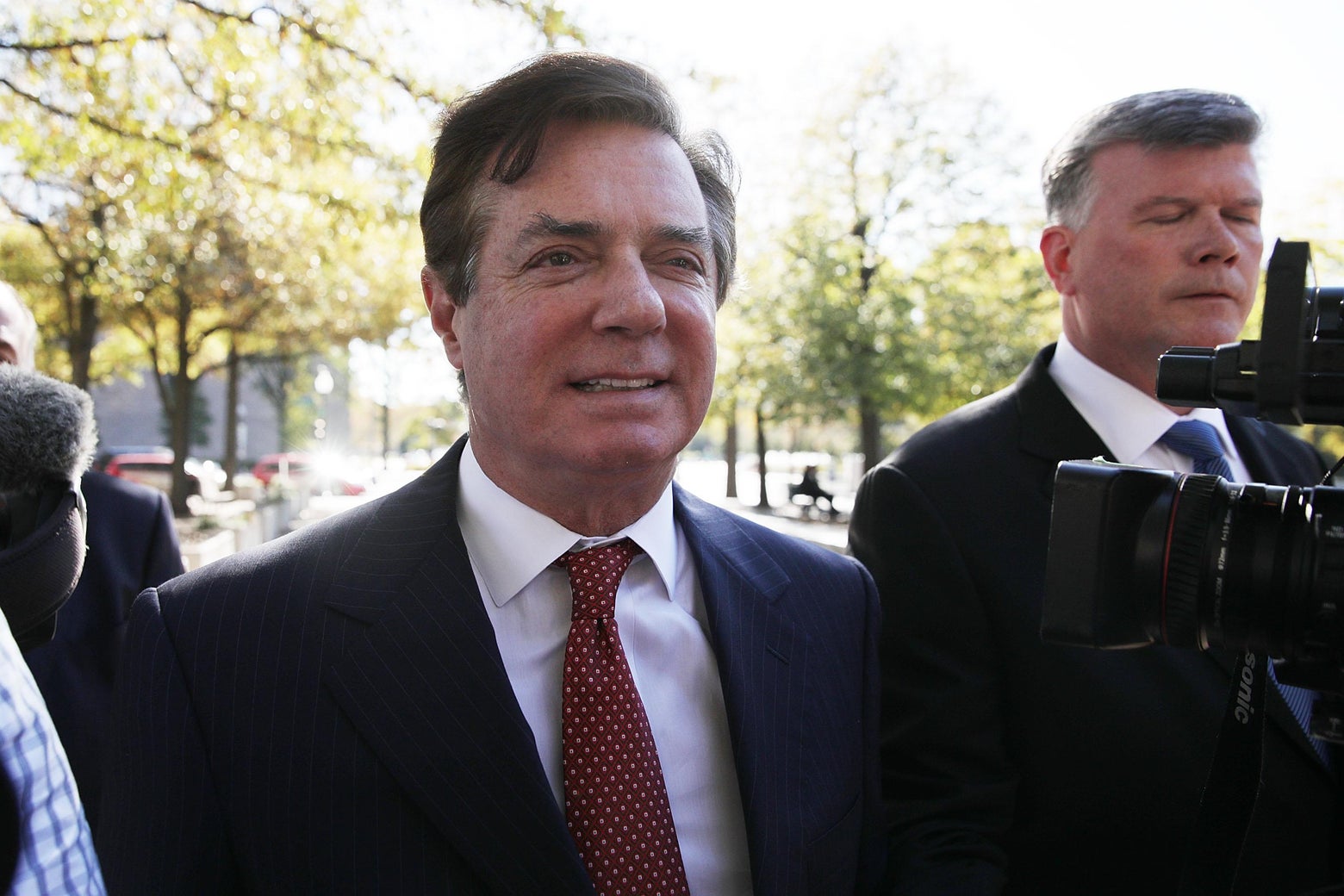
Manafort Left an Incriminating Paper Trail Because He Couldn’t Figure Out How to Convert PDFs to Word Files
Pro tip: If you’re going to falsify documents, it’s probably a good idea to learn how computers work.
Slate Magazine
334 points · by ronwen · 8y ago · 224 comments
Here's how (on windows): download qpdf (http://qpdf.sourceforge.net/) and run
qpdf.exe -decrypt encrypted.pdf woho.pdf
    # usage:
    #    decrypt.sh mypdf.pdf
    # the decrypted file will be named mypdf.pdf, while the old encrypted is now mypdf.pdf-encrypted.pdf
    #
    echo pdf to de-secure: $1
    read -n 1 -s -p "Press any key to continue"
    mv "$1" "$1"-encrypted.pdf
    qpdf.exe -decrypt "$1-encrypted.pdf" "$1"
    echo encrypted file is now named: $1-encrypted.pdf
echo decrypted file is: $1When I want to "protect" a PDF, I print it as a TIFF and then PDF that document. It's less "protecting" than "making it difficult to alter or copy-paste from," but it works. (Also good for ensuring your redaction blobs can't be moved.)
If you use the following GhostScript command it's still possible to select the text in the unprotected PDF.
"%ProgramFiles%\gs\gs9.22\bin\gswin64c.exe" -dSAFER -dBATCH -dNOPAUSE -sDEVICE=pdfwrite -sFONTPATH=%windir%/fonts;xfonts;. -sPDFPassword= -dPDFSETTINGS=/prepress -dPassThroughJPEGImages=true -sOutputFile=Unprotected.pdf Protected.pdfSince this is a common 'technique' to 'protect' PDF documents, as some PDF viewers (such as Adobe reader) won't allow selecting text on these 'protected' PDF's. It's so common that most PDF tools assume an empty string if no password is explicitly supplied.
Source: I run a SaaS that converts PDF invoices to structured data, so I've examined quite a few PDF files the last couple of years.
The semantics of the bits are described in ways that are very open to interpretation, and can be used to specify combinations of permissions that just don't make sense (example: allow content extraction for copy/paste, but don't allow content extraction for accessibility purposes, like screen readers for the blind). I suspect there are no two PDF parsers that handle that bitfield in the same way, and that it may not even be possible to implement support for it without baking in contradictions and unexpected behaviors (from a user's perspective at least). I'd be surprised if even Adobe's implementation handled it in its entirety.
Sending files to someone else is a problem with a ton of solutions, some of them better than others, but none of them actually solving the problem. Email often has size limits and spam filters block certain attachments. Dropbox is often restricted at most workplaces, and not everyone uses it. It also has size restrictions. USB is the most reliable, but then you get into the whole "it's NTFS formatted which doesn't work on my Linux machine" or it's HFS and I need to use it on Windows" nonsense, plus sending it longer distances takes days through the mail.
But converting documents... guys it's just electricity running through fancy sand. It shouldn't be that hard. I work on software where I'm often connected to a jump server without Office installed on it, and the software expects me to open a spreadsheet for troubleshooting. I was doing some audio recording recently and the hoops I had to jump through to save it as MP3 weren't insurmountable, but still pretty annoying.
And don't get me started on the Office 2003 spreadsheet that makes me boot up my Windows XP VM to open because the macros won't work on Office 2017. Or when I need to use Visio but there's no Mac version so I have to open my VM too.
And the web just makes it worse... no more software incompatibilities because when software isn't supported anymore, we just shut the servers down and everything is gone forever.
https://keybase.io/docs/kbfs has more info
There are tons of "blue laws" in the US, some from over a hundred years back. Sometimes the police decide to enforce those. One such occasion precipitated the landmark Supreme Court case Lawrence vs. Texas.
http://www.politifact.com/truth-o-meter/statements/2014/jan/...
Three Felonies a Day
speed limits, imperfect stops, improper turns from a stop, unsafe lane change, following too closely, breaking too fast...
The problem with a lot of these is the definitions contain imprecise terms subject to an officers whims of interpretation.
And that's just driving. Many laws are just ridiculous and you don't even know they exist to avoid breaking them.
Google "never talk to cops" for an interesting video from a law prof and a cop.
To have the analytical bent to think through all the risks you're exposed to in your criminal financial dealings and to take steps to reduce those risks probably also means you're able to realize (1) you can only reduce the risks so much so that a substantial possibility that you'll lose everything continues to exist; and (2) there are a lot of not-unambiguously-illegal ways to make money and acquire power capitalizing on your excellent analytical abilities.
Martin Shkreli is a perfect example of a CEO that can get canned when it is decided he should be.
And unless someone is an incredibly paranoid person which has the privacy routines ingrained in their DNA, everyone does make stupid mistakes every once in a while.
https://www.cnn.com/2013/10/04/world/americas/silk-road-ross...
But not always true. No one's figured out Satoshi Nakamoto yet.
But yes, you're correct it's not a forever and always thing.
And 'ol Ross had a whole journal of his illegal activity sitting right on his hard drive.
Just because nobody has published it?
Is that a fact?
https://www.buzzfeed.com/jasonleopold/manafort-under-scrutin... (bottom)
The entire inventory of the store is barely worth 25K, I assume he must have been loading up on gift cards a la Mexican drug lords (http://am.blogs.cnn.com/2009/06/10/drug-lords-using-gift-car...).
$21,300 for his meds. The remaining ~4,000 maybe just fell out of his wallet.
https://nytimes.com/2018/02/23/health/valeant-drug-price-syp...
That's not to say that he couldn't have learned were he interested, but his daily life had very little intersection with this kind of thing until he spiraled into a hole of debt, at which point "do I trust this person" ranked a lot higher than "how are this person's technical skills?"
Background: https://www.google.com/amp/s/amp.ft.com/content/efda2ca2-ec6...
"Paper trail? There was no paper! How could there be a trail!?"
The "e" in "e-mail" stands for "evidence." :)
(Or at least for those who the FT thinks would pay for a subscription)
Window management in Windows GUI:
1. Usage of File Menu and/or Ribbon Menu
2. Knowledge of Word's PDF integration
File System knowledge:
1. What a "file" is
2. What "file formats" are
3. What a PDF is
4. That a word document can be saved or printed as a PDF
Etc etc etc
I work with non-technical folks all the time and printing/saving as PDF comes up often.
Usually in most cases I can install a PDF printer and let them "print to PDF" and they can understand it, but before they know the process, they look at me like I'm speaking Latin when I try to describe what files are, what PDFs are, what conversion is, what the file menu is used for, etc.
HN readers who don't work with non-technical users may not realize just how lost and unable to explore many people are, particularly when they didn't grow up with computers. There's also a huge problem with "dialog blindness."
If you have an understanding of how "computers" (hardware, OS, apps, websites, doesn't matter it's all the same mystery box) work then you can explore with less fear. I deal with people in their 20s and 30s who don't grasp that a "scanner XYZ not found" error may mean that they should look for a way to select a scanner. Many of my older end users are clearly using a lot of software entirely by rote, though it's definitely not limited to them.
He knew enough to attach the file to an e-mail and send it to someone else asking for a PDF version. So the only piece of missing knowledge here appears to be finding the option in word's menus.
Back to the privacy point, we are currently going through NIST 800-53 at work. We only need 800-171 but we thought the 800-53 standard would make us a better organization. So many things I didn’t think of. Do you have a micro-cut shredder first of all? Those Enron-esque cross-cut shredders don’t cut it anymore with open source machine learning that can easily reassemble those documents. Also, do you have an access code for your printer so the document only prints when he/she is up there, and doesn’t get left throughout the day in the tray for prying eyes? Also are your servers currently sitting in inventory up high on the shelves in case water gets into the building? So many things...
AmazonBasics 12-Sheet High-Security Micro-Cut Paper, CD, and Credit Card Shredder with Pullout Basket https://www.amazon.com/dp/B00D7H8XB6/ref=cm_sw_r_cp_api_zCfK...
The austerity and economic issues are very tiny part of the contrast here, the real damage is the instability in an already fragile region of the world and the machinations to act against the interests of almost all parties in the region except for the Russians.
It’s my hope that “financial crimes” are just going to be a convenient way to indict the many many people who have committed crimes like him.
Back in 2016, a weird / interesting / pretty smart idea in Clinton’s platform was to help the US deficit by only enforcing current tax laws. Lol that’s all it was, enforcing the laws that were already there to raise an additional 100 billion+ in revenue every year. It makes you think how many people are committing tax fraud at this very moment...
https://www.bloomberg.com/view/articles/2016-01-25/climate-c... and the linked https://www.bloomberg.com/view/articles/2015-11-06/exxon-mig... are the examples I've found so far, but I remember him making the comment repeatedly.
They often are. Despite the many actually heinous crimes he committed, Al Capone was ultimately nailed for tax evasion.
That's interesting! When I googled for this, I found a few papers, but nothing like a git repository. Do you have more information?
https://www.theguardian.com/world/2018/jan/03/stasi-files-ea...
Quick history refresher: Pompeii was an ancient Roman city-town near Naples. When Mount Vesuvius erupted in the year 79, Pompeii was covered in ~15 feet of lava and volcanic ash. One imagines that this was highly distressing to the residents of Pompeii, but none were available for comment as they were all busy being incinerated. I guess we'll never know how they really felt about it.
Then sometime in the 1900s a group of workers were excavating the area for a new project. They had been burning these odd little bits of coal they'd found. Imagine the horror when someone realized the "coal" was actually old manuscripts that had crumpled up into little balls of carbon due to the volcanic eruption. The workers had been burning priceless ancient Roman artifacts!
Researchers were able to mechanically separate some of the manuscripts, and with the aid of modern computer vision systems, we've been able to read some of them. It's quite an amazing story.
So I guess you probably want to spend the extra $20 and spring for the really good incinerator on Amazon. You don't want future historians literally digging through your incriminating financial documents.
[0] https://en.m.wikipedia.org/wiki/Oakland_firestorm_of_1991
>Try it in Adobe Acrobat (via the “Save as Other” command under “File” on a Mac) and you’ll quickly be redirected to Adobe’s website and presented with a handful of subscription packages that will allow you to transform your documents. [...] Indeed, it’s probably a little safer, all things considered.
If I was doing shady stuff the last thing I'd want to do is send my incriminating documents to some 3rd party service. That being said I would also probably not send them over the clear in emails either.
It's pretty insane how cavalier people are with email security (or lack thereof). I can't imagine that they would be so lenient if they were sending each other the files over regular mail. I think most people simply don't realize how thoroughly unsecure stock email is, you're basically lending an open postcard over the internet and you can be sure that a bunch of copies are made along the way. It's pretty much the worst way to share sensitive documents online short of posting them on facebook.
To capture incriminating physical mail, the authorities have to already be monitoring you at the time you send the documents. With email they are typically able to go back and capture emails from days, weeks, and years prior.
I know I'm nitpickig, but the USPS photographs of all pieces of mail and digitizes it. This information is considered metadata and is not protected against unwarranted searches, so postcards are much worse (for privacy), because even the small-town PD can get access to them without having to look for an "IT guy" to help. Email requires assistance from a TLA agency (or a search warrant served to the mail provider).
Thanks, I had no idea.
While doing some genealogy recently I found that a distant ancestor had unclaimed mail in the post office shortly before he died.
I found it vaguely amusing to envision walking in and asking for it now, 125 years later; I guess some distant descendant of mine might be able to ask for a photo of mail I'd sent or received.
I noticed that when I select a region of text with a mouse, the retracted' black text becomes white text over black background. It revealed name of our competitor, addressees and numbers in their offer, the whole retraction was just a typographic trick.
When in doubt, print -> scan -> convert to pdf.
I compared documents and maybe not surprisingly, they seemed relatively minor points.
"I attempted to transform my Word draft of this blog post into a PDF. I confess that I did fumble a bit at first (it’s been a while), but I eventually managed to get the job done. According to my stopwatch, the full ordeal took me 42 seconds."
When the real problem ws turning a PDF into Word.
Another example: I seem to recall a case awhile back where Word change-tracking contained sensitive information even though “the document” didn’t seem to.
Sadly it used to be easy to rely on plain text implicitly but then we made Unicode so complicated that you have to be careful there too. Fingerprinting through zero-width sequences, etc. is essentially unnoticeable if you do not actively look for it.
http://articles.baltimoresun.com/1999-04-12/entertainment/99...
Where he fell down was in the actual conversion step, and in failing to realize that his email to Gates about the conversion were themselves a history of the edit. But his technical instincts were sound. If all Mueller had was that final PDF, he wouldn't have been able to detect the fraud (absent some other info, that is).
[1] Obviously "PDF" is a histoically complicated format and some versions have features that might allow tracking. But the PDF/A documents emitted by typical "export" tools are stateless representations of printed documents, AFAIK.
Word has a Document Inspector [1] that cleans up documents’ histories. He had it converted back to a PDF because that’s the format (a) the original document was in and (b) most bank documents are provided as.
[1] https://support.office.com/en-us/article/remove-hidden-data-...
Metadata can be removed, and PDF signing can cryptographically prove a file has not been edited or modified, but it is similarly not typically the standard choice for a conversion tool.
The better (technically, not legally) approach might be to directly edit the PDF, though I'm not sure what the tooling is like there.
Manafort is not a smart man.
https://www.theatlantic.com/magazine/archive/2018/03/paul-ma...
These programs should protect user privacy by stripping identifying information by default, allowing the user the option to preserve it.
All technology should protect its users by default, otherwise everyone is at risk, not just the bad guys.
I don't think that's fair to say. You can literally import PDF files in Word via the most common File > Open dialog. [1] You can also save as PDF in Word via the File > Save As dialog. [2] These are not exactly some obscure hidden functions.
--
[1] https://support.office.com/en-us/article/edit-pdf-content-in...
[2] https://support.office.com/en-us/article/save-or-convert-to-...
Also he was not failed by a piece of software. They recovered the document from his email. How would his email strip the document of identifying information?
When you deal with Russians crooks and people in those circles, you tend to lower your guard. You think you will not get caught "because in Ukraine they had money in suitcases," or through a gazillion shell companies. The funny thing is that he might have just gotten away, if he wasn't involved in the Trump campaign. Call it greed or money mismanagement, but knowing when to quit may mean life or death (kinda)
Manafort pleading innocent could be a strategy to appear as the victim of the "deep state".
You can plead however you want to, but if the evidence is crystal clear, you're toast. Even if Trump pardons him, NY would step in http://thehill.com/homenews/state-watch/333370-ny-ag-investi... , apparently a lot of the laundering took place in NY (get paid in foreign bank from foreign sources; don't declare to IRS+State; pay suppliers and mortgages from that account directly, without declaring it. Millions and millions of it, not chump change)
Decisions, decisions. Give up Trump (if he is hiding something) and kinda go to witness protection because they'll get sued for decades or life in jail.
https://support.office.com/en-us/article/edit-pdf-content-in...
Hindsight is always 20/20 I guess.
j/k
Separate OT: Do we know any political party that colluded, in primaries? Or that received foreign $? Or used 'bots' to make it seem like they have support? Or that had it's operatives use state instruments to disrupt the opposing party?
Manafort was campaign chairman and is alleged to have convinced Trump to change positions on Ukraine as a a result of outside funds. Hence investigating money laundering is directly relevant to Mueller's remit.
Where can I find the source for: 'Manafort was campaign chairman and is alleged to have convinced Trump to change positions'.
Also, what is your feeling on amount and frequency Dems were actually paid directly by foreign govs?