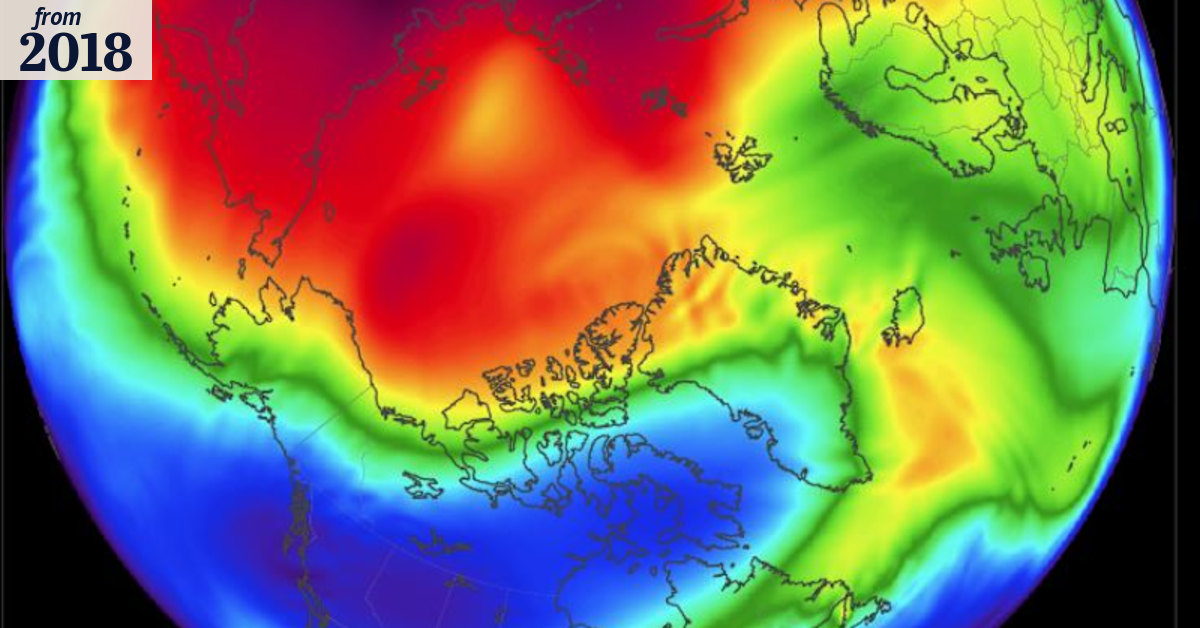
Arctic temperatures soar 25 degrees above normal in the dead of winter
Shipping can navigate easily through the Arctic Ocean as the ice melts in abnormally high temperatures for February.
The Sydney Morning Herald
249 points · by kevinyen · 8y ago · 147 comments
It’s like if I take the Lord’s name in vain and then get sick and you tell me this shows that I shouldn’t swear. Then you lick a handle on the subway and get sick and I tell you this shows how disease is transmitted by germs. The two may look superficially similar, but the underlying reasoning is important.
There's nothing logically or philosophically or scientifically preventing both explanations for why we each got sick from being simultaneously true. You're attempting to draw a dividing line between "religious thinking" and "rational, scientific thinking". No such division existed throughout history. Even today many "scientists" think along religious terms while many religions are evidence-obsessed. Counter-examples abound.
[0] https://en.wikipedia.org/wiki/Climate_change_in_the_Arctic
[1] https://www.skepticalscience.com/global-warming-cold-weather...
The last three years have been highly above average in the arctic. This isn't "arctic has one warm day!". It's "the entire year is abnormally warm in the arctic, like the past three!"
The appropriate comparison would be the US having a whole winter which is 10-20 degrees colder than normal.
The discussion is we know this is happening, what do we do to stop it?
Hot weather in July in the Northern hemisphere is not unusual and does not require explanation or study. Snow in July would be unusual and would require explanation and study.
The problem is how much and how often this happens: global warning is very likely to be caused by human activity.
Future looks ugly, everybody is (maybe unconsciously) afraid and at fault. And instead of looking for a solution I use my brain 40 hours/week to solve useless problems. Those who have also money send cars in the space. What could go wrong.
Insane heat waves AND insane cold snaps is very much part of 'global warming', or the consistent moderate increase in energy we're doing.
Thousand and ten-thousand-year storms and extremes become yearly or monthly events as the range of the system's outputs has changed. Expect other cold snaps… and ridiculous, dangerous heat waves… and other sorts of dangerous and destructive weather events.
We're all sure gonna be kicking ourselves after it all goes Mad Max. Completely avoidable, yet all but inevitable with no off-switch in sight in the real world.
So yeah, we're doomed.
The thing is the curve is moving towards higher temperatures and we get unexpected deviations more on one end than the other. And have you considered these events may be not significant - yet, because the science department is hopelessly understaffed?
Let's say your assumption is that the things we observe happen by chance. Now, we have, say 100 years of temperature records. If only the last year just happens to be the warmest year of all observations, there would be an 1:100 probability that this was by chance.
Now, Wikipedia says: "A 2013 article published in Geophysical Research Letters has shown that temperatures in the region haven't been as high as they currently are since at least 44,000 years ago and perhaps as long as 120,000 years ago. The authors conclude that "anthropogenic increases in greenhouse gases have led to unprecedented regional warmth."[12][13]"
So it is way more than one warm year in 100 years.
But to comprehend the unlikelihood that this happens by chance, consider another record. Look at this graph:
https://upload.wikimedia.org/wikipedia/commons/thumb/f/f8/Gl...
It shows that the instrumental temperature record sind 1880 to today. You see that since 1980, every year was warmer than all the years before.
What is the probability of that for the hypothesis this happened by chance? From 1880 to 2017 are 137 years. The last 37 years have higher temperatures than all the years before. Assuming that no systematic change is happening, the probability is the same as putting the numbers from 1 to 137 into a box, drawing blindly 37 from them, and discovering that you have drawn the numbers 100, 101, 102, 103, 104, and so on, until 137. What is the probability of this?
It is given by the binominal coefficient:
https://en.wikipedia.org/wiki/Combination
with n = 137, k=37, 1 : n! / (k! (n - k)!).
Using Python:
    >>> def fak(n):
    ...     if n <= 1:
    ...         return 1
    ...     return n * fak(n-1)

    >>>def binom(n,k):
    ... return fak(n) / (fak(k) * fak(n-k))

    >>> n=137
    >>> k=37
    >>> binom(n,k)
    3902541575254646835963436276286280L
1 / 3902541575254646835963436276286280
Do you still think it happens by chance?
xkcd had a nice illustration: https://xkcd.com/1732/
I mean, that would be really really nice.
Everyone is agreeing there is climate change, in fact there have always been climate change and according to them the climate have been much worse than it is now.
Most sceptics even agree that humans affect the climate.
The discussion as far as I can understand is to what degree do humans affect it. I.e. is it enough for us to worry about it.
There is as far as I have been able to learn no actual consensus, in fact, ICSC has been lowering their projections over the last 10 year or so.
If you want to figure out whether you should worry or not may I suggest you try and find out what the official consensus on humans effect on the climate is. You will be surprised how little certainty you will find. I certainly was.
This is, after all, rather like living with the sword of Damocles over my head. I'd really rather not have it dangling there, glinting menacingly at me, but wishing the sword wasn't there doesn't help one jot.
I'm sorry, but it is impossible to be a truly intelligent person that also believes in any religion without serious cherry picking or psychological compartmentalization. I say this as someone that loves studying religion (I have a degree in it), but I study it as an artform of human expression or an oddity that once was, not as a serious pursuit of self-completion. Hopefully, we can one day study those that deny basic climate science and geology the same way...
Most skeptics if not all of them agree there is climate change, most of them even agree some of it is man-made.
The discussion is how much and you won't find any consensus on that no matter how much you try to ask for it.
People still want their 24/7 AC, their steaks, their huge cars, their big heat inefficient houses, their plane flights etc.
No one does a thing.
Believing in climate change, or not believing, when reflected in the actions of people, is in my eyes completely equivalent.
However, it is true that too few people in "developed" countries do that. And it's also true that too many people in "less-developed" countries lust after energy-intensive lifestyles. So overall, its unlikely that overall climate forcing will decrease. Unless solar energy and battery usage take off exponentially enough.
Even worse, there's already enough CO2 in the atmosphere to drive substantial climate change. And the poles are warming fast enough to drive substantial CO2 and CH4 outgassing from melting permafrost.
So maybe it's just too late. And so maybe the rational option for those alive now is to party hearty. Russia and China probably like that path.
People will keep eating candy. They will never eat their vegetables, unless they taste like candy. It's pointless to imagine worlds in which they eat their vegetables and everything is great because, although it's possible to write a plan to get from here to there, those worlds are strictly fantasy. The plan can not be followed. I could also write a plan for the sun to rise in the west—and it would also fail, for largely the same reason.
If you want to solve the problem, make a better, cheaper vegetable that tastes like candy.
For instance, the following products are worse for the environment than their alternatives:
1. Hand-crafted, locally produced goods
2. Non-factory farmed food
3. Organic food
How do you know?
I live in Whitehorse, Yukon. For reference I drive due South to Alaska.
The weather here is nothing, and I mean nothing like it used to be. It would reliably be -40 for all of Jan and Feb in the past. The river would freeze to the point of holding the massive festival ON the river with cars, tents, thousands of people ,etc.
The river has not frozen for a decade, it regularly goes above freezing in Jan and Feb, and even some of the mighty lakes up here don't freeze enough that you want to walk on them. The ice used to be so think my 4 ft. ice auger wasn't long enough to let me ice fish.
It's actually happening this weekend! It's always the last full weekend in February, in case our city piques your interest ;)
http://www.northofordinary.com/winter_rendezvous
Anecdotally, I've also heard from a couple of farmers that the wind up here is different than it was in the '70s.
My first year it didn't get above -40... daytime high temps :)
And as a crazy question, given that there's only a population of 25k in Whitehorse... what's the tech scene like? :)
25deltaC = 45deltaF (just multiply by 1.8 for delta C to F)
Ah why did you reply to your own comment instead of pressing edit. I thought you were the grandparent poster replying to the correction. God damnit.
http://ocean.dmi.dk/arctic/meant80n.uk.php
Last 3 years have been truly crazy.
Was hard from the beginning to understand the severity of the situation with no units denoted.
Here in Toronto, it's been 16˚C this past week. In February. We've had about 2 or 3 real snowfalls that stuck around for a few days before melting.
As somebody who loves ice skating outside, it's really frustrating. And I love the snow.
Every year it seems like the winter gets a little milder...
It snowed the day after it was 75˚F.
It's rather usual for a northerly place like Calgary to go from -20˚ to +20˚ Celsius (or the reverse) over the course of a day due to Chinook winds from the mountains. They're really quite a sight if there are any clouds—you can watch the wall of whatever front is blowing in.
In Ontario, it's rather unusual for the same kind of phenomenon, and we've experienced it multiple times this winter.
One single day hit 16 at the max. Another hit ~14. That's a very generous way of looking at our weather this winter. This has been a much snowier winter than last year as well (and some others of recent memory).
Yes it's been unusual to have the final 2 weeks of February average above 0 during the day.
Both December and January were very cold with a monthly mean temp of -5˚C (ref: http://climate.weather.gc.ca/climate_data/daily_data_e.html?...). By mid-January there were a ton of stories in the media about how cold our winter had been and various records had been set. Everyone in the city was complaining about this winter for most of it (until recently).
Example: https://www.theglobeandmail.com/news/toronto/fourteen-cold-h...
Relevant quote: Following a sudden stratospheric warming, the high altitude winds reverse to flow eastward instead of their usual westward. The eastward winds progress down through the atmosphere and weaken the jet stream, often giving easterly winds near the surface and resulting in dramatic reductions in temperature in Europe.
see also (in german): http://www.meteoschweiz.admin.ch/home/aktuell/meteoschweiz-b...
Not necessarily. If there was no long term warming trend, records would become less common over time, since they would be weather-related random values and there are more previous year data points to compare against. A warming trend would act counter to that effect, but not necessarily overcome it.
yes it does.
“This next batch of abnormally warm air is forecast to shoot the gap between Greenland and northern Europe through the Greenland and Barents seas. Similar circumstances occurred in December 2016, when the temperature at the North Pole last flirted with the melting point in the dark, dead of winter. Similarly large jumps in temperature were documented in November 2016 and December 2015.”
It happens every year? Therefore it's not unusual.
So that makes this, “This latest huge temperature spike in the Arctic is another striking indicator of its rapidly transforming climate.”, uh, what?
While we're quoting the article:
> These kinds of temperature anomalies in the Arctic have become commonplace in winter in the past few years.
Implying they haven't been in the past.
I wasn't implying that.
> Implying they haven't been in the past.
Nor that.
My only intention was to agree with the original commenter that the title and start of the article made it sound like this one event was a complete anomaly.
Later on we find out that, no, this has been happening for a while.
If it is not an anomaly then we need to know how frequently this temperature spike happens. Multiple times during the winter? Has it been spiking only in the last few years. How anomalous is it?
Am I not allowed ask these questions?
1. Climate change implies increased variability in weather--hotter summers, wetter winters. Agriculture does best in a relatively stable environment. Just look at California--extremely wet winters followed by extremely hot wildfires. It's hard for a species to thrive in a very wide variety of conditions. Not impossible, of course, with humanity being the crowning example of that kind of flexibility, but it's harder for an annual grain like wheat, rice, or corn to pull off.
2. Less sun at northern and southern latitudes mean a shorter growing season.
There are a few other reasons I can think of for why yields will generally drop, among them ozone pollution, but they're not related to climate change specifically.
There's a book discussing the business opportunities being created by global warming - "windfall" by McKenzie Funk.
A and B are instance of cognitive dissonance.
I'm in category C. I would be in favor of any measure that could help reducing the risk even if it decreases greatly my comfort. But I don't see this happening. Even small harmless restrictions are not taken. Try to tell people that they should drive smaller and less powerful cars for instance.
But maybe the rational attitude to have (which is less heard) is to stop caring as we're not going to solve this anyway. We're not going to solve our mortality problem either and we don't worry too much about this. Future generations will have it harder than we had (climate change, pollution and resources depletion) but why should we worry about them (esp. if we don't have kids)? It's not like we really care about miserable people living now.
Deep Bore Into Antarctica Finds Freezing Ice, Not Melting as Expected | National Geographic https://www.youtube.com/watch?v=fyjt5zpNAeg
At the Ross Ice Shelf in Antarctica, scientists used a hot-water drill hose to create a hole through the thick ice until they reached the perpetually dark water. What they found surprised them. Christina Hulbe/University of Otago/K061
Real weather information: https://www.youtube.com/channel/UC6VhLE7qAeW8NZm6PsXGGrQ/vid...
Sure. Great idea. Brilliant. Why wouldn't we welcome it?
The comparison to "getting colder" isn't really valid, as it is not the only option.
Most people would like things to stay the same. Perhaps we should be looking at what temperature would be the most beneficial to the planet as a whole.
If we were to create a new earth, what would be the ideal temperature, how would we manage it, where is that in comparison to where we are now, how can we get there.
Is it a dangerous question? probably.
Earth itself will do just fine at any temperature that's below literally evaporating. Various life on this planet has evolved to thrive in wildly disparate climates, and short of complete eradication of an ecosystem, surviving organisms both tend towards better suitability for their given environment and adapt their environment towards better suitability for them (both with limits). We humans should be looking at what temperature ranges would be the most beneficial to human society as a whole. Sure, that's incredibly self biased, but as a human, I contend that's an incredibly useful bias to have.
Attempting to adapt the environment will have unforeseen, probably serious, consequences. I for one hope we do not try, or have no choice but to try, geoengineering attempting to avoid catastrophe.
Having read parts of the official IPCC report, there are still significant holes all the way down to the treatment of the woefully incomplete data used to draw admittedly uncertain conclusions. The picture is nowhere near as certain as many have been lead to believe, and it is difficult for me to take climate change reporting seriously, because as soon as one moves past published literature, the concept of uncertainty is abandoned for politicized groupthink.
Now, it is not unreasonable to assume that something is happening. And, given the chance that it is not transient, it makes sense to hedge our bets and reduce emissions. However, even here I hesitate because of an almost total void of literature discussing the potential benefits of a warmer earth.
Such is the curse of taboo.
A warmer weather is an 'unknown'. We have trouble with EVERYTHING. We hardly know anything atm with the stable environment so a whole new challenge of future planet might be just to much. It is already to much.