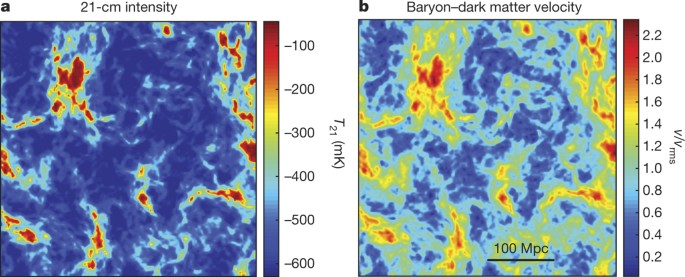
From studies of the cosmic microwave background we can be pretty confident that temperatures were very uniform at the time of recombination, and that the cooling of the CMB (which was fixed at that time [1]) closely resembles the adiabatic expansion of an ideal gas. So we're already seeing cooling-by-separation. If we have a decent idea of the history of the expansion, then we also have a decent idea of the temperature of the CMB at the surface of last scattering. Since we look so intently for tiny overdensities or underdensities to seed structure formation (collapse of matter into early galaxies), it's hard to imagine where one could hide an enormous underdensity or overdensity that could cool the CMB across an enormous region (we see the same temperature along widely angular-separated lines of sight; this is the horizon problem [2]) without leaving fingerprints.
The period between recombination and "first light" from the first stars (triggering reionization) is not especially well understood, but the expectation is that the expansion of the universe would be pretty smooth in that epoch. So the neutral hydrogen around the time of first light being cold enough to produce the unexpectedly strong 21cm absorption line is an oddity.
If evidence holds up suggesting that this gas is uniformly colder than expected then we could take the position that our idea of the history of the expansion is somehow wrong, or alternatively that some other process was at work at the end of the dark ages. We have constraints on both; and in particular "some other process" is tricky because the almost-exactly-black-body spectrum of the CMB puts constraints on early cooling-by-clumping (where cooling is up to "chemistry", where that's a(n exothermic, in this case) reaction between particles of different species).
There could be "chemistry" in the dark matter sector that allows dark matter to cool by extremely local clumping (for example, if in the "dark ages" before recombination there are two oppositely-charged dark matter particles and at recombination they combine into one neutral dark matter composite particle, analogously to how electrons and protons recombined into neutral hydrogen), but then you have to figure out how to have the dark matter be colder than the hydrogen and how to thermalize the hydrogen to the dark matter. You also have to avoid smearing out small matter density fluctuations.
If structure formation works the way we think, everything at recombination seems too uniform and diffuse for local gravitational interactions to do the job of transferring much momentum from the matter sector to the dark matter sector in time for the 21 cm absorption line seen by EDGES. There are also constraints on extra long-range interactions, so Carroll's raising the idea of a zero-mass boson mediating the interaction is hard to imagine (a massive mediator would be shorter-range, in general, and could carry more momentum between matter and dark matter, but there are constraints on such interactions from the much later universe -- for instance, we would expect missing momentum in particle physics experiments, along the lines of the missing momentum that led to the discovery of the neutrino).
The problem is that there are lots of strongly correlated observations and pushing at one tends to cause problems with one or more of the others. But that's what theorists in this area (model building) seem to like to do. :-)
- --
[1] Peter Coles (cosmology, Cardiff) has a good, accessible write-up from some years ago, adapted here: https://ned.ipac.caltech.edu/level5/Glossary/Essay_lss.html
[2] https://en.wikipedia.org/wiki/Horizon_problem?oldformat=true