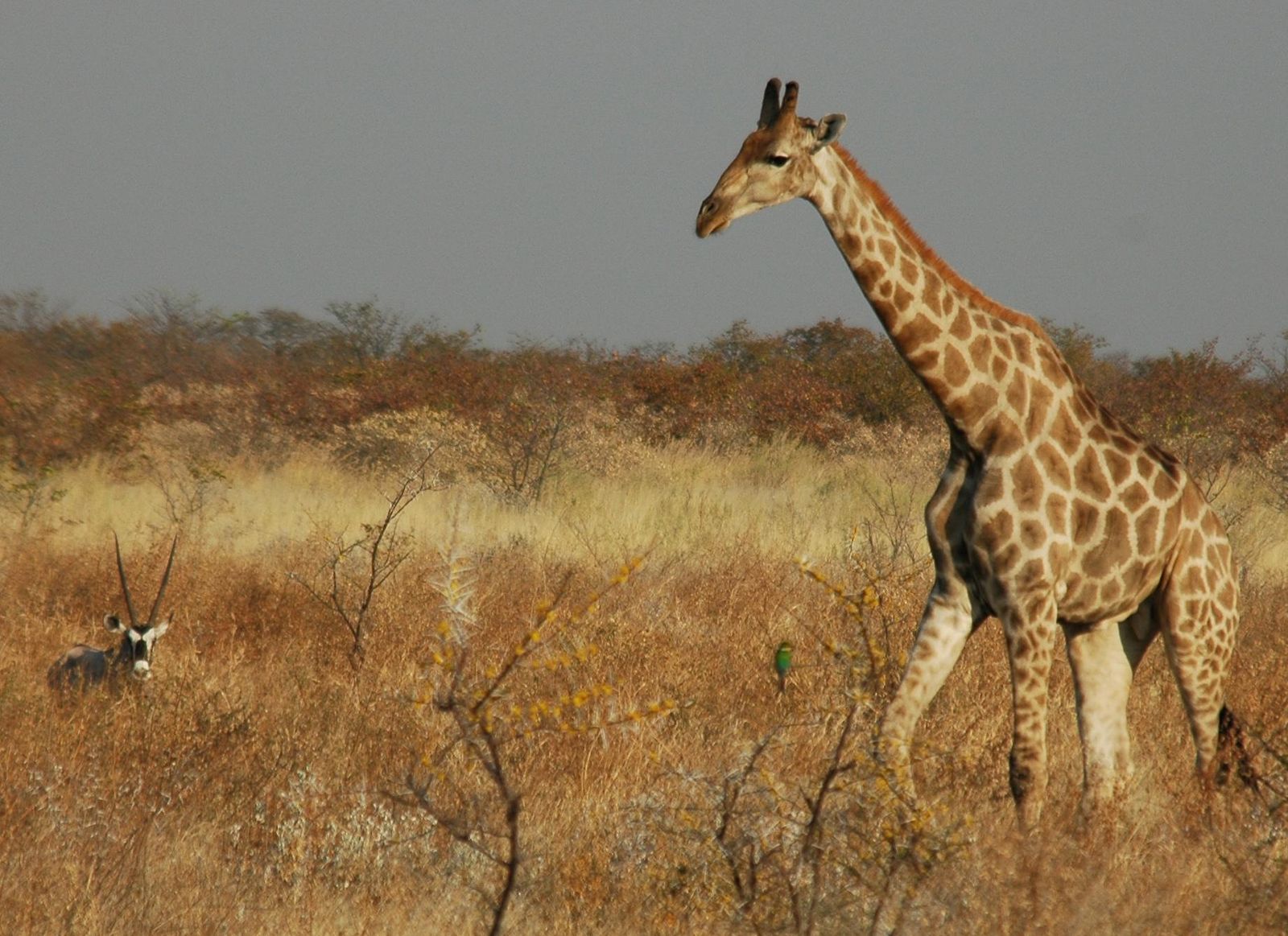
Giraffes Silently Slip Onto the Endangered Species List
Years of habitat destruction and poaching have reduced giraffe numbers by 30 percent, placing them in the vulnerable category for the first time
Smithsonian Magazine
465 points · by Red_Tarsius · 8y ago · 191 comments
I wish more people could understand this. Hunters paying for high dollar trophy hunts are literally the only thing keeping African megafauna from total extinction at this point. It may hurt for someone who loves animals in a "Disney" sense to understand this, but most hunters have a far deeper love, respect, and appreciation for the natural world than any new age "environmentalist".
We (hunters) have been doing this work for generations now, and it's not pretty. Not everything can be turned into a touchy feely bumper sticker that agrees with your political stance. The reality is that wild animals are a natural resource which must be carefully managed if they are to continue existing.
I’m all for any solution that doesnt involve hunting. But the fact is that altruism has its limits, and pretending like that’s not the case is threatening the existence of these animals.
Maybe I'm wrong, but I'd like to see hard numbers, not just some feel-good anecdotes about local people raising giraffes for hunting.
With the private game farms, some more context for people who are not familiar with them. They are generally facilities with 100's of acres of land and high fences around the perimeters to keep the animals in and the poachers etc out. Each animal has a dollar value associated with them. A Blesbok(type of Antelope) goes for about $400(what they charge a hunter if they get one) and it goes up to $50,000+ to get a Cape Buffalo.
Needless to say there is a lot of incentive to take care of the animals. For example one time I was visiting a family member that owns a Cape Buffalo farm in South Africa when someone left one of the gates open overnight. The herd of 50 got out and went a few miles down the road. That day was a "all hands on deck" to herd the ~2.5 million dollars of live stock back to the farm. There was a vet on stand by and they brought in a helicopter to do a survey and assist. The operation makes makes money for him, he employs a people and brings in money from tourists etc. and he is incentivised, by money he makes from his business, to take care of the animals.
This is in sharp contrast to the government of South Africa that has trouble taking care of the basics for the majority of the population, like education, at times maintaining reliable electricity (ask people there about the Escomm rolling power cuts when the grid is over capacity, or water in Cape Town... the water crisis has much more to do with poor utility management than climate change), most middle class people hire armed response private security services and don't rely on the police for security, etc..
Another relative works for a company the does municipal land valuations for tax assessments. It is not uncommon that they will get a contract, perform all of the things required for the contract, but then the municipality will hold off on paying (6+ months) until his company takes legal action, puts on lien on the municipalities assets and begins to seize them by going in and physically starting to take furniture, cars etc..
Some brought up a good point with the conservation efforts to hunt the older animals in the wild. Those permits can help to fund the conservation effort, but given how corrupt the government is there, someone with money could pay off a bureaucrat to look the other way with a permit etc... and then will the money actually be put into conservation efforts.
I could write a book on this (and have to an extent here) but this is in one of the larger, more developed economies in Africa that some refer to as “Africa Light”. Now imagine what is happening in African countries with even less functional governments.
Glad you asked. The power utility is called Eskom. I like in Tshwane and we don't experience 'rolling power cuts'. Not sure why you think making a comparison between a private game farm(er) and national govt service provision connects with giraffe conservation efforts
  1. Paid trophy hunting where proceeds go towards reservations
  2. Make giraffe burgers common and desirable so we have giraffe farms for manufacturing giraffe meat
  3. Domesticate giraffes and make them the new dog/cat
4. Similar to #3, progressively breed smaller and smaller giraffes so they're hardier, take less space, and can eat anything. Make them the new deer (how deer are viewed in the US).https://en.wikipedia.org/wiki/Giraffe
This has been your regular reminder that "endangered" is a technical term with a specific meaning, and that misusing it makes it harder to focus global resources on species that are actually endangered. Thank you for your attention, please return to freedom and consumption.
> Two subspecies, the West African giraffe and the Rothschild giraffe, have been classified as endangered, as wild populations of each of them number in the hundreds.
>announced yesterday that it was moving the giraffe from a species of Least Concern to Vulnerable status in its Red List of Threatened Species report. That means the animal faces extinction in the wild in the medium-term future if nothing is done to minimize the threats to its life or habitat. The next steps are endangered, critically endangered, extinct in the wild and extinct.
Let startups and big corporations manufacture convincing fake shark fins, rhino horns and giraffe tails, and mail it to anyone who would try their luck passing it off as the real thing.
Hans Rosling of gapminder made it clear how different they are. South Africa is very dependent on tourism.
And it's not just SA National Parks. The municipality of Tshwane/Pretoria has reintroduced giraffe and other herbivores into some of its reserves. And now it collects more revenue from ticket sales and property tax.
Humans are the most wasteful species.
[1]https://waitbutwhy.com/2014/06/taming-mammoth-let-peoples-op...
James Damore will be eager to know more about this theory.
Maybe it's because Microsoft worked on a project to help conservationists protect giraffes: https://blogs.technet.microsoft.com/machinelearning/2016/04/...
This might be an example of how a specialized dataset that was used to train an AI for a specific task, was later taken as part of another dataset to train a more general AI and the result was an AI with a "distorted view" of the world.
Over a billion more people there by 2050 and the continent will be the hardest hit by climate change. We're just burying our heads in the sand about the reality of it.
Now Africa is growing very quickly. We should let it grow as we once did. Saying that they don't have the right to build cities and factories, since African nature is so nice and our isn't anymore, is a bit Euro centric.
Again, I don't disagree with your reasoning, and it is easy to back up by saying everyone else has done it, why would we stop them from doing it. I guess my argument against this point is that every society in the world should be doing their best to try to prevent things like this, so we shouldn't just let people do obviously terrible things to the environment, just because we have previously done it.
This is obviously a high-level response, not getting into particulars, but I hope you get the point at least.
People cite their distaste and dislike of American and European all over the world yet the vast majority of those places champion all things American or European / white, if only in things like food, music, entertainment, fashion, and lifestyle -- if not more / everything. I know it's not "our" responsibility after a certain point so I'm just being curious on a very "surface level" here.
Dunno. Look at EEU; all the garbage that was known not to work in WEU was thrown into it instead of giving them the newest, safest and cleanest tech. Also pressuring them to cut their forests and sell raw wood for cheap to WEU, Ethiopian-style. Do you think Africa will fare better?
In terms of climate change, Europe and North America have made huge cuts in emissions at great cost to their economies. Unfortunately, not all large economies are doing their part globally.
Amount of money being also poured into the countries who’s cooperation is needed for conservation is also not small. No one is asking countries to help for free.
It’s a very disheartening argument to say that because others have made mistakes, anyone that has a choice today should make the same mistake. Especially, since those being killed off can’t exactly fend for themselves.
India has 300 million people without electricity, and they're doing exactly what the US and other nations did years ago: focus on improving their quality of life, using inexpensive coal and fuels.
I think this push to save endangered species is basically a form of colonialism where rich white people (whose ancestors destroyed their native fauna) tell poor brown people what they should value even when it gampers development.
The more I travel, and the more I see and learn about the world, humans, population and the environment, the more I am dead-set on the idea of mandatory population control. We need to put limits on how many children a couple can have. I know China's policy had some serious downsides, but at this point I fear much, much worse if we don't.
Let's reverse the trend and start offering financial rewards to people that don't have children.
Natural selection at work.
Is there any scientific evidence that dishonesty is a genetic trait, though?
Let's have severe penalties for those that break the rules, or mandatory abortions, or one of 30000 other possibilities.
yes, I know it's extremely, extremely unpopular, but with what I have seen on this planet, I genuinely believe it's our only hope.
Have you seen any of Hans Rosling's [1] talks on the topic of population growth? After watching, would you still think there is need for mandatory population control?
We need to do everything we can to stop population growth. 7 billion is more than enough. I strongly believe we should get it back down below 5.
We're killing the planet, making species go extinct, don't have enough food, drinking water or energy for what we already have.
> have you seen any of Hans Rosling's [1] talks on the topic of population growth?
I have not, and my internet is a bit too expensive to watch YT right now, sorry.
A note of irony: ostriches are African fauna that are unlikely to soon go extinct, because they've become livestock.
Our species will come and go having done little more than left an mass extinction event in the fossil record. A record that will never be perceived since our specie's experiment in sentience was clearly a serious evolutionary error.
All Giraffes or any species need do is wait out the storm. Thus, if we care to, all that needs happen is to convince humans to keep a given species around in a wild state until humanity finally wipes it self out. I imagine a millennia at most.
As it stands humans have the best shot at doing this. Perhaps we'll manage to save the giraffes as well and take some of them with us.
Furthermore, advancing technology makes smaller and smaller groups with smaller and smaller budgets, more and more deadly. If there remains even a modest chance of a species ending war per century century, then our remaining time as a species is very short indeed.
So while they are certainly worth doing, the species can not be saved by something as simple shifting asteroid orbits or colonizing Mars. We have to solve the other much harder problem.
Big if true!
But everything that we know is a tiny blip on the timeline, and "the data" is practically meaningless. If humans died out soon, our existence would still be so fleeting that the universe would hardly know we were ever here.
As a US citizen, what can we really do. I realize our country shares responsibility for climate change, but isn't a major problem here also poaching? To really solve this, wouldn't Africa have to step up and crack down locally on industry damaging the environment, and poaching?
I don't think anyone is burring their heads in the sand, we just have no power to change things here or abroad. Half of our country still thinks climate change is a hoax...
That's not quite true. Most Americans (7 in 10 in a recent study [1]) believe climate change is happening. The difference is that half are unwilling to pay extra in electricity bills and other areas to deal with it.
The overtones of political tribalism in your denouncement of "half of Americans who believe it's a hoax" is good reflection of why politics is so divisive in the US and only grows further apart on important issues.
[1] https://www.scientificamerican.com/article/most-americans-wa...
Most of the demand comes from SE Asia and China where they think this stuff cures medical conditions.
Long term, those governments need to modify primary and secondary school curricula to unambiguously dispel those myths. Eventually, the people who believe rhino horn cures cancer will die out or be pressured by their children, but this will take at least a generation.
In the meantime some species will go extinct. Their only hope is a sudden and prolonged recession or depression in Asia.
How many people in the developed world believe that vaccination causes autism? Or that they have biological intolerance for MSG? Or take extreme doses of vitamins or minerals?
I don't think that any amount of grammar school curricula could overcome the human tendency to believe in crazy shit, non-backed by science or reason. This human nature even transcends class, and appears among the relative elite (e.g. fear of irradiated food, avoidance of gluten when your not even celiac, Elon Musk's belief that we live in an alien computer simulation, etc).
You can perhaps use school curricula to shift mainstream thought, the Overton window, etc. But there will always be enough "alternative view" enthusiasts that I doubt you could ever eliminate demand for rhino horn as an erectile dysfunction treatment.
This seems like it has being going on for a while and the Asian governments just don't do anything.
---
Also WRT to finance incentives for locals: IIRC rhino horn goes for obscene ammount of dollars in Asia, so any tourism dollars will have to compete with that.
EDIT: and worldwide, i.e. reducing the international demand
That's one thing people here could work on.
I do not bury my head in the sand. Instead I try to convince people on HN all the time that people in Africa should stop procreating to solve these problems.
Things tend to break down a bit when utilitarians try to force moralists to adopt their view, or vice-versa. In the end, it should just be sufficient to have some reason to care about the environment.
We lost species all the time, it's a normal part of evolution.
Also, why is it sadder that humans lead to their extinction than when other species extinct each other?
Its "sadder" because its preventable. Humans are self aware and know that we are causing this. If we change our behavior it wont happen.
But let's be clear, right now, we are sh*tting where we eat. There will be consequences for us as a species if we carry on the way we're going. At best our civilization will be greatly reduced in advancement, quality of life, and many will die in the process. At worst we'll join all the other extinct species.
I'm saddened by the pain and death of individual organisms, but not the loss of a species that they make up.
It would be an undesirable state of affairs to see giraffes go extinct in the wild, but zoo populations can maintain themselves and would probably expand to compensate if they were the only populations left.
Today, we have the IUCN, which didn't even exist until 1964, fifty years after the Passenger Pigeon was gone. We keep track of at risk populations and have a vast infrastructure of care facilities and a lot of interested parties and money in keeping species from dying out. We have an interconnected global communication system to always know what is at risk everywhere. Whereas bans on the hunting of passenger pigeons in the 1880s and 90s weren't enforced and few were aware of them it would be much easier to spread information on and enforce such bans today.
The only captive population of passenger pigeons in the early 20th century was at the Cincinnati Zoo, which slowly died off because they only had an unsustainable population starting out of 20. Today, there are thousands of captive giraffes around the world, and the news of their endangerment should promote more preserves to adopt giraffes to make the species can be kept stable if they die off in the wild.
For the majority of the homo sapiens' history we were hunter-gatherers and were doing fine because that is how we were designed by nature. Because our population didn't spiral out of control or was at least tempered by the amount of food, our hunting and gathering didn't throw whole ecosystems out of balance. Small communities offered close relationships that are rare to find now in our multi-million strong cities. Hard conditions permitted for only the most fit to survive so there was no need for extreme medical intervention.
I find this whole narrative parallels how when people who grow tired of cities and go into the forest to try out that lifestyle at first completely disregard, say, the Native American's techniques to build houses and try to build cottages until a tree almost kills them when it barberchairs and even if they do manage to build something that resembles what they're used to they have to abandon it quickly because it's just hard to build and maintain, doesn't go well with fire and so on. Then over trial-and-error they eventually come back to the original Native American design because it was tried for millennia and can't be improved any further.
So this very much reminds me how now everyone says how sitting is bad for you - yeah, no wonder. Or how the obesity sky-rocketed when some unscrupulous or ill-advised agencies decided to recommend that ridiculous amount of carbohydrates and sugars aren't bad for you, but fats are. The physique and athletic ability that so many people strive for by going to the gym was effortless for hunter-gatherers because they didn't overeat and physical activity were a part of their daily life(not to say that hunting all day is effortless, just the physique came as a by-product of surviving).
Of course, our population has grown much too large for everyone to go into the forests, so we've kind of screwed ourselves already by burning that bridge, however I think we can at least steer humanity in the right direction by looking at where we came from and trying to chart our future path using that.
I'm genuinely interested in hearing criticisms about this hypothesis since it's been brewing in my head for a while and I figured the best way to test it is to put under some form of peer-review.
> course, our population has grown much too large for everyone to go into the forests, so we've kind of screwed ourselves already by burning that bridge
Yeah, that's the ugly part of it. I think we've roughly got the choice of consciously trying to damp population and affluence (the resource & pollution cost per unit of population) , or maintaining the status quo of growth and accelerating into a pretty hard population crash.
My mental model for continued climate change, as a reasonably predictable consequence of continued human "business as usual" is +4 degrees C or higher global warming with billions of people dying.