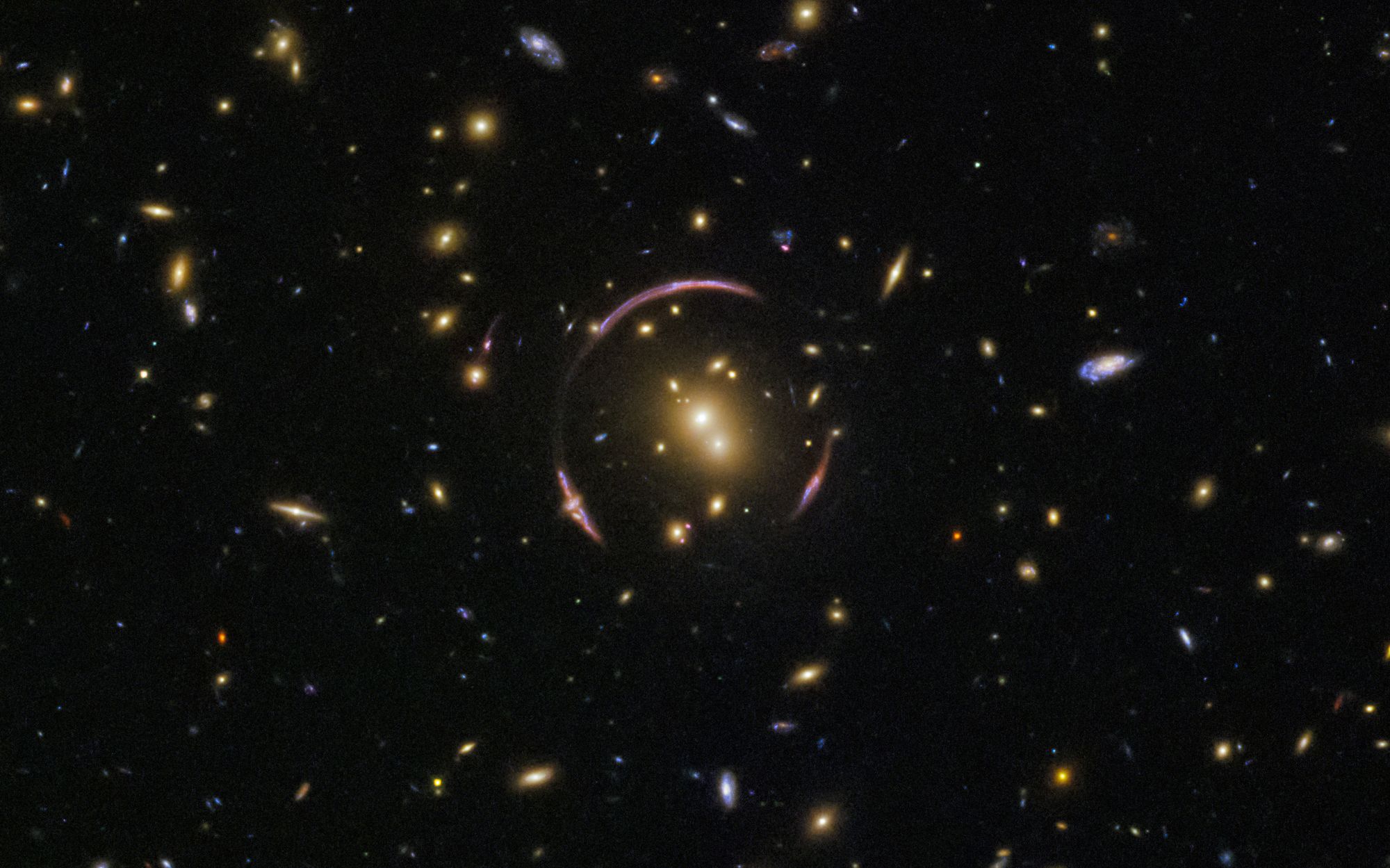
Hubble Telescope Discovers a Light-Bending
The perfect circle surrounding a galaxy cluster in a new Hubble Space Telescope image is a visual indicator of the huge masses that are bending time and space in that region.
Space
239 points · by katiey · 8y ago · 57 comments
Einstein also had the benefit of knowing the null result of the Michelson–Morley experiment (1887), and Hertz's experimental confirmation of electromagnetic waves moving at the speed of light (1889) predicted by Maxwell.
Einstein, of course, explicitly recognised Maxwell and kept a picture of him on his office wall.
While Einstein's theoretical work is fabulous, it was Maxwell who first broke away from the mechanical model; something that even his illustrious contemporaries struggled to understand.
If you appreciate Einstein, yet know little of Maxwell, then The Man Who Changed Everything[0] is a great introduction.
[0] https://www.goodreads.com/book/show/29442.The_Man_Who_Change...
And there is zero common ground between them. The standard model says, in a way, that gravity cannot exist (because gravitons are impossible, nothing in the standard model could carry the gravity force), and the special theory of relativity says nothing about anything other than gravity and spacetime. Or we should say, it describes spacetime, but not what's in it.
And yet there are ridiculously obvious empirical links between both of them. There's many, such as the famous e=mc2 equation, or the speed of light that can be measured in both theories using vastly different theoretical underpinnings, yielding the same value. And yet, theory says they have nothing to do with eachother. The speed of light could very well be very different, it would not be a problem, so why does it match ?
But my favorite is that inertia only exists in the standard model. Gravitic attraction only exists in relativity. But they are determined by the same property. We know that to a factor of about 1e-50 there is no difference between inertial mass and gravitic mass ... and yet all our theories say that there is no link whatsoever between them, that that's just another amazing coincidence.
And half of the physics of the 20th century can be described as "ah ! problem with relativity. Oh wait no. But ! Problem found ! Nope. Found it ! No. Here there might be a flaw in relativity and that would explain all these ... nope, no flaw".
In many ways, if we had found a huge problem with general relativity, we could have been much further in our understanding of the universe than we are now.
http://www.stsci.edu/hst/phase2-public/13003.pro
"The fundamental unit of star formation in the Universe is neither a star, nor a galaxy, but a star forming region with a typical scale of at most 100s of parsecs."
More interesting stuff at: http://www.stsci.edu/
Here's the first video https://videos-f.jwpsrv.com/content/conversions/xTYS7F8k/vid...
Second video https://videos-f.jwpsrv.com/content/conversions/xTYS7F8k/vid...
I guess we just aren't always lined up with them?
I.e. our intuitive, euclidean concept of space is actually the most correct, albeit an abstract, inferred phenomenon.
Further, I don't think space (or time for that matter) are comparable to the notion of ice, but let's keep it simple for now :-)
The difference between the two is that the 'warped' space is what we observe (because observing is an electromagnetic process, subject to gravity), 'real' space is something we can only infer (or observe in photos like in the linked article)
We can know the Earth is round without any reference to Euclidean space or Euclidean coordinates- just trace out a big triangle and you could observe that the interior angles will sum to more than 180 degrees.
The key word is "seem", which means that the light-bending characteristic of gravity make space seem like something it is not. Hope this helps.
If you look in the right place, you will see the back of your head- several times! So there's an illusion of seeing yourself in several places at one time. But toroidal space really is different from normal space (even if it's basically flat and Euclidean, the geodesics are different).
So it seems to me that you can have warped spacetime that produces illusions like duplicate galaxies.
https://www.encyclopediaofmath.org/index.php/Desargues_assum...
When light is bent while passing by a huge mass, this axiom fails so does the geometry.