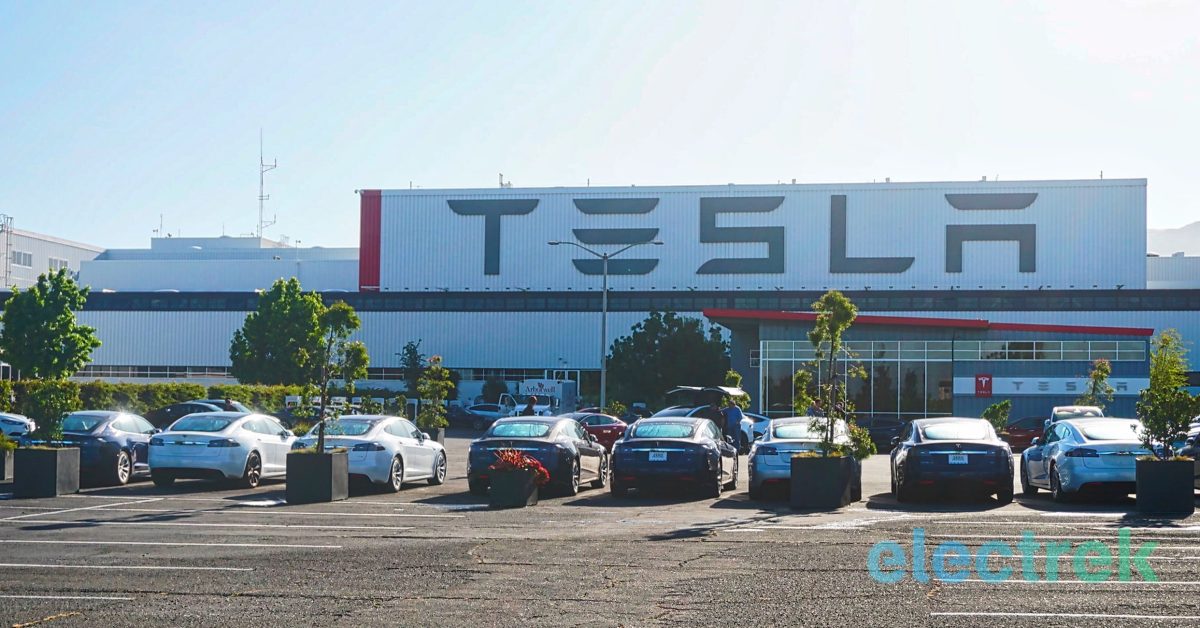
Tesla starts brutal review of contractors, firing everyone that is not vouched for by an employee
Over the past few weeks, Tesla CEO Elon Musk has been warning of a focus on efficiency at Tesla’s Fremont...
Electrek
175 points · by WalterSear · 8y ago · 98 comments
Really, every place I've worked, you could say this happens every month; almost always I've needed an employee to sign off on my hours, either the person I report to or the person they report to. I always took that as a vote of confidence, personally.
(I mean, obviously, even if I get fired, I expect to get paid for hours worked, but point being, the guy just signed off on spending $15k-$20K, depending on the body shop cut, for a month of my work, I'd assume that would trigger at least a few minutes of "what did Luke do for me this month?" and a phone call letting me know not to come in Monday if the answer was "Not much".)
The corollary to that is that if you get to the point where you need to check on the vouchsafety of all your contractors - en masse - something is seriously wrong with your company.
That sounds reasonable, although I could see a need for some exceptions. For example, I could see a company using a contractor for its front end web development and another contractor for running the web server. The first contractor would be working with employees, such as sales and marketing that decide what is supposed to go on the site, and they could vouch for that contractor. The second contractor, the one running the web server, could easily end up only interacting with the front end web contractor.
Sure, the Contractor on the front lines actually doing work may be "liked".
It's the middle manager/Contractor's boss sitting in an office 1,000 miles away that Elon wants to get rid of.
Employees can apparently hire/manage Contractors directly, but Contractors can't outsource the work they were hired to do.
I think the key is that as an employee, you are expected to act in the interest of the company in ways that are different from what you are expected to do as a contractor.
My perception and experience is that as a contractor, I'm supposed to do what you tell me to do. If you tell me to do something stupid, I'm supposed to tell you it's stupid, and to explain why, but if you say do it anyhow, well, that's my job. It has more to do with task-based work.
My perception is that as an employee you are expected more to act in the best interest of the company.
I personally have a hard time seeing the difference between the two, because I'm not omniscient, I am sometimes wrong, and if the boss has heard my arguments for why the way they asked me to do a thing is stupid and still wants me to do it that way, well, maybe the boss knows something I don't know, right? The company, by making them the boss, has said that the company thinks the boss knows more than I do, so maybe the right thing to do is to go along with it?
(I'm mostly talking of "the right way to do it" in the sense of "the most efficient or correct way to do it" - I think of ethical dilemmas in a different sort of way.)
As an employee, if you object to something your boss is really on board with, you can expect to be fired.
It is, in general, a career limiting move to tell anyone above you that what they're asking you to do is stupid. Maybe if you're a God-tier management consultant, you can propose changes and expect to have them implemented. As a regular employee or contractor schlub, no. If you want to keep your job, adopt their perspective.
(Illegal actions are another issue. While it's illegal in many jurisdictions to fire a whistleblower, in practice you're still risking your job to blow the whistle. Not that you shouldn't do it.)
>>> The company, by making them the boss, has said that the company thinks the boss knows more than I do, so maybe the right thing to do is to go along with it?
I don't assume that for one minute. I work in a job where there is literally nobody else in the company with my expertise.
It's not just a "vouch", the language used is: "a Tesla employee putting their reputation on the line."
It's like the tesla-mafia, watch out or cousin Elon is coming for ya!
I always thought of us contractors as stateless mercenaries, and you cant expatriat (aka fire) a stateless mercenary.
Also regarding the useless middle management Elon mentions- thats the beauty of sub-contracting.
The poor fool at the end of the chain usually has to do the managment work and projekt-management too.
Because there's lots of companies that rapidly cut down on contractors, and I doubt they'd all have an article written about them at the top of Hacker News.
I'm neither here nor there about the company, but I note that it competes for a lot of my attention. I feel like if they decided to switch to all Macs, or abandoned Slack for IRC, I'd see a story about it here on Hacker News.
Even if no one vouches for the butt hole in department C they can still be necessary. Something to keep in mind before making sweeping changes without regards to the details.
https://electrek.co/2018/0...ployee/#disqus_threadNepotism and bribes are going to happen, but I think there will be some fast lessons when Tesla axes employees for this behavior.
It makes it more clicky.
Personal vouching for other people generally is the best guarantee for performance in absence of better criteria.
Trust is not a bad thing.
Trust does not alone degrade accountability. But you need to have a second accountability mechanism in place. Trust, but observe is the classical zen guidance into holding accountability within a group.
Then the group dynamics kick in - tribalism and pathological cronyism.
Exclusive clubs are a typical organization principle in the human species and they increase efficiency within the group by increasing trust and improving the quality of communication through larger shared background. Tribalism alone is not a problem to members within the group.
To agents external to the specific group tribalism may manifest in many negative ways, of course, but it is totally context sensitive if it's a problem or not in the general sense. Many elite organizations, for example, exhibit highly tribal behavior.
Then we get to the black sheep of the lot, pathological cronyism. I think we all can agree without further explanations why it's bad, but, the prerequisites for the pathological cronyism are many of the same kind as needed for the positive patterns exhibited in human socities, including trust and tribalism.
The thing that keeps everything from collapsing into a self-satisfied old boys network is accountability.
But using trust - instead of, say, bureaucracy - as one of the key ingredients of a company culture sounds to me totally great.
If a bunch of your engineers (or whatever) went to Stanford, they people they trust are also much more likely to be from Stanford, because those are the people that they know. The same holds for any university.
Then as time goes by the organisation becomes increasingly dominated by Stanford(or whichever) because the follow on hires also recommend people that they know — eg Stanford and the likes.
Now you have ensured that if someone cannot - for any reason - get into one of the feeder supplies, typically because going to those colleges requires a huge amount of money, or they’re super prestigious (the fancy UCs say) which have strong correlation to wealth (if you’re poor you can’t support the costs involved in getting a successful application).
So now you end up where large groups of people, for reasons outside of their control, and irrespective of talent, cannot get a job at your company.
At no point does anyone say “I don’t trust X”, it is simply the requirement that you have to /know/ someone to get a job there. Even if people are not trying to be assholes it is required nepotism. Even if you’re trying not to be biased, your hiring pool has already shrunk to match the backgrounds of your existing engineers.
If you want you could probably make a dumbass simulation of this, and I suspect if you start with X colours it will devolve to a small number fairly quickly.
The large scale discriminatory criteria of gender, race and age should be accounted for but beyond those constraining who you should vouch for sound extremely constraining.
I understand the argument, and I think the effect you suggest is plausible - I'm not just convinced it's such an effect that could or should be accounted for (mainly because I have no idea what process beyond blind bureaucracy could do this).
> Often, it is like a Russian nesting doll of contractor, subcontractor, sub-subcontractor, etc. before you finally find someone doing actual work.
I'd also argue that these multi-level contractor setups are a major security concern. Ideally they should make it policy to have no more than one additional level between Tesla and the contractor performing the work.
Aggregate contracting will make assigning liability a difficult task and it's likely the person working for you is being underpaid as each layer takes their cut. Meanwhile you get 100% of the shit-storm from any media backlash about worker salary/conditions.
A few basic reasons:
* You can't do it in-house as well as a contractor who specializes in this field, or as well as this particular contractor. Very broadly speaking, the best people in field X want to work for themselves, do things their way, and keep the revenue from their work. They don't want to be several layers deep in management at your company, to have f-ng morons (i.e., anyone else) telling them how to do their job, and to be paid a salary for the breathtaking, save-the-day miracles they routinely output.
* It's not worth the investment: You would have to find and hire talent, ramp up, provide resources to them (equipment, training, etc.), be able to manage the talent in a field that isn't your expertise, and keep them busy and interested. Maybe you don't have enough scale in the things they do to support quality resources; maybe you just don't have enough work or enough interesting work for them.
* Every additional employee or capability is a distraction for the organization, including management. Keep focused on the things you do best and that are strategically important; you don't even have time for that. If you're small restaurant chain, IT isn't strategically important - it just has to be reliable and good enough. Outsource it and focus on world-beating food, service, and marketing.
* You don't want to pay benefits, taxes, or have the other responsibilities of being an employer. See: Uber.
* Sometimes it's just politics: I once worked in an outsourced capacity for a company where the IT manager simply didn't want to invest in a technology that would threaten their fiefdom, so somebody brought in a contractor. It was not a fun place to be.
1. You can get a functioning team much more quickly.
2. It's a lot easier for someone unfamiliar with the field in question to evaluate the quality of a consulting company than to evaluate a prospective hire.
3. It's a lot easier to get rid of them once you don't need them anymore.
This is in contrast to employment consultants getting fees in intervals over a period of a person's time with an employer, usually done for executive positions. So I'd say optimise your agreements with contracting firms for quality rather than quantity by paying them bonuses in intervals, with a low initial payment for the finding the candidate.
Sarcasm aside it seems like Tesla has operational issues. This coupled with the story a few weeks back about somewhat "slapdash" power module assembly is a bit concerning.
Musk is a visionary... but few visionaries are excellent operations people.
It’s possible that musk is just trying to cut their burn rate and is going to blame the inevitable decline in production after this on ‘restructuring’ or whatever.
Which would take months. This is about sending a message as much as it is about cutting costs (fast).
Why? SpaceX, sure. But Tesla? Just because it gets more news coverage?
"Engineer at Tesla" beats "engineer at IBM" but probably is socially inferior to "radiation oncologist".
Obviously status is to some extent subjective and culturally/individually determined, but there's broad agreement that certain jobs are higher status than others by various groups of people.
Which begs the question: can Tesla afford to fire contractors? R&D on complex parts takes years, even at Tesla ...
who would not like to cut down mess like this?
Contractors generally get paid significantly more than employees in the short term, and Tesla is on the line for getting to profitability.