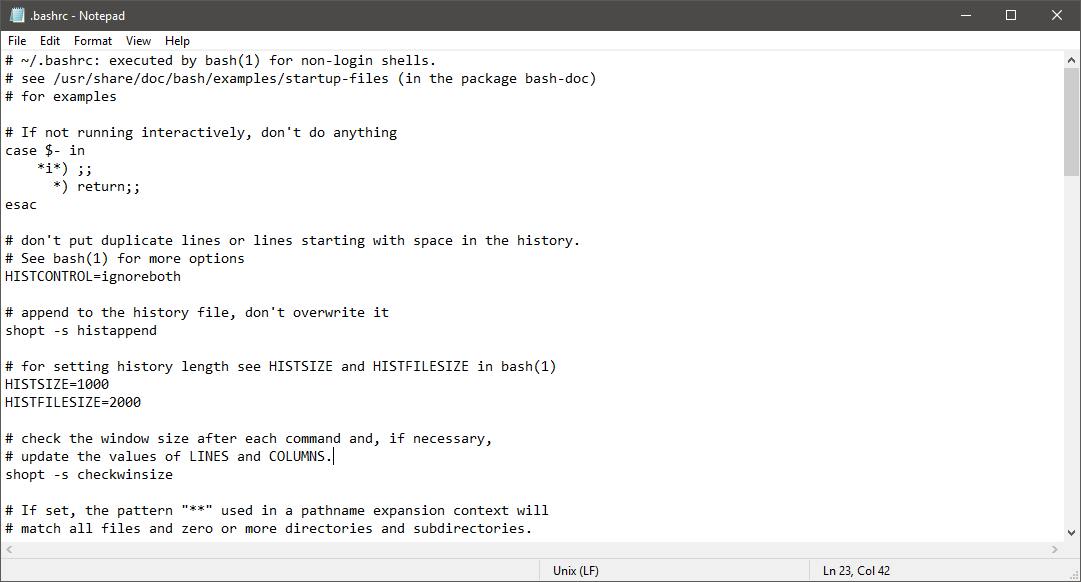
Introducing extended line endings support in Notepad
For many years, Windows Notepad only supported text documents containing Windows End of Line (EOL) characters - Carriage Return (CR) & Line Feed (LF).
Windows Command Line
327 points · by dEnigma · 8y ago · 193 comments
Is this Microsoft's crowning achievement? No, it's just a stupid little historic decision that someone remembered and decided to fix. They even took the time to enable admins and power users to use the old behavior. I too don't see who'd want it, but who knows? People do unexpected things sometimes.
Why bash them for that? There are enough good reasons to bash Microsoft... There are Microsoft products that fill me with a fiery rage of a thousand suns. But they did something cute here, someone there deserves a good word.
Confession: This is the one I care about.
Granted that's mostly because I already knew what to expect going into Google IO.
So sure, this is good. It doesn't exactly undo all those decades of grief. So we're laughing grimly at the "progress".
From Microsoft's point of view, when they held >90% of the PC market, what would be the point of even thinking about interop?
I mean, Notepad is a silly thing, sure. But the crazy spec incompatibilities between MSVC and the C9x and C++03 standards were a huge source of grief for me personally. And the mess caused by Microsoft's "Java" implementation was straight up evil.
(I googled "define bugsmithing" without quotes, and this HN thread I'm typing in was the top result behind only an unrelated site called the bugsmith, an exterminator. I didn't see any relevant hits.)
"Smithing" in English refers to making something, in the sense of a blacksmith forging iron. So in this context "bugsmithing" refers to making bugs -- deliberately (more or less) doing things differently or incorrectly so as to increase the impedance required to do work on less popular platforms. Microsoft was famous for this.
I've dealt with a Microsoft storage library for Java once that had an absolutely idiotic bug - you'd store a certain value, but would get something slightly different when retrieving it in 100% of cases [0]. I reported the bug and it was quickly fixed. But what amazed me was that the next version came out with a page long description [1] and analysis of the bug, its meaning for compatibility with other storage clients in different cases, the fix, and astonishingly a new flag you could enable if you want to keep retrieving screwed up values.
[0]: https://github.com/Azure/azure-storage-java/issues/30
[1]: https://github.com/Azure/azure-storage-java/wiki/Java,-Andro...
And the apparent routing of all bug reports and feature requests to /dev/null -- er, the recycling bin -- certainly seems to be an institutional thing. I have no doubt that thousands of their paying customers have complained about this to Microsoft over the years and it had to have been ridiculously simple to address.
This is the first time Microsoft has actually released it though. And that's an institutional thing.
Kudos to them, interoperability is always nice. Maybe they can acknowledge the existence of (and respect) other bootloaders, while they are at it.
Unfortunately, it seems their hearts are set on running everything inside windows, including GNU/Linux minus Linux (WSL).
Side note: I think we should just start referring to WSL as GNU/Windows.
Sharepoint?
When the death count gets that high - it's easier to call it buying the eventual death of a new laptop. Buying a new laptop has become a somber affair to go along with the eventual reinstall of your entire setup far too soon.
Luckily there are tools today that make this much less painful.
This particular bug, however, required use of Notepad++ instead for years. Repeat for every other missing or broken piece of MS tech. Vista was so bad I was willing to suffer on the spot switching to Mac.
I'll accept this is as a symbolic peace offering - years of having to install a separate text editor and lots of other unnecessary won't get back that time.
There's a lot of innovation coming out from MS, something we normally wouldn't have said even 3-4 years ago.
Looking forward to the increased linux integration to continue, and have a good look. Until then, MacOS, despite it's aging warts, just works and stays invisible for the most part.
I expect Windows to become more Linux friendly.
Addressing the "bug" is not simple - the edit controls behaviour could be changed in which case it could cause existing programs to behave differently, or extra code would have to be written for notepad to do its own text editing. Microsoft takes backwards compatibility very seriously.
Anyone curious about the Microsoft side of this should find Raymond Chen's Old New Thing blog interesting (about 5 posts a week). For example here is content tagged history: https://blogs.msdn.microsoft.com/oldnewthing/tag/history and here is how there are actually two copies of Notepad on each system: https://blogs.msdn.microsoft.com/oldnewthing/20090312-00/?p=...
You just add a new mode to the control that enables the new behaviour. Existing programs using it would work fine.
> Today, we’re excited to announce that we have fixed this issue!
But the word bug has been coopted by the masses to have the wider meaning of “doesn’t meet user expectations”.
In any case, bugs need not be only in software. As as earlier comment says, bugs can be in specs, too. Here, the spec was buggy and that has been resolved.
Or to put it another way, the defect was in the spec, and that has been resolved.
(Note that many specs are implicit and best derived from the software in question. If that is the case for Notepad, then fixing the bug in the spec requires one to fix the code. I somewhat doubt Microsoft follows that practice, but it's certainly not beyond the realm of the possible.)
Take a look at the first screenshot on the announcement page and then tell me it's working as intended.
I am not sure, when they introduced it. It might be that it happened in Windows 95, when edit became a stand-alone program. Not sure if the QBasic-based editor in DOS 6.22 or earlier supported it.
Meaning, of course, that they would use them in Windows, so there would be a text editor and a start menu that work. Not buy and kill.
The problem is that when it was first introduced in windows 95 the registry would easily and often corrupt causing many issues so some people still associate the registry with being a bad design, when it was actually just a bad implementation of a good design.
I can only assume that requiring an ops team to change a setting in a basic text editor is pretty standard in the Windows world, too?
While I did once know a developer who used notepad as his primary editor, it was never intended to be anything but a very simple editor for INI files and the like.
This is the wrong comparison. Notepad is like nano or ed. More powerful editors are available on Windows too.
> I just assumed any programmers still on Windows would be using Notepad++ or some sort of IDE.
Usually we do. But notepad can be invoked quickly from the command line, tends to handle huge files better than N++ or other IDEs, and is opened by default by a lot of utilities like git (you can change this, of course, but you might miss one). So it ends up getting used a lot for quick one-line changes and improvements are still welcome.
That's been my experience too --- I've opened several hundred MB files (mostly logs) in Notepad, mostly for searching through, and it handles it quite well. Inserting characters at the beginning can get a little laggy, but that's still nothing compared to a lot of other IDEs/"industrial strength" editors that choke on much smaller files.
...and yet the standard Windows edit control that Notepad is based on does nothing fancy at all; its data structure is basically one array that holds the entire file contents. No ropes, gap buffers, or other "advancedness" --- just one big buffer. It also means extremely low memory usage, a tiny amount of fixed overhead + file size.
(I am one of those programmers whose main source code editor on Windows is Notepad. I also mainly use the cmd for compilation. I've never felt the need for anything more complex, and I do use an IDE (VS) mainly as a debugger, but if I just want to open source code and read or edit it, I use Notepad. Then again, I don't use those languages where an IDE is almost mandatory for navigating through source code, so it works well. In the time it takes for an IDE to load, parse, and display a file, I could've opened, edited, saved, and compiled with Notepad.)
I mean there is only so many ways of putting together two different characters. Is it supposed to be \n\r or \r\n? Or just \n? Or mabe it's \r? So much of the last 35 years have gone to writing the wrong line endings for the intended platform...
As long as the telemetry/phoning home is still pervasive and difficult to disable completely, no. Ever since ~2K/XP or so it's always been one step forward, many steps back.
Just a tad less dramatic that a robotic telephone assistant, but still :)
Full disclosure, I work for Microsoft, this post doesn't reflect my employer in any official capacity, etc.
It has been 25+ years in the making.
Too bad about the telemetry and lack of privacy, or I might actually be tempted to use it. :-/
https://neosmart.net/blog/2017/hello-betterpad/
(Only other features iirc are hyperlinked URLs and unsaved document persistence after reboot/kill a la text edit on macOS.)
Turns out that an update did not properly write out "\r\n" but rather "\n". Looked fine in Notepad++ of course, but sure enough in MS Notepad ... things look garbled.
It feels a bit wrong that it supports old MacOS CR though. Isn't that thoroughly obsolete, and encouraging its use only going to prolong its death, making it harder for everyone else to have to keep supporting it?
I am so sick of having to tell people not to use Notepad because it is badly broken and always has been.
You shouldn't have to tell people to download Notepad++ or use WordPad if they want to read a text file.
Edge, WSL, open source powershell, open source dotNet Core, VS Code and now a Notepad with line endings.
Windows is consistently getting better as a developer's Operating System.
I don't think it needs much improvement, really. Anything besides fixing bugs in its own code (i.e. this "extended line endings support" is in the edit control) would go against its core principle. There's Notepad++ and all the other "heavier" editors if you want more features.
https://stackoverflow.com/questions/7812142/how-to-toggle-cr...
Right after Windows give up CRLF line endings, it will be immediate compability disaster.
(I slightly kid; that's the official Unicode "line separator". Never actually seen it in the wild, and not entirely sure how the Unicode consortium expected it to come into usage.)