@johnnyryan.bsky.social (@johnnyryan) on X
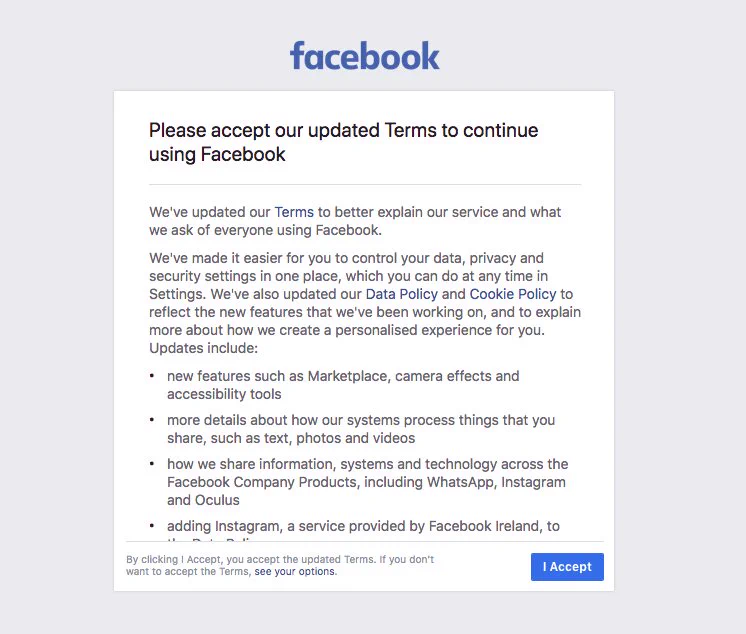
Facebook is confronting EU users a new “terms of service” dialogue that denies access until a user opt-ins to tracking for ad targeting, and various other data processing purposes...
X (formerly Twitter)
284 points · by fredley · 8y ago · 359 comments
I'm appalled that thousands of people still work for this company by choice.
For another, the reason there's no mass exodus from Facebook is that Facebook users do not perceive the company as harming them. They perceive it as a useful service for staying in touch with friends and family. The utility it provides outweighs privacy concerns, because most people do not care about digital privacy. They care that no one is watching them go to the bathroom or have sex, but they do not care whether advertisers can target them based on aggregated information.
While I am not a user and don't condone their practices, lots of people are happy and willing participants. Whether they need to be protected from themselves ala seat belts and cigarettes is a societal decision, but right now it's clear the citizenry has a favorable view of them even despite the onslaught from legislators and overarching media narratives.
Going on a tangent here...But I've been thinking about this. At some point it's going to come to a head between these two views of FB if the squeakiest wheels also influence laws. If you rock people's comfy boat too much, there will be backlash.
Anti-Disclaimer: I do not work for Facebook nor have I ever have in the past.
I think the challenge on expanding on that is that you have not made a case for why it is objectively bad. Your posture is one of an assumption that everyone here understands and has the facts that you have. So it is hard to answer your question without knowing what you are thinking.
Additionally, I am wondering why the question is specifically about FB devs, as opposed to Google's? Or frankly, so many other companies who are likely making money in similar ways. Guessing that should include Yelp, LinkedIn, etc (not sure, though). Are we targeting FB merely because they're very effective?
For me, I have said it here and in person before: I do not see a problem so far in what Facebook is doing. I mean, I have quite a lot of personal issues with Facebook, which is why I have never had an account. Over 10 years ago when my friends in college asked why I did not have an account, my response was always "Why would I want a private company to know who my friends are? That is information that is precious." However, that's my personal issue, and my stance is and has always been that if a particular user is OK with Facebook having that information in exchange for their services, there is no ethical/moral dilemma. It is a transaction, and neither party is being coerced. So I have never been in favor of legislation that limits this relationship.
Now it should not be hard to understand that for me, if I've lived a fine life all this time without Facebook, any kind of argument that "not joining Facebook is not a realistic option" will not receive my sympathies.
The basic data collection is fairly transparent: Everything you provide to them (content, contacts, etc) is available to them. No user should be surprised that they utilize this information. It is the default assumption for any online service. If you use your Facebook account to log into other sites, it should be obvious that Facebook has that info. With regards to the more "shadowy" aspects (e.g. cookies tracking you across sites, etc), a point could be made, but honestly none of this is shadowy any more - it's been in the press repeatedly for years. Once again, if the users don't care, I don't see how it can be "objectively bad".
People tend to invoke the user's ignorance: Most users are not tech savvy and cannot be expected to know how all this works - so they cannot reasonably know they are making a bad bargain. I am not sympathetic to this. The reason is that in all the years Facebook has been in existence, I have talked to and educated many average folks about the potential downsides of giving a private company so much information about you. Everyone I spoke to was quite OK with the whole concept. Not one person felt it was problematic. So not only do I not have a reason to think FB is "objectively bad", I cannot even invoke social proof! Whatever bad people keep claiming is coming out of FB is something most of the population does not think is bad.
I have few sympathies for the (very few) people who are whining about it, because their behavior is similar to irresponsible adults who continually make bad decisions and have lives wrecked as a result, and then expect to get bailed out. Like not buying earthquake insurance in an earthquake zone and then demanding compensation when they lose their house.
Facebook did not become what they did by being clever against their users. They got there by working with them. Any discussion of issues about Facebook without implicating the users who happily helped them is biased.
Finally, and perhaps the most controversial part of my comment: Let's not kid ourselves. People are upset about this because it helped Trump more than any real concern about our privacy. Had a more likeable candidate (Obama, etc) used data from CA to help win an election, I would expect a fraction of the coverage this is getting right now. In fact, I think Obama did heavily utilize these services in 2008 and 2012 - just not as effectively as Trump's campaign did. If anything, Trump's campaign was merely more effective.
1. I support opt-in by default organ donation because even though it's a "dark pattern", it creates the most public good.
2. I think developing AI will lead to lots of good things. Therefore I think the ends justify the means.
As a modern analogy, imagine Erdogan's military and bodyguards. With all the global news on the matter, it's evident they are causing a lot of oppression to many people and basically contributing to a dictatorship, yet they still do as they are told from the top because their own benefit depends on it. Hell, he even got them to suppress a coup threatening his own power.
In order for FB to really change, it needs to change from the top. Otherwise, it's a massive effort to convince everyone at the bottom to push back against the top and threaten their own job security. The reality is Zuck, Andreessen, and the other board members at the top don't care to change, because changing for the benefit of their users also means less riches for themselves.
For various reasons, I would estimate Google and Microsoft have historically had the possibility of recruiting from about half the senior Engineers in my niche.. Facebook and Amazon are a bit lower, maybe as low as a quarter.
For companies bought by these companies there is a general readjustment as up to about half the engineers who would have refused a job offer from them leave while trying to take the most value in vesting schedules and line up something elsewhere.
The "Exoduses" from incompatible buyouts don't really make headlines because 50% over ~3 years with replacement is hard to see from the outside and most tech mergers are catastrophes if both companies' lines were actually supposed to remain profitable.
https://medium.com/@bozhobg/facebook-doesnt-plan-to-be-gdpr-...
Head in sand like this approach will remain unacceptable to EU.
EDIT: removed wrong link.
What does that mean? Why did you link to your parent comment?
Facebook has become a social justice issue (to steal a strong phrase).
My guess is that "we can silently change our ToS at any time" is no longer possible, and that's why you cannot login without agreeing first.
Given how deeply tracking is built into their business and technical model, I wouldn't be surprised if it really was too difficult to implement.
I haven't signed in for years, but I have stuff on there going back to high school (back when you had to have an education email address to make an account, now that I think about it) which I'm sure would be fun to look through down the road.
They are selling you to not just advertisers but selling your profile to companies that are able to use your profiled information to make their own decisions about things.
It's not just about advertisements. Imagine if you didn't serve a single advertisement and instead bought profiling information about people. You could use that profile information to make business or political decisions regardless of whether an advertisement was sold.
You could influence politics because you "know" your target audience.
Say, for example, the US presidential election or Brexit. Those are just the most high profile places for your profile to be used without ever having presenting advertisement to you.
Net neutrality is another one.
The big money is going to be selling your profile to everyone, including insurers - health, auto, home, etc. Good luck getting a good deal when they know how much you drink and the food you eat.
To the government - eventually that guaranteed Social Security and 401k will be means tested, and it appears you're spending on luxuries that disqualify you.the possibilities are endless.
And I know for a fact that there are more than a few HN readers who work for companies mediating this data.
Directly go to reddit or 4chan. Everything on facebook is 7 day old trash from reddit.
> Also, I don't even see adds with and Ad-blocker. What are they going to try to sell me, a meme page subscription?
You don't see it does not mean facebook does not track you and is not interested in selling stuff to you. It will just use your data to sell stuff to your family members.
[1] https://www.slate.com/articles/technology/technology/2015/07...
In many jurisdictions that's illegal. EU is saying FB's approach is also illegal unless they make some key changes.
Personally, I hope FB just quits Europe.
Button 1: Agree and proceed. Button 2: Set up credit card billing. Button 3: Close account.
For US & Canada this was $86.65 in the last 4 quarters.
For Europe this was $34.95.
Keep in mind they likely don't target ads using just one person's data: accuracy can be improved by looking at the data of similar people, and looking at the data of friends and family. It isn't as simple as offering a $10/month plan to keep your privacy, because they want everyone's data.
"Your data is worthless, everyone's data is priceless."
In other words, are 99% of European citizens going to just click through what ever annoying prompts they have to in order to get to their facebook (thats what I would do) or is there an actual widespread cultural difference in the EU that would stop large segments from agreeing to this.
It also coincides with FB's recent privacy breach news and overall general public dissatisfaction with FB's policies.
I know a lot of folks who simply don't use FB and are realizing that it's "really not free" in liability terms.
So does this turn into a groundswell? Probably not, I agree with you. However, it does put some fences up that is probably causing FB to feel a bit more nervous. GDPR may be the first of many such efforts...
Amongst "ordinary" people, there is a growing sense of unease about data collection - reflected in the "Facebook must be listening to my phone because they overheard a conversation I was having and now I'm seeing ads for it".
I believe people are starting to understand the implications of data collection and are quite unhappy about it.
Because my guess would be that it would be cheaper to adhere to the rules rather than let a competitor grow big in Europe and eat their market elsewhere.
Unless, of course, their central business model is incompatible with GDPR-compliance in the first place...
Tracking is not the primary service Facebook provides to their users, so the GDPR will not allow them to bar access for users who do not opt-in to being tracked.
- accept ToS and use Facebook, or
- deny ToS, download user data and delete account (under 'More options').
Companies have always been able to deny users access if they don't accept a ToS, but clicking "I Accept" to the ToS shown in the screenshots is not a GDPR opt-in, and I cannot stress that enough. It is just a ToS update, which does not cover GDPR-compliant opt-in to tracking. The tracking questions following it are also not GDPR-compliant.
They will have to ask properly for opt-in when the 25th rolls around, or they will face fines for non-compliance.
FB is trying to muddy the waters with this ToS update, probably to fool people into thinking "well, I already accepted a bunch of stuff a couple of weeks ago, I'll just accept this GDPR thing as well". It seems that you've bought in to their misinformation campaign.
The GDPR stipulates that you cannot make access to your service contingent on opting in to tracking, unless you service cannot possibly function without tracking. Strava would be a good example, it cannot possibly work without tracking a user's GPS location.
But FB works just fine with no tracking at all. The only thing that would be compromised is be FB's business model, and that's just tough luck, they'll have to come up with something better, a model that doesn't infringing on people's privacy.
Source: I work for a telco/ISP and we are extremely aware of GDPR and the consequences, and we've been working diligently for ~2 years to make our entire business GDPR-compliant. Training courses and tests of our understanding of the rules are mandatory for everyone, from customer support to CEO.
They have a very easy choice actually. Either abide by the rules if they want to service EU citizens, or GTFO. If they want to give up a couple hundred million users and hand them over to the GDPR-compliant competition, that's their choice. It would be monumentally stupid, though. FB needs EU users a lot more than EU users need FB, but they're trying very hard to spin the press to make it appear the other way around.
It's like when McDonalds or a similar tax-dodging company threatens to leave a country if they face being forced to actually pay the taxes they owe. Leave millions and millions in profit right there on the table for their competitors to grab? Yeah right, ain't gonna happen.
The real question isn't population, it's revenue per user. An typical American or a European will draw a lot more revenue to Facebook than a typical person from a 3rd world country accessing Facebook through "Free Basics."
My educated guess is that Europe is Facebook's #2 market behind the US, and there's enough revenue there for them to change their business model.
https://s21.q4cdn.com/399680738/files/doc_financials/2018/Q1...
From Slide 5:
Q12018: Europe was #2 with $3.036B in revenue
Q42017: Europe was #2 with $3.250B in revenue
And so on, it looks like every quarter on this slide has Europe in spot #2 behind US & Canada.
I 'm also in the EU and this makes perfect sense to me: if you can't accept seeing some ads then you can't use the free service. I highly doubt people are willing to pay $5 cash / quarter to use it, but i would like to see FB giving that option, just to see how miserably it fails.
Facebook would still work just fine without the tracking, as proven by the fact that you can switch off targeted ads and everything still works fine.
Does anyone know if Google has made any statements on this?
While I do trust Google more than I trust Facebook, I also actively avoid giving information to Google (through various practices).
Personal information that is deliberately and freely made public by the owner of that data (ie. you, the user) is free to use, both for the service on which you make it public, and for anyone who happens to read it on your publicly visible profile/wall.
The reasoning is that you made a deliberate choice to make this information public, meaning you have given consent to public viewing of said data.
What this Facebook issue is about, is the collection of personal data that you have not made publicly accessible, because it is private to you. FB is using this data to tailor ads and to modify your feed, giving you politics you agree with, suggesting pages for you to join, and so on. FB is also profiling you and inferring your private information, and using that to track you across the web (on every single web page with an FB "like" button, for instance). They have a disturbingly detailed profile on all of their users, including highly sensitive data such as political standing, sexual preferences, medical history, even possible infidelity.
FB is perfectly usable without giving them access to any other personal information than a fake date of birth and a throwaway email account. It is perfectly usable with "targeted ads" turned off. It is perfectly usable without the "optimized news feed", it can just default back to a chronological feed instead.
The violation of their users' privacy is not essential to the service FB provides to their users.
Edit: they are doing this before the May 25th deadline.
> When assessing whether consent is freely given, utmost account shall be taken of whether, inter alia, the performance of a contract, including the provision of a service, is conditional on consent to the processing of personal data that is not necessary for the performance of that contract.
As such, trackers in 3rd-party advertising network code probably won't count as necessary; it's necessary for the ad network, but it is not necessary for the website displaying the advertisements, as proven by ad-blockers.
Likewise, the facebook like button and other "plugin" components aren't "necessary", they merely add value to the existing content / features, and must therefor be entirely opt-in.
At least, that's my understanding, which is entirely too facile to be taken as legal advice.
EDIT: As petercooper pointed out below, in addition to proving necessity, you must still also prove in court that you have balanced the necessity against users' rights and interests. As such, I no longer feel confident to say I even have a clue as to what is legal and what is not, for FB or for anyone else, until there's a big enough court case to set precedent.
Next up: the US targets Germany's auto industry - a backbone to their economy - with tariffs or other import restrictions, seeking to damage BMW, Mercedes, and Volkswagen in any and all ways possible. Easy cover: Germany having the world's largest current account surplus, at 8% of GDP. Recourse after that: more restrictions, regulations, targeting of US tech giants in the EU, and tariffs on various US products.
France says: Germany and its trade policies are a problem, seeks to reduce German dominance while trying to remain more neutral with the US:
https://www.politico.eu/article/emmanuel-macron-says-german-...
It's going to be a very interesting year or two.
I'd love it if Facebook were nationalized (or destroyed), but none of the coverage of the GDPR made it sound like it was going in that direction. I thought it was just another stupid "click here to acknowledge our cookies" rule that was going to spam up the internet.
Since they are being selective on the users they accept based on being tracked, they are now on track for another EU fine.
Regardless of whether this is for the "greater good", this is deeply unsettling territory.
Or do you foresee this being like drug prices, where the US subsidizes drug development for the world?
At the end of the day this will need to be decided in courts.
E.g. allow them to either sign up to the tracking or pay 100$/month for access
Tracking would not be mandatory to access the service, as the alternative way (to pay for the service) is available
The same can be said about google's search service. The search still works, but adsense and adwords won't work without your private info. And google can claim it doesn't sell search, they sell ads.
What you're looking for already exists; install WeChat.
The only problem is: Facebooks terms of service isn't really reasonable, and most people won't understand the implications. As I understand the GDPR one of the goals is to give users a set of rights, in regards to their data. These right cannot, under any circumstances, be violated, just as you can't bond yourself into slavery or sign away your right to free speech.
Facebook and others are currently trying to find loophole, like with the cookie-law, except this time the EU did it's homework and companies won't get of with such simple solutions. Really if Facebook believe they can't do business in the EU after the 25th of May, due to the GDPR, then they shouldn't. Just close of all EU activities. Of cause I understand why they won't, the company would lose a good chunk of it's value, but it will anyway if it can't find a way to legally operate under the GDPR.
Facebook doesn't have a right to track people in the EU without gaining their consent to it in a way that complies with EU law.
EU citizens have a legal right to expect that Facebook will comply with European consumer protection laws.
If Facebook doesn't want to properly comply with EU regulations, they're free to totally withdraw from the EU market. Otherwise, it can expect penalties for its willful noncompliance.
a) Tracking non-facebook users via Facebook icons on web pages, and
b) Storing the information of non-users such as photos other people take, phone books other people upload, etc?
Same as the cookie situation Europe has, but more so.
Consent must also be given explicitly, you cannot have a pre-checked "yes" checkbox or an "accept and continue" button.
Consent can also be given in a legally binding contract. A website ToS is very much not able to override the GDPR.
I know my reasons for wanting to ditch FB personally (I'm about 50/50 on that), but I'm curious as to your reasons for wanting others to dump it.
Here is what remained: https://web.archive.org/web/20151011192709/http://observer.c...
Basically, anyone using it, encourages more people to use it, thus causing further damage.
(I don't have a FB account)
Is "consent" gained by a screen with only an "I agree" button even kosher by it?
> This appears to breach several important principles of the #GDPR, including the principle of purpose limitation, freely given, non-conditional consent, and of transparency. In other words, if Facebook attempts to collect consent in this manner, that consent will be unlawful.
E.g. I spent 3 years at Yahoo (more than a decade ago now) wrangling with US product managers that found it incredibly hard to accept that the "workarounds" they kept proposing for EU requirements for payments systems were highly illegal in the European countries we operated in, as a means to cut effort. My team existed pretty much only to form a protective layer between the US payments team and the European business because the European business didn't trust them to not pull a fast one to save time, because they didn't understand the seriousness of the requirements.
But in many European countries, the courts takes a very dim view on that kind of attitude.
You cannot grandfather in user consent, especially not with a blatantly non-compliant procedure like this one.