163 points · by anarcat · 8y ago · 133 comments
https://system76.com/laptops/galago
https://www.avadirect.com/Clevo-N130WU-13-3-QHD-Core-i7-Inte...
Some googling suggests the Serval WS is a Clevo P775DM3-G, and the Oryx Pro is a Clevo P650SE.
People upthread were wondering how they're doing all that with just 21 people or whatever, that's how. They slap a new label on Clevo hardware and dress it up with some nice photos. Most of those 21 people are probably web developers, marketing/photographers, and warehouse staff.
They might not even be doing their own firmware updates, they might just be getting Clevo to deliver specific features for them. Maybe they are doing some minor OS customization, or EFI tweaks to help Linux compatibility, but they can't be doing all that much work with 21 people to spread between development and normal sales/warehouse work.
This vastly trivializes the work System76 does for months and sometimes years leading up to a product release. We don't simply take an off-the-shelf product that already exists, throw an OS on it, and sell it.
System76 works with upstream manufacturers (like, yes, Clevo for laptops) to determine what types of products to develop, including their specifications, design, etc. for months up to a release. These products do not exist before we enter into these conversations.
Once that has been determined, designed, and goes into production, we start on firmware. We ensure all components are working together and with the Linux kernel (often requiring changes to the components' low level interactions with the OS, since the upstream components themselves are often manufactured with the assumption they will be used by Windows).
Once that is complete, we test with Ubuntu and Pop!_OS specifically, ensuring the OS is working perfectly with the hardware. If there are any OS-specific changes to be done, we write that behavior into Pop!_OS and/or our "driver" which is preloaded on all machines (and available in any Ubuntu-based distro, Arch, Fedora, etc.), with the intent to upstream that into Ubuntu, GNOME, and/or Linux itself as quickly as possible. When this is more generic like ensuring HiDPI works great out of the box, this actually ends up benefiting competitors like Dell's XPS 13 probably as much as it benefits us, but we put in the effort to file the bugs, track them, write the code, and get it upstreamed.
Once all of that is complete, we finally offer it for purchase and market it with all of our pretty photographs, sales pages, etc.
What ends up happening, then, is Clevo offers a machine with a similar-looking chassis for sale as a barebones laptop. This is the result partially of the decision making System76 has made for what to produce in the first place. These products, however, do not contain any of the firmware or driver work that System76 has invested in. They do benefit from the nice photography and advertising System76 has done, and since they look similar, people assume they're going to get the same machine for cheaper "directly from the manufacturer."
Edit: regardless, this is a bit beside the point of the linked blog post, and is also becoming less and less true as we work on designing and manufacturing our products completely in-house.
https://www.reddit.com/r/linux/comments/5umefi/comment/ddvcx...
What do you mean by "products"? Is it a particular combination of a specific barebones Clevo laptop installed with specific components (make+model) picked by System76?
> Once that has been determined, designed, and goes into production, we start on firmware. We ensure all components are working together and with the Linux kernel (often requiring changes to the components' low level interactions with the OS, since the upstream components themselves are often manufactured with the assumption they will be used by Windows).
What do you mean by "ensure all components are working together"? Do you mean check whether a component is already supported by linux and in case the support is iffy the System76 staff picks some other component (make+model) that's better supported?
It's kind of a case-by-case basis. But some products, like the Galago Pro and new Oryx Pro, are the result of years of working with our partners to even develop a certain class of computer. For a long time, Clevo wasn't even interested in a thin and light aluminum machine (much less a sane HiDPI resolution), but we worked with them to get that into production. The display resolution in particular was a win for us, as they had originally planned to go with a 3840×2160 display, but at 13", it was too-dense for most of our customers without fractional scaling. So we had them source a 3200×1800 display, which is just right. And when our customers and fans wanted a slimmer bezel on that machine, we released the 14" version with the same exact chassis but a bigger display and smaller bezels.
>What do you mean by "ensure all components are working together"? Do you mean check whether a component is already supported by linux and in case the support is iffy the System76 staff picks some other component (make+model) that's better supported?
Some components—like a DAC or Ethernet chipset—are not always directly chosen by System76; it's a decision our partners make when the product goes into production. Much of the time those components work perfectly fine out of the box in Linux, but sometimes it requires some firmware or driver work to get it working perfectly, usually if the component itself was only originally developed for and tested against Windows.
Just as an anecdote, my Dell XPS 13 DE (9160) came with Ubuntu preinstalled and "support" from Dell and it still had issues. My personal favorite was a null pointer bug in the WiFi driver where switching WiFi connections would result in a kernel panic.
I'm curious what do your firmwares actually improve?
Running Linux on MacBook Pro has also exposed me to the struggle of firmware updates and all that jazz.
So the hard work of Richard Hughes on LVFS is not lost me but I think he could have definitely handle the whole S76 issue more professionally. The whole blog post has a very personal vendetta overtone.
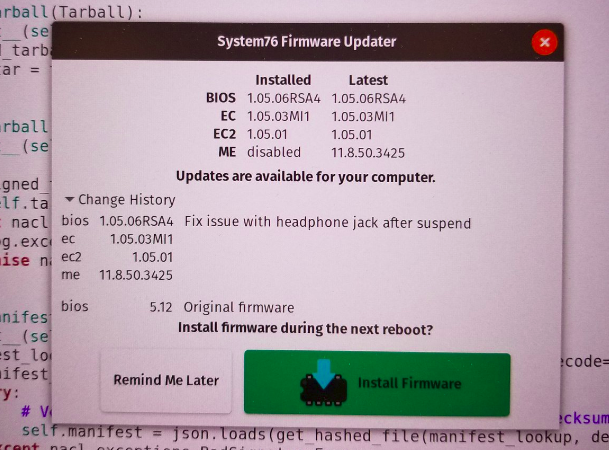
> The way forward from my point of view would be for System76 to spend a few hours making UpdateCapsule work correctly, another few days to build an EFI binary with the EC update, and a few more hours to write the metadata for the LVFS. I don’t require an apology, and would happily create them a OEM account on the LVFS.
That is not how large organizations work. And if you're trying to build something to get large vendors on board, this demand for apology nonsense is not going to help you.
PS. Don't own a S76 system, don't work for them.
Wikipedia indicates they employ 21 people. That could be off by an order of magnitude and it still wouldn't qualify as a "large organization."
"System76 is also focusing on several other time-intensive efforts (like building a US-based manufacturing plant, designing in-house products, and building a well-received GNOME-based OS for both System76 customers and any interested users)"
Like shit if they are designing and building a manufacturing plant with 21 people in house whilst also maintaining normal business selling and maintaining hardware... My hat goes off to them...for either being amazing or being so crazy stupid to think they could pull it off!
Designing in-house products is what they already do, and have done prior to Pop! so this shouldn't take user level app developer time that could be spent on better support for their users.
Building yet another distro is a waste of time and effort and only undermines goodwill with their users (I bought a Galago Pro to run Arch, and Pop came out 6 months after I received it -- I don't want yet another vendor controlled os). When Pop came out, they retargeted efforts around supporting only that system, leaving user choice by the wayside. The end result is that it burned me in the form of a missed firmware update that killed my battery, and customer support responses that boiled down to "run Pop!".
It's one thing to want to do something crazy -- it's quite another to hurt your customers in the process.
He is specifically not demanding an apology, and is explicitly saying he is happy to continue to work with them.
But at least he's willing to work with them.
> I don’t actually mind if System76 doesn’t use fwupd and the LVFS, I just don’t want people to buy new hardware and be disappointed.
As someone uninvolved who occasionally looks at linux laptops, this is really useful information for me. One of the (apparently) core developers of (apparently) a tool that allows cross hardware compatibility for linux is saying "this laptop does not adequately support arbitrary versions of linux, and they don't have a compelling technical reason why".
It is the kind of crap one would expect from a project spawned of the Gnome camp...
> I don’t require an apology
Get turned into:
> [...] this demand for apology nonsense [...]
Richard basically says "you don't need to apologize, just implement LVFS". This implies that the wrong which necessitated an apology was not shipping LVFS which is not the case. The only apology they might owe him is for not notifying him of the reason why they chose not to ship LVFS after spending time with him investigating using it.
This situation is like spending the day with a car salesman and then leaving without buying a car when the salesman takes a potty break. Then the car salesman runs a TV commercial that says "<you> wasted my time. I don't need an apology though, just buy one of my cars."
Ended up buying a Macbook Pro.
I did use a gazelle at one of my jobs, and had fewer issues with that. In general though, I'd be extremely chary of buying system76 in the future. They're basically just rebranding generic Clevo laptops with very little value added imho. If I absolutely needed a Linux laptop I'd preferring dual-booting a Mac using rEFIt, buying a Dell XPS, or virtualizing.
I would say that I am very satisfied with S76. The 2 times I have had to contact them during the last 16 months or so have been good experiences, as well.
I've had 1 or 2 minor help request issues and they've always come through promptly.
Got mine since 2010 or 2011. It's my only machine, is used daily and regularly, and works without issues.
That touchpad though; it does acquire sentience sometimes :) [I don't care, tbh; it's something I can easily tolerate from a small retailer doing Linux-only work, versus e.g. Dell, HP, Lenovo, etc.]
Fun fact: my precision 3800 trackpad works way better on Fedora 27 than on windows 10. However, that is no match at all compared to a macbook pro.
First, all the Linux installers I tried couldn't see the SSD, like, at all. I had to disable RAID support in the BIOS (I still don't understand WTF is RAID doing there provided there's only one disk). Then, no matter how I tried, it just refused to boot from UEFI. Then, when I enabled legacy boot in the BIOS and finally managed to make it boot into the system, it hung up when switching to graphics mode, screaming that "watchdog detected a hard/soft lockup on CPU". When I finally managed to have X running, it's apparently running on the CPU, and xdriinfo says there's no direct rendering support. It took me nearly 2 days to get kind-of-but-not-really usable system. I still can't adjust screen brightness (other than in BIOS...)
The last time I had this much trouble with installing Linux was back in the nineties. But hey, the HiDPI display is indeed beautiful.
I just moved from my x230 (FHD mod, coreboot, and x220 keyboard) and the only thing I miss is the trackpoint so far.
Asking out of actual curiosity. I'm not familiar with puri.sm
Not affiliated with system76 but I do own one of their laptops.
Thought it was worth it because I was supporting a Linux-friendly company.
The laptop had constant fan noise issues and the touchpad stopped working after a year.
Now I use a fanless desktop mini pc that I found on AliExpress that has Ubuntu pre-installed. Life is much better now.
That's.... not how this should be handled. Unsure this person's position, but if they're high enough to matter, that's not the position they should be taking here, regardless of their feelings on the matter.
They also didn't address the technical parts of the article besides saying "it will probably work though we haven't tested it". They didn't discuss the reason for the degradation of communication, nor the particulars of the decisions made, or even acknowledge the scenario the article outlined, instead talking about the author negatively.
I didn't like the attitude in the original post, and I can understand why there is a little spice in System76's reply. Recommending a competing laptop brand over an issue as trivial as an alternative BIOS update mechanism that doesn't match Microsoft's compliance requirements seems like seriously sour grapes.
It seems they expect System76 to invent an in-house firmware update system that does not use the official mechanism supplied by their chipset's support package, and somehow this is automatically a better outcome than what existed already.
Maintainer should be reminded that toiling for free (presumably) on an important subsystem grants no special rights or entitlements, and lashing out at a vendor because they didn't toe an ideal line looks very immature
edit: sadly maintainer isn't even working for free, they're a Red Hat employee
It sounds like the folks at System76 have a limited amount of resources available and this is not an immediate priority for them. That's understandable considering the last 6 months have been a security shit show. I mean sure why not overhaul your firmware delivery system on top of everything else?
It also sounds like Richard is butt hurt that they didn't notify him of their priorities. And so he passive aggressively wrote a public blog post trivializing the amount of effort it was going to take to switch and then advised people not to purchase their products. That's kind of petty.
I find it really insulting when someone tells me how long it will take me to do something without knowing what constraints I'm forced to work under, so the "just a few hours" remarks annoyed me.
The fact that they ship replacement parts at all puts them above most OEM's who don't believe you have the right to repair your own machine.
Why would I want to repair a computer in warranty if I could instead spend time with my friends?
If not in warranty, I of course would appreciate manuals' and spare parts' availability.
But those are two very different kind of situations.
"At any point in time, we are more than happy to bring a computer in and do the repair work."
No one has to do the repair work if they don't want to!
I disagree. I buy from, for example, ThinkPenguin, precisely because they've vetted the systems and I'm confident they will "just work" if I do a fresh reinstall.
I find it hard to imagine a situation where a s76 laptop can do something that a Dell XPS can't.
Dell's hardware generally works quite well with Linux. Since 2014, I've bought two desktops and two laptops from Dell, and everything has worked out of the box with the Linux distributions I've tried. My employer bought a new desktop computer for me from Dell with Ubuntu installed. There's no need to pay a premium.
First, all of our computers come with lifetime technical support. Me and my team are readily accessible both via the phone and our support system, for as long as you own the product. We not only support the Ubuntu and Pop! operating systems, and all of their software components, but we also help with printers, installed software, hardware issues, network configuration, and everything that comes our way. Few competitors will teach and educate and help in the ways that we do.
Next, all of our products also support our engineering efforts in the Linux community. Many desktop bugs and issues that we discover and fix affect every Linux user. For instance, NVMe drives had been around for a few years, but it was our engineer that found the GRUB install bug that prevented automatic installation on those drives due to a regex error with handing /dev/sda vs. /dev/nvme0n1. That fix was incorporated in Debian, Red Hat, and every other version of Linux that used the GRUB bootloader. The work we put into our operating system benefits all users in many cases. Buying our products means that when we discover bugs in the operating system, we can get them addressed quickly and effectively without waiting to deliver patches.
> LVFS is neat and we'd love to use it. We also have a couple of constraints that make that difficult: licensing/legal constraints imposed on us, plus time/effort constraints due to everything else going on.
...ok, that means there's non-free software in their machines, right?
Whether the Linux customization is enough value-add is your call, but that's how all of these companies work.
Aside from System76, can anybody recommend powerful laptop fully compatible with Linux?
Of course, I can buy any laptop with several GPUs and install some Linux distribution. But I don't want to spend 4000 USD and then discover that some hardware isn't supported.
P.S. This time, I really don't understand why my comment is being downvoted.
http://www.dell.com/learn/us/en/555/campaigns/xps-linux-lapt...
I've been tracking this for some time and whenever I look the nvidia binary driver is the gold standard, intel is close, and amd's binary blob is a distant (and problematic) 3rd. So bad game reviews on linux often put a "doesn't work" in the AMD column.
From my poking around a bit, It seems the Dell xps series (it can come with linux preinstalled), many ThinkPads and some HP machines play nice with many distributions. Wifi cards can (still) be a bit of a pain point.
I don't recall where I first heard of them, but I see they're listed at https://www.gnu.org/links/non-ryf.html .
The website mentions the GNOME Software center and automatically installing everything. Does it work through the package manager (apt, etc.) similar to the proprietary driver installer in Ubuntu, or does it just automatically do its own thing?