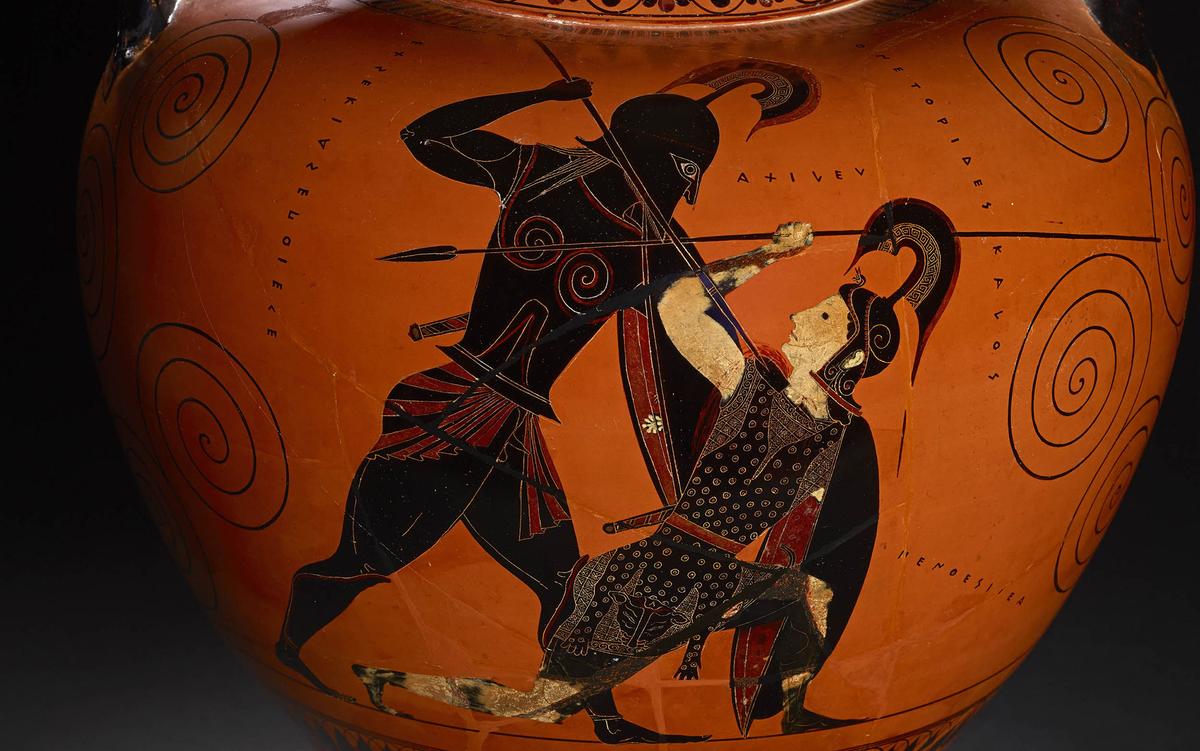
When Homer envisioned Achilles, did he see a black man? | Aeon Essays
The Greeks didn’t have modern ideas of race. Did they see themselves as white, black – or as something else altogether?
aeon.co
69 points · by diodorus · 8y ago · 93 comments
Their word to collectively describe foreigners is literally "those who speak in an indecipherable language": "barbarians", where "bar-bar" was meant to be a vocalization of a random foreign language (like we would say "blah blah").
That said, they were white in the sense that modern Greeks, southern italians, and middle easterns (Egyptians, Lebanese and so on), eastern turks, and so on, are white. And modern Greeks still are closely related to those ancients according to studies [1][2], so you could look at George Stephanopoulos (both parents Greek-American immigrants) for a quick example.
There weren't however "white" with a modern European and American conception of "whiteness" which restricts it to anglosaxon populations.
In fact when they started immigrating to the US in the late 19th, early 20th century, they were considered decidely "non-white" material, and were subject to abuse and racist attacks (including being a major target for the KKK) [3][4]. At the time, the same was true also for Italians, Bulgarians, Albanians, Jews, and so on -- even Japanese and Chinese immigrants.
Generally, "white" then was whatever fitted the WASP look and worldview. So it wasn't just about skin pigmentation.
[1] http://www.sciencemag.org/news/2017/08/greeks-really-do-have...
[2] https://www.smithsonianmag.com/smart-news/dna-analysis-sheds...
[3] https://ahepa.org/about-us.htm
[4] https://www.thenationalherald.com/171404/no-greeks-need-appl...
https://kenanmalik.wordpress.com/2013/02/17/the-making-of-th...
The idea of race is much newer than people realize.
I don't know what era is referred to as modern, but southern Europeans, some Middle Easterners, and eastern Europeans are considered white in the US today.
That wasn't the case for much of the 20th century -- and you'd be surprised even for today if you speak to them about their experiences re: racism.
I'm in one of those categories and I've experienced extremely minimal racism in the US. I think the UK has more racism against my category.
I think that "some Middle Easterners" is the most controversial category in my list. I have a hard time imagining that Bashar al-Assad would experience very much racism if he were a normal private person.
The first part is trivially true, since those concepts only make sense in an American context. They did however know about race, they were certainly aware of the racial difference between themselves and say the Egyptians or Nubians.
I think what confuses modern Americans is that many Ancient peoples (just as many peoples today) lived in ethno-states, or at least ethno-societies. Biological race was so highly correlated with language, culture and religion that there was little basis for the kind of purely biological racism that exists in America.
Thus while on the one hand they would certainly consider most foreigners inferior to themselves, some even subhuman, that wasn't based entirely on biological race, and definitely not on the modern and rather arbitrary white/black distinction.
[1] Hi Stavros!
This is often difficult to be understood in a place like the US, where everybody is from somewhere else and only came there recently-ish (even the arrival of Columbus is not much in European, Asian, etc historical terms), and thus there's not much of any collective ethnicity -- and people soon learn to shred their prior (pre-immigration) ethnic traits and norms in order to fit.
No it's not. bar bar is not directly similar to bla bla, except for the repetition. The phonetics can't be glossed over.
bleh- is a reconstructed proto-indo-european root (also bhle) meaning to swell, and if that isn't clear enough on its own consider the descendent to blow, German blasen and compare that to bubble, german Blase or to bubble, German blubbern in the sense to swall, blurb, bla blah. Surely that seems sound immitative anyway.
I don't know a root for "bar", but consider German brabbeln in the same sense, which looks to have a semitic influence. This might be sound immitatitive for all I know. Anyhow I find more interesting barde (the singer) compared to persian barde (slave), if you think of enslaved eunuch singers as a semantic link. And then consider that foreigners became enslaved often enough.
I mean, they literally cut young boys balls off, like with cattle. Because of taboo and social stigma, I think such a connection would not survive very long. But I know very little about Persian, so this is entirely speculative. The singing barde sense has an entirely different root in PIE, but beyond that, who knows? There's no timeline for PIE and internal reconstruction is, well, I'm not going to try it here. Anyhow, a semantic relation between slaves and praise, or at least a positive connotation can be observed in persian. Slavery like racism really seem to be deeply ingrained in culture.
There's also barb as in barb-wire, cognate to beard, with a different root given by scholars (celtic bardos, < PIE gwerhd), but who knows. I find the bearded, unshaven ones* as description for barbarians kind of entertaining. In the same sense, incivil ruffian in allusion to slavery I have to guess that a barbarian might well be a slaver, slave trader.
Do I need to mention "Babel" related to incomprehensible language?
Also, I cannot find a root for brat beyond Old English, but I wouldn't find a connection surprising, compared to the etymology of Ger. Mädchen (girl, compare, maid, house maid, maiden) and also perhaps boy, girl, garcon (I am not quite sure). Consider that by archaic social norms, women were treated as slaves of the patriarch, father or brother, e.g. literally sold of if money was tight, in the worst case.
So, the etymology of bar bar is inconclusive from where I am standing, but "sound immitative" is hardly ever convincing for words with a long history.
PS: to the b/w question, compare that to dark or shiny, considering some supposed etymologic theories of aryan (e.g. golden or noble), and that the Median Empire reached into the area of modern greece, or that it's not even clear where the Persians came from before they reached mesopotamia.
I didn't say that bar-bar is "blah". Just that bar-bar is a vocalization of foreigners speaking, like blah itself is a vocalization of someone speaking.
The rest of the details are not really relevant to the more specific (and less about the word barbaric or blah and their etymology and phonetics) thing that what I was saying -- which was simply that "barbari", the ancient Greek word for foreigners meant literally people speaking a different language (whether the vocalization was formed in Ancient Greece or PIE is not really relevant. It was still understood as "foreign speakers" by ancient Greek and only later took the "culturally foreign or not as developed" as a connotation).
>I don't know a root for "bar", but consider German brabbeln in the same sense, which looks to have a semitic influence. This might be sound immitatitive for all I know.
It is "sound imitating", as a vocalization.
"The term originates from the Greek: βάρβαρος (barbaros pl. βάρβαροι barbaroi), which in turn originates from the incomprehensible languages of early Anatolian nations that were heard by the Greeks as "bar..bar.." In Ancient Greece, the Greeks used the term towards those who didn't speak Greek and follow classical Greek customs" (Wikipedia)
I simply find it very unlikely that an onomatopoeia would spontaneously achieve word quality with suffixes, inflections and all that jazz. Classical Greek and Latin are preceded by a long pre history of fractured dialects and, well, disputes over territory. By the time they became somewhat standardized, a lot of meaning was ignored and conflated. I don't understand how you can find that irrelevant to the origin of a word. I do understand that you feel somewhat overrun. I didn't mean to discount the theory, just noting that it is (likely) not the full story.
By the way I found that ''to boil'' is derived from a root bher-, rather close to bhel-. Certainly boiling creates bubbles. All the while warmth is a positive term. Also, to bear'' comes from a similar root. And those d not seem to be purely PIE innovations.
Compare for example
https://en.wiktionary.org/wiki/%D8%AE%D8%B1 (Arab. "karra" - 1. ''to murmur, bubble, gurgle''; but also 2. ''to fall, sink, prostrate oneself'' ... "to fall at somebody's feet?") (Pers. "xar" - 1. ''donkey, fool''; 2. ''idiotic''; 3. ''big, great'')
https://en.wiktionary.org/wiki/%D8%AC%D8%B1 (Arab. "jarra" - ''to pull, draw, stretch, rob, cause, drive slowly, pasture freely'' and then some)
https://en.wiktionary.org/wiki/%D8%AD%D8%B1 (Arab. 1. "hurr" - ''free, unimpeded, set free, born free, noble, unmixed''; but also 2. "harr" - ''heat, burning'')
https://en.wiktionary.org/wiki/%D8%AC%DA%91 (Urdu: root, foudation, but also stupid, lifeless)
Interestingly, I found ''donkey'' and ''big, great'' are supposed to be near homophone in old Egyptian as well https://en.wiktionary.org/wiki/%EA%9C%A5%EA%9C%A3#Egyptian.
The way I heard the story of ''barbar'', Germanic Vandals called the folks on the African north coast Barbarians, also because of the language. Today still called Berbers. I am aware that Slavic languages follow a similar paradigm, Czechs call Germans "nemcie" - ''mutes''. At the same time, the origin of the word slave from Slavs is contested, so what do I know.
Nevertheless, you might know the words ''Habiru''. Consider that in context. Also, "hurr" above reminded me of "Hurrian", but that's barely a hunch.
Furthermore, most racial conceptions obsess with superficial features that may not correlate with large differences in DNA. There may be two people that look more similar but have wider differences in their DNA than two people that look different.
Yes, all words and objects and categories are only leaky abstractions. Our universe is a shimmering swirl of unique patterns, all boundaries ultimately fuzzy.
At the same time, there is observable structure. Words and categories emerge and are judged by their usefulness, how they help us in everyday life -- despite being leaky abstractions. They're never bulletproof descriptions of reality, or you wouldn't be able to say much.
"Jock" vs "nerd", "white" vs "black", "tiger" vs "rock"… Among the infinite axes of how to slice and conceptualize reality, which ones are worth giving a name to? Who decides?
What I was trying to say is that uncomfortable, leaky abstractions are absolutely standard. Is a virus alive or inanimate? Are physics and chemistry distinct disciplines? When does an embryo become a human being?
I wasn't being snarky with my "who decides?". If your actions to change established concepts and words manage to overcome the perceived utility of these concepts and words for others, people will change their vocabulary and the way they view the world. It's happened before. It is an elaborate dance of utility, so keep fighting.
It's as if the author is trying to exonerate the ancient Greeks from the pervasive ideological racism (I really wish there was a more specific word for this phenomenon than "racism" as ot is a complex result of many things) of modern European history by demonstrating that "white" and "black" races did not exist with them, or at least not in any form we would recognize.
But white + black != racism. Even if the categories came later, Aristotle did introduce the idea of the "natural slave," or the claim that certain races of people are only fit to be subjugated in forced labor to others. That's pretty much the essence of racism. The priests Christianized it, while the merchants learned the practice of transoceanic slaving from the North Africans. It's more like a pasta salad of evil with ingredients from all over the world.
Well, they didn't have "pervasive ideological racism". Even making someone a slave (which they did practice) wasn't about considering them inferior -- just considering it just spoils for them having lost a war.
And they could care less if those were black or white or whatever. They could (and did) make slaves of people in the nearby city-states as well.
Aristotle's idea of a "natural slave" wasn't really widespread as a cultural norm them. That would happen much later, especially with later Christianism, and would find it's ideological justification with colonialism and writers like Gobineau.
If one looks to Egypt, Italy, Greece and Turkey circa 3,000 years ago, or all those countries within the Mediterranean basin, there is substantial evidence that the average "racial genotype" is much like it is today. (a mixed race hybrid between shades of beige and vey dark brown.)
Visual evidence can be seen when Comparing "Miss Egypt 2006"... http://www.santabanta.com/photos/miss-universe-2006/619218.h...
...To the Egyptian wall paintings of King Tutankhamun's tomb: https://www.timesofisrael.com/secret-tut-chamber-egypt-calls...
Both representations above have straight hair, medium brown skin and awesome physiques.
It goes to show how silly these questions are. Would a Greek Byzantine frame himself as the same race as an invading Ottoman? Assuredly not. Race being purely a matter of skin color is a modern idea.
But it's good enough for government work...
"There is relatively little genetic difference between the human populations of different continents"
There is relatively little genetic difference between dog populations on different continents...
"and levels of skin pigmentation are a very poor proxy for general genetic relatedness. The distinction between ‘black’ African and ‘white’ European peoples, then, is not just unGreek: it’s also unbiological."
Completely wrong... if you're judging just between black Africans and white Europeans then it is a pretty good proxy for general genetic relatedness. It is absolutely insane to think otherwise.
Skin color is not a good proxy for genetic relatedness because it's only one of the many different traits that make up a human.
You would surely agree that two humans with different skin colors but all else equal are more closely related than two with the same skin color but nothing else in common.
And it turns out that is exactly the case. Africa has the most genetic variation since it's the origin of humans so a black African can very well be much more related to a white European than to another black African.
https://en.wikipedia.org/wiki/Human_genetic_variation
In computer science terms it would be trying to do a dimension reduction by only naively comparing the first coordinate. That would work only if skin color is the principal component of genetic diversity but it's pretty unlikely and insane to declare that a priori.
> In general, however, an average of 85% of genetic variation exists within local populations, ~7% is between local populations within the same continent, and ~8% of variation occurs between large groups living on different continents (Lewontin 1972; Jorde et al. 2000a). The recent African origin theory for humans would predict that in Africa there exists a great deal more diversity than elsewhere and that diversity should decrease the further from Africa a population is sampled.
Which is literally what the GP said.
You should put up or not make drive-by comments.
Government racial data is intended to reflect culture and has nothing to do with genetics, it's not intended to be scientific nor should it.
https://www.census.gov/quickfacts/fact/note/US/RHI425216
>The U.S. Census Bureau collects race data in accordance with guidelines provided by the U.S. Office of Management and Budget (OMB), and these data are based on self-identification. The racial categories included in the census questionnaire generally reflect a social definition of race recognized in this country and not an attempt to define race biologically, anthropologically, or genetically.
The modern view of race that categorizes other ethnicities as almost an entirely different species requires ideological flexibility which to the best of my knowledge isn't compatible with the world view and beliefs of most ancient people.
I am no history buff though, I would be interested in hearing a contradictory point of view.
It is fascinating to see the dynamism of race in India. The early British (pre 1800s) didn’t seem to hold racist views of the natives, in fact many of them had Indian wives and children, and adopted Indian clothes and culture. Some even converted to Islam, many were fluent in Persian, the language of elites at the time. But that begins to change markedly when British supremacy is assured in secured in the 1800s after many successful wars.
The whole "colonialism is to blame" is a new argument, to me, though. I do hear a lot more of these, "the past was a utopia, and modernity has screwed things up" statements of late and I can't figure out how..... maybe that wasn't your intention and I totally misread your statement. I apologize if that's the case.
The Romans were quite liberal, once you have let yourself be conquered by them. As long as you recognized the state and paid your taxes, you were free to do what you wanted.
There are very few recorded persecutions of religion cults in non-christian Roman times because of this. Christians, Jews, druids and the followers of Bacchus, they all were considered a threat to the state and that's the reason they were persecuted, not because of some form of racism.
For them everybody else, with the exception of the Egyptians, where uncouth brutes or at best upstarts, but this was more of a cultural thing than a racial.
"The modern view of race that categorizes other ethnicities as almost an entirely different species"
On the contrary, people have never been less prone to dehumanise others than now. In the Ancient world every civilisation relied heavily on slaves, which definitely where considered less than human. Today it's hard even among hard core Nazis to find someone claiming that other races are non-human. Inferior perhaps, but still human.
Exactly. The theory was developed to justify the prejudice and subordination, not the other way round. The idea of viewing Europe as a single ethnicity labelled "white" is extremely modern-American too.
I just really liked it.
The first mentions I know of people based on their race in when talking about "the negroe", but it is still implied as being people from Sub Sahaaran Africa, but by virtue of ignorance about individual tribes/regions, a common name was used. I remember a famous criticism to the constitution created after the French revolution that talked about "the rights of men"; instead of the rights of the French, the Englishman, the Turk; which were seen as completely different groups of people given the time and difficulty of travel.
Plus, I dislike the confusion between slavery and racism. People used to take what they wanted by force, and when allowed, they'd take human beings. I doubt it was because they hated other people, instead it was because they were allowed to subjugate other people; motivated by financial/power motives. Enslavement was a common practise until the ideals of humanism won over the super powers of the time; humanism won over human greed.
This describes modern racism too.
One obvious counterexample is that Alexander the Great's empire reached northwest India. The idea that Greek society would be so isolated from the world – not coming into contact with travelers or traders or captives from beyond the Mediterranean – seems ridiculous to me.
Speculation isn't worth much. Your intuition is clearly that someone wouldn't define themselves along those lines, but intuitions are often wrong. And it's not obviously and unequivocally true that the overwhelming majority of Greeks would never see someone distinctly foreign looking.
Given, this is early 1st century AD Jerusalem, not Greece, but classical Athens was no less cosmopolitan, and the gymnosophists were well attested in Alexander the Great's time.
They also probably knew more about the world than the average American today. Greece was a bustling center of trade and the Greek peoples had numerous colonies. Not to mention, as someone did, Alexander the Great that conquered basically the entire Ancient world.
They knew about the existence of other races, sure. My point is there was nowhere near enough contact or integration with them for the Greeks to begin defining themselves in relation to them.
http://www.raceandhistory.com/historicalviews/rome.htm
>Interestingly, at least ten Africans became Emperors of Rome. They are listed on the historical record as the following: Macrinu, Firmus, Emilianus, Septimius Serverus, Pescennius Niger, Aquilus Niger, Brutidius Niger, Q. Caecilus Niger, Novius Niger, and Trebius Niger who was a proconsul in Spain.
Racism of the white vs. black kind came out much, much later.
Referring to blackness had nothing to do with race, they're talking about people that went outside and worked. That's why the women were "white". Think antebellum south, holding an umbrella.
Even in my own family when someone would come in from working outside in a garden with a tan, my grandma would say their skin was black. It just means tan or darker.
The younger generations born in the last 25 years didn't even experience this world when people commonly left the laptop or phone and still went outside and worked. It's not surprising as a result that we're seeing such gross misinterpretations pop up.