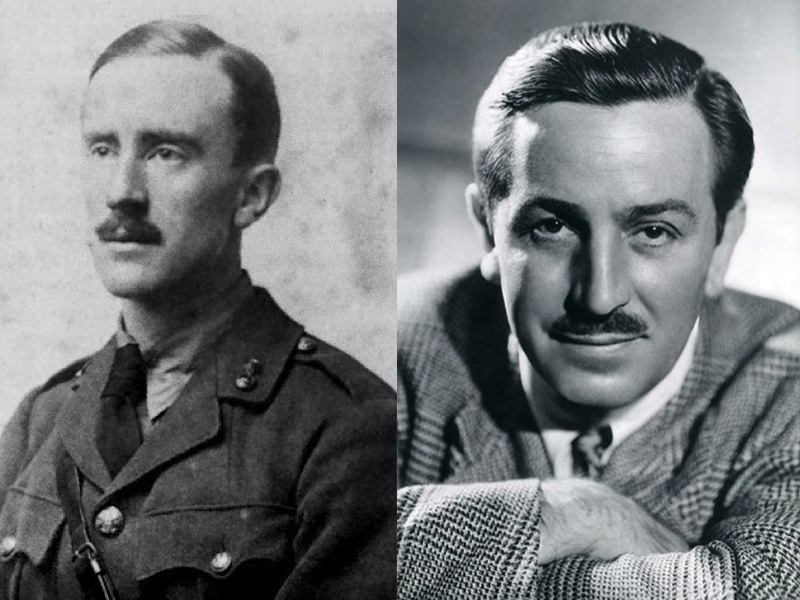
J.R.R. Tolkien Expressed a “Heartfelt Loathing” for Walt Disney and Refused to Let Disney Studios Adapt His Work
Image via Wikimedia Commons I’ve just started reading J.R.R. Tolkien’s The Hobbit to my daughter.
Open Culture
195 points · by jedwhite · 8y ago · 168 comments
[1] https://www.goodreads.com/quotes/411971-i-cordially-dislike-...
I don't know, but I can think of an analogy: If angels were commonly depicted as cheerful and a bit silly characters in cartoons, perhaps religious people would have the same complaint.
By the way movies do get angels wrong, they are described in the Bible as having 6 wings for example. No Christians that I know are angry about that.
From what I can surmise the elves represent preindustrial humans. The Maiar are elemental forces (fire, water, etc). Not sure what the Valar are exactly, lesser gods of mythology I guess.
Within that landscape play out all manner of basic lessons, the importance of different crafts, the danger of vengeance, etc.
I guess “bippity boppity boo” and the patron saint of class mobility didn’t do it for Tolkien.
Also, Valar and Maiar are greater and lesser Ainur, primordial spirits. Angels might be the closest thing, not elemental forces.
Well, tbh, if you've seen Dwarf Fortress or read Terry Prattchett, then one of the first things that comes to mind is work ethic and moral. The ethic is highly puritan and greedy, the moral is upright but loose. I'd say that's somewhat faithfully represented, except that the sense of a wider community is missing, they don't live in a mountain and of course Disney didn't do war machines jugging liters of bear and hoarding gold for the sake of it. One might argue those features were exaggerated in folk lore to begin with.
Wikipedia should have some more [1], but I can't get past the Etymology section. An ancient mythology about short spirits not withstanding, it's rather obvious that German Zwerg was related to work, Werk, PIE wérǵ- [2]. Now if I look at the indo-arian cognates, I can't deny that those look similar to warrior, related to PIE wers-[3]. That leaves the initial d unexplained. My best guess is that's pejorative, because we- as in very, venerable etc. is too positive, but which short root the d came from I wouldn't know. I guess so far that's nothing new and where previous attempts called it quits.
By the way, guess the Zerg from Starcraft are an analogy to Zwerg, and then some. kekeke
[1] https://en.wikipedia.org/wiki/Dwarf_(mythology)
[2] https://en.wiktionary.org/wiki/Reconstruction:Proto-Indo-Eur...
No, it is not obvious. In fact, that is not a mainstream etymology at all. Nor is positing the initial dental as a “pejorative” prefix, something any recognized scholar of comparative Indo-European linguistics would do. Furthermore, your connection of ‘dwarf’ and the PIE ‘work’ root to ‘warrior’ is, frankly, crackpot.
Is it? A quick glance at the Wiktionary reference and the etymology section in the Dwerg-article on the German Wikipedia doesn't yield any concrete evidence to support that statement.
'Rather obvious' seems overly optimistic — I would go with 'dubious' at best. For all we know some travelling story teller made the word up on the spot because it had the right dwarfish feel.
Tolkien and Lewis were part of a cohort that really enjoyed a form of pagan Germanish/norse Romanticism. Novalis was a big influence, and Lewis was quite open about his love for the Eddas. Both of them also were devout Christians, and I feel this response is more of them attempting to baptize the things that they love in a Christian sense. Christian philosophy tends to find in many things God working in them to bring people to awareness of Him, and ultimately to a saving reconciliation through Christ. But that tends to impute characteristics that go beyond the actual intents of the works as written, sort of a metatextual thing which can be valid in a sense (lewis's love of romanticism probably did awaken him to Christianity) but otherwise isn't, since each person would approach the work differently.
As for barbaric, ugh. Tolkien bowdlerized the old myths as much as anyone, with his happy little Hobbitses enjoying their baccy and his noble, stately ageless elves. In the old myths elves stole babies, made milk curdle, inflicted sickness through elf-shot, and much more.
Tolkien to be blunt is a huge snob. He loves his happy little common people so long as they are the right type, little red-nosed burghers who live on their green farms and enjoy good pipeweed. If they are the wrong type, if they happen to work in factories instead, well there are your orcs and goblins. It's no coincidence the Trolls in the hobbit speak cockney. he dislikes Disney because Disney is vulgar in the old sense, low culture, but seems to forget that a belief in elves or fairies was pure low culture, until romanticism made the elites interested in it. Chesterton says you need to be a common bumpkin (like himself) to really deal with them.
A few years later the Disney version came out, and the production value was incredible while the story and all meaning was just lost.
And the messages Disney sends to young girls, in particular, are horrible.
https://www.theguardian.com/film/2013/may/16/disney-princess...
It seems to me that if a hyper-sexualized/glamorous Princess Collection will make 2% more profit for Disney then that's what's going to happen regardless of how many young girls feel inadequate about their looks and end up with eating disorders.
And yeah, sure, they'll kowtow for a while when there's a backlash, and maybe you'll get a plot like in Frozen about sisters who are supportive of each other. But that lags the culture by like 10-15 years and only happens when there's profit in bucking the damsel-in-distress princess tropes that Disney itself is mostly responsible for.
Maybe once they could be ahead of the game instead of patting themselves on the back for finally reversing long-standing trends of their own creation. Wouldn't it be nice to have a back catalog you could be proud of, rather than have to apologize for?
(edit: based on another of your comments you seem to be fully aware that there is great non-sexist non-objectifying anime out there, so your "almost any" comment is confusing. I don't know much about anime, but I've been watching some of the highest-recommended and rated films and they've all been great about this in my opinion.)
The story has some pretty strong religious themes, where her love for the prince is coupled with a longing for an eternal soul (which mer-people does not have). If she can make the prince love her, she will receive an eternal soul. In the end this does not happen and she kills herself, but the angels nevertheless grant her an eternal soul due to her selfless love.
The story is incredibly sad, and I find it strange when people blame Disney for bowdlerizing it. A faithful retelling would have been unwatchable and probably incomprehensible for a modern American audience.
But first she has to spend 300 years in 'purgatory'. Also don't forget the closing paragraph where we learn that every time a child misbehaves the angels add 1 day to her stay in purgatory and every day the child is a 'good' child and obeys her parents a day is removed. So unless you want the Little Mermaid to never get into heaven you better be a well behaved and happy child.
Is this really true? It sounds to me a bit like the reasoning that has caused Hollywood movies to very obviously try to pander to the lowest common denominator (i.e. movies as entertainment as opposed to artistic creation, explosions and car chases rather than storytelling etc).
I think of this as a self-fullfilling prophecy: if movies are advertised as crude entertainment, most people will go watch them expecting crude entertainment and will be disappointed if they get anything else. Which forces the studios to keep pushing out crude entertainment.
Apologies if I misunderstand your comment.
(note: I'm European.)
What did you think of the Danny Kaye movie about Hans Christian Andersen?
https://www.atlasobscura.com/articles/tolkien-cs-lewis-disne...
Isn't that always the way?
I agree with the rest of that sentence, but this really isn't true. Disney's bowdlerized versions actually do harm and even displace the source material in public consciousness.
https://www.amazon.com/Complete-Grimms-Fairy-Tales/dp/039470...
Spoiler & trigger alert - the princess discovers the true nature of the Frog Prince not with a kiss, but by flinging him against a wall. Many of the other stories are equally blunt, forceful, or realistic for the times they came from.
Of note is the modern excision of the last phrase from the closing formula: "And they all lived happily ever after until they died."
For example, in the Grimm Brothers version the stepsisters cut off toes and heels to fit into Cinderella's shoes and ride to visit the prince with blood dripping down on the ground. Later they were blinded. The already old version I read while growing up in the US in the late 1960s left that part out.
More interestingly, the Grimm Brothers themselves altered many of their own stories substantially in the 7 or so full editions of Grimms' Fairy Tales they published before 1857. Some of the originals were pretty crude.
That he "displaced source material in public consciousness" is hardly a critique, in that case I guess we should stop making new music and literature as popular newcomers tend to displace what's previously popular in the public consciousness.
You could easily level the same criticism against Grimm.
What about the next Walt Disney?
About as far from "without doing any real damage" as it's possible to get.
Those Coca-Cola ads really didn't change the popular idea of Santa Claus. Here's a good explanation: “Did Coca-Cola Invent the Modern Image of Santa Claus?”
Coca Cola's interpretation of the tradition is as valid as anyone else's.
Obviously he should have. Disney's work is at least as objectively important to an understanding of modern western society as Tolkien's or Lewis's is.
Still, if your life's love labor was to have crafted a history and arc detailing in great precision the tales of the seven houses of the children of Aulë, "Hi Ho!" might have been a bit much to take.
Also the whole thing about copyright, the famous "eternity + 1 day", so there's that.
That wasn't Disney, it was Jack Valenti, and it was less one day, as to "comply" with the restriction in the Constitution that the term must be limited.
I watched Song of the South recently. And I have to say that aside from some racial stereotypes, that were not necessarily negative stereotypes, the movie seemed like an earnest effort to portray the black character (Uncle Remus) in a very positive light.
The movie did receive condemnation from the NAACP and others. But much of that was based on the erroneous assumption that the movie took place in the antebellum south and thus assumed Uncle Remus was a slave that was just cheerful and happy.
The movie does not explicitly identify the time period but the clothing and Disney themselves make it clear that it is post-civil war.
The only real controversy was that of a movie that portrayed rosy racial relations and some cliches in a time when racism was rampant and racial relations were poor.
But to me there are two schools of thought in regards to Hollywood portrayals like Song of the South. Some think you should tell only the truth and show how awful everything is so people will hopefully change. And others think you should show an idealic fiction that shows how things should be. I tend to think the latter is more effective.
(I fear the upcoming Amazon Middle-Earth series will be a GoT-style abomination that tries to fit Tolkien into something it simply isn't.)
Tolkien did not think fairy tales were children's stories, and Disney treated them as if they were.
http://brainstorm-services.com/wcu-2004/fairystories-tolkien...
If you wanted to, you could read it as a fantasy of a pre-industrialized country getting threatened by industrialization but rejecting it and continuing in their old ways (allegory, ha!).
So personally, I'd say the Shire plot has a happy ending in the book. I'd see Frodo's fate and the general decline of the world as a bittersweet ending, but those elements have been kept in the movies relatively unchanged.
I don't think Tolkien would have liked the movies, but then again, he is dead.
Then they should clearly say this is not based on the books right from the start. The first movie was still somewhat acceptable as a book adaption, but the second and third go so far away from the actual characters and events it should be called something else.
Personally, I can't get over the fact they cut out Tom Bombadil. This was discussed before on HN and someone said Jackson had a good reason to do that, but it just rips the heart out of the whole thing. It's exactly what Tolkien was complaining about: here is a good old fairy story that has been "adapted" for the large screen by taking out everything that makes it a fairy story- the whimsical, otherworldly magic of the fair folk. What we're left with is epic battles, action ballet (I'm thinking of that scene where Legolas kills the oliphant) and just generally fantasy porn. Great sets and costumes, but there's nobody in there.
I can't fathom what went so wrong afterwards.
I enjoy Tolkien over Disney any day because I don't even view them in the same league.
Disney took ancient mythology and did with it what could be compared to the simplified version of Hawkings book "A Briefer History of Time".
In the case of dwarves I feel that it doesn't change anything if you bastardize something that is already based on mythology.
If anything this to me new revelation about Tolkien is a negative rather than a positive. Not that I care enough to make it that but I just don't think they should have had such strong opinions on Disney's work when they were themselves fully capable of creating amazing works of fiction.
This truly does seem like Oxford dons thumbing their noses at an American.
Either way, that’s not the same as loathing. It’s more dismissive and pitying. Loathing suggests at least a strong dislike of the person.
Norse:
- The Poetic Edda
- Prose Edda
- Beowulf
- Volsung Saga
Middle English:
- Pearle, (The concept of The Ring being "My Precious")
Welsh:
- Culhwch and Olwen, inspired Beren and Luthien (Silmarillion)
- Red Book of Herghest (Welsh Vellum) directly inspired Red Book of Westmarch
Finnish:
- Kalevala (Story of Kullervo) inspired Children of Hurin (Silmarillion)
German:
- Nibelungen and later work Der Ring Des Nibelung, inspired The One Ring and the myth of Broken Sword reforged.
Norse:
- The names of Gandalf and the 12 dwarves are directly taken from Prose and Poetic Edda
- High Elves / Gray Elves are inspired by Norse Calaquendi / Moriquendi
- Balrog and the Bridge of Khazad-Dum are direct allegory to norse fire giant Surtur and the Birfrost (recently depicted in Thor: Ragnarok)
Celtic:
- The Elves of Middle Earth (exiles) are based on Celtic fae gods, the Tuatha-de-Danan
References:
- https://en.wikipedia.org/wiki/J._R._R._Tolkien%27s_influence...
+100 I've said this before, but I've not heard anyone else say it. That is an important life-skill.
I really love fine craft beer. But can still sit down happily in a cheap pub and drink a jug of Victoria Bitter. It helps greatly to have entirely distinct mental categories in such cases.
VB, Carlton, Budweiser, or any other mass market lager isn't bad beer. It's not good beer, there's nothing remarkable about the stuff, but it's not like it's vinegar or has massive technical flaws. The quality control and consistency of mass market lagers is something that many craft breweries and brewpubs could only dream of.
There's plenty of craft beer that I've drunk that's distinctly different from batch to batch, their consistency is all over the show. But I know that if I get a stubby of VB, it's going to taste exactly like VB.
These people were true artists and pioneers: https://www.youtube.com/watch?v=MYEmL0d0lZE
It's perfectly reasonable to appreciate Disney & Co's contribution to animation and visual story-telling without respecting the underlying stories.
[0] https://audioboom.com/posts/4420047-the-fellowship-the-liter...
I've started talking to trees since discovering this.
[chef's kiss]