Why We Disagree with The New York Times
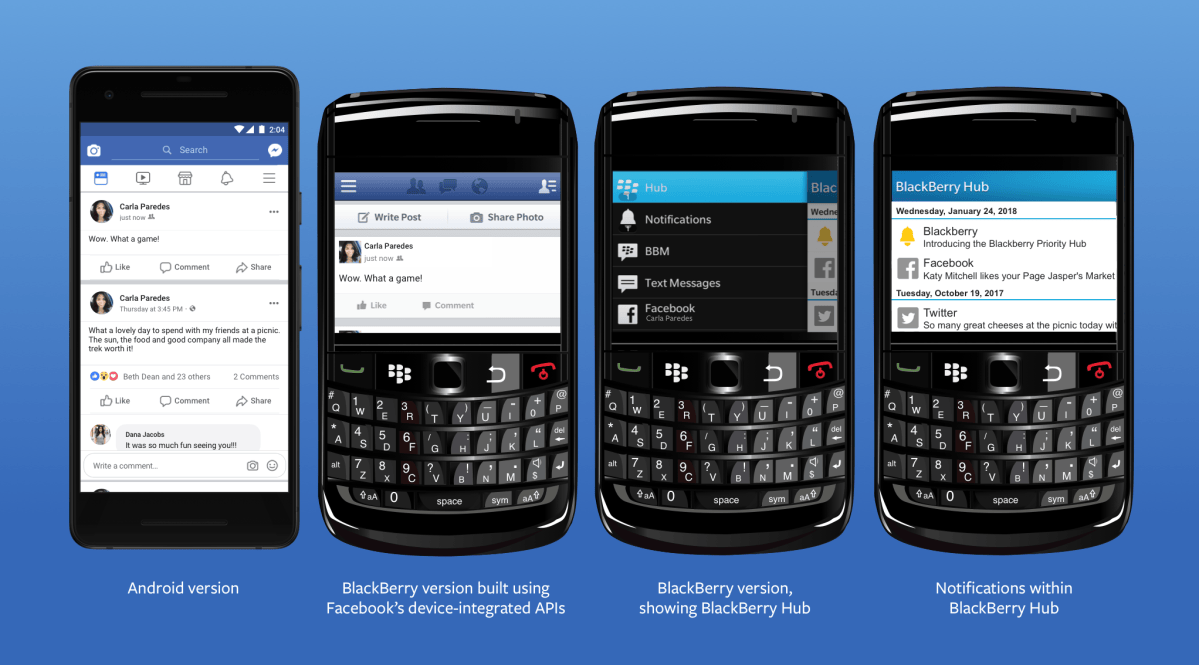
In the early days of mobile, we built a set of APIs that enabled other companies to recreate the Facebook experience. This is very different from the public APIs used by third-party developers.
Meta Newsroom
346 points · by sqdbps · 8y ago · 304 comments
- Obviously in order to integrate FB functionality into a Mobile OS UI requires an API to render the data being displayed.
- If your phone has a home screen widget which shows friend data, obviously that friend data came from a Facebook API call.
- If you type your Facebook username and password into a settings dialog in order to enable that home screen widget to function, that’s pretty obviously consenting to enable the functionality.
- There once was a day when we demanded our social media platforms to provide these “open access” APIs to specifically allow for accessing our own social feeds on our own devices.
We trust our user agents to render our private information on our devices. Sometimes we even trust our user agents to leverage network services to improve the on-device performance (i.e. Amazon Silk)
If and when user agents exfiltrate our personal data off device for data mining purposes (i.e. Chrome Omnibar) it should be disclosed and opt-in.
It sounds like Facebook provided an API to device manufacturers to allow them to deeply integrate social features on device. This has historically been considered a Good Thing. It sounds like they put together a legal agreement that required these device manufacturers to take due care in implementing these features to protect user data. Also seems like historically this is what we would call a Good Thing.
When you enter your username and password in order to view your Facebook feed — that’s called a “user agent” and that’s something appreciably different than a third party quiz app sucking in friend feed data.
However, Chrome Omnibar aside, user agents are not expected to exfiltrate data in any way, and if that occurred, that would indeed be a story I’d like to read, and my ire in that case most certainly wouldn’t be directed against Facebook.
If the device makers applications merely fetched data on behalf of users and displayed it on their machine it would be no more of a problem than my email client.
In the first place it looks the apis provided access to data the users had opted not to share in the second place the times article seems to state that partners partook of that data themselves rather than merely acting as a client example
"Facebook acknowledged that some partners did store users’ data — including friends’ data — on their own servers. A Facebook official said that regardless of where the data was kept, it was governed by strict agreements between the companies."
Before deciding if facebook's response was reasonable did you even bother reading the times article?
This statement from the article is meaningless, as many legit things might mean "third party storing data" as: 1.) Storing and editing contact imports, if user wants. This is technically friends data, but it's my contact list. 2.) Proxy-ing and caching: we are talking about shitty phones mostly before android and ios were mainstream, so "store on their servers" could be as simple as an artefact of implementation of non-html facebook client app on that shitty phone. Example of such artefacts: custom notifications channels, caching, downscaling of images. I think that blackberry did proxy all of their communications through their servers (not 100% sure), so if Facebook was available, they probably also had to store something on their servers.
The journalist didn't even attempted to distinguish between "my device is calling this api" and "company is doing requests" and resort to conflating those two and ambiguous "some partners did store users". This is example of journalist trying to create a story instead of getting to truth. If they would dig deeper, and try to figure out which companies stored data, what type of data (was it contact import, caching, or did they download full graph?), and what was purpose, it would be valuable article.
It's hard to see any way in which making users choose between sharing their info with every dodgy quiz their friends use and forcing their friends to install the Facebook app and let it get its tendrils into their devices in order to interact with them would've been good for privacy, but this is exactly what the NYT is insisting Facebook should've done.
I think we're trying to make this different in hindsight, but APIs for this sort of thing are the replacement for "please give my app your Facebook password". I hope everyone remembers how Facebook used to ask users for their GMail password and how Mint (still) asks users for their banking passwords.
And if what you are doing is "giving an app access to my account", then letting them see everything you see is a pretty natural API.
I think over time we have realised that users want more fine-grained permissions so they don't have to make such difficult decisions of whether they "trust" an app, but I know that as a developer and user I get pretty annoyed when other software cannot interact with an app for me because the API is too limiting.
This type of thing in journalism really concerns me with the recent moral panic against 'fake news' and the attempts to create systems which define it. When what is 'true' or factual or not is so often subtle and easily spun/twisted. Which is ironic in this context because Facebook and NYTimes are both leading players championing these efforts.
In defense of Mint, most banks are severely behind the curve when it comes to authentication, and there would be no way to provide that service otherwise.
Where the financial institution has a better API, Mint happily supports it. (Interactive Brokers, IIRC, is an example of this.)
And we still demand them for other types of apps.
If I have a Mac or iPhone, I can connect the Apple-supplied Mail app to Gmail with IMAP or POP or whatever it uses. If I have Windows with Outlook, I can connect it to whatever mail server too. And this software gets access to all the content of my emails, which is private data.
Likewise, on a smartphone, I can install a third-party app to access Hacker News or Reddit. Because both of them have an open API. (In fact, for a long time there wasn't an official Reddit mobile app, and they encouraged you to go third party.)
Because that's where the ground of your argument sits: because of server-side "rendering" the data must be sent to the servers of the software author, in this case Huawei but doubtless many others, instead of to the device that actually displays the information.
... and that's exactly why everybody's doing cloud based software. Because it allows them to abuse this. And once they've got the customer by the ... they ask money for that.
Cloud based software is how the author of a todo-list app can hold users' data hostage more effectively, more detrimetentally to the customer than Microsoft's monopoly that was blown up in the cause of justice.
The NY Times article makes it sound like Microsoft was allowed access to my data. They were not. They were allowed to create an app that had access to an API so I could access my data from the Windows Phone device.
I don't know if that happened or not, but the way this article reads is very misleading and several of the vendors that they listed did not actually have access to the data.
I personally setup FB to do contact syncing with my Google contacts so I could get the FB profile pictures for all of my contacts. Does that count as Google improperly using FB user data? I don't think so.
If NYT are correct then we can kiss goodbye to APIs that are used by any services that are not explicitly written and signed by the service provider. In the extreme that means you won't be able to log in to facebook on the web, only via a facebook app, because there's no guarantee that a 3rd party web browser isn't stealing data. That goes for any and every service dealing with personal data, and we pretty much lose the open web.
I want to protect user's data as much as anyone, but if a user deliberately installs a 3rd party app and enters their credentials into it, then they are consenting to that having access to their data under that app's privacy policy/terms. This should be obvious to all users, especially where GDPR advice has been implemented.
Taking that even further, if you really want to avoid the need to trust anyone, you'd need to run an operating system created by Facebook running on hardware created by Facebook. Otherwise, the OS and hardware vendors of course have access to your personal data. I guess it's all a spectrum, and certain hardware/software vendors you just need to trust (or at least assign blame to them, not Facebook, if they maliciously steal your data).
Some might argue that centralized walled-gardens like Facebook are actually a risk to "the open web," rather than contributors by allowing access to some data via an API.
See how that's a bit different? One of them is offering public information (say, stock quotes), publicly. One of them is offering private information (my sexual orientation and date of birth) to tons of third parties I didn't consent to having that information shared with.
I don't see how the situation is actually different now: if you run the official Facebook app on your Galaxh phone then Samsung could scrape and exfiltrate the data anytime it wants. It is Samsung's fault if they do it not Facebook's.
> Facebook’s view that the device makers are not outsiders lets the partners go even further, The Times found: They can obtain data about a user’s Facebook friends, even those who have denied Facebook permission to share information with any third parties.
[1] https://www.nytimes.com/interactive/2018/06/03/technology/fa...
Facebook officially blessed other platforms, allowed them to say you were signing into Facebook, and then allowed those platforms to have access not only to your data, but your friends exhaustive data. Facebook was aware of this, explicitly allowed this, and their only safeguard was vaguely worded policies with their partners.
Even if the partners haven't stolen any data or broken their policies, Facebook intentionally and knowingly gave my data to a third party without my consent. Presumably now all 66 of these device partners have my full data, and I did not sign in on their device or otherwise authorize it.
I friended my cousin because she is my cousin. I didn't think about what kind of device she uses. I certainly didn't intend for her to hand my personal information over to a company that I don't know.
The problem is in offering an API that makes abuse trivially simple and putting all of your faith in the "click agree" model of expecting developers to (a) understand and (b) actually comply with your policy. Particularly when many of the developers in question are non-native English speakers, or even if they are native speakers and don't bother to read the policy carefully.
These apps are just alternative Facebook clients. Don't we _want_ a system where you can use different clients to access your own data?
If the problem is not trusting the client, well, that'll be a problem for any such system, even some utopian fully open, distributed and federated social network - until you build an open source client yourself.
One thing is allowing the official FB client to see those data (FB has those data anyway), another thing is to let third parties see them and possibly store them on their servers and not only on our devices.
This is different from email and email clients. First, the expectations are different: if I send you an email I expect that you can forward it to your friends or anybody else unless I explicitly ask you not to. Second, local clients don't send mail to their authors, same for address books. Third, we know that Google and others can see most of our mails anyway, because most people use only webmail and messages are stored on the servers of those companies.
Finally, FB didn't tell us about this API and what it can do. It's this secrecy that's hurting them IMHO. Sure, I concede that they couldn't foresee the current climate around their company when they made the choice not to advertise it, or we wouldn't be in this situation now. But we're here also because of chain of bad choices from their side.
My suggestion for a social network of the future is to have a single API, used also by the official client. The servers must not trust any client, which is the usual thing we do in web development, and give all them the same level of access. It's up to the user to decide if they want to use the official client or one of any third party.
> The Blackberry used by the Times got data about the friends of the journalist even if those friends didn't consent to that.
They did consent to that - by becoming your friends! Are you saying that every time you open your friends' Facebook pages, a notification should be sent to those friends requiring consent?
I think perhaps you meant something else - the Blackberry got data about the friends even though the user did not consent to that:
> The Hub also requested — and received — data that Facebook’s policy appears to prohibit. Since 2015, Facebook has said that apps can request only the names of friends using the same app. But the BlackBerry app had access to all of the reporter’s Facebook friends and, for most of them, returned information such as user ID, birthday, work and education history and whether they were currently online.
This is also questionable. Would you say that Chrome requests and receives prohibited data, when you use it to browse your friends list? We are talking about the distinction between client(full access) and third-party app(limited access). The cases described in the NYT article seem to be clients.
Further on your point:
> This is different from email and email clients. First, the expectations are different: if I send you an email I expect that you can forward it to your friends or anybody else unless I explicitly ask you not to.
You seem to be making an argument against your claim here. The parallel would be, if I accept your friend request, I expect that you can see my data and use it(i.e. by browsing your friends list on the Facebook site, or the Blackberry client).
> Second, local clients don't send mail to their authors, same for address books.
Perhaps, but doesn't that hinge on the definition of "local clients"? For example, my Outlook definitely shares information with a cloud server. Was "The Hub" an unknown/unexpected feature of the Blackberry client?
> Third, we know that Google and others can see most of our mails anyway, because most people use only webmail and messages are stored on the servers of those companies.
Are device manufacturers not included in those "others"?
The email client parallel with Google is even more in Facebook's favour. For example, is Mozilla stealing data about my friends when I use Thunderbird to access my gmail account? What if I explicitly ask it to store my emails in a "hub" of sorts, so I could sync them between PCs?
> Finally, FB didn't tell us about this API and what it can do.
I think this is the strongest point, but it's important to note that we are judging Facebook's old decisions by our new increased focus on privacy and user-focused control. As one user gave an example, we used to give our passwords to sites back in the day, so they could integrate with other services(actually, this still happens in some apps..)
> My suggestion for a social network of the future is to have a single API, used also by the official client. The servers must not trust any client, which is the usual thing we do in web development, and give all them the same level of access. It's up to the user to decide if they want to use the official client or one of any third party.
But isn't this literally what is happening here? The "secret" API does not have access to any data the "official" one(used by the site) doesn't(at least, the NYT does not present any evidence to that effect). You also seem to access it by giving your credentials to the "third party client", i.e. no "special access".
- How on earth does Facebook justify giving direct API access to information that users have, in every setting possible, marked as private?
- How on earth does Facebook justify offering deep API access on users who have literally disabled API access to their data?
It's ridiculous, and it's more ridiculous that users here are conflating "basic API access with a sane permissions system to give you control" with "deep API access with no privacy controls whatsoever that openly defy existing privacy controls".
It's not acceptable, and frankly, this is EXACTLY why government regulation of data online isn't a possibility, it's an inevitability. Because when the penalty for ignoring the user's selection of "DO NOT MAKE MY DATA AVAILABLE OVER THE API" and "DO NOT MAKE MY DATA AVAILABLE TO FRIENDS OF MY FRIENDS" etc is now billions of dollars in damages and potentially criminal charges for executives, magically, these violations will stop occuring.
Until then, everything in this document is either a lie or sufficiently legalese'd that it's worthless, just like the lies that they told to Congress, just like Zuckerberg's lies to E.U. as well.
I cannot wait until it is a crime to share private user data against their will. We live in a wild west and the past 10-15 years are proving just how much sheer damage we have caused in society by not criminalizing disrespect of digital privacy.
Here how it seems really non-crazy to me as a programmer. Let’s say I make phone with a Linux OS. I want to make an app to let users check Facebook on my weird OS. I ask Facebook, they say no. I then build an app to call their API and let users do stuff.
All my app does is call the API and show it to the user. In order for the app to function it has to use private data. But the data are not retained or analyzed, just used to operate the app.
This is how all 3rd party apps work. The APIs were not for the general public, but only to trusted third parties. The alternative is that only Facebook can build and show apps.
So this is pretty much how APIs have worked forever and why you only install apps and log into apps you trust.
It would be like complaining that Adobe Reader can read private files from your laptop via Windows/Mac APIs. Of course it can, this is good. It’s bad of Adobe were to misuse the data.
It would be like being concerned because both you friends both use Chrome to access your individual, private bank accounts. Google accesses your private information, with your permission, to display data on your screen. It’s only bad if they misuse that data.
However your reply completely fails to grasp the problem, like so many others. It's not the fact that I type in a user/password and get my data, it's that, I type in my user/password and Facebook authorizes access to as many as 10,000 to 100,000 other accounts data, based on proximity to my account.
That's because you're just making up a problem that doesn't exist. The replies are all talking about what is actually happening, not your fantasy world. As the article states: " friends’ information, like photos, was only accessible on devices when people made a decision to share their information with those friends".
The user logs into Facebook on the device. This log-in action the part of the user is effectively permission to share data with the device.
> - How on earth does Facebook justify offering deep API access on users who have literally disabled API access to their data?
When the user logs into Facebook on the device, they are giving permission for their data to be transferred via an API to that device.
I do not understand your outrage.
As well as the data of 10,000 to 100,000 connected users as both friends and friends of friends have data pulled without any checks by the third party.
"When the user logs into Facebook on the device, they are giving permission for their data to be transferred via an API to that device."
When the user selects to have their data limited to friends only, and not friends of friends, then additionally disables API access to their data explicitly, no, they are not "giving permission for their data to be transferred via API".
They are quite explicitly doing the opposite.
My outrage, stated multiple times and oddly invisible to the users here, is that my user/password doesn't authorize the third party to access 10,000 to 100,000 other users private data, and those users personal settings should override any third party data hose utility.
How naive is Facebook really?
Inside the Bubble at Facebook
"Management will laud what employees do, show them selective facts that justify their views, and hire/promote those who behave similarly to them. Employees in isolated teams with training in a single function may not realize the broad, unintended effects of their company's work. They'll assume the best of their coworkers that they've developed friendships with from working in the trenches, without inquiring into the larger effects they're having."
https://www.nemil.com/tdf/part1-employees.html
Would love feedback.
On the one hand, Facebook's got a point, that if you want to be able to use Facebook on a device without going through the Facebook app or the website the device needs to be able to authenticate onto some sort of API.
On the other hand, the NYT article makes the claim that the makers of the devices got access to the Facebook data, writing "Facebook acknowledged that some partners did store users’ data — including friends’ data — on their own servers". However, Facebook never followed up on that in their article, just pointing out that if you are logged into Facebook on a BlackBerry that the BlackBerry can make the same requests you could if you were logged into Facebook through the web browser.
The question that matters which neither side addresses well is how much of that data makes it to device maker servers (for a while, the NYT homepage was claiming 'dozens' but they removed that and it doesn't appear to be substantiated in the article).
There are related worries with the device having access to the Facebook data itself, but at that point you need to start worrying about malicious activity by device makers in general. E.g. will my phone start sending my web history back to its maker as well? my bank account numbers?
And the whole time they're pointing at facebook as the corrupt ones.
Care to elaborate on why this data should be allowed to leave the phone? (and be allowed to be collected regardless of user's privacy settings)
For example, when they say "Facebook Gave Device Makers Deep Access to Data on Users and Friends", they mean Facebook let them write software that could be run by their users and give those users access to information their friends had shared. There's nothing technically untrue about this, but it gives a false impression about what information Facebook made available to who. It makes it sound like Facebook gave a big fat chunk of user data to device makers as a bribe to include Facebook on their devices, when in reality we're talking about giving their software the access it needs in order to actually provide access to Facebook in the first place.
I've seen a lot of very confused comments here and on Twitter as a result.
These two things are not mutually exclusive. They effectively did both, even if the intention is unclear. You must have forgotten how bundled apps on OEM Windows worked.
Facebook makes it sounds like the user is in control.
FB says: ‘Contrary to claims by the New York Times, friends’ information, like photos, was only accessible on devices when people made a decision to share their information with those friends.’
This is the only disagreement as I can see.
If FB is correct here, then the whole thing is a non-issue. Some API giving access to the data otherwise available through a web browser is a good thing.
On the other hand, if an API provides access to information that isn't accessible through a web browser (and doesn't show in the official FB app), then it's reasonable to loudly complain.
FB saying "we didn't share photos" is trying to say "well, we didn't give away everything"
- You cannot sync your address book contacts with facebook in order to get profile pictures (you used to be able to do this)
- You cannot write an alternative Facebook client (with a better timeline, no ads, ...)
- You cannot write a complete bridge to another social network (e.g. implement Federation)
- You cannot build a P2P (serverless) application over Facebook. E.g. a chat, or something to send a file to a friend on Facebook, or to initiate a TeamViewer-like session.
All of these are either explicity forbidden by policy, or have been closed by specific changed to their API.
To be honest, I don't care too much that people were able to scrape data I put up voluntarily. The German Facebook clone was called StudiVZ - Student's Directory. This sounds a lot like a telephone book, and that was the mindset and expectation I had when signing up to Facebook. Create and curate a profile for friends and friends-of-friends to see, and I didn't care much if others saw anything, because it was irrelevant to them. I mostly cared about meeting people - being found, and finding other people. In this light, I'm more concerned about data freedom than data protection. While the latter is important of course, it's unfortunate that the former is always forgotten.
Mark got away with telling Congress ~"we don't share with third parties" and now they're saying Blackberry's not a third party.
If it's all okay, why didn't Mark come clean? and tell his Congressmen? He had a chance to explain this arguably-harmless behavior, but he chose to sidestep it. Why? Did he not understand the question?
It's fine that this data-sharing is maybe reasonable. It's not fine that Mark withheld this from Senators. This is exactly what they were asking about, and given the chance to explain, he chooses silence. He gets to avoid the public debate while the techies argue amongst themselves.
(Also any OS/kernel manufacturers who get access to your data through your usage of the OS or TCP/IP stack).
Facebook is sharing your data with Blackberry in the same manner.
I don't even see a consent difference, since you need to explicitly consent to sharing your data by entering your Facebook user/password into the Blackberry UI app. Similar to how you write your user and password into Chrome, thus "sharing your data" with Google. It also doesn't seem like there's any evidence that the UI apps were intended to secretly collect and store data(Was "The Hub" an unknown feature?)
I don't believe the evidence presented here invalidates Mark's answer. His answer would have been meaningless if he had taken the definition of "third party" put forward in the NYT.
They specifically mention that they were able to use BlackBerry Hub with a reporter's account to query Facebook data. The article never states whether BB Hub connects to Facebook directly, or whether it receives data from a BlackBerry-operated service.
The latter case is clearly user-hostile. If BlackBerry (the company) can read user data and Facebook claims not to allow 3rd-party access, then that is bad, and it should be treated as a breach of the user's trust.
The former case is more complex. As a user, I care a great deal that I can access Facebook using my choice of browser, whether that's Chrome, Firefox or Edge. I shouldn't be limited to the top three either. Some users may prefer a browser that works with their screen readers, others may prefer the built-in browser in their smart TV, and others yet might prefer a unified messaging app, like BB Hub.
The distinction between what happens locally or in the cloud is often unclear, and it's not getting any better. Chrome on Android wants to accelerate mobile connections by routing them through a compressing proxy. I can get an extra-secure version of chrome from authentic8 to protect against malware, with the caveat that it runs in their datacenter.
I feel that the tech industry in general, and Facebook in particular are struggling to tell users what happens with their data. Sometimes it's because things actually are complicated, and sometimes just to hide obvious overreach. The obvious blowback: complaints, strict regulation and mistrust. As the people who build and run systems, we should strive to do better. Regain the trust lost by past mistakes, and get back to the point where one could realistically apply hanlon's razor to reports of user surveillance.
https://www.nytimes.com/interactive/2018/06/03/technology/fa...
On one hand, Facebook is clearly correct: If FB makes an API, and a user gives an application (written by a third party and run on a fourth party's device) their username and password, then FB cannot be blamed for the application using the username, password, and API to retrieve private data. Indeed, that's the point.
On the other hand, appearances make it look like Facebook is hiding some things: why is this not a public API? What trust are you putting in these third parties, what are you giving them that not everyone would be trusted with?
But most of all, people are waking up to the vulnerability of their private data. They are realizing that some things they've been taking for granted for years are dangerously insecure. So we have users, such as reporters, suddenly realizing that their device has access to all the data you view on it. Any third party app you give your FB uname/pwd to has access to everything on your Facebook, and the only limitation is whatever their terms of service are. (So does any software that app runs on top of.) Coming to this realization, we see backlash not always correctly directed. It would make at least as much sense to call out those third parties rather than FB, and ask them to prove they do nothing nefarious with this trust.
Is it too optimistic to hope this will stir mainstream interest in free and open source software?
Thanks!
I'd prefer to use Signal and my family uses it to communicate but it's definitely not as nice as Messenger.
This is what they do on mobile:
* Lie to you about how many messages you have
* Ask you to install an app to see those messages
* Upon installing the app, give them permission to mine your data
Two people you don't know made a deal about how to use your information without telling you. There is no reason to think they are going to keep that deal, no reason to think anyone is actually checking up on your information, and no reason to think either of them cares... and no way to know if anyone actually keeps the deal... and probabbly no recourse even if you did know someone broke the deal.
1) If people don't want to read the fine print, whose fault is that? 2) How have we gotten to a point where we are abdicating our choice voluntary, and then acting begrudgingly toward the new owners when they misuse it?
I must apologize for my cynicism here, but we've been going around this mountain for a very long time now (circa 2013 IINM?). I'm getting tired of hearing how people are feeling violated due to their own actions.
Does a Facebook-approved "mobile experience" count as an official FB app or a third-party app? It seems to me that the FB post is trying to frame it as the former, and everyone who's upset is trying to frame it as the latter.
Is that what this entire disagreement is about? Because if it is, maybe it would help if we just focused on that question.
How does Facebook approving of some obvious third party make the third party not a third party? Approval and third party status are orthogonal.
Their PR problems aren't rooted in SV, yet that's who this is targeted to. It doesn't make (good brand) sense.
Silicon Valley is the last place I'm consistently hearing full-throated defenses of Facebook. It makes sense to keep one's base in order.
It's the only one that could matter to them. Congress flopped when Zuckerberg testified. They are clearly no present threat. And we haven't seen a wave of action from states' attorneys general. We have no evidence users are decamping. And by extension, the advertisers are staying.
The only weak point is in (a) recruitment and (b) political support from the tech community. The first can be solved with money. Fortunately, Facebook has pots of that stuff. The second relies on keeping the armies of defenders, who call every Congressional office on their own accord on a strikingly-regular basis, working.
For an example of what happens when one loses their base, look at Uber. It went from teflon to pariah virtually overnight.
I could buy "Congress" or "the European Parliament", but outside of those answers I don't see it. Average users don't appear to be rejecting Facebook to a meaningful degree, no matter how much news outlets beat the privacy drum. But the Valley is small enough that FB could get stuck paying extra for engineers or even losing domain experts.
More broadly speaking: consumer boycotts don't work (directly), but supplier boycotts sometimes do. That includes labor.
To do so, these companies sent the same sequence of bytes from your mobile phone to the Facebook server, as the Facebook app does, or as any person can do. I can write my own Facebook app today, and there is nothing that Facebook can do about it, except sue me.
THAT IS A GOOD THING. LITERALLY FIVE MINUTES AGO THE COMMUNITY WAS FIGHTING IN THE COURTS FOR PACKAGES SENT OVER THE INTERNET TO NOT BE CRIMINALIZED.
Remember the whole thing about violating the terms of services of a company which forbids scraping making you a criminal hacker?
The only thing Facebook said to Apple is: Let's make a deal, we will not sue you, you put our logo into your phone, also we promise not to break your app.
No data was given to anyone! This is literally my iPhone/Samsung/Blackberry running an app that gives ME access to MY Facebook data.
It doesn't even go to Blackberry's server! The nerve of people to pretend as if the data ON MY PHONE is someone in the hands of a third party, as if my phone really belongs to the manufacturer. Again, we used to be fighting for the idea that these devices should belong be unlocked, should be under our control. Now you guys pretend that data my phone downloads from Facebook is somehow a violation because I decided to use an app that someone else wrote.
There is no possible universe in which that is bad. Think about the ramifications of these new ethics that people suggest here.
However, as you say, it is not clear at all. If that is the problem, the New York Times should write an article about that, not 5000 words of all kinds of insinuations, with the goal, it would seem, to generate the maximum amount of confusion, least amount of education, and thus the most amount of outrage.
Like you send the same sequence of bytes that they do, but the difference is that it should be different depending on who is sending the bytes, no?
In other words, it worked exactly like the Facebook app written by Facebook itself.
Hasn't FB had a history of assuming the decision was positive if the user didn't opt out, through a difficult procedure?
Facebook lies every possible time, it’s built into their perverse business model. Even if the article was actually wrong, it’s only fair that they get a taste of their own medicine every once in a while.
Bunch of nonsense. Of course there were.
Facebooks best interest, not 'common interest'
That is a big door and a pretty open use case. I am not buying into "and this is actually good for the users" story.
To me, FB must clearly choose how to handle this: (A) "we made a mistake, sorry; we will fix it" or (B) "this is working as designed; if you do not like it, go away". They could probably justify either case both internally and externally (better ethics vs better revenue), but trying to stand in the middle as they have often done in the past will likely backfire. Buy more popcorn. My 2c.
Spoken like the true Anti-Privacy Overlords they are. :(
> These partners signed agreements that prevented people’s Facebook information from being used for any other purpose than to recreate Facebook-like experiences.
That sentence does not make any sense. Signed agreements do not prevent your information from being used in other ways. That's insane, literally.
> Contrary to claims by the New York Times, friends’ information, like photos, was only accessible on devices when people made a decision to share their information with those friends.
In the past, Facebook Legal has stated that once a Facebook user has signed up, they consent to having psychological experiments performed on them with no further notice or direct consent. Facebook has acted on this and intentionally made hundreds of thousands of people fall into a depression, just to see if they could, and then they bragged about it. The sentence quoted above actually means "friends’ information, like photos, was only accessible [whenever and however we wanted to]" as Facebook considers those people to have already "made a decision to share their information with those friends" when they signed up.
No, they did not. They adjusted the proportion of positive emotional expressions and negative emotional expressions in users' news feeds in order to test for an association between that proportion and emotional expressions in users' posts. There are serious problems with what they did, but "intentionally made hundreds of thousands of people fall into a depression" is late-Slashdot style trolling.
One does not grasp the true harm caused by unethical experiments by reading only the documented (published or non-published) scientific results. Two extreme examples which I am by no means comparing to that of Facebook, but rather as canonical examples of unethical science, include the Tuskegee experiments and Nazi experimentation. Reading only the published results of these experiments does not convey the horrific harm that actually occurred. The same principle applies to referring towards Facebook's scientific data as an argument that these experiements were not unethical. The scientific results only serve to shroud and conceal the actual activity which occurred in the production of these results.
(edited for clarity)
And, where did the Nazis publish, again?
We certainly need people to responsibly interpret peer-reviewed literature for lay audiences. Responsibly.
Off topic but that ^^^ is exactly why, after 20 years, I finally gave up on Slashdot and then stumbled across HN and couldn't be happier. I have, in recent times, gone back for a visit just to see what it's like and... realised my decision to leave Slashdot was made probably 10 years later than it should have been.
“On display? I eventually had to go down to the cellar to find them.”
“That’s the display department.”
“With a flashlight.”
“Ah, well, the lights had probably gone.”
“So had the stairs.”
“But look, you found the notice, didn’t you?”
“Yes,” said Arthur, “yes I did. It was on display in the bottom of a locked filing cabinet stuck in a disused lavatory with a sign on the door saying 'Beware of the Leopard'.”
Breach of contract opens you up to civil liability. Having this agreement creates disincentives that wouldn't otherwise exist.
"Prevent" doesn't mean to make something physically impossible or remove the ability to choose. Police can prevent drunken driving by announcing they will have DUI checkpoints on New Year's Eve. It doesn't make it physically impossible to drink and drive, but if people choose not to because they want to avoid the consequences, some drunk driving has been prevented.
How much restitution am I entitled to for an ambiguous violation of an amorphous concept like privacy? And how much is Facebook entitled to from a partner who (might have) violated that agreement, causing non-measurable harm to me?
This is getting a little conspiratorial: contracts are very real, and though I didn't see ours and was not privy to any special user data we might have received, we are very careful about that kind of stuff and liability is a huge, huge deal.
A contract stipulating that data has to be protected in a certain manner is a reasonable protection, depending on the sensitivity of the data.
It's very strange that you'd throw your hands up and say, 'well FACEBOOK didn't do it so you're out of luck.' Facebook did do it by not regulating there third party agreements.
Well, it’s only prevention if it succeeds.... otherwise it’s just a failed attempt.
The real insanity is with the users. FB did the most obvious thing. The user-base somehow magically thought they were providing all those free services because they were nice guys.
It was obvious to anyone since the beginning that FB was a clearinghouse for private data trading. How else could the model remotely work?
I tire of this argument that users should obviously know they are trading their personal information in return for access to a service. They don't know this. It's obvious in a conversation with any (even lightly) tech-illiterate person that nothing about how the modern internet economy works is obvious.
Think back to the emergence of the web as a truly popular medium. There was no Google Analytics, no FB tracking buttons that follow you around on every web site you visit (that one is particularly egregious - FB users are tracked even when they aren't on facebook.com, and we expect users to just know this?), just advertisers buying a banner ad slot from the owner of a web site. Back then social networking was, what, AIM? That was free and they didn't harvest user info for it. The change has been gradual, and the idea that users should have kept up with every development that led us to where we are today is preposterous.
When this has happened in the past the answer has been clear: knowledgable people come together to pass laws that benefit individual citizens who have neither the knowledge nor time to learn.
I consider myself relatively tech savvy, but when - thanks to the GDPR - that hive of scum and tracking that underpins the modern internet was revealed I was really shocked.
Clicking one of those "manage your cookies" links is a truly enlightening experience.
How should Average Q User even begin to grasp the implications of this fucking datasucking hydra?
I was glad having "deleted" my Facebook account some 4 years ago.
Man, I didn't no 10% of the shit that's really going on.
FB may have started out as an invite only thing for technically savvy(ish) college kids, but those days were completely over the minute they got their app so tightly integrated with iOS and Android. So ... circa 2010 maybe?
FBs target audience now is literally the same as or even wider than television. We don't expect granny to understand the economics of her cable box.
She's used to paying the cable bill, seeing a few ads and feeling free to use whatever is on offer. Because she paid for it.
For instance the guide channel is not "free" from her perspective, and she has no expectation that she should need to be suspicious that for insance, the guide channel is tracking her viewing habits and customizing the programming on offer so as to massively sway public opinion and elections.
Average US consumers are used to this model, whether or not the fine print spells out something else. They're going to think "I paid my cell phone bill, therefore I am paying for facebook" ... the question never even arises.
In fact, so much so that it's been hard to get people to realize that the recent issues haven't been related to ads at all. Facebook itself stills seems to be trying to blur the lines between data collection and advertisement.
To me there's nothing wrong with ads. Even content-targeted ads (if I'm reading about gardening then show me an ad for potting soil or gloves). But the push towards creating profiles that follow you around to target ads to you on multiple platforms based on your previous behavior is just creepy and dangerous (when political ads and control over the data comes into play).
Perhaps someone was also mining the AIM data, but that would never have occurred to me to do. I doubt the tools to analyze and monetize it existed yet in any case. I'm not even sure the tools existed to monetize a social network when Facebook started.
It's a kind of weird conceptual leap to be honest, when compared to thinking about just selling ad space or perhaps targeting it based on people's interests.
This is just hindsight talking. It was hardly obvious from the beginning because it was hardly obvious how big the market for granular private data was going to be.
Facebook, in the beginning, was functionally just a stripped down personal page with a status update feature analogous to AIM. It didn't really ask for any information that you wouldn't have gleaned from a 10 minute conversation with a person and almost everything it got about you had to be volunteered (e.g. favorite music, movies, etc.)
The News Feed didn't get introduced until a few years in and it prompted massive outcry from Facebook users for how invasive it seemed, but even then most people assumed the problem was going to be that it violated some implicit social consensus where people should have to go looking for information about you, not have it sent to them in an notification blast. In other words: "stalking should be hard."
The ad-supported business model at the time didn't rely so heavily on micro-targeting by "revealed preferences," it was assumed they would target based on the declared preferences that you gave them (e.g. favorite movies, music, etc.) The idea that Facebook (or even data analytics as a field) would eventually become sophisticated enough to devour the news media in general and tailor you a bespoke reality based on your implied tendencies and personal weaknesses to manipulate you was, at best, fodder for some speculative cyberpunk fiction in the early days. In fact, Facebook didn't really even make forays into being a news clearinghouse/media aggregator until the mid 2000s when "going viral" became the hot trend in media, which is what ultimately led to the media world putting themselves over a barrel to social media companies by myopically chasing traffic in lieu of building an audience.
By the time I deleted my facebook, no one even saw my goodbye post on their "feed." It was a different internet than the one on which I naively signed up. I, and a host of others, enabled that new internet. I have much less interest in this one.
The day FB was announced was the day I said “this is a bad idea.”
I and many others on HN have NEVER made a FB account, and my life seems to generally have been better for it.
But it was obvious then, and it is obvious now.
Matter of fact it frankly looks even worse today, since there really seems to be no solution, and the granularity of tools and regulation is too coarse to deal with this scenario.
The only real option I’ve seen seems to be to drop off the internet.
If something's too good to be true it's practically always neither good nor true.
The problem is that via apps you get the user info directly. And their friends' info too. That's how Tinder can show how many mutual friends you and the profile you're looking at have. That sounds nice, but as the data left FB's servers, there's no way that users can control what happens with it.
Those ads are targetable by categories determined from private data, but Facebook doesn't give anyone else the data, that's literally why people would purchase ads through their exchange and not through another exchange.
Google has the same model, they don't sell your data, they use your data to match you with advertisers through a fairly opaque interface that lets advertisers reach the categories of people they want to reach, without revealing the data to allowed them to put someone in that category.
Kind of like how your Mom will set you up on a blind date based on what she knows about what both parties want, but doesn't disclose all your information because she doesn't want anyone to be upset with her.
That's interesting. Do you have a link to source?
However, the claim that they made "hundreds of thousands of people fall into a depression" is pretty exaggerated - FB demonstrated it could influence the mood of users via changes to the algorithm, but the overall effect size was small (Cohen's d = 0.001).
I am very critical of FB and this type of research, but don't know if anyone became depressed over the experiment. It's possible, but wasn't demonstrated.
https://www.theguardian.com/technology/2014/jun/29/facebook-...
https://www.forbes.com/sites/kashmirhill/2014/06/28/facebook...
https://www.nytimes.com/2014/06/30/technology/facebook-tinke...
https://www.sciencenews.org/blog/scicurious/main-result-face...
https://www.washingtonpost.com/news/monkey-cage/wp/2014/07/0...
Here's a news article about it (probably).
https://www.theguardian.com/technology/2014/oct/02/facebook-...
Yes but just two sentences later in the post...
> And our partnership and engineering teams approved the Facebook experiences these companies built.
They're saying they inspected these apps. You jumped to "literally insane" so fast there.
Here's the situation. The user has purchased a device (such as a smart phone) from a device manufacturer (such as Apple). The device runs an operating system (iOS) and a whole boatload of software, including telecommunications equipment necessary to operate cellular radios, the higher level OS, then user-installed applications and such.
If you don't trust the device manufacturer, then that's the ball game. If you assume that the device manufacturer is untrustworthy, then you should assume that it can steal the user's data just as easily from a web browser (when the user visits facebook.com) as it can from a native application.
When the user decides to sign into Facebook (or any website or application) from their device - the manufacturer-supplied device - the user is trusting the manufacturer with their data. Whether the application is delivered through a web browser, or is a so-called 'native' app installed through an app store, doesn't substantially change the trust relationship between Facebook and the manufacturer. If you believe the manufacturer is doing nefarious things, then you should assume the manufacturer will install a spyware web browser that siphons data out of every web page that you visit. Partnering with the device manufacturer to allow them to distribute a Facebook-branded mobile app does not substantially grant them more trust than they would have already.
Why is this, though? How is it different from any other legal agreements?
Suppose I tell you a secret. You promise only to share it with others who will keep it a secret. You share my secret with Bob. Bob promises he won't share my secret. Bob shares my secret.
You broke your promise. You tried not to break it. But break it you did.
Then you face the legal consequences for doing so. Thats what prevents people from breaking them in first place. Unless you are arguing that all legal contracts are useless because they can be broken.
I am not asking about the logistics of leaking. Yes ofcourse its physically possible, I am asking why the consequences of breaking a contract don't matter in this specific case.
Do you think that Facebook's data is more important than the information banks/health providers share and should not be shared even if proper contracts for its use are in place?
Companies share sensitive information all the time, this is not a new thing, contracts are real things, breach of contracts is a big deal, consequences can be huge.
Both FB and most of the entities with whom they would have shared data are huge, and there'd be way to much risk in not being smart with the data.
So whats the point of any legal agreement then?
Your tone is as if to imply that nobody but the company benefits from making 'huge sums of money'. There are employees, vendors (selling goods and services), stockholders (retirees?), governments (taxes) and so on. Why the idea that earning money is somehow not the purpose of a company? It is at the core.
Metaphor is literally dead.
> they consent to having psychological experiments performed on them with no further notice
Sounds like the third parties delivered!
The difference between Facebook and a casino is more about the physical limitations of their storefronts than business models.
I complain about GDPR because it buttressed Facebook's position [1].
[1] https://www.wsj.com/articles/how-europes-new-privacy-rules-f...
This article is really just skeezy. Reads like “we were just doing all the stuff you accused us of, but it’s ok because we are huge creeps too.” It’s so cringe-worthy.
For example, consider how the groups feature was abused to prey on people seeking addiction support -- and how even in the midst of such abuse, Facebook lauded some of the organizations in attempts to improve its reputation by highlighting what good it can do.
< https://www.theverge.com/2018/5/21/17370066/facebook-addicti... >
Basically every feature of Facebook that adds a tiny bit of value to a random person's life is actually just some deeply engineered data-harvesting dark pattern that opens up huge other groups to targeted harm.
I see a lot of comments of the spirit, "I would leave Facebook except ..." with some reason like it's the only way to see family photos, it's the only way to participate in online groups, etc.
Just delete it and leave. Share photos some other way. Find groups some other way. The population-scale downsides are just so serious and severe in the case of Facebook that people shouldn't be making the choice to stay on the platform anymore based on narrow-scope, small scale upsides that it offers for them in limited settings.
The huge, up-front, unlimited scale harms it facilitates are reaching a point where they need to be a daily civic concern for everybody.
I dont scroll anymore. I check it for events and messages.
Thats it.
Do that 1-2 times a month, all my facebook needs are met.