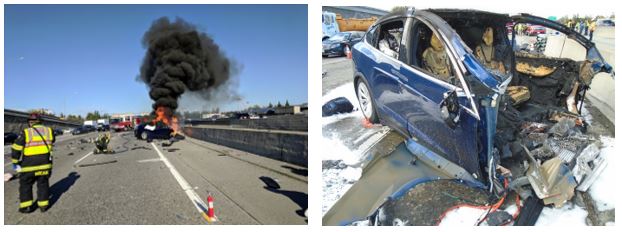
NTSB: Autopilot steered Tesla car toward traffic barrier before deadly crash
Model X "began a left steering movement," then sped up, report finds.
Ars Technica
509 points · by nwrk · 8y ago · 521 comments
• At 8 seconds prior to the crash, the Tesla was following a lead vehicle and was traveling about 65 mph.
• At 7 seconds prior to the crash, the Tesla began a left steering movement while following a lead vehicle.
• At 4 seconds prior to the crash, the Tesla was no longer following a lead vehicle.
• At 3 seconds prior to the crash and up to the time of impact with the crash attenuator, the Tesla’s speed increased from 62 to 70.8 mph, with no precrash braking or evasive steering movement detected.
This is the Tesla self-crashing car in action. Remember how it works. It visually recognizes rear ends of cars using a BW camera and Mobileye (at least in early models) vision software. It also recognizes lane lines and tries to center between them. It has a low resolution radar system which ranges moving metallic objects like cars but ignores stationary obstacles. And there are some side-mounted sonars for detecting vehicles a few meters away on the side, which are not relevant here.
The system performed as designed. The white lines of the gore (the painted wedge) leading to this very shallow off ramp become far enough apart that they look like a lane.[1] If the vehicle ever got into the gore area, it would track as if in a lane, right into the crash barrier. It won't stop for the crash barrier, because it doesn't detect stationary obstacles. Here, it sped up, because there was no longer a car ahead. Then it lane-followed right into the crash barrier.
That's the fundamental problem here. These vehicles will run into stationary obstacles at full speed with no warning or emergency braking at all. That is by design. This is not an implementation bug or sensor failure. It follows directly from the decision to ship "Autopilot" with that sensor suite and set of capabilities.
This behavior is alien to human expectations. Humans intuitively expect an anti-collision system to avoid collisions with obstacles. This system does not do that. It only avoids rear-end collisions with other cars. The normal vehicle behavior of slowing down when it approaches the rear of another car trains users to expect that it will do that consistently. But it doesn't really work that way. Cars are special to the vision system.
How did the vehicle get into the gore area? We can only speculate at this point. The paint on the right edge of the gore marking, as seen in Google Maps, is worn near the point of the gore. That may have led the vehicle to track on the left edge of the gore marking, instead of the right. Then it would start centering normally on the wide gore area as if a lane. I expect that the NTSB will have more to say about that later. They may re-drive that area in another similarly equipped Tesla, or run tests on a track.
To me, that this behavior was added via an update makes it even harder to predict - your car can pass a particular section of road without incident one thousand times, but an OTA update makes that one thousand and first time deadly.
Humans are generally quite poor at responding to unexpected behavior changes such as this.
The saying has been beat to death, but it bears repeating: Tesla is a prime case where the SV mindset of "move fast and break things" has resulted in "move fast and kill people". There's a reason that other vehicle manufacturers don't send out vehicle software updates willy-nilly, and it's not because they're technologically inferior.
At the very least, you should be able to get some sort of magnitude/fuzzy understanding of how frequently the new code is disagreeing, and you can figure out where and go check out those conditions.
I recently got downvoted for that exact line of reasoning.
Looks like some people don't like to hear that :-)
In the accident, the driver double-tapped the Park button which activated the Autopark feature, exited the car and walked away. The car proceeded to move forward into an object. The driver claimed he merely put it in park and never activated the auto-park feature. Tesla responded with logs proving he double-tapped and there were audible and visual warnings.
Well, I looked more closely. Turns out Tesla pushed an OTA update that added this "double-tap Park to Autopark" shortcut. And it's one bad design decision after another.
First, let's note the most obvious design flaw here: The difference between instructing your car to immobilize itself (park) and instructing it to move forward even if the driver was absent (Autopark) was the difference between a single and double tap on the same button. A button that you might be in the habit of tapping a couple times to make sure you've parked. So it's terrible accident-prone design from the start.
Second issue is user awareness. Normally Tesla makes you confirm terms before activating new behavior, and technically they did here, but they did it in a horribly confusing way. They buried the mere mention of the Autopark shortcut under the dialog for "Require Continuous Press".[2] So if you went to turn that off -- that's the setting for requiring you to hold down a FOB button during Summon -- and you didn't read that dialog closely, you would not know that you'd also get this handy-dandy double-tap Autopark shortcut.
Third is those warnings. Useless. They did not require any kind of confirmation. So if you "hit park" and then quickly exited your vehicle, you might never hear the warning or see it on the screen that, by the way, that shortcut that you didn't know existed just got triggered and is about to make the car start moving forward while you walk away.
So I think it's quite plausible that the driver was not at fault here -- or at least that it was a reasonable mistake facilitated by poor design. It's unfortunate that Tesla was able to convince so many with a "data dump" that the driver was clearly at fault.
I still recall that poor NYT journalist that Tesla "caught driving in circles"[3] -- while looking for a hard-to-find charger at night. Now I hope we are developing a healthier skepticism to this (now standard) response from Tesla and look more deeply at potential root causes.
[1] https://www.theverge.com/2016/5/11/11658226/tesla-model-s-su...
[2] https://youtu.be/Cg7V0gnW1Us?t=2m10s
[3] https://www.forbes.com/sites/joannmuller/2013/02/14/teslas-g...
1) https://goo.gl/maps/iWEcY7hU4DJ2
2) https://www.google.com/maps/@52.3314532,4.799684,3a,60y,221....
Differences:
a) Clearly different road markings between the gore section and normal lanes
b) BIG brightly colored and lit sign above the barrier
c) the barrier itself has a shock absorber/deflection thing like 10 meters in front of the concrete
I know what you mean, once you truly start to trust someone else to do a job you simply stop giving it any attention. It's being handled. So you maybe hover a bit at first, keep an eye, generally interfere. Once that stage is over, you just do other things safe in the knowledge that someone else is competently handling the task. Until it blows up in your face.
This level of autopilot legitimately terrifies me. Not because it's bad, but because of the way it will make the humans who are supposed to still be responsible stop paying attention
I am utterly, completely lacking in surprise that they didn't provide the relevant context, "... fifteen minutes prior."
This just looks... really bad for Tesla. It's more important to them to protect their poor software than drivers.
You think this one crash makes them evil?
Indeed; here's a close-up of the critical area. Note that the darker stripe on the bottom of the photo is NOT the crucial one; the one that the car was supposed to follow is the much more faded one above that that you can barely see:
https://www.google.com/maps/@37.410912,-122.0757037,3a,75y,2...
(Note that I'm not blaming the faded paint; it's a totally normal situation on freeways that it's entirely the job of the self-driving car to handle correctly. But I think it was what triggered this fatal flaw.)
I don't even see any sort of road-bumps to warn drivers of this dangerous obstacle approaching.
Note that I'm not defending the safety of them; I'm just surprised to see someone call them out as a hazard as they're such a common sight.
[0] http://4fhmzg4ct6wezwll3wmp9kl9.wpengine.netdna-cdn.com/wp-c... [1] http://citeseerx.ist.psu.edu/viewdoc/download?doi=10.1.1.212...
The problem with the attenuators are that they don’t get replaced fast enough which makes these accidents a lot deadlier.
You can see the difference between a used and unised attenuator in this article. http://abc7news.com/automotive/tesla-claims-missing-safety-b...
I don't think a road like this would be possible in most of the EU. Autopilot needs to be fixed, but this road is also super dangerous and probably would not be allowed in the EU.
How often do non-autopilot cars fatally crash here? This does look like a bit of death trap to me!
I've driven in almost all countries in the union and I'm sure that and worse is readily available in multiple EU countries. While it's true that the EU subsidizes a lot of road construction local conditions (materials quality, theft, sloppy contractors) have a huge impact on road and markings quality.
A non-autopilot car crashed at this exact spot a week earlier. This crumpled a barrier that is intended to cushion cars going off the road here, and contributed to the death of the Tesla driver.
The fact that a human crashed at this exact spot confirms that it really is an unsafe death trap.
You can see that yellow line at the accident site.
Now, why didn't they start a new yellow line where the lane split? That would give drivers (and software) an important cue: if you are driving down a "lane" with a yellow line on the right, something is seriously wrong!
https://en.wikipedia.org/wiki/Yellow_line_(road_marking)#Uni...
A little off topic, but I'm curious: I usually use "by design" to mean "an intentional result." How do other people use the term? In this case, the behavior is a result of the design (as opposed to the implementation), but is surely not intentional; I would call it a design flaw.
In fact, it is intentional! Meaning that the system has a performance specification that permits failure-to-recognize-lanes-correctly in some cases. This element of the design relies on the human operator to resolve. Once the human recognizes the problem, either they disengage the autopilot or engage the brakes/overpower the steering.
Now, you could argue that the design should be improved and I would agree. But we should perhaps step back and consider some meta-problems here. As others have stated, the functionality cannot deviate significantly from previous expectations without at a bare minimum an operator alert, training pamphlet or disclaimer form. Tesla's design verification likely should be augmented to more comprehensively test real-world scenarios like this.
But the real core issue is that the design approaches this uncanny valley of performing so terribly close to parity with human drivers that human drivers let their guard down. IMO it's the same problem as the fatality in Phoenix w/an Uber safety driver (human driver). When GOOG's self driving program first monitored their safety drivers they found that they didn't pay attention, or slept in the car. IIRC they added a second safety driver to try to mitigate that problem.
Working as intended: the system works in a basic average-observer human sense
Working as implemented: there were no errors in implementation, and the system is performing within the tolerances of that implementation (but the implementation itself may be flawed, or may be to a design that violates average human expectations).
Aside: the following another car heuristic is dumb. It's ultimately offloading the AI/decision making work onto another agent, an unknown agent. You could probably have a train of teslas following eachother following a dummy car that crashes into a wall and they'd all do it. A car 'leading' in front that drifts into a metal pole will become a stationary object and so undetectable.
It's the Machine Learning equivalent of Zen navigation: http://dirkgently.wikia.com/wiki/Zen_navigation
I expect any system that lets me drive with my hands off the wheels for periods of time deals with stationary obstacles.
What is being described here, if it's correct, is a literal "WTF" compared to how Autopilot was pitched.
I wouldn't be surprised if the US ultimately files charges against Tesla for wrongful death by faulty design and advertising.
IMO, maybe the roads need to be certified for self-driving. Dangerous areas would be properly painted to prevent recognition errors. Every self-driving system would need to query some database to see if a road is certified. If not, the self-driving system safely disengages.
My understanding is that Telsa's autopilot is pretty different from other more mature self-driving car projects. I wouldn't read too much into it.
Does Uber use LIDAR?
And I agree with certified roads. But even then, if a truck drops cargo in the middle of the lane, you'd want to be in a car that can detect something sitting still in front of you.
I'm sure Tesla's engineers are qualified and it is certainly easy to second-guess them, but it is beyond me why they would even consider a BW camera in a context where warning colors (red signs, red cones, black and yellow stripes, etc.) are an essential element of the domain.
>On Wednesday, Mobileye revealed that it ended its relationship with Tesla because "it was pushing the envelope in terms of safety." Mobileye's CTO and co-founder Amnon Shashua told Reuters that the electric vehicle maker was using his company's machine vision sensor system in applications for which it had not been designed.
"No matter how you spin it, (Autopilot) is not designed for that. It is a driver assistance system and not a driverless system," Shashua said.
https://arstechnica.com/cars/2016/09/tesla-dropped-by-mobile...
Really? Really?? I mean if was designing a self-driving system pretty much the first capability I would build is detection of stuff in the way of the vehicle. How are you to avoid things like fallen trees, or stopped vehicles, or a person, or a closed gate, or any number of other possible obstacles? And how on earth would a deficiency like that get past the regulators?
But on the other hand, gores like that can also trick human drivers. Especially if tired, with poor visibility. In heavy rain or whiteout, I typically end up following taillights. But slowly.
You can argue something between those two options, but ultimately it is just a semantic argument (e.g. "it just chose to ignore it" which is effectively the same as a non-detection, since the response is identical).
https://www.wired.com/story/tesla-autopilot-why-crash-radar/
True, but not one into which the car should have merged. Although crossing a solid white line isn’t illegal in California, it does mean crossing it is discouraged for one reason or another.
I love seeing the advances in tech, but it’s disheartening to see issues that could have been avoided by an intro driver’s ed course.
While the anti-tesla news is bad, tesla needs to be more clear that this really is a failure of autopilot and their model - they can't expect a human to get used to something working perfectly, clearly is hands were close to the wheel in the very recent past (tesla is famous for not reading hands on wheel).
I'm hoping google can deliver something a bit safer.
that's quite fucked up.
https://www.youtube.com/watch?v=PzHM6PVTjXo
I simply love the inflated "dummy car".
"Unless the road marking is 105% perfect, it's never the fault of the autopilot, but look, autonomous driving!" is just pure marketing, without any substance to back it.
Example: https://www.google.com/maps/@42.6871358,-73.8004004,90m/data...
Wait, how can that be? I mean clearly it didn't detect the barrier in this case, but that wasn't by design was it?
Wonder if the barriers can be modified to look like another car to these systems, but still remain highly visible and unambiguous to human drivers?
Part of the overall problem is that these roads were not designed for autonomous driving. This is much like the old paver roads were fine for horses, but really bumpy/distractive to car wheels and suspensions.
Overtime, we adapted roads to new tech. This needs to start happening now too.
The fault here isn’t with road design. The fault here is with Tesla shipping Autopilot without any support for stationary objects, AND their delusional and (should be criminally reckless) decision to not use LIDARs.
A car without ABS or power braking is not legal to be sold today. We need to apply those standards here: anything more than cruise control (where the driver understands they need to pay attention) needs to have certain safety requirements.
At the end of the day we want to know if the autonomous systems are safe. Policy decisions will end up depending on that determination. That requires clear definitions for what constitutes failures and accurate gathering of data.
I wouldn't say it's by design or expected behaviour because if a Tesla approached a stopped vehicle, the expectation would be the car would stop.
https://insideevs.com/tesla-model-s-rear-ends-another-parked...
One of the options for Autopilot is that you can tell it "Never go more than X MPH over the speed limit" with a common setting being a few miles an hour over.
The car never adjusts the cruise-control set speed by itself, with one exception: if the current road has no center divider, then it clamps the current speed to no more than the posted speed limit + 5 mph. The term "clamps" is in the programming sense: if cruise-control is already set below that speed, nothing changes.
The car never increases the cruise-control set speed. Only the driver can do that.
In other words, the driver had already set the cruise control to 75 mph and likely had the setting at speed limit + 10, which is aggressive. The reason the car accelerated is because it determined there were no cars ahead of it traveling at a speed lower than the set speed. Unfortunately, that conclusion was absolutely correct.
There’s no way in hell Tesla would have gotten away with selling this for so long if their users were allowed to read the unobfuscated source.
The fact that people are given no control over these things that can kill them while the manufacturers can just mess around with it without any real oversight is absolutely insane. I really don’t think the average IRC lurker who could figure out how to compile the firmware could be any more dangerous than the “engineers” who wrote it in the first place.
All of that being said, I still think Tesla has mostly the right approach to their Autopilot system. There is an unacceptably high number of crashes caused by human error and getting to autonomous driving as fast as possible will save lives. It is virtually impossible to build a self driving system in a lab, with all current known methods you must have a large population of vechicles training the system. The basic calculus with their approach is that the safety risks of not getting to autonomous driving sooner is more than the risks of failures in the system along the way to getting there. It is admittedly a very fine line to walk but I do see the logic in it.
I do think that Tesla could do more to educate the users who are using early versions of the software.
This kind of stuff is why I’ve lost all faith in Tesla’s public statements. What they said here was, for all intents and purposes, a flat out lie.
Clearly something went wrong here, but they lept to blaming everyone else instead of working to find the flaw.
   At 3 seconds prior to the crash and up to the time of impact with the crash attenuator,
   the Tesla’s speed increased from 62 to 70.8 mph, with no precrash braking or evasive
   steering movement detected.
[1]: https://www.ntsb.gov/investigations/AccidentReports/Reports/...
[2]: https://arstechnica.com/cars/2018/04/why-selling-full-self-d...
The industry has many highly effective AEB systems, and has for years now. I cannot comment on Ford's because I don't know specifically about its problems.
On turns, it doesn't accelerate, only maintains speed; can be frustrating if you want to act like a racecar driver. For example, following someone around a freeway curve at 45mph, and the other driver changes out of your lane. Despite having adaptive cruise set to 60mph (or higher), it will stay at 45mph until after the curve, and only accelerate after ~5 seconds of straight roadway.
It does sound the collision alert (sadly no autonomous braking here) very consistently when I'm accelerating or adaptive cruise is on, and there's a stationary object ahead.
Now I don't have the numbers memorized, but in previous Tesla, Uber, Google threads - only Google had reached records similar to human level crash safety. Keeping in mind however that they are still working on driving through snow, construction sites, non-existant (paint gone) lane lines... so the test areas are quite specific still.
I realize Tesla isn't advertising level 5 autonomy - I'm just responding to the above poster.
But I understand where you're coming from, and I agree: Tesla quickly released statements claiming the safety benefits of Autopilot, putting all the blame on the driver, and even providing misleading statements ('the driver was warned multiple times' but leaving out that that happened 15+ minutes prior). That was the exact opposite, when they didn't know the cause of the accident, but were quick to just deny any wrongdoing.
I don't understand why they would issue any statement other than, 'condolences, we're committed to safety, we're working with the NTSB to understand what happened'
Precisely. As I mentioned in another comment: Autopilot indisputably failed.
They are (understandbly) shifting the discussion away from the technical issue (Autopilot failed) to the legal issue (who is to blame), because the latter is something that they can dispute.
But skipping to Level 4 fairly clearly requires LIDAR at this point in history and Musk is on record saying he thinks it can be done with cameras and radar alone. So pride will prevent that.
So, having your hands on the wheel and not moving them can be sensed by the Tesla as "not having your hands on the wheel".
I don’t understand why people had faith in AP 2.0 in the first place, especially since Tesla boasted that it took them only 6 months to develop it. And unlike AP 1.0 the regulated ADAS features were not enabled (officially as in outside of AP mode) on it for the longest time some still aren’t.
and best of all, guess what Tesla shows on that landing page. A driver with their hands in their lap
I've yet to see an incident so far where a human driver, properly engaged with the driving experience and road conditions as they should be when in charge of a vehicle, couldn't have taken action and prevented the accident. There were 7 seconds between the beginning of the maneuver and impact; Human reaction time (including taking action) is typically 0.5 seconds. That leaves 6.5 seconds to correct steering or apply the brake, bearing in mind that Autopilot will always relinquish control in either situation.
Not apologising for Tesla, they need to sort out this edge case, but that's exactly what it was and exactly why the driver is supposed to remain engaged.
Their lawyers and their marketing departments are contradicting each other.
Their legal department will always insist that your hands must remain on the steering wheel. If your hands are not on the wheel, and the car crashes, they will mention this clause and implicitly blame the driver.
Their marketing department (like this webpage) say "This car can drive itself!".
And the car itself? Well it has a sensor that detect hands off wheel situations (plus point from the lawyers' "cover our asses" side), but it allows a few (/lot of) seconds of that situation before it warns you (their lawyer must've once screamed "Why the fuck does the sensor tolerate this situation!").
For a stupid analogy, it's almost like a bar owner advertising his bar as a smoke joint, but saying "you're not allowed to smoke in here, and I can spot anyone smoking" but still tolerating a few minutes of lit cigarettes.
I mean, auto-pilot, as promised, would be a god-send for such a poor driver (or anyone with even mild motor impairments). That it preformed soooooo poorly and that Tesla has responded soooo shadily, should put anyone seeking auto-pilot (as a real need, not a gadget) on notice.
Whoah. So there were NO alerts for 15 minutes prior to the crash. Compare this with Tesla's earlier statement:
> The driver had received several visual and one audible hands-on warning earlier in the drive and the driver’s hands were not detected on the wheel for six seconds prior to the collision.[1]
This gives a very different impression. They omitted the fact that there were no warnings for 15 minutes. Frankly that appears to be an intentionally misleading omission.
So basically the driver was distracted for 6 seconds while believing that the car was auto-following the car in front of it.
Besides, it doesn't matter: if the drivers hands were on the steering wheel they clearly weren't alert enough to hit the brakes or steer away from the impact so the point is entirely moot: autopilot was in full control of the car, whether the driver had their hands on the wheel or not to satisfy an alarm doesn't matter.
Emergency breaking feels not ready for prime time. I hope there are improvements there. Don’t want to see autopilot disabled as a result of this, would rather Tesla use this to double down and apply new learnings.
Just so sad to hear about this guys death on his way to work - not the way I want to go. :(
I would. I think any self-driving system that expects the "driver" (passenger I guess) to take over in tough situations is bound to fail again and again. If people feel like they don't need to pay attention they won't no matter how much they know that they should.
I think that partial autonomy is a sort of uncanny valley, either side is much safer.
Until it's significantly improved, it should be a backup safety system rather than a driving and safety system.
I disagree. It's the same term as in aviation and does the same thing.
> penalise them for marketing imagery that includes people driving with their hands off the wheel
That's more reasonable.
I agree that Tesla obviously needs to be learning from this. But at this point in time, Autopilot needs to be turned off until Tesla can fix the fundamental flaws in the set of sensors on their cars. There is now strong evidence that Autopilot is dangerous, and there is still weak evidence that it is less dangerous than the alternative (i.e., a human driving).
I expect that the NTSB will eventually issue a safety recommendation that Autopilot not be used in its current form. I'm a bit surprised they didn't issue an urgent recommendation in the preliminary report, or even before.
So we could pull all the self driving cars off the road, but then we inhibit their ability to collect the wide range of real world data necessary to build the technology. Or we could pull the less successful tech off the road sooner, but that would cause those programs to wither and hand the market to one or two well funded players.
I just don’t see how pulling the tech off the road because of a flaw that Tesla has likely already fixed would accomplish much.
I do struggle to understand what we should do, but I’m not so quick to think the tech should be pulled.
I'm... not so certain. Why? The autopilot had likely exhibited proper behavior every time that the vehicle had passed that particular section of road prior, and if the driver was paying full attention to the behavior of the vehicle, he would only notice the problem around the 5 second mark.
Five seconds, if you have no reason to be concerned about the vehicle's behavior, is not much time - especially if you consider that alert drivers are recommended to give themselves a minimum of 4 seconds of reaction time (i.e. follow a vehicle by at least 4 seconds).
In this specific case, because if a driver is watching the road in front of them, four seconds is an awful lot of time to watch yourself head toward and then accelerate into a cement barrier, all without touching the brakes. It's fine to want Autopilot to be better, but as a matter of law, it is the driver's responsibility to slam on the brakes in that situation, and move into a legal lane.
More broadly, it's because the contract of an L2 system is that a human is in control at all times. L2 systems are assistive and not autonomous. They will never disobey a driver's presets, nor override a driver's real-time inputs, even if the car thinks it is safe(r) to do so. This is a major design principle behind every L2 system, and the reason why there are no scenarios where an L2 system is considered at fault by law.
Now obviously, if there were a bug that caused an L2 system to override a user's input -- say disregarding someone hitting the brakes, or overpowering the steering wheel, that'd be a systemic failure and grounds for a recall. But we haven't seen any cases of that, and there are hardware precautions (e.g. limited torque in the Autosteer servo) to minimize that possibility.
The driver had actually reported to Tesla problems about that specific section of road.
> Tesla has said that Huang received warnings to put his hands on the wheel, but according to the NTSB, these warnings came more than 15 minutes before the crash.
> Tesla has emphasized that a damaged crash attenuator had contributed to the severity of the crash.
These may or may not have been factors contributing to the death of the driver, and ultimately may or may not absolve Tesla from a legal liability.
However, the key point here is that without question, the autopilot failed.
It is understandable why Tesla is focusing on the liability issue. This is something that they can dispute. The fact that the autopilot failed is undisputable, and it is unsurprising that Tesla is trying to steer the conversation away from that.
The discussion shouldn't be either the driver is at fault or Tesla screwed up, but two separate discussions: whether the driver is at fault, and how Tesla screwed up.
Autopilot doesn't need to be perfect, just better than humans.
Speak of the devil...
It’s amazing that given the slander Tesla has been passing off as PR in this case, that anyone could defend them in this, yet here we go.
In this case, it very clearly was.
Just as you or I as Tesla drivers need a subpoena to get access to the black box data for our own insurance or criminal claims against other drivers, but Tesla is more than happy to put out press releases on your driving telemetry if they feel it suits their narrative.
https://www.ntsb.gov/investigations/AccidentReports/Reports/...
So even a three-car pileup with the Tesla steering straight into a barrier at 71MPH & accelerating, with the car catching on fire & being reduced to a husk, still isn't enough to kill a driver immediately. In a way, you could interpret that as demonstrating how safe Teslas are (at least, without Autopilot).
I am not sure of the specifics of this case, but traumatic cardiac arrest is, as a generalization, "largely unsurvivable". An asystole EKG, in concert with the mechanism of injury, may be enough for us to do so, and we do not need to transport what is at that point a dead person (even if there is resuscitation being attempted, for a multitude of reasons - sometimes even "for the family's benefit"[1]) just to get them to a physician to declare death.
In many states, EMTs (with ~200hrs of medical training) are able to declare death legally, in the setting of evisceration of heart/brain, decapitation, "body position incompatible with life".
This is the situation to the best of my knowledge as a paramedic of nine years and a state certified EMS Instructor and Evaluator.
[1] it should be noted that this is done in a setting where its judged the "best" course of action for grief, establishing end of life directives, and the like, and _not_ as something that is intended to falsely convey hope.
> The car was towed to an impound lot, but the vehicle's batteries weren't finished burning. A few hours after the crash, "the Tesla battery emanated smoke and audible venting." Five days later, the smoldering battery reignited, requiring another visit from the fire department.
Where is your LiPo god now? Batteries have more energy density than 20 years ago, ok. But they are also much more dangerous. Now imagine the same situation with Tesla's huge semi batteries. They'll have to bury them 6ft under, like Chernobyl's smoldering fuel rods. Minus the radiation.
Some Tesla batteries have caught on fire after collisions. None caused injury to car occupants. In one of the first publicized cases, the car even told the driver to pull over safely, and the fire only started afterwards. There are vanes to direct flames.
I've seen my fair share of ICE fires. They are not pretty either. We have grown accustomed to them, firefighters know how to handle them, and the car industry has fixed most of the early issues that caused fires. It can still happen.
The same will be done for car batteries.
I agree with the energy density argument. My Leaf stores about 1 liter worth of gasoline as energy. When we reach energy densities comparable to current fuel tanks, we'd better be much more advanced in this aspect.
I'm bearish on Tesla (not financially, but I'm mostly a pessimist in regards to their news).
But to be perfectly fair: I'm not sure if 400 gallons of diesel fuel (typical in a 18-wheeler) could be put out by a typical fire-department.
There was a tractor-truck spill due to an accident in my area once. The fire-department closed down BOTH sides of a 2x2 lane highway (55 MPH zone, very few traffic lights, a grassy median). You don't mess with 400-gallons of inflammable diesel.
The good thing about diesel is that you can just, burn it out. Burn all of it. Close down the highway of course, but once it stops burning, its safe to cross. It may take 30 minutes to an hour (all the people stuck in traffic can get out of their car, talk with each other, play on cell phones or something...), but a controlled burn is better than an explosion.
I'm not sure if Lithium Ion has a good procedure yet.
https://www.nytimes.com/2007/04/30/us/30collapse.html
The overpass was reconstructed and I-580 highway reopened after 26 days:
https://www.sfgate.com/bayarea/article/A-MAZE-ING-His-reputa...
You're expecting their engineers to design a battery that remains safe after a 70mph crash into a barrier?
"FDA said my farm is producing salmonella-infected chicken. Downvote their report on this URL!"
I'm not saying he's really going to do it, but I question your certainty here with a total lack of actual evidence.
Options:
* In 2018, A foreign-born Capitalist billionaire with sometimes negative press coverage suggests creating a Ministry of Truth named after a Russian propaganda newspaper to call out journalists who make false claims in their reporting. He registers a corporation for that purpose on the 100th anniversery of a bloody revolution bringing about the Soviet Union.
* A man known for using puns and showmanship in their communications trolled a bunch of people who latch onto his every word, especially when they don't like the man.
And to ComradeTaco, this isn't the presidency, and he didn't spout hate speech. It was a joke.
FYI, the October Revolution anniversary is Nov 7th (Oct 25th using the old calendar).
Can you link to what verified that?
The entire problem manifests from calling this lane keeping mechanism "Autopilot." Tesla should be prohibited from using that language until they have achieved a provably safer self-driving level 3+.
The problem is exacerbated by Musk's aggressive marketing-driven language. Saying things like we're two years out from full self-driving (first said in 2015) and the driver was warned to put his hands on the steering wheel (15 minutes prior to the crash) makes Musk look like he is plainly the bad guy and attempting to be misleading.
"Provably safe" probably means some sort of acceptance testing -- a blend of NTSB-operated obstacle course (with regression tests and the like) and real world exposure.
Every time, we have a big discussion about autopilot safety, AI ethics, etc.
What about lack of focus?
Tesla has already reinvented the car in a big way--all-electric, long range, fast charge, with a huge network of "superchargers". It's taken EV from a niche environmentalist pursuit to something widely seen as the future of automotive.
Why are they trying to tackle self-driving cars at the same time?
This feels like a classic mistake and case of scope creep.
Becoming the Toyota of electric is vast engineering challenge. Level 5 autonomous driving is an equally vast engineering challenge. Both represent once-in-a-generation technological leaps. Trying to tackle both at the same time feels like hubris.
If they just made great human-piloted electric cars and focused on cost, production efficiency, volume, and quality, I think they'd be in a better place as a business. Autopilot seems like an expensive distraction.
They are reason alone for me to never consider one, that a private moment for my family might end up a pawn in some "convince the public we're safe using any weasel stretch of the facts we can" effort.
If this is disruption, I'll wait for the old guard to catch up, lest I be disrupted into a concrete barrier and my grieving widow fed misleading facts about how it happened.
If that were actually the case, then what are they supposed to say?
>lest I be disrupted into a barrier
This made me audibly chuckle.
Autopilot software that are not safer than human pilots shouldn't be allowed to be sold to the general public until they fix their stuff. And even if they are safer most of the time, we are at least used to how human drivers react, most of them don't accelerate just before a crash.
The “Autopilot” branding implies that users need not pay attention, when in reality, the system needs interventions at infrequent but hard-to-predict times. If an engineer at Apple can’t figure it out, then the average person has no chance. Their software sets users up to fail. (Where failure means permanent disability or death.)
Inevitably, Musk fans will claim that recalling Autopilot actually makes Tesla drivers less safe. But here's the problem with Musk’s framing of Autopilot.
Sure, maybe it fails less often than humans. (We don't know whether we can trust his numbers.) But we do know that when it fails, it fails in different ways — Autopilot crashes are noteworthy because they happen in situations where human drivers would have no problem. That’s what people can’t get over. And it is why Autopilot is such a dangerous feature.
An automaker with more humility would’ve disabled this feature years ago. (Even Uber suspended testing after the Arizona crash!) With Musk, my fear is that more people will have to die before there is enough pressure from regulators / the public to pull the plug.
Oh the hubris of man. I am not even a Tesla fan, but still. "I'd rather have 2 of 100 people drive against a wall instead of 1 of 100 automatic cars driving against a wall.", that's what you are essentially saying, no?
Here’s another question: why wasn’t the ‘gore’ zone detected?
Why did the car thing it was safe to drive over and area with striped white lines covering the pavement?
It saw the white line on the side of that area and decided that was a land market but ignored the striped area you’re not supposed to drive on?
If you’re reading the lines on the pavement you have to try to look at all of them.
I don’t know if other cars, like those with MobileEye systems, do that but given Tesla’s safety claims they’d better be trying.
http://www.dailymail.co.uk/sciencetech/article-5582461/Tesla...
Edit: Google street view of the location: https://www.google.com/maps/@37.410912,-122.0757037,3a,75y,2...
BTW does anyone know why it’s called a ‘gore’ zone? I can see it being a (brutal) nickname but I’m hoping there is some better reason.
Normally, that area has a barrier designed to save lives, by slowing down cars and providing cushioning. However, the emergency-cushion was already damaged from a prior crash.
Without an emergency-cushion, running into a straight concrete barrier has known, lethal consequences.
EDIT: Just to be clear, I'm just guessing.
"The crash created a big battery fire that destroyed the front of Huang's vehicle. "The Mountain View Fire Department applied approximately 200 gallons of water and foam" over a 10-minute period to put out the fire, the NTSB reported.
"The car was towed to an impound lot, but the vehicle's batteries weren't finished burning. A few hours after the crash, "the Tesla battery emanated smoke and audible venting." Five days later, the smoldering battery reignited, requiring another visit from the fire department."
Shouldn't it be possible to make the battery safe?
Given that, the value of autopilot seems dubious...
I'm not inclined to trust Tesla's statistics given how cavalier they have been about putting their shoddy autopilot product on the road and marketing it as being better than it actually is.
https://techcrunch.com/2017/01/19/nhtsas-full-final-investig...
A 40% reduction still means plenty of anecdotes for media fodder.
There may come a time when autonomous vehicles make driving so safe that the only data we can and should rely on is the rare anecdote like this and the subsequent NTSB report, like airlines. But while it’s always good to take seriously the lessons that NTSB’s targeted investigations provide, a lot more people will die tragic but less-publicized deaths if we stop any company from deploying an imperfect but still overall beneficial technology.
(Not to excuse tesla here though, if that wasn't clear.)
Subtle bugs in self driving cars would be a simple way to assassinate people with low cost overhead. One OTA update to a target and you could probably even get video footage of the job being completed, sent to the client all in one API call.
Surely by now someone must have completed a cost analysis of traditional contractors vs. having a plant at a car manufacturer.
Am I the only one thinking about this?
https://en.wikipedia.org/wiki/Michael_Hastings_(journalist)#...
There's no evidence that Cruise is in the same class as Waymo.
determining the path of travel through lanes markings that suddenly fade out while moving in 70mph on a busy freeway requires advanced AI
its pretty clear the self-driving gods are not giving these cars a grounds up understanding of physics and self-preservation. They best thing they come up with is programmed to drive X mph and to respond probabilistically to a large but finite set of training input scenarios.
Tesla is relying upon advanced AI to do things that its sensors can't do reliably. Its only Tesla who is trying to make self-driving cars off of cameras and inaccurate radar alone.
Maybe Lidar really is too expensive for mass-market adoption. But its the most obvious solution to the problem right now, instead of trying to solve harder problems (ie: camera recognition of 3d objects over trained neural nets).
Is it? Unless you are talking about NASCAR, an adversarial game where rational agents compete for road space, driving is essentially a physics problem: maintain a speed and direction that does not exceed the vehicle's ability to correct them so as to avoid any stationary or mobile obstacle.
In this case, the vehicle was accelerated to a speed (72mph) that far exceeded its safety speed against oncoming stationary barriers (0mph).
I concede that discerning what is an obstacle and what is drivable road surface is a hard computer vision problem, hence the tendency to simplify it using 3D data, radar/lidar etc. But still, not quite general AI.
- perfect cv image classification (+ low visibility )
- anticipating behavior of bikers, children, elderly, animals, near roads
- responding to human non-verbal communication
- responding appropriately to never before seen obstacles/scenarios without being a nuisance on the road or endangering other drivers
- vehicle dynamics (+ in rain, ice, snow, emergency etc)
...
I would guess to do these tasks with accuracy similar to humans approaches a problem space that's as difficult as general AI
some of these seemingly require the machine to have theory-of-mind which is general AI
The same happens with humans. Reason is extremely slow. Pilots are trained to act fast training the subconscious, not the logical mind.
Hence, the opportunity for an automated system that does not do that to be much safer, by relying on reaction times rather than strong AI.
Where a human driver would use subtle cues to anticipate a slowdown of the preceding vehicle before a turn, an automated system can get by by simply slamming the brakes in less than one millisecond when it detects braking from the other vehicle.
It's rather uncontroversial that this kind of accident falls under civil law, because there is some degree of liability involved in marketing a product as being safer than a human driver, but then fails in an instance where a human driver flat out would not fail: apples to apples. If the human driver is paying attention, which the autonomous system is always doing, they'd never make this mistake. It could only be intentional.
But more controversial and therefore more interesting to me, is to what degree the system is acting criminally, even if it's unintended, let alone if it is intended. Now imagine the insurance implications of such a finding of unintended killing. And even worse, imagine the total lack of even trying to make this argument.
I think a prosecutor must criminally prosecute Tesla. If not this incident, in the near future. It's an area of law that needs to be aggressively pursued, and voters need to be extremely mindful of treating AI of any kind, with kid gloves, compared to how we've treated humans in the same circumstances.
https://www.google.com/maps/@37.4106804,-122.075111,3a,75y,1...
If it were night and a car in front blocking view of the concrete lane divider, it doesn't seem too difficult for a human to change lanes at the last second and collide as well. (And indeed, there was a collision the previous week.)
There's no excuse for not having an emergency collision detection system... but it also reminds me how dangerous driving can be period, and how we need to hold autonomous cars to a higher standard.
[1] Thanks to comments by Animats and raldi for the location from other angles
Its got a couple scenarios in my experience where it shines - chiefly long drives on clean clear interstates and stop-and-go traffic - but its got suicidal tendencies in others.
Its not unlike being driven by a tipsy friend or a teenager - there are enough indications that it can't be trusted.
Unlike those situations, its easy enough to take control back once you realize that.
Marketing it above its capabilities surely isn't helping, though.
This is what Elon's personality cult, and the psychological need to defend a large purchase, does to people. You are making excuses for a clearly defective product that wouldn't be acceptable if this was anyone other than Tesla.
Perhaps I wasn't clear enough about the two use cases I cited, but the car performs excellently (and entirely soberly) in those situations.
It's a tool that has significant utility and significant footguns. I'm not advocating whether you should use it or not - I'm sharing my experience with where the system delivers and hoping users are looking past the hyperbolic marketing.
Its abundantly clear (even to us in the Elon personality cult?) that Tesla and Elon have done themselves a disservice with how they handled this tragedy.
Parent clearly outlines the limitations, as well as where AP works well, and you tear into them with "fanboi" trolls? Given that you know nothing more of the parent's psychological state than a name on a screen, you might try dialing it back a bit.
You're giving too much credit to the average driver. Just because they're richer than the average driver doesn't mean they're going to be more discerning about the car's advanced features. Addtionally, Tesla still advertising Autopilot as "Full Self-Driving Hardware" is borderline negligence.
and then one day you get an update that breaks your mental model you have been familiarized with, your Tesla crashes and you die.
a) Tesla making enough money to make Space X work
b) Being able to establish a colony on Mars, using Space X
I think he's super honest about the Mars stuff. I also think he's being super deceptive about the Tesla stuff. Is that ethical or not? I don't know. From his larger point of view (risk of earth annihilation vs a bunch of rich americans dying in Tesla failures)... who knows.
If he is super deceptive about X, then there is really no reason to believe, or incredible naive to believe that he is super honest about Y for all Y
    The NTSB report confirms that. The crash attenuator—an accordion-like barrier that's supposed to cushion a vehicle when it crashes
    into the lane separator—had been damaged the previous week when a Toyota Prius crashed at the same location.
    The resulting damage made the attenuator ineffective and likely contributed to Huang's death.
Maybe one day, when the majority of cars are self-driving, road design will change. To get there, self-driving cars will need to prove themselves on today's roads so people will buy them.
http://www.dailymail.co.uk/sciencetech/article-5582461/Tesla...
I do think that an "Autopilot" / "ProPilot" / "SuperCruise" type system that does adaptive cruise + lane following + emergency braking should do a better job at detecting and reacting to that kind of barrier, but there is also evidence that this is a problematic location that has seen crashes by plenty of non-computer-assisted vehicles.
Edit: Google street view of the location: https://www.google.com/maps/@37.410912,-122.0757037,3a,75y,2...
Unless you want to ramp up caltrans to the point where it can fix non-essential parts of any and every roadway within hours of degredeation, it’s entirely impractical to expect them to be in perfect shape.
Looking at the video of the guy that tried that same route again, it looks like the sun was straight ahead (see starting 37th second of video [1]), and I am wondering if the camera had an issue identifying the sign due to the glare from the sun.
Do we know if this problem has been fixed now? Can the chevron be identified at the same location by other Tesla drivers today, months after the guy that tested it and posted the video of his car swerving at the same place [1]?
Following lane markings are never going to be a 100% reliable method for navigating roads. Even humans miss merging lanes, or have issues at complex surface street intersections where there are multiple overlapping lanes. But humans take evasive action.. they slow down, re-access, look at signs and probably get honked at.
Following other cars is never going to be a reliable method for navigating roads. I don't know what the guy in front of me is going to do! I keep my safe distance and take evasive action if the guy in front of me does something stupid.
I feel signs are most reliable in that sense. If there is a missing sign, a human is more likely bound to make a mistake as well. Maybe I am biased, because as someone who sails, signs (buoys, lights, colors, etc.) are what guide me in my navigation as there are no lane line markings on the water (not a perfect analogy because the speeds/traffic patterns are very different, but the point I am trying to make is about humans identifying the signs with muscle memory). A vision based neural network should be able to do the same.
[0] https://english.stackexchange.com/questions/249780/what-do-y... [1] https://youtu.be/VVJSjeHDvfY?t=37
If your hand is always supposed to be on the wheel, why is does the car not constantly alert you when it detects that your hands are off (similar to how cars beep at you if your seatbelt is unbuckled while driving)?
For every release, I'd expect the score to improve. With a system like this, I would think you'd detect the "drive towards traffic barrier" behavior.
Car accidents will kill people at least as long as there are any human-piloted vehicles on the road and probably long after (pedestrians, etc.)
What doesn't need to happen is companies in the self-driving space recklessly exaggerating their cars' ability to self-drive.
Waymo and Cruise have done a good job at that so far, by taking the conservative route of testing their systems in controlled environments before unleashing them on an involuntary public.
But please continue to blame Autopilot for not being smarter than the human operating the vehicle.