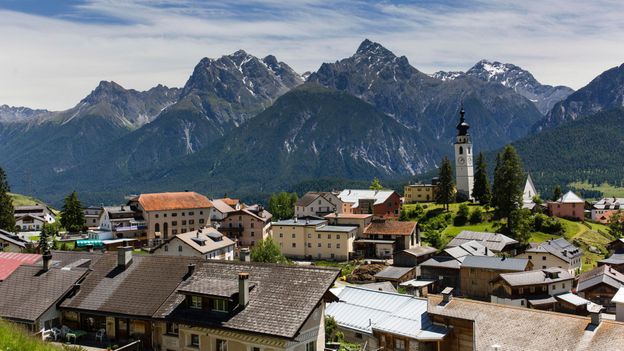
Switzerland’s mysterious fourth language
Despite Romansh being one of Switzerland’s four national languages, less than 0.5% percent of Swiss can speak it.
bbc.com
162 points · by MiriamWeiner · 8y ago · 124 comments
e.g. https://i.redditmedia.com/VEUcNGVHkNv6E03iKnczBLELoqL4prdSsw...
That sounds reasonable, except for the fact that many, if not most, of the modern European national languages are in fact, newfangled mashups. National language standards are by and large the invention of the past few hundred years, where they either took a single regional language and called it the language language (such as French) or they kind of "mashed up", artificial standard (such as German). And yet somehow, these languages eventually took hold.
If Romansch doesn't die out in the next century, it's highly likely that a single standard will emerge.
We have put activities in place to try to save Mirandese.
In Spain likewise, after the civil war, regions got active to ensure their local languages strive alongside Spanish.
In Germany some states have the option of children having after school activities in the regional dialects.
[1] This is not too different from the situation with High German being used in education even though everyone speaks in dialects.
The people are speaking their own dialects which differ that much that you can easily locate from which part of the country the speaker is from.
The native German Swiss only speak their Swiss German dialects among each other, with no single one dominating. In writing OTOH, standard German is used, although of course the usage of standard German has a much longer history than in the case of Romansh.
Italian German, French, an yea, e'en English, have mutually all-but-unintelligible variants.
Well heck, the same thing can almost be said of German.
Also, if I got it correctly, Romansh is one of Switzerland's national languages, so theoretically one could move to Graubünden and acquire Swiss citizenship through Romansh, and not French, German, or Italian?
In total number of speakers, it's possible, and I think it's been the case historically (just by general population growth). In relative numbers (fraction of the population), it's been shrinking and I don't see this changing. Main reasons are that:
  a) as mentioned in the BBC article, people move, and it's very difficult to keep the language after one or two generations if you don't live in that region,
  b) even if you were to move to a Romansh-speaking area (as a Swiss national or as an immigrant), the incentive to learn is low because almost everyone also speaks (Swiss-)German.
> national language
It has a slightly different status than the other 3 languages, Wikipedia explains it well [1]. I don't know if you could get citizenship that way but you'd definitely be on the news.
[1] https://en.wikipedia.org/wiki/Romansh_language#Official_stat...
Sample (from The Fox And The Crow):
  La vulp era puspè ina giada fomentada.
  Qua ha ella vis sin in pign in corv che
  tegneva in toc chaschiel en ses pichel.
  Quai ma gustass, ha ella pensà, ed ha clamà
  al corv: «Tge bel che ti es! Sche tes chant
  è uschè bel sco tia parita, lur es ti il
pli bel utschè da tuts».Be interesting to hear more about that.
Similar languages exist in Italy, by the way:
* https://en.wikipedia.org/wiki/Ladin_language
* https://en.wikipedia.org/wiki/Friulian_language
And there are also Germanic dialects that are isolated within Italy:
https://en.wikipedia.org/wiki/Languages_of_Italy#Non-Romance...
Fascinating stuff!
So when speaking with others that share the same language knowledge, it is just less effort to do so than pause while trying to remember.
Never change, rappers, never change...
You can use Google search in Romansch and they was a translation of Windows 7 and Office.
Western half speak french as a primary language and visiting cities there reminds me of france, except there werent any ghetto train stations. Northeastern parts speak german. Going down south the primary language was italian. Once you move to the outskirts of italy the infrastructure looked like it hadnt been maintained in ages.
Also police at the train station are armed with assault rifles too, but switzerland is not like this so yeah
Also because both germany and switzerland are beautiful in all regards :)
Spoken by a few South Tyrolian friends of mine, either as mother or as second tongue.
They can effectively learn 4 languages in the school:
* Ladin (elementary) * Italian (elementary) * German (elementary) (South Tyrol is ~60% German speaking autonomy in Italy) * English (when I went to school (started in 1999) it was introduced in middle school, nowadays it's late elementary AFAIK)
- More people speak Portugese in Switzerland than Romansch
- More people speak Albanian in Switzerland than Romansch (there are 350k Kosovars in Switzerland, almost 5% of the population)
https://www.eda.admin.ch/aboutswitzerland/en/home/infografik...
BTW, the Swiss government has several amazing infographics about the country, extremely well designed an informative:
https://www.eda.admin.ch/aboutswitzerland/en/home/infografik...
German, French, English, and Japanese
Over 1/3rd of the of the starters of the Swiss Soccer National team are Albanian. (Shaqiri, Xhaka, Berhami, Dzemaili).
They have scored 60% of the Swiss goals in the world cup tournament so far
Also, Dzemaili's roots are Macedonian, not Albanian.
I live in the US, and this country recognizes both the differences of citizenship and ethnicities (at it actually celebrates it). Eg. If you immigrated from Italy to the US, you are still italian. Your ethnicity doesn't just disappear. If you get the citizenship, you become Italian-American, and you are free to claim both.
Also, Blerim Dzemaili, is Albanian. (btw, about 30% of Macedonians are ethnic albanians). If he wanted he could get the Albanian citizenship, and actually be eligible to play for Albania as many other ethnical albanians have done. (G. Xhaka's older brother, Taulant actually plays for Albania).
Džemaili was born to Fekredin and Shemije Džemaili,[4] an Albanian family from Bogovinje, https://en.wikipedia.org/wiki/Blerim_D%C5%BEemaili#Childhood...
No. Google translate. I really disagree with this idea that the death of a language somehow means we are cut off from the culture that used the language. Nobody speaks ancient Egyptian but we can still translate their hieroglyphs. Universally common language promotes communication, cultural exchange, understanding and general world peace. I'd rather focus on the promotion of wold languages than the maintenance of isolated regional dialects. I'd rather learn Arabic than Welsh, Cantonese over Romansh.
Wow. "Romansh" is recognized by my spellchecker. But "Shia" of Shia Islam is not. Makes one think.
I've been interested in the general idea since reading 1984... where language shaping and limiting thought is a central idea. But I'd be curious to know how much scientific support this idea has.
The Wikipedia article you linked has some of the details, but they are obscured a bit if you aren't looking for them. The linked main article on Linguistic determinism has some more direct details in its Criticism section: https://en.wikipedia.org/wiki/Linguistic_determinism
http://www.slate.com/articles/podcasts/lexicon_valley/2014/0...
It is not necessary to have a grammatical future tense to talk or think about the future. In fact, English does not have a future tense in the technical grammatical sense of 'tense'.
More generally, there's no evidence for the existence of human languages with the sort of lack of expressive power that you're talking about. All languages appear to be more-or-less equivalent in their expressive power, although of course that does not imply that exact translation is possible in all instances.
I was thinking the other day about that language that has no relative left/right and instead everything is based on (effectively) compass direction. The speakers reportedly have excellent direction sense compared to the average non-speaker. Their language is much more efficient at certain tasks we struggle with (English has crutches like "stage left", "starboard", and "your left" to compensate, but unless expected and practiced those are always effort/error prone. I myself fail at simple right/left way too often.)
Obviously this is a linguistic (and arguably cultural) trait with some value, without denying the value of also having relative kedtýright.
This language is unique (? or at least very rare), which tells me it failed to spread. Logical, as it would be hard for non-native speakers to pick up.
But that means "losing the evolutionary race" has no particular relation to the VALUE to us.
Would be OK to forget how to make stone tools because we don't need them for now?
Traits are useful in some circumstances and not some useful when circumstances change, who say you would not miss them in the future?
Knowledge is knowledge, it adds to our always imperfect understanding of the world.
https://numberwarrior.wordpress.com/2010/07/30/is-one-two-ma...
Idioms. Metaphors. Reference to background material. Such things may not be expressible in as few words, but there is no idea that cannot be expressed eventually.
Bad example. We know how to decipher hieroglyphs because we discovered that there were actually equivalent to another language that was well known at the time. There's tons of other languages we have no idea idea how to decipher, such as Linear A.
If the language dies before a substantial amount is written down, the training data will never exist.
What is now China with a few local variants was once covered in numerous dialects like India today, though not as numerous. However, one unifying language has led to a less fractured nation compared to say India or even Europe.
Just because something is doesn't mean it's right. Tooth decay is also a natural process, as is myopia, and cancer.
I've no problem with Cymraeg, it's interesting, part of my ancestry, part of British history, half of its fluent speakers prefer it. But if the government stopped putting it up, and supported more learning of major World languages in its place, then I think Wales as a whole would be better off.
Just because something is old, arose in one's own country, etc., doesn't mean it's automatically more valuable (not even culturally) than other things. [And vice-versa of course.]
Which is not intended as celebration, just conversation.
Maybe a brash conclusion would be to think that small cultures hamper progress by elevating the barriers to communication and spending energy pointlessly (from an utilitarian point of view) on little artisanal trinkets that are vastly more inefficient compared to, albeit somewhat dystopic, modern manufacturing and unified cultural anglosaxon mish mash.
I don't think art is a linear progression.
> It might be a sensitive topic
You're telling people of non-dominant cultures that their art and "artisanal trinkets" are, at best, a worthless waist of time.
True, I lumped it together with technology. The case with art is, it benefits from perspiration from other artists which ocurrs mostly at the scale of bigger cultures.
> You're telling people of non-dominant cultures that their art and "artisanal trinkets" are, at best, a worthless waist of time.
Well, that's the logical conclusion from a pragmatic viewpoint, but emotion bends logic, therefore causing many inefficiencies (which may look "efficient", but just because of looking at them through the filter of emotion).
However, I don't follow the dogma of pragmatism on a personal level, which is just another point that explains the human paranoia between logic and emotions.
That was the fundamental belief behind the eurocentric approach to anthropology, and other ethnocentric supremacist belief systems which from ignorance brought a lot of hardship to the world.
You don't have to look far enough to see how your culture, not long ago, was just as niche and pointless as the ones you're criticising now. You should also know that dominating cultures have already succumbed into irrelevance in spite of all the supremacist beliefs. Perhaps there's something to be learned about poopooing other cultures
However, this optimization makes also our civilization more fragile, so the tradeoffs are more complex than in your version of the theory.
The standard knee-jerk reaction of wailing at the passing of yet another little-spoken language always fails to take into account the other side of the equation: a huge number of problems on this planet stem from the fact that people speak different languages and profoundly fail to understand one another.
Paying the price of losing little-spoken languages and the bits of culture that tag along with it is a very cheap price to pay when compared to what is gained.
I strongly disagree with whatever led you to believe such a thing.
That was the original thought behind Esperanto... the idea was that there was strife between different groups of people because they speak different languages, and that a universal language would solve this (or at least bring them closer together). [1] Whether this worked out or not is left as an exercise to the reader. ;-)
How much of this do you really attribute to different languages? By and large everyone in America speaks English, but the past couple years in particular has very much demonstrated that we profoundly fail to understand one another. To me the language is obviously important for literal communication, but to an extent pretty irrelevant to the communication barriers in society.
I'm sure common language helped Russia and Ukraine when they went into war.
What you're looking for is single worldwide culture. But I doubt that could happen. E.g. colonies in "New World" soon departed from their parent cultures. Even if someone would establish a single culture, it's set to collapse and split into a myriad of smaller ones.
There're a lot of things that define culture. Looking at US coasts-vs-flyover divider, language is not what keeps people together. Even if they shared a somewhat similar culture, different environments make people go in different ways.
> I really disagree with this idea that the death of a language somehow means we are cut off from the culture that used the language.
Culture is much more than just translating words. Different people care more about different things. That PoV is lost when nobody speaks the language natively. Well, it may exist in a book in a library. But there's no way to experience the culture anymore. So yes, it's dead, but not lost.