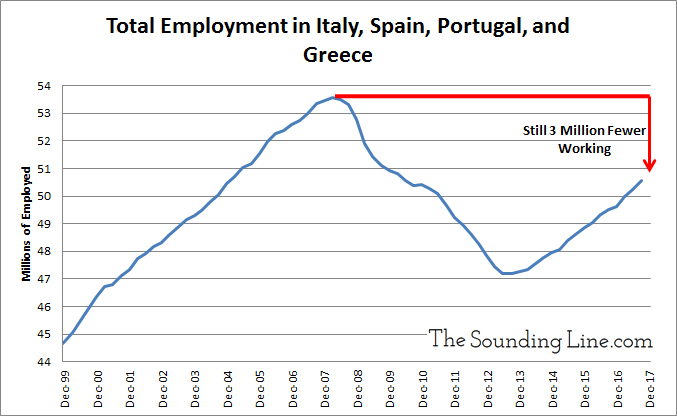
Southern Europe Has Not Seen Net Job Creation in over a Decade - The Sounding Line
The number of employed people is still lower than in 2005 despite the population of the region having grown by over three million people since then
The Sounding Line
225 points · by Four_Star · 8y ago · 198 comments
If they had separate currencies, Spain could inflate away a lot of their debt. This would cause a bunch of pain for your average Spaniard, but it would also mean that Spain's currency devaluation could drastically help its exports (and of course one of Southern Europe's most valuable "exports" is tourism). A direct consequence of being on the Euro is exactly what you point out: labor isn't really cheap enough to be competitive.
Which is why Euro is good for Southern European countries: it forces them to concentrate on productivity rather than economic alchemy. Spanish labor got too expensive? You don't need a government to inflate your currency, you just start lowering your rates. My fellow Italian workers cannot find a job? Stop talking about "articolo 18", stop looking for assured indefinite term contracts, accept the reality! Enterprises know ups and downs: when thing go well, they'll be happy to pay you good money for your services, but when hell breaks loose your salary will be a burden for them. Either accept that employment contracts can be terminated before your retreat, or keep up the good work... uh, keep up the work... just keep up!
Every time I read histrionics about how the euro is a straightjacket, a trap, an evil German plan to benefit itself at the cost of its neighbours etc I just sigh. I am not even a supporter of the EU, but blaming the euro for low southern productivity is just wrong. The PIGS countries aren't seeing high unemployment and poverty because of the euro. They'd still have high unemployment even if they had their own currencies. The causes are fundamental.
All a floating currency would do is make it easy for them to screw over lenders in the short term by inflating their debts, which would be compensated by the markets charging much higher rates (this already happens because investors fear default instead of inflation). It'd also act as a forcing function to require the people living there charge (foreigners) prices that are reasonable for what they can provide, rather than expect them to accept market realities and actually lower their prices in order to compete.
Thats why they still can borrow cheap money despite being basically broke
Yeah, and that experiment has gone very well... /s
What it actually does is cripple them from one of the major tools to control your own economy. It's no "alchemy", it's a tool -- the greatest economies of the world use it whenever they have to.
Tourism seems to be pretty price inelastic to be honest (as seen by neverending lines and crowds).
> labor isn't really cheap enough to be competitive
Minimum wage in Spain is lower than in other https://upload.wikimedia.org/wikipedia/commons/thumb/3/3f/Eu...
And this applies even for higher pay functions, it is usually lower than even Germany.
I'd attribute their lack of growth more than internal culture (management culture, investor culture, etc), lack of investment and other factors.
Many of these are the counties that are beneficiaries of the policy. Ireland is a more reasonable counter- similar problems to Spain, but a good recovery.
Additionally and more concerning is that there is also a very real sense in Barcelona that “innovation happens elsewhere” when you talk to these same smart people. It is strange and it is like they’re looking for permission to do something different. It is almost as if the social contructs support doing things the way they’ve always been done.
Example: Even side projects would never get shipped and when I probed as to why my friend told me he “couldn't justify spending effort on this project to his family because he wasn’t getting paid for the work.” ... he had already built it the entire website and codebase and never shipped. (Surreal)
I like another commenter think about starting my next venture in Spain but my gut and experience says it would be a bad idea if you needed to hire tech talent locally.
It is not the status. For long being a manager was the only way of getting a reasonable salary and to get to older age with a job. Developers were young and badly paid. It existed a generation for whom being a developer or just knowing about computer was a high pay job, but that disappeared fast.
Nowadays is changing fast. The main factor is companies that create product instead of consultancy companies that sell labour. For a consultancy, their profit is the difference between what a company pays and what the employee gets a salary. For a company with a product, the product quality, features and development time is important, so they pay and respect developers a lot more.
I have been part of the indie game development scene in Barcelona. I have met several people in their twenties, half my age, with published successful games in mobile stores and Steam.
Barcelona, the city I know, is changing fast for the better. Even that it is going to take time to get rid of the old habits. But I can see myself going back in a decade if they want to hire a developer in his fifties.
Care to elaborate? Genuinely curious. Spain does attract expats, they are however often pensioners.
Usually engineers aren't that well regarded in Spain, people tend to aim to get into management.
Other than that, salaries are pretty low and work culture is quite intense at most places, with people usually working ~10 hours a day. This is aided by the general lack of options in the market and a quite high degree of conformity which is a byproduct of the rigid educational system in Spain and which most graduates are embued with.
Innovation, aside from a couple startups is lacking as most of the ecosystem is made of big consulting companies which have agreed to set cap on salaries to protect their shrinking margins resulting from years of cranking poor code by replaceable coders working in bad conditions.
However, things are getting better with the arrival of some international companies like Xing or local successes like Cabify.
Spain is a really attractive place for high tech, with most of the Mediterranean coast boasting Californian climate with Richmond house prices, great cuisine, high level of services comparable to Northern Europe and quite open culture. So it's logically pretty undervalued in my eyes.
(1) Favoritism: Knowing or being the right person is quite more important than doing a good job. In small companies usually the boss family and close friends are in the top positions. Usually the best way to move upwards is to kiss your boss ass rather than being a good professional. Pretty much the opposite of a meritocracy.
(2) 'Low level corruption': We all talk about the big scandals, the ones that move millions and fill the news. We talk less about what I call 'low level corruption', or everyday small acts of corruption. Not paying taxes, cheating on the utilities, doing some underhanded businesses. It is quite disheartening when you are trying to be an honest citizen. Feeds a lot on point (1).
(3) Conformism: Most people have little ambition in terms of professional development. Spain is one of those countries where civil servant is a dream job. People look for easy and stable jobs where they can get just enough money to get by, and enjoy their free time. Live is pretty good due to the cost of living and public services, and because of (1) chances are you won't get far no matter how hard you try, so why bother? An extensive support network of family and friends gets you covered in most cases, so people are not really worried about hitting rock bottom.
(4) Envy: Maybe due to (3) society as a whole is full of envy and jealousy. We tend to say that this is a country of 'cainites', in reference to Cain, the biblical character who killed his own brother. We also say 'Nobody is a prophet in their own land', another biblical phrase to signify how hard is to get recognized by your peers. We seem to be happier being mediocre together rather than people sticking out. As one of my friends says, 'if I get screwed, everyone gets screwed', as he would sabotage anything that doesn't go his way. Instead of keeping up with the Joneses, we would try to drag them down to the mud with us.
(5) Bad social and economic status for specialized workers: As I said in Spain a civil servant is a dream job. On the opposite side, most specialized jobs are not really valued in any way. Software Engineers would have good economic and social status in other countries; not so much over there. You would be mocked as a geek and nerd by your peers and your work wouldn't be appreciated. Salaries are much lower than other developed countries, not only because of cost of living, but proportionally too. In some places you would be paid a working class income.
Put all these points together and you can see why we can't attract talent. Poorly regarded social status and income, in a place that doesn't value you, with very few opportunities and chances to advance your career.
> Spain is one of those countries where civil servant is a dream job
Not any longer, at least not in my circles. Years of neglect by the goverment and bad publicity by all actors have made civil servant's jobs both scarce and not that attractive. If there is any other alternative it's prefered over this.
> 'Low level corruption' [...] doing some underhanded businesses
Unfortunately Spannish economy depends on this. People have a meager salary, self employed people cannot demand the correct price for their services (most of the time) because people cannot pay it, so they don't have enough to pay taxes, that means less money for everyone in a vicious circle.
So we don't have enough jobs for everyone, and the taxes self employed people suffer impose most of them a decision: evade some or close shop. Being that the second option is non-sustainable (not enough jobs, remember?) they tend to do the first.
The rest are quite spot on and I agree with them.
I recently moved to France and had at one point considered moving to Spain. My wife and I are Canadians and we both wanted a change of pace from North America. Although France's visa scheme is somewhat more difficult and expensive than Spain's appeared to be we ended up going with France because you can get Permanent Residence and/or Citizenship after 5 years. And I can keep my Canadian citizenship. Spain is 10 years and the only way to be a dual citizen is if you're born in Spain or to Spanish parents.
It's pretty decent and more companies are moving here now. I mean occasionally you see ridiculously low salaries but I used to see that in London too.
I think the education system could be improved to help more people learn English and encourage people into fields that offer better prospects - but the latter seems to be a problem in almost all countries.
Let's compare the workforce of countries with an ageing population and rapidly dropping net population with countries like Australia that are absorbing 250k immigrants per year into "self employed" (read: rich third worlder's buying a house and a passport) of course you're going come up with a figure like that.
Throw in some countries with massive populations who have also got an ageing population but have 20x the population of Portugal to make them look bad on absolute numbers and you have a winner. Of course a tiny change in employment is going to look amazeballs or on the other hand terrible.
The difference is..being in one of those countries right now but from the greedy nation of Australia is that sustainability is practised. It's not all about greed here. You don't need to destroy the planet to have a family here so seriously a big middle finger to anyone who thinks that Europe not growing is a "problem".
Imho stuff like this doesn't even qualify as journalism, and shouldn't been such credit even to discredit it.
The myth that economic growth means more waste is just wrong. Compared to the early 20th century we use ~90% fewer resources per dollar of GDP created.
You can grow your economy, without actually becoming more efficient, or profitable, by tweaking either of those parameters.
But even though that previous paragraph was overblown there are differences. Maybe because of the Mafia's firm grip, maybe for other reasons. The Italians seem to feel rather strongly about the differences. Google for "italy mezzogiorno" if you want more.
https://en.wikipedia.org/wiki/Autostrada_A3_(Italy)#History and ponder the sums and delays. It'll make you feel better about the cost overruns wherever you live ;)
They're more visible in the south because due to locals cultural differences, they want their presence to be seen over there in order to keep people under control, which is not the case in the north where they stay put for having a completely different way of doing business.
https://www.telegraph.co.uk/finance/financialcrisis/9006027/...
You have the same talk in US, that California and New York pay all the taxes and carry on their back other "unproductive" states.
"Around 1000 A.D. Northern Italy and Central Italy had a more active civil society,[2] with many citizens taking part in politics and social gatherings in their communities. Northern-Central Italians had a mutual trust for their fellow citizen, governing horizontally. Politics was less hierarchical in their region. Southern Italy, however, was very different from its Northern-Central counterpart; a group of Norman Mercenaries created order in the area. The governing structure was much more vertical: the peasants were controlled by the knights and the knights were controlled by the kings. Northern and Central Italy created a democratic-type system for their citizens. Conversely, Southern Italy created a feudal and autocratic system of governing. Putnam concludes that these long-standing differences still help to explain North-South differences in governance, many centuries later...The civic nature of Northern Italy and Central Italy dating back to medieval times has caused the region to be prosperous in modern times. Southern Italy, however, with its more feudal nature in medieval times has caused the region to be the origin of the Mafia and has created a less successful region. The Mafia's hierarchical structure is very similar to Southern Italy's feudal roots, according to Putnam."
Southern Italy (generally seen as being south of Rome or Lazio, the state Rome is in), has far less industry and mostly relies on agricultural products. I have family in southern Italy and it is very hard for young people because there are few to no opportunities. Many young people leave for better opportunities in the northern part of the country or they leave Italy entirely, which further deepens southern Italy’s economic rut.
See: https://en.wikipedia.org/wiki/List_of_Italian_regions_by_GDP
In the US, New York and Massachusetts have 2x the GDP per capita of Mississippi (or, eg Connecticut has a 70% higher GDP per capita than Arizona; and that's despite Arizona's GDP per capita being as high as Germany) -
https://en.wikipedia.org/wiki/List_of_U.S._states_by_GDP_per...
The problem is the industry presence and the type of those (south was mainly low-skilled manufacturing and agricolture, both of which are being heavily delocalized by globalization leaving almost no well paying jobs in those regions)
The EUR was forced on Germany by France (Mitterrand) as a precondition for reunification. Germany was dragging its feet with a common currency and needed be dragged towards a EUR.
The French intention was to controll a unified Germany with a common currency.
The article's author makes some observation on employment volumes in Southern Europe, then decries "the Eurozone's failure to implement meaningful pro-growth reforms". In that context, It makes sense to try to estimate how much of the economic activity has simply been reclassified. The fact that it isn't taxed makes it, once again, more difficult to measure (if that's what you meant by your "Taxes exist for a reason" truism) but not irrelevant.
Along the same lines, where is the birth rate? And death rate? And general population growth / delta?
Finally, has, for some reason, automation been a better fit for the industries in these regions?
I need more data. I need more information.
Spain has a problem with permanent labor given to senior employees with most youth being excluded from full time jobs. There is also some type of earn-in system to get to a full time job. If a lot of local industry is tourism, those can be filled with temporary work as well, that is probably not accounted for in these statistics.
Factually this is BS. While there's underreporting in Greece, way more than "10% of actual" income is reported -- closer to 70% or 80% [1].
And one of the reasons it's not higher it's that there are quite high taxes (including a 24% VAT on most purchases) for little to no return from the state (no good healthcare, no money for schools, no road maintenance, etc). It's like sinking money down the drain.
([1] In fact a study by the Applied Economic Research at the University of Tübingen in Germany puts the whole Greek "shadow economy" to 20% of the GDP -- for comparison Germany's is around 10% and USA's around 5%: https://www.forbes.com/sites/niallmccarthy/2017/02/09/where-... ).
I'm sorry, what? The WHO puts the Greek healthcare system at #14. The UK is at #18, Sweden at #23, Germany's healthcare system is at #25, and Canada, Finland and the US are at #31, #31, and #37, repsectively [1][2]
And a more recent paper from The Lancet[3] puts Greece at #19. Sweden, Finland, and Canada have usurped Greece coming in at #4, #7, and #17, repsectively. That means that your healthcare system is still objective scoring better than Germany, the UK, and the US (the last of which is arguably a low, low goalpost, I admit).
[1]: http://www.who.int/healthinfo/paper30.pdf [2]: http://thepatientfactor.com/canadian-health-care-information... [3]: https://www.thelancet.com/journals/lancet/article/PIIS0140-6...
Statistics are not necessarily the same as "ground truth".
- Hospitals are under-stuffed,
- doctors make a pittance and ask for side-money to take care of patients (what is known as the "envelope" system, from small mail envelopes where such money are customarily handed over in),
- rooms are full and patients are stuffed in beds in the hospital corridors (called "camp beds")
- waiting times are horrid
- lack of modern clinical equipment
- hospital workers are overworked
- drugs are often lacking or late
- doctors and nurses are underpaid horribly (think McDonalds level money at public hospitals)
- lack of ambulances and people dying after waiting for 2-3 hours to be taken to a hospital and so on.
Now, despite that, there are a few things that make the Greek healthcare system still rank high: good doctors (some of the best in Europe), and a legacy of free access to healthcare for working people (who are mandatory insured) -- that is increasingly corroded and people are asked to pay ever more of medical expenses, drugs, etc.
Still better than the US, of course, but that, as you said is a pretty low bar.
Here are some more modern sources for the current (last 5-10 years situation, although some of the above issues are much older):
https://www.theguardian.com/world/2017/jan/01/patients-dying...
https://www.vice.com/en_uk/article/bjyyp8/the-corruption-i-s...
http://www.ekathimerini.com/225105/article/ekathimerini/news...
https://www.zerohedge.com/news/2017-01-02/7th-year-austerity...
Also it seems that the WHO paper seems pretty old - I scanned it for a publishing date but couldn't see one, but all the papers it references are from 2000 or older. After the financial crisis quite a lot of public services suffered pretty badly from spending cuts. Furthermore the Lancet paper seems purely focussed on mortality over a pretty broad span of time (1990-2015), which is of course pretty important ... but is only one part of what you want to measure when talking about healthcare ("did the patient die from their knee operation" doesn't answer questions of wait times, quality or cost).
The spending cuts after austerity noted by a more recent study (Euro Health Consumer Index - https://healthpowerhouse.com/media/EHCI-2017/EHCI-2017-repor..., performed yearly) which assesses Greece a bit lower, 32nd out of 34. It seems to suggest that the cuts have a pretty significant impact:
" Greece was reporting a dramatic decline in healthcare spend per capita: down 28 % between 2009 and 2011, but a 1% increase in 2012! This is a totally unique number for Europe; also in countries which are recognized as having been hit by the financial crisis, such as Portugal, Ireland, Spain, Italy, Estonia, Latvia, Lithuania etc, no other country has reported a more severe decrease in healthcare spend than a temporary setback in the order of < 10 % (see Appendix 2). There is probably a certain risk that the 28% decrease is as accurate as the budget numbers, which got Greece into the Euro. "
I'm not Greek and have never experienced their healthcare system so I have no idea which of these is the most correct, and even then relying on a ranking system might not give us an accurate assessment. However I would be extremely surprised if Greece was able to continue providing healthcare of a higher standard than Germany, Sweden and such.
see: https://www.statista.com/statistics/629463/shadow-economy-it...
The US has a $1 trillion shadow economy, around 5% +/-. Canada has a 10% shadow economy. Norway is up at 12%.
https://www.forbes.com/sites/niallmccarthy/2017/02/09/where-...
You can't make cars 'in the shadows' for example.
So while that may be a silver lining ... it's not a very happy one in the long term.
Sure they do, and since capital controls were enforced it's even harder for businesses to evade taxes because usage of plastic money has increased a lot. The largest percentage of tax evading in Greece comes from self-employed people and not from businesses.
Part of the issue is that Spain & periphery tend to have fewer 'large industrial conglomerates' that enable profitable things to be done at scale (i.e. making cars etc.). % people employed at companies with >1000 people is much bigger in Northern Europe - which makes it more difficult to compete in the periphery.
But really, this is what can be expected with a true Union in Europe, and it's why Germany is so keen on it, and of course the Lib Dem (i.e. business types) are super keen on it in the UK, despite populist upset over Brexit.
The short run advantages of common market and supposed common risk of the Euro (which never happened), the downside is that skilled people are flooding out of the mediocre areas into the competitive areas.
Portugal is turning into a nation-sized retirement home, sadly.
In an odd way, this might actually be a 'net good thing' economically, because Germany might be better at putting people to productive use in industry ... which is why the Lib Dem types like it (i.e. they see the economics) ... but really this speaks to an existential challenge to the very nature of European nations and peoples.
Portugal is nowadays a paradox: it has 2 contrarian political systems. One for locals (pro-socialist) and another (raw liberal) to attract foreign money.
E.g: Foreign pensionists don't have to pay taxes, €500k 'investment' (buying an house is enough) will grant you citizenship, Websummit (and consequently raw capitalism) was seen as the Truth by government. All this done while rising taxes for local middle class (freelancer's taxes are a joke), advocating a rigid job market and other ideologic measures that promoted a brain drain like never before.
Yes, Portugal is a great contry for hollydays and retirement, but, sadly, it stops there. However, if you afford to live as a semi-retired (like many remote devs) it might worth it: sun, sea, food and safety (on the places where you'll be at least).
Vermont has a 2.8% unemployment rate and a $50,000 GDP per capita. Comparable to Sweden and the Netherlands.
Wyoming has a 3.8% unemployment rate and a $65,000 GDP per capita, nearly 50% higher than Germany, and almost comparable to Norway.
Los Angeles has a 4% unemployment rate. NYC has a 4.2% unemployment rate.
This also sadly relates to the skill chafe that happens with new graduates from universities every year, a bunch of people are competing for moderately few open positions in the spring/summer, then companies have trouble hiring if they need people in the fall/winter.
But hey, VT is pretty sweet, so thanks for standing up for us!
They are not growing leaps and bounds and don't have vast concentrations of power and industry.
But yes, they are not good examples.
As you point out - Vermont and Wyoming are more like Scandiavian countries - small, well managed, not growing.
I don't know what a Spain analogy would be in the US? Maybe a Souther State like Mississipi? i.e. very traditional, not hugely functional, talent leaves, but they're stable enough ...
My own country was in very dire straits after WW2 and it took a lot of work and clever scheming to get on top.
Though Portugal is mountainous, it is not a huge impediment
They are ideologically for 'freedom', but pragmatically they are the party of business.
The EU is, at least on the books 'good for business'. Open borders, free trade, free movement of people and labour - it's all theoretically very good for business.
Lib Dems tend to be leftish on the social front, i.e. things like gay marriage because it's mostly a freedom/personal issue.
They tend to have an educated, business oriented backing, and are inherently globalist.
https://www.bea.gov/newsreleases/regional/gdp_state/qgdpstat...
By that same measure, Singapore could grow by 20% and it would be "nothing" compared to 2% in the US.
To be fair, the ECB has been saying as much. Portugal, Spain, Italy and Greece have needed to make structural changes to their labor markets, pension benefits, and tax and regulatory systems for years. Unfortunately, their voters prefer things like screaming at Macedonia about what it calls itself [1].
[1] https://www.theguardian.com/world/2018/jun/17/macedonia-gree...
Or just look at the unemployment statistics. https://www.statista.com/statistics/268830/unemployment-rate... The countries outside of northern Europe that are on the Euro or pegged to it have much higher jobless rates than those with their own currency. Czechia, Romania, Poland, Hungary are not pegged while Bulgaria, Lithuania, Estonia are. Similarly outside the EU, Bosnia is pegged and doing poorly, Iceland is not and doing fine even though they were very hard hit by financial crisis.
It's exactly analogous to the way the fixed gold exchange rate was deflationary during the Great Depression and as soon as countries dropped the gold standard they started recovering.
These terms have wildly different meanings depending on the context. In my use, structural change refers to revenue-neutral economic rule making. Austerity means deficit reduction.
Making it easier to hire and fire employees is a structural change. Making it cheaper to form a new business, or increasing funding to courts, is also structural change. Removing requirements that e.g. hairdressers be licensed [1] is another. Some of these measures may actually increase deficits, at least in the short term.
[1] http://thefederalist.com/2015/07/15/texas-supreme-court-stri...
https://i.imgur.com/dooDKYT.jpg
If Finland had controlled their own currency, they could have made adjustments based on their unique circumstances. Instead they were left to suffer through a miserable near decade long rolling recession.
As a Southerner, I think we do need structural changes; unfortunately, as you write, these are usually a code for austerity and job precariousness, whereas the changes we need are at the top level, not bottom. In government, major companies and even many small ones. We have hard-working and qualified people, who are wasted by the corrupt and incompetent.
What the article does not mention is that of course many people from Southern Europe have migrated north to find work. We now see for example young people from Spain coming to Eastern Central Europe (V4 countries), I think that's happening for the first time in history.
Median usual weekly real earnings for Americans 16 and over were 5% higher in Q1 2018 then they were Q4 of 2007 [1]. From Q1 2014 to Q1 2018, we've seen that statistic grow at about 1% per year (CAGR).
I think "all the US's problems" is a pretty extreme stretch. Monetary policy may have prevented a worst case depression scenario but the economy is still wildly unbalanced. Assets re-inflated but wages did not and there's still far too much private debt.
I vehemently disagree with this claim. The central banks of the world have merely masked a massive default on debt by inflating it away in a coordinated manner. The owners of that debt made out like bandits while the rest of us paid for it through the devaluation of our savings and wages.
It's like complaining that your company has to many customers.