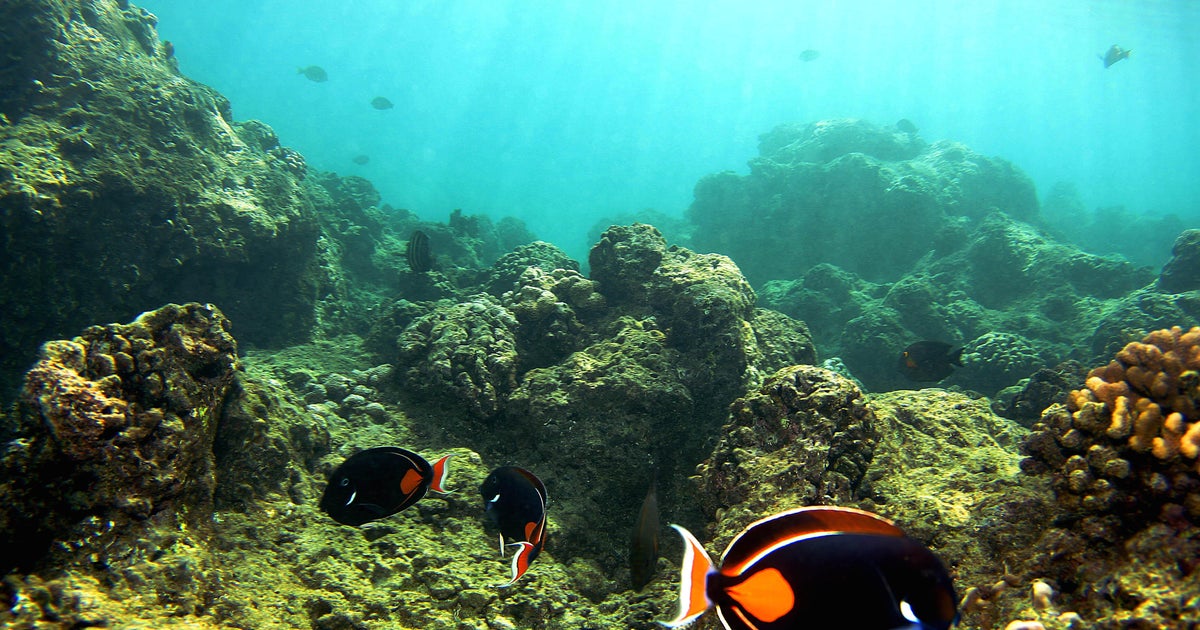
Hawaii moves to ban sale of sunscreens with coral-harming chemicals
Up to 14,000 tons of sunscreen are released onto coral reefs each year, leading to widespread dead zones
CBS News
204 points · by DoreenMichele · 8y ago · 77 comments
It's unfortunate that they are giving credence to EWG as it damages the credibility of the article. EWG amounts to an anti-science pro-organic industry group that uses pseudoscience to push their agenda.
https://www.acsh.org/news/2017/05/25/dear-ewg-why-real-scien...
And yet.
This author's analysis of the EWG "Dirty Dozen" pesticide-residue-on-produce report -- https://www.forbes.com/sites/stevensavage/2018/04/10/the-inc... -- made me wonder about this source.
This author (Steven Savage) claims that: (1) there is evidence that non-organic produce contains more residue of the kind of pesticides which are only used on non-organic produce and not used on organic produce; (2) there is no evidence that the levels of pesticide residue found on non-organic produce are toxic to humans; (3) there is no measurement of the levels of residue of the kinds of pesticides used on organic produce on any produce; (4) there is no evidence that the kinds of pesticides used on organic produce are non-toxic to humans.
This author additionally claims that (5) the EWG report reports fact 1, ignores facts 2, 3, and 4, and uses this combination of facts which he says are misleading in order to assert that certain kinds of produce are more toxic to humans in their non-organic form vs. their organic form. His claims seem to agree with the literature to the extent that I'm able to understand it. As far as I can tell, every year EWG puts out a report which makes this assertion, every year it gets this criticism, and every year their report does not addres this criticism.
Having read this makes me somewhat more skeptical of the EWG's coverage of all topics, not just pesticide residue on produce but also active ingredients in sunscreen.
With all that being said, I currently mostly use sunscreen whose only active ingredient is zinc oxide, which is also the active ingredient in the diaper cream I use on our baby. I don't have any evidence that this is better or worse than using the stuff that kills the coral reefs. It's just convenient.
Granted this is just an opinion. EWG attacks conventional pesticides while ignoring organic practices (see their dirty dozen list). They cite the fraud scientist Seralini when attacking GMOs. Looking at them it's pretty clear they are an organic industry front group.
Personally I think we could achieve more by picking up some ideas from organic farming (e.g. more diversity to combat pests, better preservation of the soil) without demonizing all advances in agriculture like improved fertilizers or GMOs.
In my own experience, organic fruits and vegetables at least taste much better.
> Second, organic produce requires more land, so it's unclear whether that scales to feed all people.
This isn't strictly true. In practice it has been, but it's not inherent to organic production in general but rather how it's been carried out so far. The agricultural system Permaculture addresses this directly and can yield on par with conventional farming.
> And third, many "organic" pesticides are not shown to be better for the environment than the non-organic alternatives.
This too isn't a strict requirement in organic farming, but I guess I'm arguing semantics here. To be more clear, non-conventional farming doesn't require pesticides.
Lack of consistent standards, or authority to enforce mean it's essentially a rubber stamp.
At least that's my understanding of Taleb's argument against GMOs.
Organic is less efficient requiring more inputs and land and can be argued is worse for the environment.
Organic uses pesticides yet they advertise themselves as not.
Worse utilization doesn't mean worse for the environment overall, especially considering the extreme damage conventional farming leaves on the health of the soil, as one example.
> Organic uses pesticides yet they advertise themselves as not.
I do think that it's frustrating the level of permissiveness that the term "organic" encompasses in the US especially, but pesticides aren't required for organic farming -- check out Permaculture.
if they can't ban the luggage-packed sunscreen, perhaps an information campaign. if I know what not to bring, I'll tend to make sure I don't, and I'm not alone.
Solar noon can vary a bit, such as 12:30pm to 1:30pm (depending on DST also).
If one of you biohackers could invent a hormone or something to change your skin color, that would be amazing. Prevent skin cancer/vitamin D deficiency, the kuro gyaru would love it, and maybe we could all find some class more interesting to discriminate against.
"Seriously"?
A fictional movie about carving out someone's brain so you can transplant yours to take over their body?
Plus the last thing I want to do after getting off a long flight is go shopping for toothpaste.
If you follow the TSA regs for liquids, it’s a non-issue.
I tend to stay outside of Lahaina on Maui, and there's a CVS pharmacy (long's drugs), a Walgreens, and a Safeway. all of them tend to carry the same mass-market greasy sunscreen with low spf values. my skin does not do well with that, and I end up extremely sunburnt. bringing my own ends up being a better value proposition.
editing to add: if I'm on vacation, I'm checking a bag, so taking extra liquids is no problem. if I'm traveling for work, I have a bag already packed with everything within TSA requirements, so no need to try to track down a store to walk or ride to somewhere near my hotel.
Most people will check into their hotel first-thing anyway. A 10 minute diversion to stop at a convenience store isn't as bad as you might think.
In the second study ZnO nanoparticles were injected DIRECTLY INTO THE BLOOD of rats with no control for non-nano particles. Crazy they even got it published.
https://www.ncbi.nlm.nih.gov/pmc/articles/PMC5615097/ [19]https://www.ncbi.nlm.nih.gov/pubmed/15191542 [63]https://www.ncbi.nlm.nih.gov/pubmed/15458794
Short summary is that beaches where sunblock is used a lot show much higher concentrations of the relevant chemical compared to beaches where sunscreen is less common or beaches that saw fewer swimmers, and that heightened levels of these chemicals can be observed up to 600 meters out from these beaches. The observed correlation between high concentrations of these chemicals in the water and the lack of coral growths is very strong.