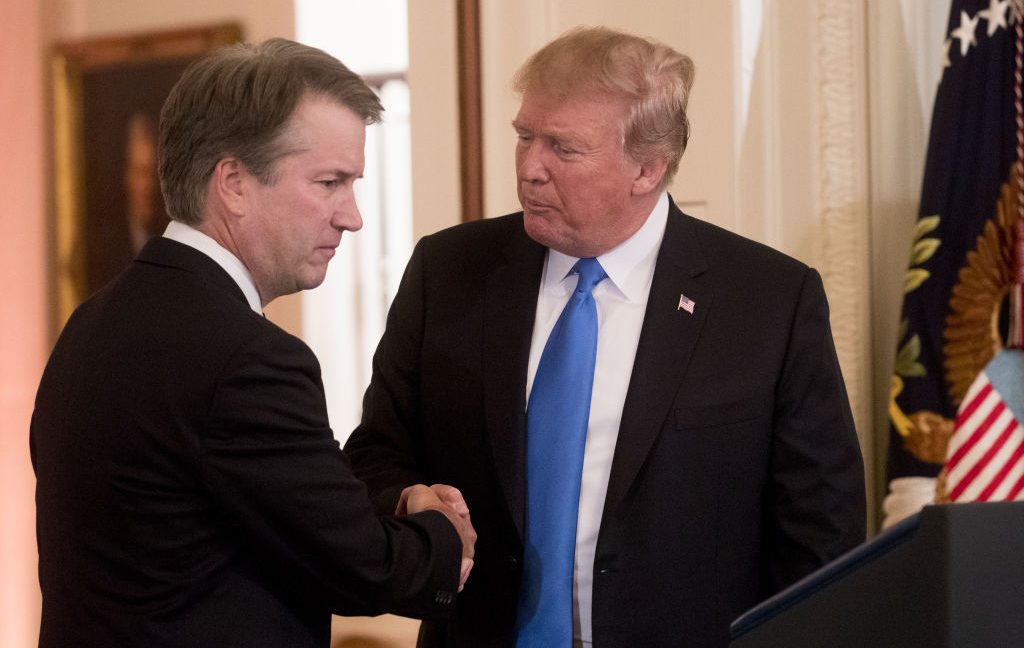
Trump’s Supreme Court pick: ISPs have 1st Amendment right to block websites
Net neutrality violates ISPs' right to edit the Internet, judge wrote.
Ars Technica
41 points · by glitcher · 8y ago · 43 comments
All walled garden, all the time. The internet in general will be replaced by 'Facebook pages'. No more URL bar. Many kids today don't know how to utilize the internet but they do know how to consume apps.
This is the future that you vote for every time you buy an iPhone or a Windows PC. This is the future you buy into when you buy an Android from an OEM that doesn't allow unlocking their bootloader.
It was fun while it lasted, but everything old becomes new again. Business interests and law enforcement are far too entrenched with the current internet for things to ever revert back to the wild west it once was.
Legislators went from thinking the internet was an inconsequential series of tubes to now understanding its implications enough to legislate it, which is indication enough that the party is over. With net neutrality dead, selective law enforcement of content (FO/SESTA) established and ISPs allowed to be choosy with how they participate in a network that depends on global participation to have any utility at all, the walls of this garden are being raised one slab at a time.
Blaming Apple, Microsoft or Google is not the solution. The storm is indeed upon us, but it's not too late to start building an ark.
We could still have a free press, since "the press" is explicitly mentioned in the First Amendment. Whether things that resemble a free press (if that's what you meant by "like") are desirable, is another matter.
That's not the case. There have always been restrictions on commercial speech that are not allowed towards individual speech. For example, it is completely acceptable to restrict commercial speech based on content.
There are plenty of Democrat VCs. I’m sure they have no interest in greed and will be happy to fund you for purely idealistic reasons.
Not really.
https://arstechnica.com/tech-policy/2017/10/another-state-la...
This is the Republican hypocrisy: only corporations (or extremely wealthy individuals) can start ISPs. Municipalities, a.k.a. The People, cannot.
Also, I’m not sure that law actually precludes a municipality from setting up an independent public utility that funds itself with subscription fees rather than taxes.
The contents of, source of, and destination of each packet is none of the ISP's business.
https://arstechnica.com/information-technology/2014/04/one-b...
You could always start your own energy company.
The next contra-agent is making sure states allow local municipalities to own, or regulate, and offer alternatives.
The track record for Republicans in the similar case of health care insurance is, ignore the problem of lack of competition, allow mergers and conglomeration. As a party, it's ideologically lost on both issues.
And the track record for Democrats is not really that much farther behind, they took a busted anti-competitive health insurance market and made it compulsory, while also offering no public option like a Medicare or Medicaid buy-in even though they certainly would have had the votes for it.
So either party poses difficulty with censorship free internet, but as there's no viable 3rd party, for now the emphasis should be on getting more technically qualified people elected at all levels of government, and accept that a lot of persuasion is going to be needed to bring Democrats along.
For all the legal scholars:
Would there be any legal distinction between signals which are broadcasted (as in traditional TV, whether digital or analog) and the structure of the internet having packets exchanged which ultimately contain two MAC addresses between two entities?
Note: Not a network engineer so additional comments on domain specific nuances I may be ignorant of are welcome.
The internet is (arguably) more powerful today than the telephone is, or ever was, as a tool for mass communication, learning, and dissention. If the government allows companies to stifle this resource without themselves providing an unbiased alternative, then the government has effectively, indirectly, snuffed out a very important medium for free speech in the 21st century.
Where that line is drawn is where there should be debate. By what definition is something hostile, and so on.
Are you proposing that EM emissions controlled entirely by the transporting party might spontaneously explode based on the content of the data as transcribed by those automated systems?
"Buy the mall + metro bundle for discounted access to many convenient routes to your favorite shopping destinations!"
This used to seem utterly dystopian, but it's probably right around the corner. For instance, Detroit could be forced to sell off highways and if GM's financing division bought one as an investment...
This is completely analogous to the current issue, just an iteration or two behind. Detroit should be incapable of "selling off highways", as they're public property built out with public money. "Detroit" is a force monopoly that purported to steward public money for public works, not a free enterprise that took private investment to improve private property. An [inherently temporary] politician purporting to represent Detroit while selling off assets for short-term balance sheet boosts is in violation of the public trust and therefore has no actual authority to contract.
All of these communication companies used to fall under the purview of regulated utilities, and were built out using public subsidies. They've lobbied to escape the regulatory regime, and are now playing the "muh propertuh" card with public infrastructure that they essentially embezzled from the public.
If big ISP wishes offer only curated media services instead of general communications, they can easily divest their holdings of this inappropriately-titled public infrastructure to another company which can then carry their traffic non-exclusively.
Sure, maintenance is expensive, but failing to do routine maintenance means a simple repair becomes a big problem.
If there's one thing that America seems to love it's building things, and if there's one thing it seems allergic to it's paying taxes to keep those things in working order.
The only way out for some municipalities might be to offload these expensive responsibilities to third parties (e.g. "Public-Private Partnerships" or outright sale) to get them off their books.
Domino's taking over road repair responsibilities is just the beginning of a sad trend.
The problem here is that roads aren't cheap to maintain but they're necessary and if the only option is a private one then equal access is critical. The same goes for network infrastructure although at a smaller scale.