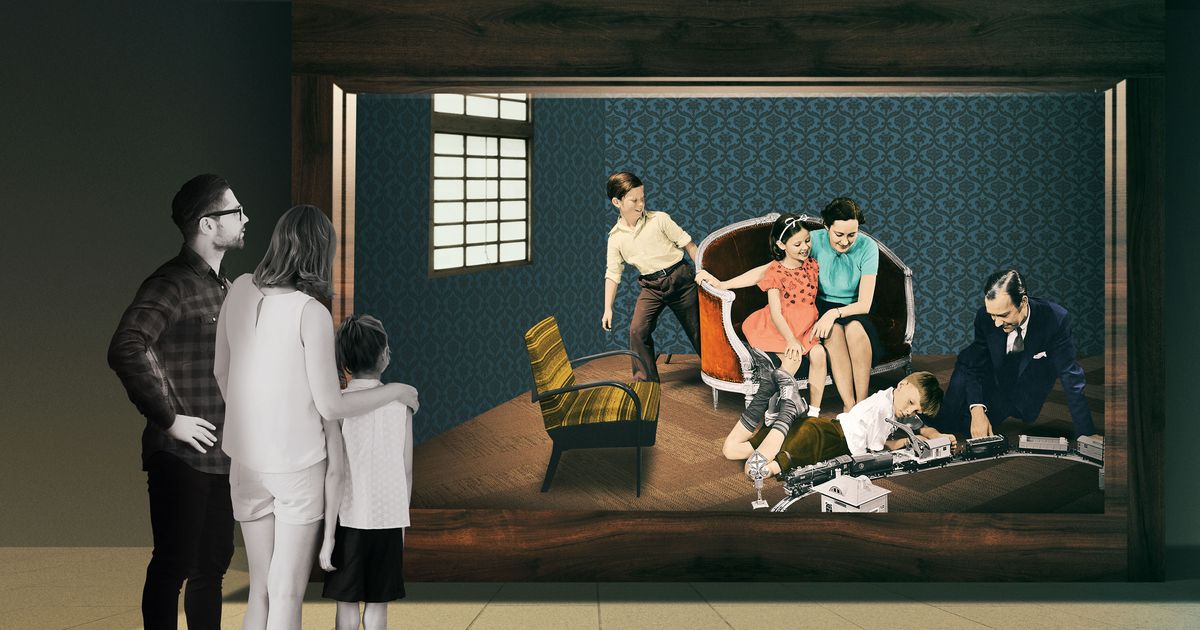
Middle Children Are Going Extinct, Just When We Could Use Them the Most
They’re empaths, peacemakers, negotiators — and an endangered species.
The Cut
75 points · by ALee · 8y ago · 135 comments
There may be something to this, but the math is so intentionally misleading as to murder the credibility of the author.
https://www.amazon.com/Middle-Moffat-Eleanor-Estes/dp/015202...
Three kids here. It's tough, sure. Not for everyone? You can say that too. Rewarding? The most rewarding thing I've yet to experience.
As others mentioned, I didn't really plan all these kids out. Life happens, I guess.
For example, I'm older than my brothers, yet the oldest of them is not a middle child, because he's not a brother of my other brothers.
When families start spreading like this, a kid can be both a middle-child and a firstborn simultaneously - it becomes relative. And the attention that their position supposedly gives them becomes harder to measure.
I've had conversations with our daughter about friends and their families. Nuclear families are uncommon now. It's just what it is. And seeing enough unhealthy marriages; it's probably a lot better that way than the old adage to "stay together for the kids".
Too much negations. Let me compile this for myself and others:
Nuclear families are not normal at all now.
There is not always a "middle child" because that requires at least 2 other children to exist.
You're trying to say that the "third child" is going extinct, which matches what the article is saying in a different way.
Technically, that's an only child and that has articles all its own...
There are both cultural/traditional and [epi]genetic implications of birth order, so this might imply a better or worse suitedness of the role of youngest-child given differing birth orders of the title-holder.
They both did end up having 3 kids, and I can report that I think the problem they thought they were preventing didn't happen. Win!
Yes, that's the whole problem with this discusion. It isn't scientific, lots of anecdata, and correlation does not imply causation.
BTW, 1 is also odd, so I'm not sure if you're just trying to say "used to have 3 children" or literally an odd number (1, 3, 5, 7, 11, 13, 17, 23, etc)
The way I see it, every child who is not either the youngest or the oldest is the/a middle child.
With 3, that's #2. With 4, that's #2 and #3. With 5, that's #2 and #3 and #4.
Though usually the context is that parents have 3 children because that's the most common version of having more than 2 children.
When I look at people who I know and their families, I can report that the middle child always appear to be self-centered, egocentric. As if they lacked love in their youth they're continuously trying to make up for the rest of their life. Oh, and they have twisted ways of justifying that behaviour.
> "Contemporary empirical research shows that birth order does not influence the Big Five personality traits."
https://en.wikipedia.org/wiki/Birth_order
The fact that such a big environmental factor doesn't effect personality at all, to me suggests that personality is mostly genetic. Anecdotally, It sure seems like kids have very distinct personalities from a very start.
Another anecdote (that personality is more nature rather than nurture), is the stories of identical twins adopted to different families. When reunited as adults, they seem to have the same personality. One such story:
> "It's not just our taste in music or books; it goes beyond that. In her, I see the same basic personality. And yet, eventually we had to realize that we're different people with different life histories."
https://www.npr.org/2007/10/25/15629096/identical-strangers-...
The single children where very demanding on their parents. The only source of attention and entertainment is the parents, so this makes sense.
Two children entertain themselves a bit more, but like in duopolic situations you have the most extreme competition. This leads to a lot of fights over shared resources.
With 3+ children fights over resources between 2 children don't lead to zero sum gains, so that the competition actually becomes less. Cooperation becomes more important. And the kids almost always entertain themselves.
I'd definitely say the 3+ children parents were usually the least stressed, but maybe that was just my impression. The older siblings at some point functioned as quasi parents to the younger siblings.
In my experience, usually one child of a set seems to always be a lot more demanding than others.
I'm now experiencing this with my own children to some extent. We have 2 kids so far, a 4 year old boy and a 1 year(and a couple months) old girl. They both wake up around 6:30 in the morning. And whereas before that meant that I'd never get to sleep in past that time, now our son just gathers a bunch of toys, climbs into his sister's crib, and they play until like 8am before they finally get bored and start calling for us. So at least as far as mornings go, 2 kids has proven easier than 1(after that initial 6 months from hell period where you don't get any sleep at all that is)
Can you go into this a bit more? I have a single child, and just thinking of trying to raise another one makes me feel like my lungs are deflating.
(If this isn't a good venue for this conversation, you can email me - my email is in my profile.)
The first is the worst, because now your life is restricted by a child. The second has a small impact, because now it takes two parents to chase the kids. The third has a small impact, because now they can run in 3 different directions.
After that though, it is no big deal. The only thing you notice is when you have to upgrade to a larger vehicle. For me this is now a van with 5 rows of seats.
Everything gets more efficient as the family gets larger. If your vehicle choice drops from 30 MPG to 15 MPG as you go from 4 to 10 people, the per-person numbers have gone from 120 to 150. It's like that for lots of things: cost of a house, time spent shopping, etc. You get a bulk discount. Things purchased for the first kid can be used for the next. The tax situation improves too. With enough kids, you probably won't have to pay any income tax.
With just one, you have already lost your ability to wander freely and be left in peace. You mostly can't lose that more. At this point, you might as well enjoy the benefits of having a huge family.
By the time our third came, I shrugged it off as "well I've already got two... what's a third?"
If I found out we were having a forth, I'd probably feel the same.
It's really weird.
Keeping the population down allows for a better standard of living for those who are alive already, and allows for sustainable growth.
A population explosion is just not possible to deal with. Imagine more people trying to get into the top schools, thereby killing your chances.
With that context, I can clearly see why nobody in a city would want to have more than 2 children.
In short, while I can see the logic in your stance... it has little bearing on the reality of creating a family.
The world population can be increased by everyone having children earlier, or dieing later.
Puzzle: Every couple in Binary Town has twins (boy and girl) at age 32. Then half the population stops reproducing, but the other half change to reproducing at age 16. What happens to the population?
2 is only the replacement rate for 'literally immortal up until a certain date' - morbidly with a corresponding high death rate the number could be 'greater than biologically the theoretical biological limits'.
Binary town's birth rate would go down initially due to the loss of participation reducing the reproducing generation by half but the time between generations being cut by half would mean an effective doubling of the per person rate. Without knowing their rate of death we can't know what happens to their true population over time and it goes without saying that the assumptions will break if their reproductive strategies change yet again.
----------------
Year 1:
age 1 = 10
births = 10
deaths = 0
----------------
Year 2:
age 1 = 10
age 2 = 10
births = 10
deaths = 0
----------------
Year 3:
age 1 = 10
age 2 = 10
age 3 = 10
births = 10
deaths = 0
----------------
Year 4:
age 1 = 10
age 2 = 10
age 3 = 10
age 4 = 10
births = 10
deaths = 10
----------------
Year 5:
age 1 = 10
age 2 = 10
age 3 = 10
age 4 = 10
births = 10
deaths = 10
----------------
Etc. The only way to see a longterm increase in population is with a birth rate > 2, and similarly the only way to see a longterm decline is a birth rate of < 2. 'Longterm' in this case meaning just one generation, at which point the equilibrium kicks in. Of course not everybody dies at the same time, but the effect is identical when you look at an average with some distribution - which is what we have.
However, this also makes the assumption that everybody makes it to the age of fertility and that everybody is fertile. Both assumptions are incorrect so, in reality, the equilibrium point for population stability is even greater than 2. In reality we would expect to see a decline in population if each couple had exactly two children.
I almost feel like that's self regulating. Scarcity of food results in malnourishment which if it doesn't kill anyone directly, will result in other sickness being more likely to kill people. Same with children surviving to adulthood.
https://www.populationmatters.org/wp-content/uploads/2018/03...
I don't think there was anyone in the 1960s screaming "oh crap... there's only 3 billions of us around here!". We're so used to think the now and here as normal conditions that we lose focus on the global trend which is absolutely disastrous.
Then again, there are other memes that lead not just to lack of reproduction, but directly to the death of the memeholder, so maybe it's not such a big deal. Still, just another thing to wonder/worry about.
There is a huge shortage of smart people on the planet to solve the many problems that exist. The best way we know to create more smart people is to encourage smart people to have more children. Unfortunately we seem especially good as a society at identifying smart people and discouraging them from having children.
The idea that smart people are only produced by other smart people is nonsense. Genes regress to the mean, so most smart people won't have mostly smart children. And intelligence is significantly affected by nurture, not just nature.
And beyond all that, smart people aren't the end-all, be-all of humanity. They make useful things, but are of course capable of great evil (or mental illness or any other issue that limits their contribution to society).
Where did I say smart people having children is the only way to create smart people or that intelligence is only affected by genes? Please read what I actually wrote, not what you think I wrote.
Smart people are the people that have the ability to solve the hard problems we face. We have a huge number of very hard problems in the world and not enough smart people to solve them all. We need more smart people.
Don't be ridiculous. If dumb people have more kids than smart people, the next generation will be dumber. Intelligence wouldn't have evolved if this wasn't true.
There are already many smart people who aren’t helping to solve those problems because they haven’t received the necessary education. I’d go so far as to say we’re probably missing out on the potential contributions of most smart people now.
What we need to do is figure out a way to radically increase access to education worldwide.
Yes we are wasting the potential of many smart people in the world by not giving them the education they need, but we are pretty good at it across most of the world already and getting better all the time. A poor very smart kid no matter where she is born will likely be identified and given an education. I personally know many smart people born in total poverty in very poor countries who have reached a very high level of education.
Another major factor contributing is children are very expensive and smart children are much more expensive to raise than the average child.
This is all tangential to my post.
The environment of humans has radically changed and we are undergoing very strong selection and adaption to this new environment. In the past the number of children you had survive to adulthood was tied to the amount of food you could bring in (as with most animals). In the new human environment the number of children you have is a consequence of how resistant you are to the cultural meme that children are undesirable.
Most people I know made decisions about having children in terms of resources. Mainly, about available time and/or money.