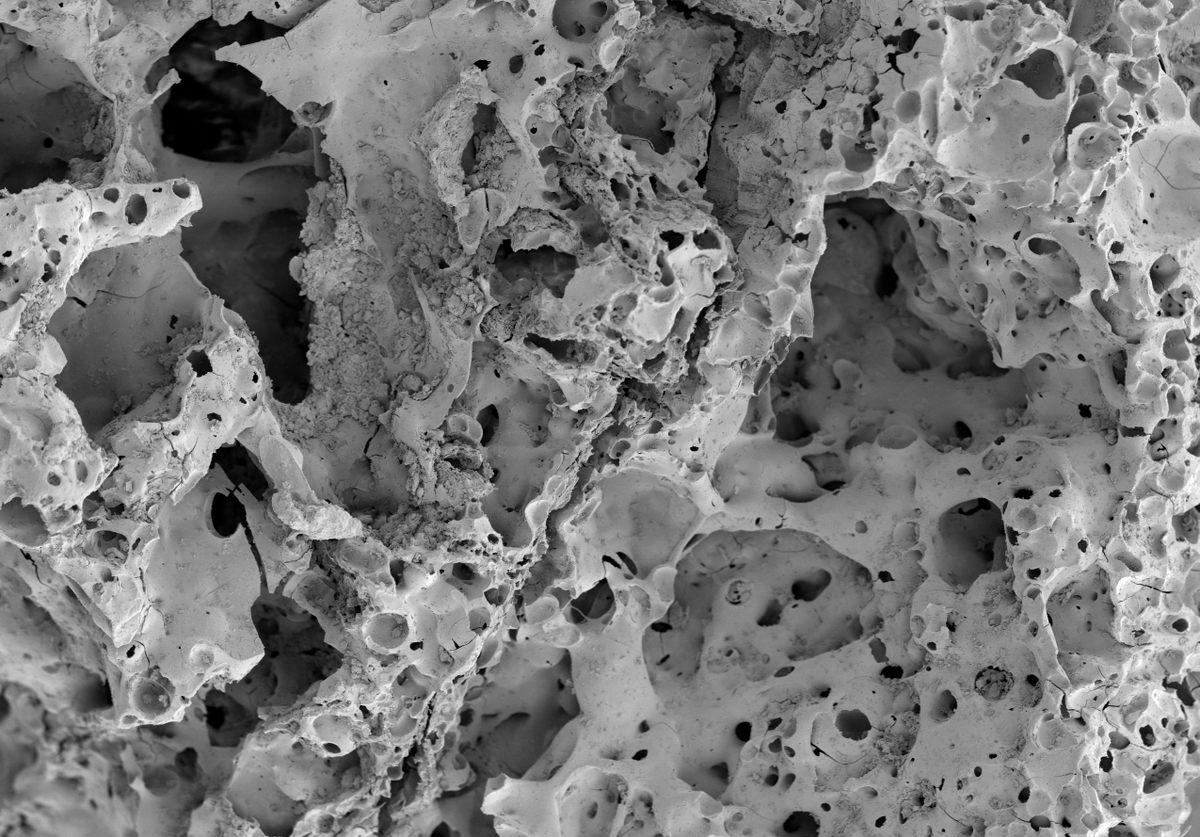
Found: 14,400-Year-Old Flatbread Remains That Predate Agriculture
The burned crumbs shed light on prehistoric hunter-gatherers’ diets.
Atlas Obscura
291 points · by vinayan3 · 8y ago · 162 comments
But why would agriculture have developed, if people were't cooking the stuff? It's true that making bread involves more work than just boiling grain. But bread also serves as ready-to-eat storage. As does beer. And I can imagine how both developed more-or-less accidentally from leftover boiled grain.
Traditionally (and for all I know) the trees weren't farmed. Somebody just walked around until they found a suitable tree and then cut it down. So...hunting and gathering. But IIR, people track the growth of individual trees to make sure they're harvested at the right age, but they aren't specifically planted or cultivated in a "farm" sense.
It's not a terribly different notion from what's being written about here I think. I would guess that humans have found starches of various kinds throughout their environment, extracted and processed them, and then made simple flatbreads or pancakes almost everywhere.
It doesn't even have to be obvious. The line from palm tree to sago is not clear at all. Why even consider eating the core of a tree? Why invent a long, multi-part, labor intensive process to make it more edible? Nobody really knows how it started.
But I think the important point I got from this was that agriculture is not a clean cut-off. You aren't digging out root vegetables one day and then planting wheat the next. There must be some kind of transition period that depends on the local plant life and many of the things that we think of as indicative of post cut-off agriculture societies probably aren't that at all.
People seem to lose sight of that fact: when you're faced with death, you'll try anything.
Even today.
There's a lot of taper along the spectrum: hunting, foraging, gardening, farming, manufacturing.
Trees, fish, mushrooms...
Ditto non food stuffs.
It's important to remember there is no evidence to suggest our 14,400 year-ago-ancestors had office / factory / workshop jobs to go to for 60 hours a week. Probably very little in the way of school or universities assignments to hand in by Friday. And they likely didn't have to pick up the dry cleaning or the kids on their way home.
I'm going to propose that, probably, everything the ancients did was labour intensive. Predominately due to not having invented the powered machine yet.
We even have the ruins of catch traps in central Asia and other places that would have industrialized animal slaughter before agriculture was ever a thing.
Agriculture was likely a required response to human degradation of formerly productive areas for hunter-gatherers due to over-taking of natural resources.
Or, inversely, as soon as they covered their food needs (which could be quite meagre) they were pretty leisurely, like many primitive tribes the ethnologists have studied.
I've read that a leading theory as the transition from hunter-gatherer to agricultural societies was that agricultural societies incentivized larger populations, were able to sustain them, and that their desire for arable land led them to fight - so the transition was not as much towards qualitatively better lifestyle but towards a qualitatively stronger lifestyle. As much as I enjoy beer, I find this more compelling than the theory that people chose to pick up farming just to drink
https://www.nytimes.com/2013/03/17/opinion/sunday/how-beer-g...
Higher ABV requires less fuel for heating the water, and results in a product that keeps better, so why wouldn't some early brewers produce it?
Wild grain would probably grow in the same place year after year, and the tribe would go back to harvest it even though they did not plant it themselves intentionally or irrigated the soil.
The problem about grain before agriculture was to collect it. The right conditions to make that feasible existed only in certain regions.
I think it is clear with this "flatbread" that we are seeing evidence for proto-pizza delivery. They may yet turn up what amount to coupons, perhaps as notches on sticks, or perhaps a receipt or change.
The tools sound like a real obstacle given how fanatically low possession hunter gatherers are - doing things like flint knapping on demand tools instead of specialized tools. Perhaps gatherer divergence - they would need just a pot and maybe a vegetation cutter at most to be useful for gathering and cooking while hunters could need just things to kill and butcher their kills. Wood and stone both being grabbed in situ.
This was my intuition as well. And IIRC, wheat was naturally plentiful in at least some parts of the fertile crescent, such that people could bake bread without needing to farm it. In such places, heavy grinding stones and other artifacts were found which suggested that people had settled (they were far too heavy to be picked up and moved from place to place) because the region was so abundant.
Not that this particular example was an accident from leftover boiled grain.
Just like the experience of fermented milk / yoghurt / cheese -- thousands of years of experience with the possibilities.
Refrigeration is not comfortable to tent-dwelling nomads.
Over the last couple of decades, this 10k-15k ybp period has gotten a lot more interesting. Especially to us romantics, who always want origins to be more ancient and mysterious. The Natufian Culture now has a lot of sites. Everything from proof of a predominantly hunter gatherer diet to a full scale sedentary city, 9,000 year old Jericho. We even know they particularly enjoyed eating cat, and may have domesticated them for food.
Even more remarkable is the progress in southeastern Turkey. Gobleki Tepeh is a find on such a scale that it challenges archeologists to re-narrate the neolithic revolution. Many think that it reverses the old narrative: Agriculture lead to caloric surpluses, permanent settlements, cities, organised religions, kings, advanced art, complex mythology... Maybe an organised religion crowned the first god-kings, designated specialised societal roles, built temples, then cities, and invented agriculture to support them.
Near Gobleki Tepeh is Catal Huyuk, a residential "city" archeologically and temporally similar Jericho. It appears to have been built after Gobleki Tepeh, a more "ritualistic" site. Perhaps archeologists should be looking for ancient temple sites, predating Jericho.
Perhaps the Egyptian pattern is to be expected. First, giant ritualistic projects are undertaken. Politics appears to be simple, the king is a god. People do what he says. Complexity comes later. Maybe this is normal. Maybe modes of production follow from modes of culture, to put it in 19th century terms.
Egypt's old kingdom were the the great builders. Out of "nowhere" they suddenly take on massive works, million man-year projects. The middle & new kingdoms were more advanced politically, agriculturally, economically & militarily. But, the scale of ritualistic sites declined. They still had great temples, and fine art keeps progressing. Literature proliferates. Law advances. But, the amount of labour dedicated to pure ritual seems to peak near the "beginning."
It is a fascinating period. The middle east definitely has its roots here. Keep up the good work archeologists. We appreciate it, us spectators.
https://phys.org/news/2017-04-ancient-stone-pillars-clues-co...
https://www.newscientist.com/article/2128512-ancient-carving...
Science might just have found the cause for the flood myth that is present in most cultures around the world.
That said, the entire site is of interest to those interested in flood myths. It was an active site during the period when climactic disasters and floods were happening. Ice melted. Seas rose. The nearby black sea was expanding, and eventually spilled into the aegean. This is also (intriguingly) the date plato gave for atlantis' destruction.
In Egypt the dakhleh oasis has evidence of habitation for 200,000 years. I don't know if what's meant by habitation means it's always been human or generally hominid. But I think 200,000 years is quite recent for any hominids other than what we became to be around.
The other interesting thing is the situation of the San indigenous people of southern Africa region. They are supposedly a very old culture living in the area well over 100,000 years and even their DNA is unique compared to other African peoples. It's odd to think the Bantu, Zulu etc. are the "invaders" of the region, the new people in the area.
There was also a neanderthal population that seems to have succeeded and older sapien population, which is unusual in the record.
It's very old people stomping grounds, for pretty much any definition of people. Pretty much anything from early homo erectus to early scholars has a token ancestor there.
http://www.astonishinglegends.com/al-podcasts/2018/5/26/ep-1...
http://www.astonishinglegends.com/al-podcasts/2018/06/10/ep-...
http://www.astonishinglegends.com/al-podcasts/2018/06/17/ep-...
Kathleen Kenyon’s findings seem to match the events described in the Bible.
Edit: OK, you'd need to say years ago but still, is this another part of the dropping the AD and BC tendency?
We use a lot more acronyms these days, generally. The better ones can be guessed from context. I personally don't mind the BC/AD, for iron age and later. It's actually convenient that year 0 corresponds roughly to the beginning of Rome's height.
OK, I'd never it before (had to google it).
IMHO these early people were smart enough to work out ways to eat things that were available to them. They probably had cooking with heat, boiling in water, grinding with stone, and probably worked out using salted water for preservation, and kept the spoiled food that had random yeast that tasted good and used it for culture.
Rice is a soft grain and can be eaten whole. Grains like wheat are HARD and need grinding to be edible. The hard grains keep well, so there was a big incentive to work out how to use them. A tribe that got it right probably had quite an advantage.
The movie "10,000" works on this idea.
But wheat did not existed back then. And the wild grains I know, are edible with your teeth ...
The quality of grains that made them staples is that they could be dried/hardened. That way they keep all winter, can be traded, etc.
For an everyday example, think of beans. We sometimes eat them fresh/soft as vegetables (green beans or edamame). More often they're dried, stored, traded on commodity markets and then re-softened to be eaten as soy cheese or chili con carne.
And these wild species formed the basis for agriculture later.
For example: What constitutes a settlement anyway? Just how long does it need to be in use before it's a settlement instead of a camp? Does regular seasonal use constitute permanence? In many hunter gatherer societies agriculture is documented. What about if shelter is natural (rock shelter), mobile (yurts or boats) or unnecessary (good weather)?
This is all part of a general ancient history rethink that I think it's fair to say is going on. We've figured out that ancient history is far more nuanced than many 20th century Western history scholars gave it credit for, and modern archaeology and genetics in particular are only now showing us the scale of our misconceptions.
Example areas of complete rethink: peopling of the Americas, continued diversity (and interbreeding with) non-homo-sapiens, speed and breadth of human diffusion, speed and breadth of technology invention and diffusion in pre-historic peoples.
Even if they are 100% right, it doesn't really upend anything majorly. It just means what it says - hunter-gatherers turned the grains they gathered into bread 5000 years earlier than we thought. Any how, the Natufians and Chinese are thought to be the first two cultures to become agricultural.
What you're talking about is 20/20 hindsight. You're living in a world with self-driving cars and Mars space probes and croissants and corn and looking back with that lens. There were innumerable barriers entering into agriculture (and not only barriers, but most hunter-gatherer bands preferred roaming around their territory as opposed to remaining in one place all the time and doing the same thing every day).
We did not have corn and wheat and domesticated animals and oxen and crop rotation. Infectious diseases were as much a problem as when the New World's indigenous societies encountered Europeans.
Anthropologists say the Neolithic revolution was dramatic because it was dramatic. It was a complete transformation of society - more socially transformative than anything that has happened in the past 30000 years.
Here's the problem, there's an established 'story' and if someone tries to go against that established 'story' about human history, they will find themselves unemployable. They will not be permitted to be a part of digs, they will not be able to find grant money, they will not be able to find a university that will take them in.
If someone finds something that even adds doubt it's immediately labeled a misinterpretation, a fake, some natural process that resembles human activity etc.
Add to that if you go back to Toba supervolcano 70,000 years ago you wipe out most of the human population at the time with some estimates getting you into a few thousand humans across the entire planet which obviously could have ended societies that did exist at the time and were not nomadic, if they were using largely grass and wood for their construction, a supervolcano erupting could have quickly led to using construction materials for heat source, as a source of food for any animals that were struggling to find food etc. Even small settlements spread out might go undiscovered by archaeologists for centuries.
If you look at Kenya’s Olorgesailie Basin there's potentially evidence of tool building 320,000 years ago. That right there kinda takes everything and goes "yeahhhhhhhhhh we're probably wrong" https://www.popularmechanics.com/science/archaeology/a194478...
Telling me we had tools 320k years ago but we didn't figure out agriculture until 12-14k years ago? Heh. Ssssssure.
I urge anyone to go read about the history of archaeology, it's only until extremely recently (the mid 1900's) that it even started to become a proper science and even then most of the labor was untrained volunteer and many an important site were discovered by people native to the area before properly trained people were notified and brought in.
Even recorded history is extremely suspect until very modern times. Some will argue it didn't become reliable until the 11th-12th century but we still see instances of stuff unreliable past that. Some firmly believe Joan of Arc is a fabrication for example, which calls 15th century 'history' into question... when someone questions her existence with logic they are quickly called a 'revisionist' and considered a nutjob though.
The fact that 'revisionist' and 'historical revisionism' exist as concepts are troubling because they are often used disparagingly of anyone that questions the 'official story' where in other disciplines it would be considered healthy skepticism.
Absolute baloney, if you were a little older you might realize that "the stories" are, in fact, constantly updated and revised which is how we would expect science to work. In this case there is other support for earlier agriculture (e.g. Tell Abu Hureyra) and the people involved in that work are hardly "unemployable":
https://en.wikipedia.org/wiki/Gordon_Hillman
That's demonstrably false. Here are a few counterexamples:
1. http://www.cam.ac.uk/research/news/from-foraging-to-farming-... (Cambridge)
2. https://books.google.com/books?id=G3QPo7lThXsC&pg=PA1#v=onep...
3. https://www.sciencedaily.com/releases/2015/07/150722144709.h...
These are all researchers that argue that cultivation occurred much earlier than the 10-12k year ago date commonly given, and was often done opportunistically by hunter-gatherer groups.
Historical revisionism usually refers to re-writing history on ideological grounds, i.e. "it would better suit my interest group if people thought it happened this way," or more insidiously "it confirms my belief system if it happened this way." That's why it exists as a concept, if someone is questioning the norm on the grounds of archeology and they get called revisionist that's just a misapplication of the term.
On the flip side, in ancient Chinese history it has been quite amazing to see how much detail preserved in written form has very recently been validated through archaeology. One major example was the 1980s discovery of the Shu kingdom: https://en.wikipedia.org/wiki/Shu_(state)
I think you misunderstood the problem. It's not about "figuring out" agriculture, it's about finding a reason to do it. There's nothing obviously benefitial in staying in one place and working just as hard if not harder.
As they say, everything is obvious in hindsight.
Are you really dismissing an entire academic discipline because you believe everyone in it is collectively either dishonest or insane?
This is the sort of reasoning that leads people to dismiss climate change or vaccination as grand conspiracies against the public. Huge claims require huge evidence. To entertain your claim I would expect you to produce not one but mountains of sources. Otherwise you're basically dismissing all of anthropology and archaeology as fake? What's more likely, given the evidence, that every academic professor is a nutjob or that you're wrong?
https://en.wikipedia.org/wiki/Doggerland
https://www.deviantart.com/atlas-v7x/art/Coastlines-of-the-I...
Even in recorded history, terrain is much more malleable than you might expect - rivers changing their course, sometimes wildly, is not especially uncommon. For instance, it is well attested that the Yellow River has changed course such that it has reached the sea both north and south of Shandong in various eras.
http://factsanddetails.com/media/2/20090526-history-Yellow-R...
It doesn't seem to be obvious to most highly educated people I know. From their perspective, the history of humanity might as well be only 5,000 years old, they rarely open up to any kind of interest in the fact that ancient civilizations from 3K-5K BC considered _their own civilizations_ to be degraded forms of much earlier civilizations.
It is also completely off the boards to discuss the potential of rapid techtonic shifts periodically erasing human societies. There are quite a few underwater cities in ruins, and of course myths and legends of even larger ones. But they don't get much play.
Importantly, cultures with oral traditions are much more capable of recording accurately details from 10,000+ years ago: https://www.smithsonianmag.com/smart-news/australian-stories...
Indeed, the tsunami back in what 2005 revealed ancient ruins out underwater, carved animals and a temple when the water receded. An entire city, right there in front of their noses, only revealed when a massive tsunami caused the water to recede temporarily.
Then look at how entire islands effectively have all traces of humans scrubbed from them when hurricanes go over, or islands that disappear outright from rising sea levels like these 5 https://www.cnn.com/2016/05/10/world/pacific-solomon-islands... as well as Sandy Island https://www.wikiwand.com/en/Sandy_Island,_New_Caledonia
That is fascinating. Which civilizations were these, and where can I read about them? Did they think that because there were civilizational collapses earlier in human history?
Australian Aboriginies where making bread from native grasses for many thousands years, finely ground with stones, toxins washed out and cooked on hot coals and stones
.. not a Seeminly well informed professor
Grain yield pre agriculture is supposed to be really low. So low that there are hypothesis claiming that it was used to brew beer and eating the grain directly wouldn't be viable for the tribe. I guess we'll wait and see as more researchers chimes into this.
Edit: Downvotes as if the comment is controversial? Here is some food for thought:
https://www.techtimes.com/articles/71133/20150722/discovery-...
http://thedailyjournalist.com/scientia/the-origins-of-chines...
https://www.npr.org/sections/thesalt/2016/07/15/485722228/wh...
https://www.sciencedaily.com/releases/2015/07/150722144709.h...
https://arstechnica.com/science/2017/08/evidence-that-humans...
http://journals.plos.org/plosone/article?id=10.1371/journal....
http://www.cam.ac.uk/research/news/rice-farming-in-india-muc...
https://www.youtube.com/channel/UC2I6Et1JkidnnbWgJFiMeHA/fea...
Mmm...that tastes...disgusting...I’m going to eat some more...
Cheese would have probably been easier than bread!