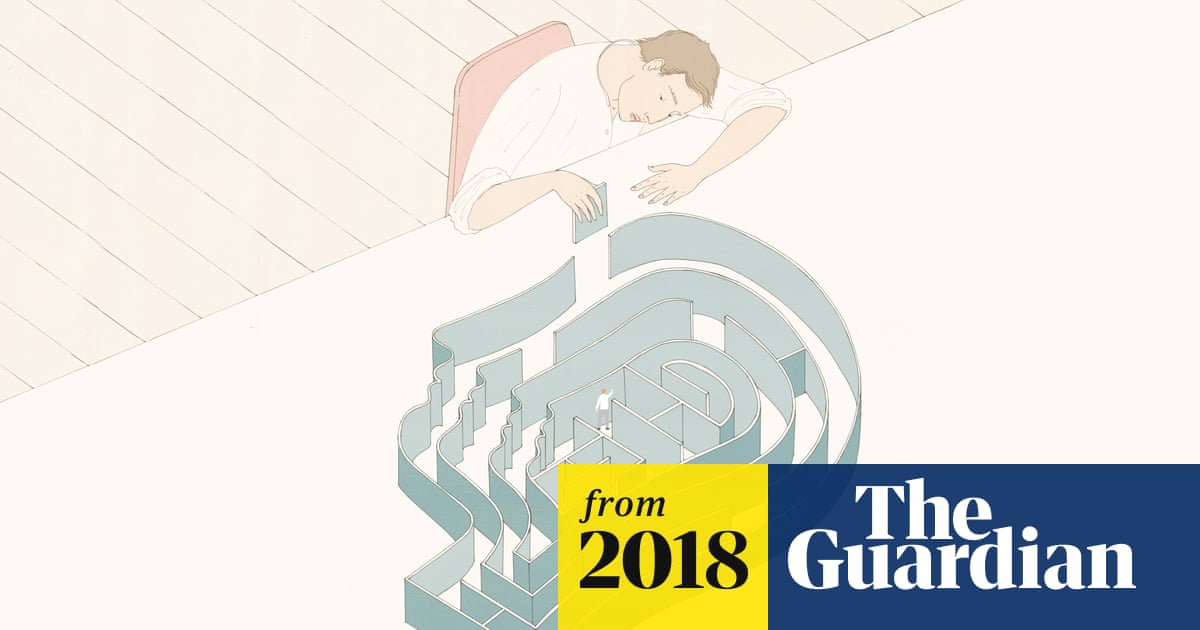
‘My brain feels like it’s been punched’: the intolerable rise of perfectionism
The pursuit of perfection, taken to extremes, can lead to OCD and depression – and the number of students reporting the problem has jumped by 33% since 1989
the Guardian
142 points · by pmoriarty · 8y ago · 99 comments
You never see mediocrity anymore, everyone has curated Instagram and Facebook feeds of their best moments. If you do see it, it's the process of something like America's Got Talent where it's laughed at.
Dave Grohl of the Foo Fighters said it really well [0]. Everyone that we see doing almost anything online is really really good at it, so people get intimidated that they can't do what 8 year old prodigies are doing. There is such a gap between good and great that people are afraid of taking the time to make the jump since the other side feels so far away. It's ok to be bad at things, it's ok if your art or passion doesn't change the world. It's ok if you enjoy the journey and the destination isn't the top of the charts or a world championship in whatever.
[0] https://www.theglobeandmail.com/life/the-hot-button/dave-gro...
Not everyone is curating profiles, not everyone cares what other people are doing, not everybody wants to be told what to think from someone else.
But you will never know if you don't turn that shit off and start to do what you want to do without fear.
People like to imagine that most gained popularity organically, but there's a lot of expensive marketing, gaming of algorithms and outright cheating (paying for followers/comments/reviews/likes, paying other personas to promote their own without disclosure etc).
It's a reminder that there are probably a lot of very capable, talented people out there who aren't as dedicated to making an online presence for themselves.
and i feel, more often than not, people in the positions of acclaim and power got there more by luck and being in the right place at the right time while having supplemented this with hard work and some intelligence, and not the other way around. it is much more difficult to exist as a person who thinks outside the box versus one who thinks inside the box but knows the right people.
It basically says that 27% of the population are night owls and are in an evolutionary sense our natural night watch and when forced into a daytime schedule, always tired.
It completely misses the underlying point.
I think people are naturally predisposed to certain behaviors but it's not a sealed fate. Diet, exercise and environment might even be more dominant factors.
Parent didn't say anything about forcing.
> Perfectionism is a personality trait rather than a mental health condition. There is no World Health Organization diagnosis code for perfectionism and it is not listed in the American Psychiatric Association’s Diagnostic and Statistical Manual of Mental Disorders. It can fly under the radar and masquerade as the pursuit of high standards, yet it overlaps with a plethora of disorders from eating to obsessive-compulsive disorder, anxiety, body dysmorphia, depression and suicide.
Note how it simultaneously says “perfectionism is not a mental health condition”, then proceeds to immediately insuinate it is effectively a mental disorder. This continues throughout the rest of the article.
The domain of neurodiversity as a whole is far more complex than reducing the whole of a phenomenon to such simplistic and IMO damagingly derogatory terms as “interolerable rise of perfectionism”.
Despite the author’s attempt to interleave a few studies with personal stories, it conveniently neglects to tell the stories of “happy perfectionism”: There are many like myself, for whom pursuing this internal motivation for perfectionism turns out to be immensely intrinsically rewarding. In fact, I believe this intrinsic pleasure some (small percentage of the population) take from striving for perfection to have played (and continues to play) a pivotal role in humanity’s rise in technological advancement.
It is not the destination, but the journey (to asymptotically approach a vision of perfection), that healthy perfectionists find so rewarding. Certainly, pathological corruptions of perfectionism exist (for example, any such case where you experience distress or suffering for not achieving infinite perfection, despite it being obviously unattainable) — but this is true for all personality traits.
Honestly I think the mental health care industry is getting nervous over how complex, diverse and non-trivial it is to understand minds.
It's easy for the field to operate on the premise 'but these poor people, we are trying to help them!'. It's at the least, a bit absurd to be hypercritical over every little detail of thinking, acting, behaving, processing, etc and consider that 'help'.
I agree with you that perfectionism doesn't have to be a bad thing. It seems more that one has to be cautious with who one displays those characteristics towards because it can easily provocate insecurity in others, unintentionally. Which can be a totally reasonable reaction, life sometimes sucks and happens and things one wants to be devoted to may have to be deprioritized.
But if you want to be a perfectionist and are in a place in life where you can afford to devote yourself that much, then you shouldn't let the fact that other people made different choices get to you to the point that it halts your own ability to progress.
Another topical example is "internet addiction"; they're not pathologizing "being on the internet a lot", they're pathologizing "being on the internet so much it materially adversely affects your life". I know plenty of people in 2018 who are on the Internet in one form or another "a lot", but at the moment don't know anybody for whom it is materially adversely affecting their life. But I knew someone circa 1997 in college for whom that would be true. (Arguably at one point I came close, but I never quite crossed the threshold of playing Quake II online to the exclusion of the things I needed to do. I perhaps did not do them as well as I should have, but I did them well enough.)
Of course there's a lot of give in that boundary, and there are people who cross it. But at least conceptually, the proliferation of pathologies is less bad than it looks. Nominally they're not creating new ones, but merely recognizing more ways in which you can be materially negatively impacted that already existed.
Sometimes you have to go through the hard stuff to get things to be perfect. Mental health care can sit there and explain every cliche aphorism while you wait to get to that point, but that doesn't mean it's doing anything useful for some individuals. It could just be a waste of time, resources, energy, and distract from focus - especially if you have a problem solving mind you value and accidentally wind up syncing into 'the problems of mental health care' while going through the process of re-correcting maladaptive perfectionism.
It has to be taken a possibility that for some people, mental health care itself can have an adverse effect on the mind. If a person isn't getting that validation in their life, it's very easy to jump to other types of problems, like psychological ones. This can give a sense of progress but is ultimately unfilling.
Anything can be made to be seen as a problem and anything can be made to be seen as a solution when mental health care is so generalized to the point that literally anything you do can be connected or related in some way to everything you do. That doesn't mean a directional rule of causality can be inferred. The obvious is that anything you do is related directly through the fact that your own existence defines the relation between what you did and what you do. There is that obvious connection. But just because some stuff you do yields results and other stuff does not, doesn't mean there exists an intrinsic rule one can rely upon eternally as though it were gospel.
Perfectionism becomes maladaptive when individuals are not willing to be adapative. The mental health care industry is not precluded from this very normal, very characteristic trait of being human. Nothing granted it that authority absolutely and nothing ever will. The industry is made of people just as capable of being flawed as the ones they identify as ill. It doesn't mean they understand all perspectives of being human.
This sentence seemed to irk me; because at what point does someone have to police themselves to ensure they don't "hurt someone else's feelings"? My generalization is a bit crass, but that's how this sentence came off.
Controlling what you say is seen as bad thing online, but it is a thing that majority of people in real world do constantly and are expected to.
My perspective in the U.S. we are living in a time where this kind of authority is desired highly by lots of people because it's being reflected as 'the standard' with the current leadership. The problem is it's fundamentally built on principles that operate like a pyramid scheme. If you want that authority, the more you must conform. The more you conform, the more sameness you see. The more sameness you see, the more you can pretend you are the one with the authority. Carrot, stick, etc.
So if you aren't the literal leader that allows you to be manipulated very easily. I'd rather just have the awareness. My individual autonomy of reasoning is not something to be sacrificed because it goes down to my own personal core and it is fundamentally vital for me to believe I am sane, which is absolutely essential when I have time to myself to think for myself (not to mention essential for survival, I reason for a living - software). It's clearly easy to get caught in the waves of group thinking. People all make mistakes.
Only to the point they appreciate being well liked by others.
The people I know who do this the least definitely have a much harder time with other people then the people I know who do this the best.
Swap 'rich' in for 'nervous'.
It's practical because if you have a condition, you can be sold a bunch of products and services you did not need in the first place! Progress.
More seriously, the explosion of conditions not based on anything tangible (pseudo, unvalidated criteria) and supported by health professionals trying to capitalize on it is the real issue. It becomes a serious issue when they convince legislators and health bodies that it's real, using lobbying and other tactics.
In fact, I think actually calling it this, a fear of failure, vs. calling it "perfectionism" is actually a lot more constructive because it makes it easier for people to agree on the problem. I think most people would agree that having a willingness to try and perhaps fail is a good thing, and a deep fear of this failure is unhealthy and unproductive. Contrast that with "perfectionism", which many people (you) argue is more about the striving to succeed and do better, and most people I think would agree that is a good thing.
Please don't define what you have as what it is. There are too many odd people who define what they are as on the spectrum and talk of bullshit like neurodiversity when people legitimately suffer and have serious negative consequences in their lives from it. Perfectionism ruins lives and warps relationships with people precisely because its not about striving while realizing you can't ultimately have it. That's just what normal people do, try and do the best they can while realizing a lot is out of their hands.
I submit that that is exactly what perfectionism is which is, for all intents and purposes, a variation of scrupulosity. What you may be describing is something like a desire for high standards or a general love of growth.
Perfect isn't even an unchanging state. The better you are, the higher your standards become.
The conclusion of the study was that the first group, who was just focused on volume of output, actually produced more creative works than the group specifically focused on "creativity".
[1] https://blog.codinghorror.com/quantity-always-trumps-quality...
Establishing dependency primarily on anything besides your own standard is a shortcut to misery when someone just doesn't care enough about every little detail you lovingly put into something.
You may annoy the fuck out of everyone around you if you are actually successful, and it's important to be in a social environment where people are tolerant of perfectionism and thrive from it.
It's just called being devoted. It doesn't have to be trivialized to a pejorative and mapped to a set of things approximately related to whatever goal you define. People can pick up on all of these things and get it wrong because unless you explain to them the point of all your work they won't necessarily understand it. It's then easy to internalize their issues as your own, which can implicitly shift your own standards, preferences.
'Better' in comparison to others is a state of mind that is ultimately destructive. If you like details and like feeling a sense of progress you define, better is perfectly fine to want to be. Muted, dull sameness has it's own tormented unchanging cyclical state that can be just as challenging to direct oneself out of once you convince yourself into it.
By deeming yourself a perfectionist, you openly state that you do not meet you own standards.
Resolution lies on either end, depending on how possible/practical it is to improve a given skill.
My dictionary defines 'exigence' (which I had not encountered before) as "an urgent need or demand", and I find that hard to parse. Is either of the parses "… who is more demanding than talented" or (like "grasp exceeds reach") "… whose demands exceed his or her talent" correct? If not, would you mind clarifying?
Many French words built on that template (direct latin root + -ent/-ence suffix) can be used as is in English, but it is not always the case.
Without such a connection, the reasoning for stating this is unclear to me. Could you clarify?
Me neither, in this context - though there's the US legal concept of "exigent circumstances" which allows police officers to enter property without a warrant if they believe a crime is in progress.
Indeed, I had encountered 'exigency' and so had some idea of the general idea—just never 'exigence'.
Don't these two sentences contradict each other? Taking 'orthogonal' to be loosely synonymous with 'uncorrelated', if they were so, then you would expect to see roughly the same number of untalented perfectionists as talented ones.
In my mind I had an explanation for that. I realize that I mainly hang out with people that I went to university with (since I moved to a new city to study) as well as collegues (which also have higher than average education).
And I figured that untalented perfectionists would have a hard time enjoying/coping with higher education and thus possibly quite underrepresented in my social circles.
Anecdotally, from what little I've spent thinking on this, my experience seem to match that (untalented perfectionists are generally not well educated).
That was my theory/reasoning at least.
Edit: In other words, it's easier to have good taste than it is to be good at designing/producing something.
The point of perfectionism is to be more talented. If you read too deeply into that and don't look at the whole picture, of course it's going to be annoying. But the root starts with a desire to be better because the feeling of stagnation is intolerable.
I suspect there’s a triplet at play here, with either discipline or bravery as the other side. A demotivated perfectionist never rises to their own challenge. With a motivated one, get out of the way or get run over.
it explains why many scientists are self-denying and perfectionistic: failure is the rule during experimentation, and progress is not guaranteed or even knowable sometimes.
i think that eventually it gets inseparable from the person. the reaction becomes a habit, and then it sticks.
https://www.youtube.com/watch?v=X2wLP0izeJE
This guy is perfect.
This is one reason why I think we need a school reform where exams aren't rated as much on perfectionism, but more on broad knowledge.
I.e. if you can only solve a part of the questions but more of the questions then you can still receive a good grade. Basically make the tests longer and more broad than what you expect and give 150% of the points. That way you can either solve 2/3 like normal, or you solve more of the problems imperfectly and get the same result. It allows for more learning styles.
This way you could probably cover much more knowledge in a shorter time frame. Because a lot of the imperfect knowledge will get better over time eventually when you learn knowledge that builds upon it.
I thought it would be more about working conditions which at least for me and with control and checks everywhere in place leaves less and less space for humans to err, favouring perfectionists.
> ‘Even exercise doesn’t sound like a total escape for Tom Nicol: he is training to beat his dad’s personal best mile time.’
Oh wow, training to beat another runner's time. What pathos, what suffering! Give me a break.
I know I have OCD tendencies, and I've found that if I can harness it properly (mostly by just being aware of when I am in a obsessive state) I can really internalize the topic at hand and add the new knowledge/skill to my everyday repertoire.