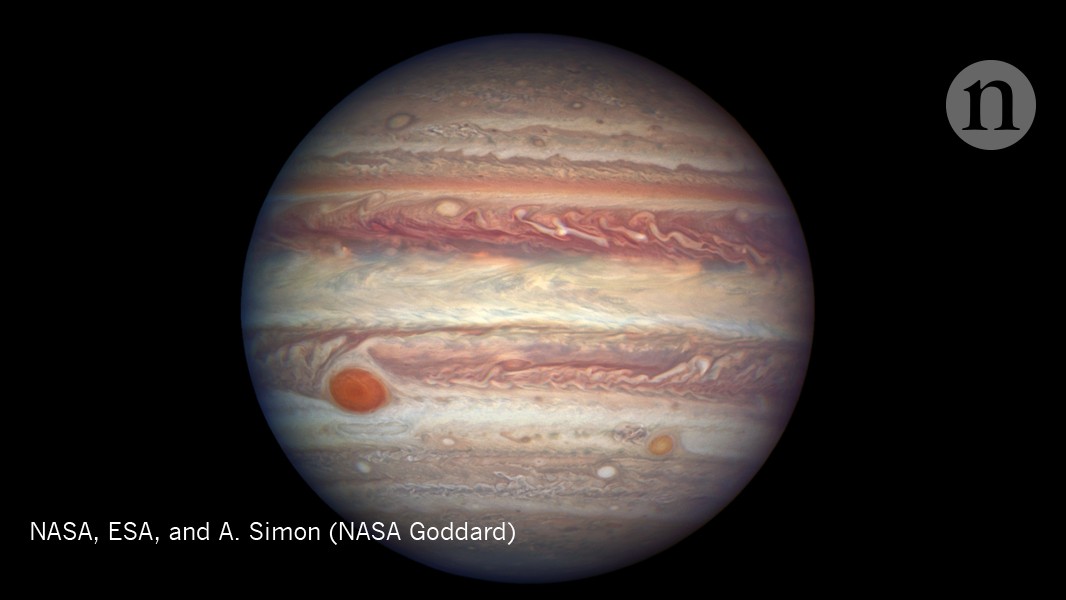
Jupiter has 10 more moons we didn't know about — and they're weird
The planet now has 79 known moons, including a tiny oddball on a collision course with its neighbours.
nature.com
249 points · by oedmarap · 8y ago · 105 comments
Plus, without a lower boundary, pretty much every single chunk of ice in Saturn's rings would count as a moon, so having a formalized definition might come in handy. ;-)
https://www.sciencealert.com/nasa-scientists-have-proposed-a...
A fun read about this:
- [Asimov - The Relativity of Wrong](http://chem.tufts.edu/answersinscience/relativityofwrong.htm)
From the link above:
> To put it another way, on a flat surface, curvature is 0 per mile everywhere. On the earth's spherical surface, curvature is 0.000126 per mile everywhere (or 8 inches per mile). On the earth's oblate spheroidal surface, the curvature varies from 7.973 inches to the mile to 8.027 inches to the mile.
> The correction in going from spherical to oblate spheroidal is much smaller than going from flat to spherical. Therefore, although the notion of the earth as a sphere is wrong, strictly speaking, it is not as wrong as the notion of the earth as flat.
I've seen a couple fairly decent arguments that Earth/Moon should be considered a double planet.
One is that for every moon we know of except for Earth's, the force on that moon from the planet's gravity is more than the force on that moon from the Sun's gravity.
That's not the case for the Moon. The gravitational force on the Moon from the Sun is about twice as much as the gravitation force on it from the Earth.
I could accept a requirement for moon status being that the thing you are a moon of is the thing that has the strongest gravitational hold on you. For the Moon, that is the Sun.
Another argument is based on the shape of the paths of the bodies as seen from the Sun. Planets follow convex paths. Their moons swing them in and out as the moons go around them, but that just reduces the curvature of the planet's orbit. The Moon, for example, turns the Earth's path as seen from the Sun from essentially a circle (the eccentricity of the ellipse is low enough we can ignore it for this discussion) into a regular 12-gon with broadly rounded corners.
Same goes for other planets with moons, except their convex shape is more complicated because they have multiple moons.
When you look at those other moons from the Sun's viewpoint, they are not following convex paths. They are more like something you might have made when you first played with a Spirograph as a kid.
Except for the Moon. The Moon's path as seen from the Sun has the same basic shape as Earth's, a rounded 12-gon. In other words, it looks like a planet path, not a moon path.
(I'm not sure if that is actually another argument. It may follow from the first argument, the relative gravity strength one...I've not tried to do the math to see).
I find both these arguments pretty good, with one caveat. What happens with even bigger moons relative to their planet than the Moon?
Imagine if Earth had a moon that was much closer to Earth's mass, say 70 or 80%, and much closer to Earth?
Going by either the tug-of-war with the Sun criteria, or the convexity of orbit as seen from the Sun criteria, I think we could get a situation where each body would be classified as a moon of the other! I don't think we want to allow a system that is all moons, so we'll need some fiddling so that in this case they are both planets.
(Credits: I'm reasonably convinced I got both of the above arguments from one of Isaac Asimov's books that collected the monthly science columns he wrote for The Magazine of Fantasy and Science Fiction)
It should at least be considered a planet and dwarf planet pair. After all, the Moon is larger than Pluto. The relative size of the Moon compared to Earth is enough to convince me. Binary planet or double planet would make fine nomenclature.
Setting up science nerds for thousands of years of suspense!
While I'm thinking about spooky space stories. Jupiter creeps me right the hell out. Thinking about being on one of its moons where Jupiter takes up a HUGE percentage of your visible sky and is just screaming radiation at you. Personify the gas giant a little and you've got a decent proxy for hell. https://solarsystem.nasa.gov/resources/184/simulated-view-fr...
Remember that they would be attracted to each other, so the orbit would have to be absolutely perfect for this to work.
Imagine an X - each moon traveling on one of the lines, and just barely touching at the center of the X. Their speed would be incredibly high - don't try to touch the other moon, in fact it would be so fast you might not even be able to see it. (In reality X would be very curved.)
At those speeds, and the necessary angle, I'm not convinced you would be able to see it at all.
The actual encounter would last for too short of a time to see (like trying to see a bullet in flight), and their motion would take them out of your field of view, unless the planet you were on was rotating very fast.
In order for a moon to enter orbit around a planet it must lose energy, there are two ways for it to do this: Crash into another object, or complicated 3-body interactions, which fling another object away.
> It may be the leftovers of a bigger cosmic collision in the past, Sheppard says.
That is the mostly likely scenario: Two objects collided, one shattered into 7 moons traveling in one direction, and the other ended up as this moon traveling backwards.
https://www.npr.org/2018/07/17/629396121/galileo-would-be-st...
If you look at Wikipedia's list and sort by year of discovery, 10 would include the ones in 2018 and 2017, while 12 includes two more in 2016. All 12 are discovered by Sheppard et al. Perhaps those two aren't news anymore?
A planet as massive as Jupiter will have captured lots(1) of objects.
1. Terry Pratchett Troll counting system.
‘Everyone knows trolls can’t even count up to four!’
(In fact, trolls traditionally count like this: one, two, three, many, and people assume this means they can have no grasp of higher numbers. They don’t realise that many can BE a number. As in: one, two, three, many, many-one, many-two, many-three, many many, many-many-one, many-many-two, many-many-three, many many many, many-many-many-one, many-many-many-two, many-many-three, LOTS.)
A video from QI official channel: https://www.youtube.com/watch?reload=9&v=7qZWM8Aatb8
And a compilation of updates over the years. It has Stephen Fry discussing the topic but in recent seasons Sandy Toksvig discussed the topic as well : https://www.youtube.com/watch?v=sGgmmX-dzgU
Its gravitational field is so huge that it is basically the vacuum cleaner of the solar system. Also a lot of things that are not in orbit of it are occasionally significantly perturbed in their solar orbits, by Jupiter, such as a number of long period comets.
An orbit can't just change from a parabola into an ellipse, without the influence of external forces. Is something slowing down these object so that Jupiter "catches" them? (Rings?)
Jupiter is in a stable orbit about the Sun, I don't think you can use the Sun as the 3rd body, you need another moon or other object.
As a layman with no astronomical credibilty I'd call those satellites, not moons.
"Natural satellite" is a subset of "satellite", thus what you'd call them is correct by definition. Let's let the astronomers with credibility play and name the objects.
Slightly related, are all the particles in (eg) Saturn's rings wver referred to as moons?
So as it stands, a moon is simply any natural body in orbit around a planet or other non-stellar object (so asteroids can have moons, and it’s even possible for a moon to have its own moon, although none have been discovered so far).
But moon anyway mostly just means natural satellite.
Most believe Pluto is a planet. Moons are rocks in orbit around planets, etc.
Why the obsession to change these names? Brings painful thoughts of our future if this is what they care about.
For centuries there were just 6 planets. Then people discovered Uranus and there were 7. Then people discovered Ceres and there were 8. Then people discovered lots of other main belt asteroids and there were 7 again. Then Neptune and 8 again. Then Pluto and 9. And now we've found all these other big bodies in the outer system and we decided to demote Pluto rather than add a half dozen new planets, just like we did with Ceres.
I don't think anybody particularly objected to the demotion of Ceres since it hadn't been around that long when it happened. But I can only imagine the furor that must have arisen when people tried to claim that Uranus was a planet despite the number of planets being fixed since the time of Homer. Well, Ok, there was the bit when they turned Earth into a planet and we all know about the people like Giordano Bruno literally burned at the stake over that.
So this demotion of Pluto is just another event in the long, long history of scientists revising what counts as a planet. I understand that it's uncomfortable to have to unlearn things you learned as a kid but science is all about changing our view of the world.
- [Ontological remodeling | Meaningness](https://meaningness.com/eggplant/remodeling)
My favorite bit:
> Jupiter doesn’t go around the sun, and therefore is not a planet by the 2006 definition.
> Don’t believe me? In Newtonian mechanics, two bodies orbit their barycenter, or center of mass. If they have equal masses, the barycenter is the midpoint between them. If one is heavier than the other, the barycenter is closer to it. If one has much greater mass than the other, their common barycenter is located within the larger body, and the smaller object goes around that point. Only then is the smaller body said to orbit the larger one. Otherwise, the two form a binary system.
> Jupiter is ludicrously heavy: it has 2.5 times the mass of everything else in the solar system combined, apart from the sun. The sun is much heavier still—but the barycenter of their mutual orbit is outside it. Jupiter and the sun are a binary system. Their barycenter is, to be fair, quite close to the sun, and informally it may be reasonable to say Jupiter goes around it. But in terms of the formal definition, it doesn’t, so by the IAU criteria, Jupiter is not a planet.
"Most believe Pluto is a planet" because they were told that by scientists in the first place. Without astronomers, "most" wouldn't even know Pluto existed.
But consider the same issue with different words.
You made your API, you told people outside the company about it, you got it widely used. Are you free to deprecate it? Are you free to change it incompatibly?
You made your postcodes to better sort and deliver letters. That was your only purpose. You told everyone about them and kept telling them until absolutely every database with addresses included your postcodes, and people started using them for other purposes. Are you free to change them if some tweak would improve your ability to sort and deliver letters?
FWIW I don't have an opinion on the matter.
And it's happened before, will happen again, and is currently happening all the time.
In the U.S., we had postal zones in certain cities. A two digit code to specify where in a large city, the letter was to be delivered. The modern zip code wasn't widely implemented until 1967. And depending on how an area grows, it's possible for a postal zone to get subdivided changing the zip code for certain areas.
Also, in 1983, Zip+4 was introduced.
So, exactly what you have described has happened.
Same thing with area codes for telephones.
Pluto might be analogous to that company originally having classified Amazon S3 as a "backup service" before deciding that it was really a new category of service that has now spawned many competitors.
The classification is designed to help us reason and talk about like things. We can all see how Amazon S3 and e.g. Dropbox are fundamentally different categories of service, and they need different names. We shouldn't be afraid of reclassifying things because people will have to change their models. The point of recategorization is that the old models are not as useful as the new models.
> Reality must take precedence over public relations for nature cannot be fooled - R. Feynman
Sometimes it's a good idea to break with the past.
Regarding Pluto: https://www.youtube.com/watch?v=BKoRt-6pjAE&vl=en
There's a lesson here: There is a middle ground between preserving legacy and causing problems by deprecation.
http://slatestarcodex.com/2014/11/21/the-categories-were-mad...