85 points · by moh_maya · 8y ago · 27 comments
Nice. It looks like this is a fresh gateway breakthrough with low hanging fruit on the other side. It's always exciting when it's not just eeking out a small increment gains blown up by University Press.
You'd have to use something like neutrons, which don't interact with electrons and can be used to image internal structure. Those tend to have side-effects, though, like inducing radioactive decay in nuclei.
The basic principle of the technique was
proposed almost 50 years ago by the physicist
Walter Hoppe, who reasoned that there should
be enough information in the diffraction data
to work backwards to produce an image of the
diffracting object.
This kind of statement just absolutely cracks me up, because it's a clear reveal that between this sort of awareness of diffraction principles, and concepts like pilot wave theory, that double slit experiments and entanglement haven't been mysterious for decades.It's all just media manipulation. There are very firmly understood concepts backing all the mechanics of quantum effects, and the journalists that push the ambiguities are simply trolling would-be amateurs for to fan the flames of confusion as a sort of outsider performance art.
I'm familiar with the work of one of the authors; he is a world expert on diffraction inverse problems in physical context. From a quick skim of the paper, it would appear that they're simply being careful and clever.
I am not an EM expert; but the fact that its been through peer review & gotten published in Nature seems to suggest scientists in the field think it is a significant advance. And from what I do know of microscopy, it is still not trivial to image (sub?) atomic size structures.
Extending the quoted paragraph:
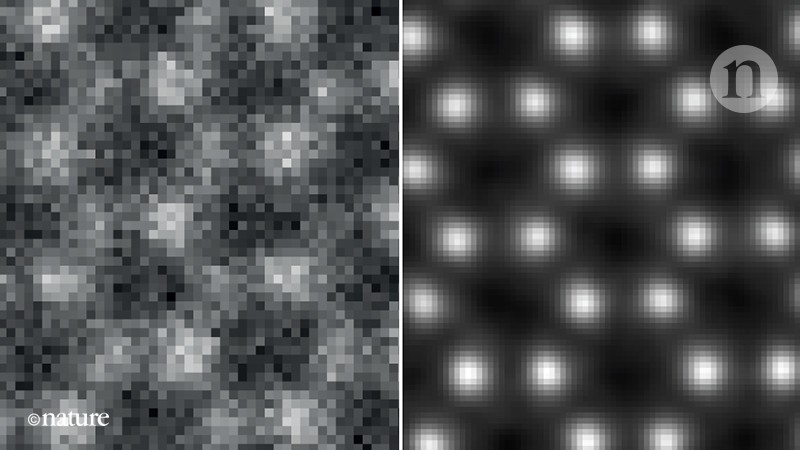
"The basic principle of the technique was proposed almost 50 years ago by the physicist Walter Hoppe, who reasoned that there should be enough information in the diffraction data to work backwards to produce an image of the diffracting object.
However, it was many years before computer algorithms were developed that could do this reverse calculation easily and reliably. The pictures produced by ptychographic methods are generated using a computer from a vast amount of indirect scattering data."
The news & views article does not claim that this is a basic sciences advance; they are claiming its an engineering / methodology / procedural advance. And those are as important, IMO.
Unless you are suggesting that, once the basic sciences are known, any engineering advance is trivial. If so, then you & I have very a different impression of how easy / difficult it is to build new "things" :)
The point I'm making is that popular discussion of quantum effects are so wildly off-base, and have muddied the waters of even trying to understand what happens between photons and electrons, by casually reading about it.
But you see something like this emerge, and it's really obvious that solutions to these problems were on the right track even as far back as the early 1900's, only to be derailed by academics emerging in the 1940's.
Principles such as: https://en.wikipedia.org/wiki/Huygens%E2%80%93Fresnel_princi... had it right very early.
So, was there an ulterior motive to all the complex obfuscation of math, and inaccurate scientific reporting throughout the later 20th century? Or has it all been one big, innocent misunderstanding, among aloof egg heads distracted by their gigantic precious particle colliders?
One wonders.
The double-slit experiment, entanglement etc. are all concerned with what happens with individual particles to produce those statistics, and what that means.
For example, it's not remotely surprising defracted light can reconstruct an image of an object (this idea has been around for a while - i.e. evanescent wave fluoresence, or the quest for a negative refractive index material which would be beat out diffraction limits handling). But that's not why it's not surprising - it's not surprising because you can also detect the existence of solid objects without actually touching them with so much as a photon purely by letting the probability field of one potentially extend through them, and then observing whether you see diffraction patterns along the path where photons do travel (basically a highly biased double-slit experiment reveals whether it would've interfered well before a particle is ever likely to have hit the object obstructing one of the beam paths).
No of course not, why would you think that? It's a difficult subject and simplifying it for the lay reader is a lossy process.
Don’t attribute to malice what can be explained by stupidity. [Hanlon]
With experimental confirmation that the universe is non-local and "spooky action at a distance" is real, the pilot wave theory "wins" and there's no measurement problem.
(It isn't journalists though, it's the physicists themselves that muddied the waters by permitting herd mentality to overwhelm science. Also, von Neumann got a proof wrong! Folks can be forgiven for not suspecting that. But once it was noticed then the "orthodoxy" should have paid attention.)
Von Neumann got a proof wrong in his textbook on QM. Grete Hermann found the error in 1935 and nobody noticed. De Broglie presented a "pilot wave" theory at the Fifth Solvay Conference in 1927.
Einstein kept pointing out the problem with non-locality and everybody thought he was getting old and foggy.
Physics is hella tribal. Physics.
I took the Copenhagen metaphysics pretty seriously. It's so neat and elegant to confound the mystery of quantum wave-function collapse with the mystery of subjective experience. The "observer-created Universe" and all that. It's very disturbing to realize that it's basically metaphysical bunk. It's just staggering.
But never mind all that!
The Universe is non-local!
*And yet-- Relativity!"
Nothing can go faster than the speed of light, but wave collapse does, so this is going to be some awesome physics!
do not copy the DOI (https://doi.org/10.1038/s41586-018-0298-5)
do not go to sci-hub (https://sci-hub.tw)
and finally do not paste the DOI there to get the article
they revised the title slightly between this and the real publication, but it's the same pub
Yes, there's a lot that's incredibly disappointing and frustrating—but is the solution to that not even to point to it? If you're interested enough, you can do whatever searches a bot would do (or build the bot yourself to do the searches).