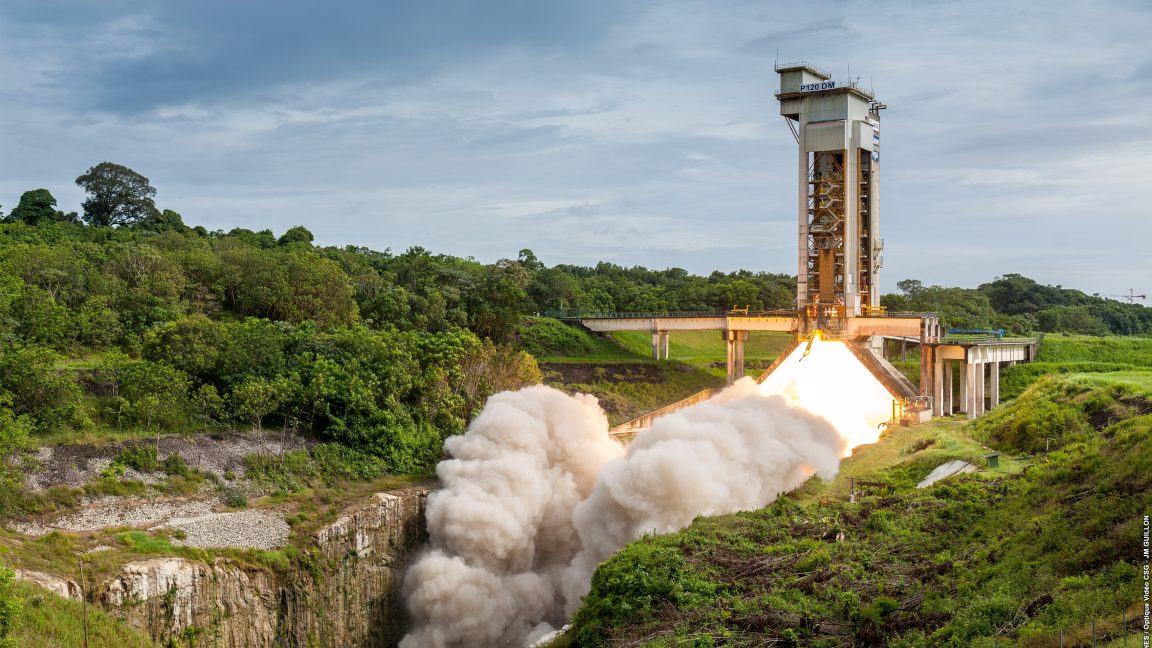
As the SpaceX steamroller surges, European rocket industry vows to resist
After 50 years of success, Europe's main spaceport reaches a crossroads.
Ars Technica
113 points · by Tomte · 8y ago · 119 comments
It feels incredibly short-term to me. How many jobs will be created by opening up spaceflight at 1/100 the cost? How many new types of satellites, technology, human transport will be created?
Electric cars? Nope, we've invested too much in ICE R&D and need to pay it back over another 100 years.
Solar? Nope, we promised the private coal plants decades of profits.
Public Healthcare (In the USA)? Nope, waaaaaay too many billions being made on insurance.
etc. etc.
Which is why we need to ignore what the establishment things and just do our own thing whenever possible, or at least support anyone trying to go clean slate.
Once it happens, as usual, the establishment begs/lobbies for political protection (think about jobs!) which will often be granted. But political favors can just at best slow their demise.
Reusable spacex rockets will be to the EU spatial industry what uber was to its taxis: turning them immediately irrelevant, and unsavageable as an industry.
A better example might be the high administrative costs of the US healthcare system. Obamacare couldn't cut all these jobs during a downturn, so they were preserved. But even now, for a lot of people it makes more sense to opt out of that craziness and just get healthcare abroad. This sector is ripe for disruption. Maybe not now, but in 10 years even more so.
One of the reason might have been vanity but if you look at it with the view point of a CEO from a European firm, reusability was a risky gamble:
1) In order to keep your manufacturing quality, one needs to produce a new rocket every two or three months. Beyond that, the people manufacturing it losses knowledge and unless quality assurance is increased a lot, you will losses quality.
2) EU was doing around 12 launches a year, and that was by being very cheap. You could plan on increasing the market share but that starts being difficult as a lot of what remains cannot use a European launcher for political reasons.
3) For the sake of the argument, let say cheaper price double the market share, that leaves 24 launches a year. Based on a manufacturing of 6 launchers a year, this leaves 4 launches per rocket. And that is with very optimistic numbers (doubling of marketshare, no issue with reusability).
4) If you look at the numbers from SpaceX, 4 launches per rocket is where the reusability starts making sense. But ideally, you want more. 5) The Airbus people have shareholders to account to, not a CEO who does not care risking going banqueroute while pursuing a dream to go on Mars.
So yeah, doable but much more difficult than in a market with better access to investment and to huge cash cows named NASA and DoD
> Charmeau said the Ariane rocket does not launch often enough to justify the investment into reusability. (It would need about 30 launches a year to justify these costs, he said). And then Charmeau said something telling about why reusability doesn't make sense to a government-backed rocket company—jobs.
> "Let us say we had ten guaranteed launches per year in Europe and we had a rocket which we can use ten times—we would build exactly one rocket per year," he said. "That makes no sense. I cannot tell my teams: 'Goodbye, see you next year!'"
http://www.spiegel.de/wissenschaft/technik/alain-charmeau-di...
If launches get much cheaper, there are many reasons to launch more stuff. To orbit, to the moon, to Mars, ...
Shotwell mentioned that SpaceX actually saved money even on their first reused booster which was broken down and inspected to pieces. So I think your number doesn't stand. The Falcon 9 has a unique cost structure compared to other rockets, completely aimed towards making reusability work out as quickly as possible.
The financial basis of SpaceX reusability is conditioned on having access to a lot of launches, and increasing the market even further by making launches cheaper. If SpaceX ended up only doing 12 launches a year each year from now on, they would lose money from reusability instead of saving it, because they would have pay ~as much to maintain the Merlin line as they do today, and that is probably most of the cost of making rockets. In order for them to make bank, they need to be able to maintain the line, and grow launches to consume all of it. (Hence, StarLink.)
Alternatively, they can produce all the first stages they ever intend to make, a good enough stockpile of Merlins for the second stages, and then shut down the line and get paid for launches without the expense of making rockets. This is what I suspect they'll do, except that at that point they will not shut down the line but will change it to make Raptors instead. Both for Raptor engined upper stages on Falcon 9:s, and eventually BFR.
In any case, Arianespace probably doesn't believe they can raise the launch count enough for reusability to be useful.
This is all aside from the reliability/engine out gains.
Similar issue with the use of solid propulsion, mainly used to also keep it in line with military needs.
SpaceX is following a series of failed initiatives - the Shuttle, SSTOs like the DC-X and Venturestar - and trying lots of seemingly crazy things in the process. Let's not get carried away by survivorship bias.
The old jobs were under your directive. The new jobs are not.
"I think we are in different worlds,” he said. “In the US, they think and they speak like this. Our mission is different. Our culture is different.”
As a fun analogy, I'd love to think what would have happened if AT&T had kept their operators and not put in electronic switches.
Commerce would still be back in the 1950's, and everyone would work for AT&T. We'd be making nowhere near as many calls, and business would operate much slower than today, meaning innovation & collaboration would be much slower than today.
But that's the choice
“The development of mobile phones will be similar in PCs. Even with the Mac, Apple has attracted much attention at first, but they have still remained a niche manufacturer. That will be in mobile phones as well,” Nokia chief strategist Anssi Vanjoki told a German newspaper at the time.
Back in the day, smartphones were pretty much defined by devices like the Palm Treo, and Palm CEO Ed Colligan doubted some computer maker was going to just waltz in and eat his lunch.
“We've learned and struggled for a few years here figuring out how to make a decent phone,” Colligan said. “PC guys are not going to just figure this out. They're not going to just walk in.”
Isn't ESA subsidized by the member governments? I'd understand if the criticism was coming from a private entity and they'd be complaining about SpaceX getting preferential treatment, but coming from a state sponsored agency it seems odd.
"ArianeGroup is subsidized by its member governments." Furthermore, "SpaceX does not have a monopoly on [American] launches, as Arianespace does in Europe" and "had to compete with the US-based United Launch Alliance from the beginning to break that company’s monopoly on military and civil space missions" [1].
[1] Ars Technica
And where should we stop counting subsidies? Are the government funded studies made by research institutes counted? They benefit a lot to the companies.
No, it's called renting. If it was unused then the presumably low price SpaceX pays for it is the right one. This is actually efficient capitalist allocation of resources. If SpaceX was not allowed to pay a rent for the launch pad, capital would be used inefficiently on building one, instead of being spent on R&D. Furthermore, the depreciation and abandonment of the launch pad itself would result in a waste of tax-payer money.
The US with ITAR and other "national security" restrictions sets up a lot of economic moats around their aerospace companies, and the government gets to pick domestic winners over foreign competition. That's a subsidy.
Everyone plays this game when it comes to aerospace, it's why there's constant lawsuits between the likes of Boeing and Airbus on at the WTO.
Government contracts are often inflated on purpose so that the work can leak towards other projects. Every country does that.
Are the European space companies subsidized by ESA and the other European space agencies? Yes. Is it much different from the subsidies in the US? Not really. Is the US space market bigger than the European market? Definitely!
EDIT: At least that was the gist of this article, it seems like other sources suggest they may pursue legislative avenues as well.
http://www.france24.com/en/20150620-interview-stephane-israe...
http://aviationweek.com/space/arianespace-esa-we-need-help
Alain Charmeau has as well:
>Even as Charmeau decries what he calls subsidies for SpaceX from the US government, he admits that Ariane cannot exist without guaranteed contracts purchased by European governments. To make the Ariane 6 vehicle viable, Charmeau said Ariane needs five launches in total for 2021 and eight guaranteed launches for 2022.
https://arstechnica.com/science/2018/05/ariane-chief-seems-f...
The planned Ariane 6 is cost uncompetitive with the Falcon 9 and variable cost and mass uncompetitive with the Falcon Heavy. There are no plans for a European reusable. The “our mission is different...our culture is different” comment implies a regulatory, not technological, solution.
This isn't really true. Ariane 6 is expected to cost €75 million for 5 tonnes to GTO and €90 million for 11.5 tonnes. Falcon 9 costs $50 million for 5.5 tonnes to GTO (reusable) and $62 million for 8.3 tonnes (expendable).
Because Ariane uses a "dual-berth" conops, it (generally) flies two payloads per launch, whereas Falcon 9's excess capacity is usually left unused. The two rockets are thus of comparable cost to a satellite customer, with pros and cons for each — Ariane is more reliable, but you have to work around the other customer's schedule.
The worry is that Ariane 6 won't be competitive with future rockets, like New Glenn or BFR.
Why would someone pay €75 million to launch 5 tonnes to GTO on the Ariane 6 when they can spend $62 million and get an extra 3.3 tonnes of capacity on the Falcon 9?
Based on your numbers, Falcon 9 is $9 million and $7.5 million per tonne. Ariane 6 is €15 million and €7.8 million, respectively. Given €1 is generally worth more than $1, and that the Ariane's prices are still just projections, your numbers don't paint the Arianes favorably.
> Falcon 9's excess capacity is usually left unused
Source? It's been a few years since I was in the launch industry, but even then piggyback slots on Falcon 9s were in heavy demand. Sufficiently so that a number of companies (e.g. Spaceflight [1]) cropped up to broker them.
>Ariane 6 is expected to cost €75 million for 5 tonnes to GTO
There are a lot of GEO sats which are right at the 5 ton range so that leaves no room for a dual launch.
>Because Ariane uses a "dual-berth" conops, it (generally) flies two payloads per launch, whereas Falcon 9's excess capacity is usually left unused.
Dual launches come with a lot of issues of coordination which crop up all the time and result in delayed launches for Ariane. Also Falcon 9's excess capacity is left unused because no one has ever asked for it. Per Musk's words they could develop a bigger fairing if a customer payed for it but no one has asked for it.
>The two rockets are thus of comparable cost to a satellite customer, with pros and cons for each
No they are not. There is literally no pro for Ariane. It's more expensive and the most important thing is that the engine is not restartable so it literally can't do a direct GEO no matter the payload penalty. That results in satellites requiring more powerful and complicated thrusters and having to sacrifice part of the capacity for extra fuel instead of just altitude correcting thrusters. All of this translates into extra cost.
>Ariane is more reliable
This is a complete myth for the media. Ariane 5's reliability means nothing for Ariane 6. One of the early Ariane 5 launch failures was due to the use of Ariane 4's software but not modified. On the other hand falcon 9 is now frozen and at this rate will have about the same launches Ariane 5 had in it's entire lifetime but only in a couple of years.
>The worry is that Ariane 6 won't be competitive with future rockets, like New Glenn or BFR.
Ariane 6 was competitive with the non-reusable falcon 9 at 90m$. The bet the European industry made was that SpaceX wouldn't be able to make an economically meaningful reusable rocket but every design choice on the falcon 9 has benefited reusability( number of engines, cost structure etc).
It's fine (or at least honest) to admit they're a protectionist block and are looking into regulation to ensure French contacts are safe.
But the mission is the same (put things into space), and the culture is irrelevant.
Once SpaceX has proven they can do safe crewed flights and Blue Origin goes beyond testing flights, why is there a reason to pay the huge ULA markup any more?
ULA, as well as Airbus, has a problem: they're constantly being meddled with by politicians without any idea what they're doing and decide stuff that's totally unreasonable from an economical point but helpful for their (or their party's) reelections. Airbus employs 130k people, Boeing 140k and Lockheed 100k, and in addition there are a lot of people in the supplier companies. That's a lot of voters, and the companies are often enough big employers on a regional/local level.
Which means: SpaceX and Blue Origin will conquer the entire commercial sector plus an enormous amount of US government work. EU-founded projects will (politically mandated) stick to Airbus, but the political inability of Airbus to innovate will lead everything else go to SpaceX/BO. And the taxpayer will have to "save" them... or have to deal with hundreds of thousands people out of jobs.
I don't think so. ULA was formed in 2006 [1]. Before that, the U.S. launch market was competitive within itself and with the Russians. The Falcon 9 first flew in 2015 (EDIT: "first flew commercially in 2013") [2], returning the American market to a competitive state. American aerospace engineers are used to working in a competitive culture. If ULA doesn't become competitive, either itself or by splitting, there are plenty of launch start-ups beyond SpaceX and Blue Origin hiring away that talent.
In contrast, the European market has no similar tradition of competition in launch services. The reaction to SpaceX isn't to consider a novel platform. It's to plod on with the old and raise the gates around European launch buyers.
Yep, exactly the same problem as IBM, Blackberry, and many other companies who were at the top and then either stopped innovating or got to big and slow.
Having the bigger companies fail in a respect is a good thing. Have those engineers go back into the free market. Have them create companies and make competition. Push technologies forward and pricing down.
Look at Rocket Lab and their Electron rocket. Pretty amazing if you ask me and didn't really cost that much.
Let the free market sort things out. It always does. Unless of course you start involving the government with their jobs program and you get an SLS rocket that costs $2b each and isn't reusable.
What we need are many more companies providing launch services. Lets get the cost down to $1k to send someone up. Lets get more companies building infrastructure in space, so we have 10, 20 or 50 space stations in LEO.
There's so much up for grabs, but it won't be available if we start protectionist policies.
Huh? Atlas I had failures in 1991, 1992, and 1993. Atlas G failed in 1984 and 1987.
https://en.wikipedia.org/wiki/Atlas_I
But I think your model is a bit of hyperbole. You’re downplaying the statistical model that goes with this. Launching a rocket is Russian roulette. The odds are quite different when you want to launch a rocket once versus a dozen times.
(1 - p)^n = the odds that I still have a rocket after n launches, where p is the odds of it blowing up on any given launch. The asymptote is at 0 and it gets there pretty fast.
The good news is that the cost benefit analysis has a similar problem.
Let’s say you want to reuse a $10M part once. Right now it costs you $20M for two flights. You create a $11M version that costs $1M to refurbish. That’s $12M for two flights or $6M per flight. You got a 40% cost improvement. So now you go for 3 flights. Now you have a $12M part that costs $1M to refurb. That’s $14M for three flights or $4.66M per flight.
From 1 to 2 you saved $4M per flight. From 2-3 you saved an additional $1.33M per flight. From 3 to 4 you’d save $0.66M per flight, by adding another $1M to your up front costs.
The bean counters are probably going to push back here. Opportunity costs you see. They’re going to demand you reduce costs, find revenue neutral ways to improve profits. For instance if you can cut 25% off the refurb costs that’s a better cost improvement than getting to 5 launches. While that makes getting to five more appealing, it also takes time. So you can imagine what the gap between five and six will be filled with. Cheaper rocket, lower refurb costs again.
If they have money to spend at this point they’ll give it to the lobbyists or marketing department. You aren’t the best investment they have anymore. Increased revenue is.
Airplanes (or "aeroplanes" on that side of the pond) have always been reusable, so Airbus was able to establish itself and build a stable business building them.
Rockets have always been non-reusable (until SpaceX), so ArianeGroup built a stable business around that assumption. Now they're being out-competed by a foreign company that has proven that assumption wrong, and they don't know what to do except demand more subsidies and a monopoly so they don't have to compete.
Who are these guys and in which century do they think they are? Innovate and compete or resign and make room for others who can do it. I'm sure there are enough European engineers who can build reusable rockets.
https://satelliteobservation.net/2018/06/02/cnes-director-of...
In which he talks about about a realistic path to a reusable rocket that could compete with Falcon 9. But it wouldn't launch until 2028-2030.
Technologically realistic. Politically unfeasible. ArianeGroup's factories provide high-paying jobs across Europe. Re-tooling them will not be possible for another generation.
Source: I worked with launch start-ups. Their dismissal by EU politicos was resounding, particularly in contrast to the American and other countries' responses.
>>> Ranzo, sitting nearby, chimed in and referenced the India-based maker of the world’s least expensive car. As he put it, “We don’t sell a Tata.”
Not with that attitude ;) There's nothing wrong with cheap spaceflight, as long as they're human-rated for crewed missions. I hope they also know that Tata owns Jaguar Land Rover.
"Vows to resist"
Resist what, exactly?
"Steamroller surges"? Really? Has the author seen a surging steamroller? That's not what steamrollers do. It's hard to stop a steamroller, yes, but its moves aren't sudden. It doesn't suddenly accelerate. You can see the steamroller a mile coming. It starts slowly and goes slowly.
And as you noted, you don't usually resist steamrollers. That's a silly thing to do.
Reminds me of the singing octopus from Orwell's examples of how not to write:[1]
> The sole aim of a metaphor is to call up a visual image. When these images clash — as in The Fascist octopus has sung its swan song, the jackboot is thrown into the melting pot — it can be taken as certain that the writer is not seeing a mental image of the objects he is naming; in other words he is not really thinking.
[1]http://www.orwell.ru/library/essays/politics/english/e_polit...
I assume that we do not know that much about the innovation due to much smaller PR budgets.
I assume the innovation is regulatory...
I'm certainly no expert by any means, but organizations like ArianeGroup comparing under development rockets to existing ones feels as though really sums up some of the issues with Old Space in a nutshell. It seems like they're thinking in terms of building a rocket where that one design might then be used essentially unchanged for 30-50 years despite there being clear theoretical improvements to be had. But that's not how the fully private enterprises seem likely to operate. SpaceX put a fair amount of effort into the Falcon Heavy for example, and it was spectacular. Except now apparently they've decided that it's effectively already obsolete, that BFR is going better then expected which mean FH will serve as a limited use minor stopgap and then be scrapped as a design. Even now I don't know if that sort of aggressiveness has really gotten into the consciousness of older style organizations yet.
I guess if they're comfortable with basically becoming a jobs program and massively subsidized strategic fallback for the EU that is in fact potentially sustainable a long time. Polities can have different levels of very long term priorities that are different from the faster pace of industry, there's nothing wrong with that. But it's a position that has risks too if the gap opens up too far, because it takes a very long time to make up that ground (if ever).