149 points · by ilamont · 8y ago · 137 comments
And presumably someone in government (in a lot of places) signed off on transporting people in these.
Yes, someone with more experience and even professionally licensed should probably have signed off on the mods. But no one OKing this service required it and it's not clear the modifications were responsible for what happened or it was just something that can happen when duck boats generally are operated in the way that they're operated.
The NTSB really should have put an end to this industry in 1999. It's tough to imagine that they won't fix their mistake this time around.
These things are insanely heavy, put through daily stress, and are basically maintained by carnies.
Whether they're sinking like brick or eviscerating the sides of buses, it's clear that they don't belong on the road.
Can't they just sunset these stupid things for the sake of the businesses, let wealthy collectors buy the old boats for their own purposes (and at their own risk), and force "Ride the Ducks" (who constantly insists that is not a single entity, despite having the same brand and business model), to purchase modern amphibious tour buses that pass safety regulations.
Surely there would become an immediate demand for a safe, comfortable, maneuverable amphibious vehicle in the wake of a crackdown on these deathtraps.
They did everything they could legally do, which is to say that they issued many strongly worded recommendations. Unfortunately they don’t have the legal authority to actually force anyone to do anything.
By all means let's get some proper safety standards for these things, but banning them outright seems excessive.
From the article:
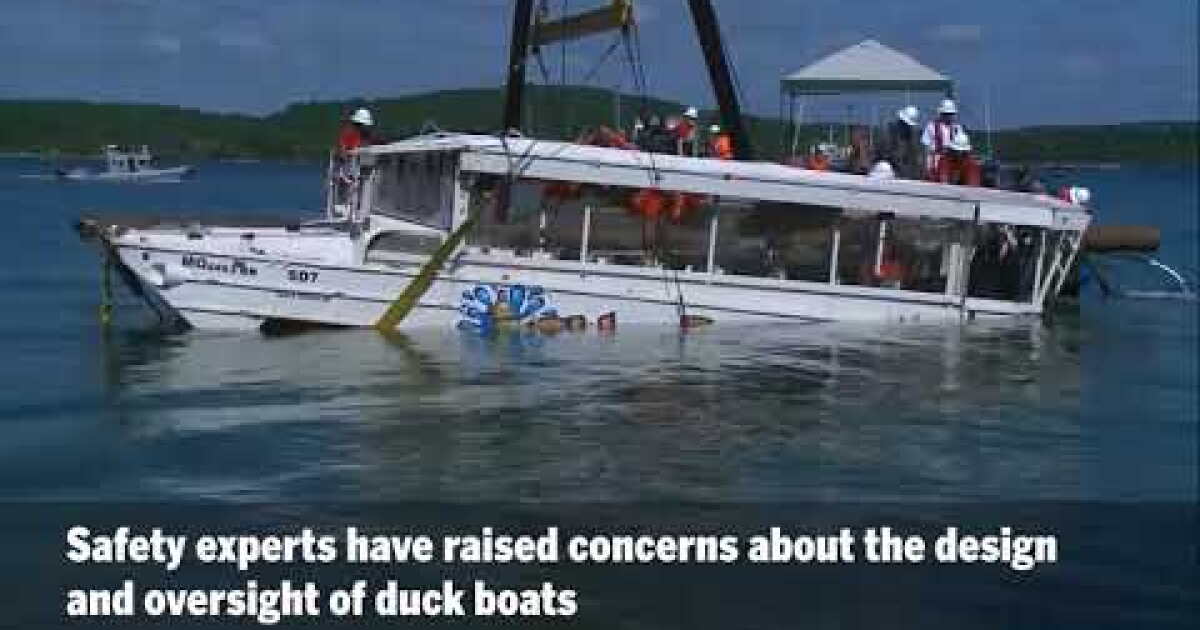
"In the water, duck boats are like a “sinking coffin” when they start to flood, said McCaskill, who plans to draft legislation proposing stronger safety standards for duck boats."
Forgive the dead horse beating, but this is why it's frequently said on HN (and in general) that safety laws and regulations are written in blood. People die, gaps are identified, gaps are closed, time passes, people complain about regulation.
People stop dying from it (because the regulation) therefore it’s not needed.
Law is similar, except on much longer timescales. I wish the laws would carry both inline explanation (comments), and explanations of reasoning and causes when changed (commit messages).
De-regulators know there is a reason, in many cases they understand it well. They don't care.
https://www.cnn.com/2015/09/24/us/seattle-tour-bus-duck-tour...
I think after the NTSB is done, it's likely these get taken off waterways --at which point, there is no reason to keep them as land only vehicles since they get such poor mileage and offer a poor bumpy ride.
I would hope that some (known) relatively simple and inexpensive quick fixes would at least be made though.
If this isn’t a good time for a regulator to intervene, when is?
Yeah the canopies seem like death traps :(
'U.S. Coast Guard spokesman Chad Saylor confirmed that the Missouri duck boat was a “stretch duck.” He said the boat was last inspected on Nov. 29, 2017, and was found “fit for route and service.”'
The town was under a severe thunderstorm warning issued about half an hour before the boat capsized.
There were numerous reports of damage throughout the county, including trees down and structural damage, said CNN meteorologist Taylor Ward.
The highest wind gust reported in the area was 63 mph.
"I believe it was caused by weather, yes," said Stone County Sheriff Doug Rader.
Any time you are traveling in a motorized vehicle there is a chance that things turn deadly. Let's allow the investigation to continue before rushing to judgement.
[0]: https://www.cnn.com/2018/07/24/us/missouri-duck-boat-investi...
> Until reserve buoyancy retrofits are completed the Board recommended immediate actions to mitigate the danger for vessels without adequate reserve buoyancy including the removal of canopies during water operations or installation of a Coast Guard approved canopy that would not restrict the horizontal or vertical escape of passengers; closing unnecessary access plugs; reduction of through-hull penetrations to the minimum size needed for operation; and installation of independently powered electric bilge pumps.
I don't have all the information, but it certainly doesn't look like those recommendations were enacted here.
[0]: https://www.ntsb.gov/news/press-releases/Pages/NTSB_Determin...
This is a strawman - no one is calling for ending the investigation prematurely.
> before rushing to judgement.
How soon is too soon to "rush" to judgement that these boats are unsafe?
The NTSB report regarding the 1999 Arkansas sinking [0] noted problems with their lack of reserve buoyancy. Certainly weather played a factor in the Missouri sinking, but so did the design flaw that causes it to sink or capsize much more easily than a modern boat of equivalent size. That design flaw has been known publicly for almost 20 years.
The passengers who drowned in the Missouri sinking weren't wearing life jackets. [1] The 1999 NTSB report recommended removing the canopies of these boats, but if the canopies couldn't be removed, then they recommended not using life jackets.
And the main subject of the article is the crash from 3 years ago in Seattle. That happened on land, caused by a broken axle. [2] It turns out the person who designed the "stretch" duck boats didn't have any formal engineering training, and it's not a huge step to imagine that stretching a vehicle in that way could lead to increased stress on the axle.
This isn't rushing to judgement. This is understanding the context of decades of previous incidents for better insight into the most recent one.
0: https://www.ntsb.gov/news/press-releases/Pages/NTSB_Determin...
1: https://www.cnn.com/2018/07/22/us/missouri-duck-boat-tragedy...
2: https://www.seattletimes.com/seattle-news/ntsb-ruling-expect...
Amphibious buses [2] are scary. They have flotation, but how stable are they in rough water?
[1] https://www.uscgboating.org/regulations/assets/builders-hand...
[2] https://newatlas.com/stagecoach-amphibious-bus-amfibus/14130...
Too much regulation and certification, and you have the aviation industry, where you can't so much as run a USB charger out to the front panel of your Cessna without the FAA coming down on you like a ton of bricks. Too little and you have people drowning and kids getting their heads accidentally ripped off. Maybe the line should be drawn at the point where you hang your shingle out there and try to make a business out of your invention?
1: https://www.washingtonpost.com/news/post-nation/wp/2018/04/0...
The last thing we need is flaming Cessna's dropping out of the sky into heavily populated areas.
Where it's amazingly safe considering it's literally aluminum tubes carrying humans through the air at almost 700 mph? I'm a big fan of what the FAA does.
This article is worded like somehow an ivy league education would have fixed that duck boats are a shitty deal. I think that's pointing the finger in the wrong direction.
Citation needed.
This whole thing is not ideal and needs to maybe be regulated. In my opinion it should be regulated because Duck Tours are a stupid eyesore and anyone who would pile on them doesn't value an actual good time, but that's just me... While the article makes sure to spend several paragraphs railing on the design by a mechanic 30 years back, it doesn't actually put together a graph to quantify duck tour accidents in relation to say accidents on greyhound or megabus. It just says these things have killed people. Great, so do rented party boats.
The conclusion it draws from the first sentence onward is that because this guy didn't go to college that he designed a death trap. He didn't even design the thing. He modified something that the US military built for storming the beaches at Normandy. It's ludicrous.
Anyone who is lucky and driven enough to get a real study in engineering should. They should also build amazing things after! And if they unfortunately kill people, then that should be evaluated on it's merits, but it's just silly to say that this guy didn't take a lot into account and worked with what he had based around safety expectations of the time. His education isn't even nearly the most important thing happening here.
The Ivy League is known for liberal arts, not engineering.
https://en.wikipedia.org/wiki/Duck_tour
If they took away the canopy and made customers wear life jackets, I might actually consider riding in one.
What's the procedure for regulating a national industry like this? The eco-tour companies out here in my state are constantly in fear of being regulated, but that's regulation on the state level, by state agencies. Duck-tours, and duck-tour disasters seem to be all over.
I suspect though that these probably fall into some crack where it's unclear who, if any, has federal regulatory authority.
Engineering school does not confer at least two things: common sense and experience. These qualities are independent from academic learning.
If the designer/modifier is found to be at fault it is far more likely to be due to a lack of research and common sense than a lack of schooling.
I mean, building a boat like that that can sink if swamped and traps passengers inside is just plain stupid, degree or not.
[0] https://www.seattletimes.com/seattle-news/ntsb-ruling-expect...
> He said the boat was last inspected on Nov. 29, 2017, and was found “fit for route and service.”
But I assume that's more like when I get my car inspected. This is one of those things I assume exist in society, but I guess I really have no idea.
I guess this news story wasn't reported anywhere else huh..
http://www.philly.com/philly/columnists/ronnie_polaneczky/du...
These “boats” (they are not) do not meet basic standards for road nor sea, are furthermore hacked together from scrap, maintained shoddily, and yet receive certifications from all government authorities from which they require inspection in order to operate.
Keep straws. Ban this.
People are rushing to judgement based on a lack of familiarity with an industry and so are extrapolating anecdotal evidence to be more widespread than it likely is given that this article seems to have been searching far and wide to dig up any incidents it could, including even regular roadway crashes in the reporting.
After a series of incidents(fires at sea, sinking) due to shoddy maintainence by poorly resourced bus mechanics and questionable modifications made in a desperate attempt to make them, technically, seaworthy according to modern regulations, they have both shut down. I'm kinda surprised the US still has them in such numbers.
And the only two major incidents at sea have been caused by extreme human error. The 1999 issue was a mechanic leaving a 4.5" access hole to the hull unplugged. And the most recent involved the captain taking the passengers out into a serious storm with 70+ mph winds and 4-6 foot waves. Like most things in the media today this just seems like absurd sensationalism over an event that people can be emotionally exploited to click on lots of stuff about.
[1] - https://www.ntsb.gov/investigations/AccidentReports/Pages/MA...
It’s like using Spitfires to transport school children.
Many tour vessels called 'ducks' are actually LARC-5s, like this one:
This firm does seem to target tourists, who would be less likely than locals to have boating experience.
Then again, I usually don't bother fishing when there are near hurricane winds forecast. Although I have gone trawling across a pond with two anchors down on multiple occasions...
http://cdn1.bostonmagazine.com/wp-content/uploads/2016/05/du...
http://www.completingmybucketlist.co.uk/wp-content/uploads/2...
https://assets.atlasobscura.com/article_images/17877/image.j...
https://upload.wikimedia.org/wikipedia/commons/b/bc/LondonDu...
https://www.massvacation.com/blog/wp-content/uploads/2012/11...
https://cdn.vox-cdn.com/uploads/chorus_image/image/50295385/...
https://www.macleans.ca/sinking-of-leviathan-ii/
> "In the days after the accident, Jamie Bray and other operators tried to defend the practice of not requiring passengers to wear lifejackets by explaining they make escape harder in an enclosed boat. That’s nonsense, says Giesbrecht. He’s conducted a study where people wearing flotation coats are plunged into water: “The assumption is this will hinder their ability to escape the sinking car.” It “really doesn’t.” "