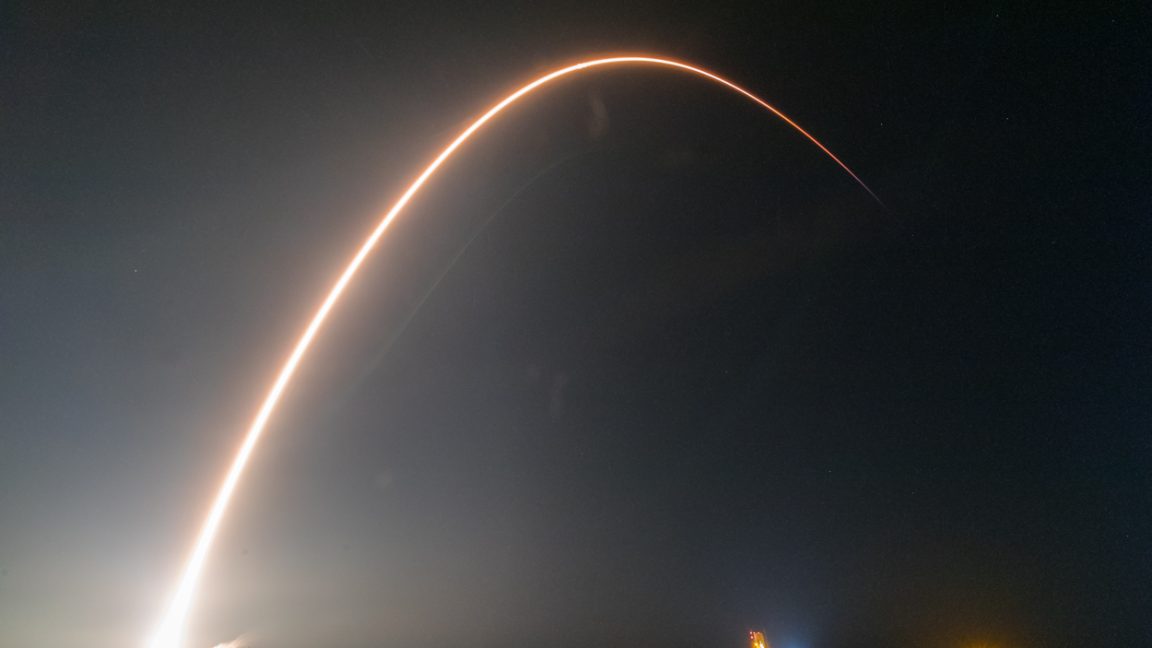
SpaceX reflies a Block 5 rocket for the first time [Updated]
Now, we wait to see when this Falcon 9 first stage flies a third time.
Ars Technica
178 points · by Tomte · 8y ago · 73 comments
It's amazing this happened just a little over a year ago.
This is also the reason reusability doesn't make sense for Ariane. With less than ten launches per year, fixed costs make up a large portion of the cost. If they only needed one rocket per year, it wouldn't really get all that much cheaper because they still need the factory.
Not yet. Costs haven't fallen. The epoch-defining change would be back-to-back commercial launches with the same booster in a short period of time with zero or little retrofitting.
I disagree. I highly doubt reusing a booster has been more expensive to SpaceX than building new boosters. It is also speculated that at least the first few customers of reused boosters were given a discount.
If you are saying customer cost has not fallen, you may be correct. I would counter with the fact that SpaceX is already a low cost provider, lowering their price more may not increase their overall profits.
> The epoch-defining change would be back-to-back commercial launches with the same booster in a short period of time with zero or little retrofitting.
The booster SpaceX plans to reuse today is a "block 5" booster. This is basically the design that SpaceX hopes will enable that zero or little retrofitting reuse.
That is false. You already pay 10 million less. That is 15% of the launch price. And 15% of the extremely cheap price that SpaceX was already selling.
The reality is that SpaceX simply increased its margin. The technology is still epoch defining.
If any competitor comes even close to SpaceX in price, they will simply drop the price again.
https://arstechnica.com/science/2018/06/russia-may-lack-the-... sums it up nicely.
Nitpicking on the language: why would SpaceX be a steamroller? Steamrollers are slow. Also, what does it mean for a steamroller to be in full force? Steamrollers push downward at a constant force, don't they?
I understand that SpaceX is crushing its competition, so you want to bring the steamroller metaphor, but perhaps for what you are saying other metaphors would be a better fit.
Further reading: Orwell, Politics and the English language[1]
When the stages separate, the first stage is going about 1.5 - 2.5 km/s. Then the second stage takes the payload the rest of the way to orbital speeds of 7+ km/s, and the first stage returns to earth.
So the first stage is going fast (several thousand miles per hour) but not as fast as things that re-enter from orbit. It still does need heat shielding, but not as much as the space shuttle or a capsule.
There is heat coating on the new rest of the rocket.
https://space.stackexchange.com/questions/13935/how-does-the...
However, they have development costs of something like a billion dollars to pay back, and no reason to lower the price drastically at this point, so new launches on reused rockets are going for ~50 million instead of 62 million.
[1] https://spacenews.com/spacex-gaining-substantial-cost-saving...
I had no idea they were aiming for this level. That is just mind boggling how drastic a change it's going to be.
This is important to keep in mind when wondering why a corporation would continue pushing its costs down after obtaining an effective monopoly. As long as Mars is the goal SpaceX won't turn into a ULA or Ariane. But if for some reason SpaceX ceases to pursue Mars then it would likely recapitulate the same business decisions of every other spacefaring corporation.
I have serious doubts about this, but it's about time that people who have the means and ability to make incredible things happen became so aggressively technological that their ideas seemed doubtful. It wasn't that long ago that many believed that complete rocket reusability impossible (to say nothing of autonomous retropulsive landings on barges getting rocked around in the middle of the ocean). Then it changed it uneconomical. Then it changed to 'oh shit, we're now a decade behind technologically.' I now find myself on the doubter side and look anxiously and happily forward to being proven wrong!
You can get a 50% reduction in costs just by going to India for launch..
Is SpaceX going for 2nd stage reuse at all? That's going to be a lot harder than booster stage reuse, since you're returning to land at orbital velocity.
And then there's the whole issue of increasing reliability of the 1st stage for reuse hundreds (or thousands) of times needed for new business models...
You can't take a rocket to India and you can't manufacturer that rocket in India (Skilset, US based corporation, ITAR) so you can't achieve your savings that way.
Even Russia - which is using a very old tried and true rocket design - can't match prices at this point. In addition, the budget cuts in Russia have resulted in a massive reduction in reliability, which has blown up their insurance cost recently.
In terms of second stage re-usability, they are looking at that for FalconX, and it's designed in at the start for BFR. Landing something from a second stage is as difficult comparatively vis-a-vis landing the first stage, as landing the first stage was compared to the suborbital hops that Blue Origin is doing.
The latest SpaceX idea (judging by Elon's tweets) appear to be some sort of Ballute based approach.
The first stage re-use should be good for 10 flights without a overhaul, with a complete tear-down on flight 10.
Out of curiosity -- can they _fly_ a rocket to India (maybe have a booster return to India instead of a drone ship ? Too far/out of the way ?
That may not help much since stage 2 would still have to be shipped around, which is probably not cost effective, and there might be other regulations that make it infeasible to launch anywhere but in the USA.
With Falcon, no way. The boosters land out at sea, but nowhere near that far out ;-)
I have not heard of that one and neither has google.
Yes, they are (and yes, it will be): "SpaceX also continues to study the feasibility of returning and reusing the second stage of the Falcon 9, and Musk said he’s confident it can be done. The question is what “mass penalty” will have to be paid, primarily in terms of the fuel needed to slow the second stage down so that it can make a controlled descent back through Earth's atmosphere.
"Still, Musk believes the Falcon 9 will get to full reusability. In terms of the rocket’s overall cost, the first stage accounts for 60 percent, the upper stage 20 percent, the fairing 10 percent, and the remainder are costs associated with the launch itself (fuel costs are between $300,000 and $500,000), Musk said."
https://arstechnica.com/science/2018/05/spacexs-block-5-rock...
All new work is now on BFR, which will have 2nd stage reusability, orbital refueling, better economics etc. I think you're also underestimating how far this Falcon will get them - their timelines suggest that this is what they'll use to launch their global internet satellite network, not BFR.
By going to a much larger class of rocket, those concessions for re-use become a smaller fraction of the total stage 2 mass.
My guess is the first full-reuse rocket you'll see will be the SSTO BFR.
[citation needed] - I don't think BFR is intended to be single-stage to orbit?