Linux Kernel Developer Criticizes Intel
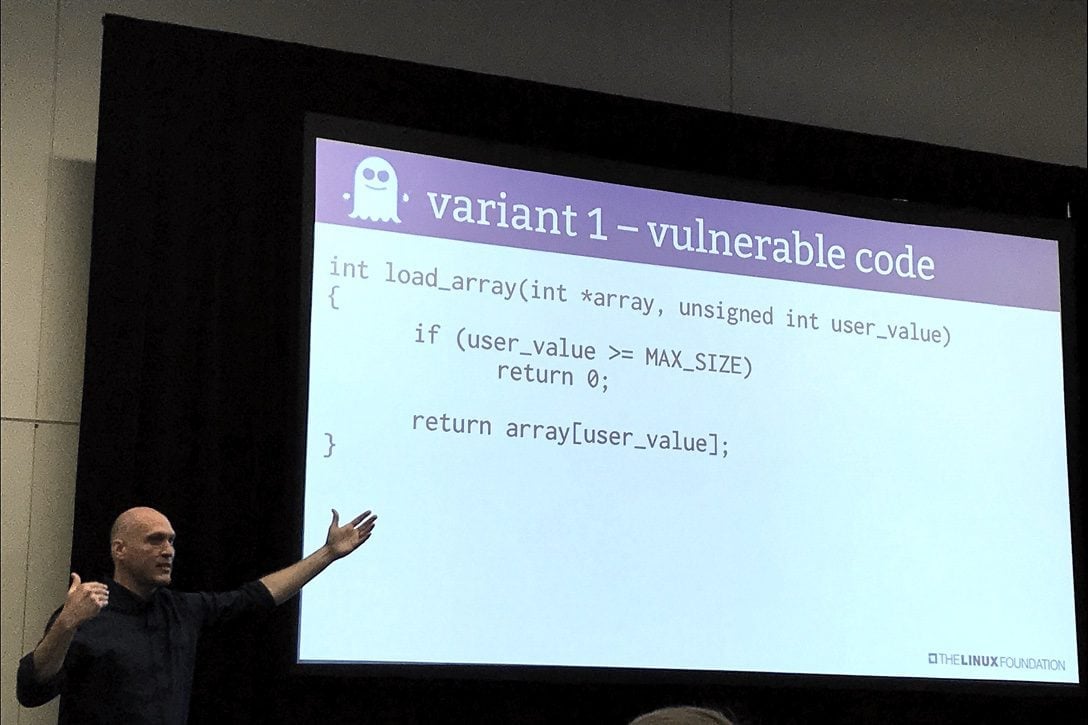
At the Open Source Summit North America, Linux kernel maintainer Greg Kroah-Hartman took issue with Intel
eWeek
454 points · by CrankyBear · 8y ago · 145 comments
Intel told quite a few members of the Linux community about this well before late December. Some got told because they work for traditional distributions and others were contacted directly because they are community maintainers or subject matter experts.
Unfortunately, Greg was not one of those folks that was told early. It's pretty clear at this point that it would have been a lot better had he and folks like him been involved earlier. This is especially true for Greg since he plays such a crucial role in stable kernel maintenance, which is how a lot of the world consumes their kernels (including distros like Debian).
I'm glad Greg thinks "Intel has gotten better at this." I'd like to think so too.
I'm biased, of course. But, I think things are much better now. We have ways of having relatively "normal" conversations about these things where a broad set of community folks are involved. It's not perfect, but it's way better than it was a year ago.
The embargo was really painful to work with, even for folks like myself who were inside Intel during the whole thing. I'm used to being able to ask folks for help and to lean on the incredible knowledge of the kernel community. For Meltdown, I was much more on my own than I was comfortable with. It wasn't fun.
Why wasn't he one of the first persons informed by Intel?
I'll give you an engineer's perspective, and specifically about Meltdown since that's what I worked on.
I posted the first Meltdown mitigations in late October, publicly claiming to mitigate a less dangerous class of side-channel (https://lkml.org/lkml/2017/10/31/884). I figured that Linus would merge it (Linus knew the real reason by that point) and would "wink" at Greg and the other stable maintainers enough to get them to merge it too. At this point, we had months before the embargo ended.
In retrospect, that was a kinda silly assumption, but I was heads down trying to get the patch to work and didn't dwell on it much. I wish I would have made more noise about it, especially as we got closer to the embargo ending.
Is there any actual statistics to back this up? I feel like RHEL and to a lesser extent CentOS have a stranglehold on the big enterprise-y environments, and I see Ubuntu basically everywhere else, and Canonical does their own kernels.
Edit: To be clear, I am aware Ubunbtu is a Debian derivative, but since we're talking specifically about who was informed for kernel level mitigations, and Canonical does their own kernels, it seems weird to talk about how Debian wasn't informed and thus people were affected, when Ubuntu being updated wasn't reliant on Debian being updated.
https://news.netcraft.com/archives/2017/09/11/september-2017...
It feels like someone at Debian is trying to avoid realy numbers or relative comparisons to make their case sound more important, but all it results in is statements like this where you look at it and go "WTF are they saying, because what it kind of sounds like seem highly unlikely..."
Edit: never mind, Android was apparently indeed effected.
High-end Android phones with out-of-order processors (the minority) are only vulnerable to Spectre, but it's a little complicated [1]. Then there is only one ARM core (Cortex A75) that is vulnerable to Meltdown, but that was released after the vulnerability was published, so software could ship with mitigations in place.
I can say that I've personally administered roughly a 1:1 ratio of CentOS:Debian despite coming from a country that's servers tend to be CentOS.
Of course, this is anecdotal, but don't undersell debian.
He is not limiting "the majority" to just Debian, though. He is comparing installs of distributions backed by companies (like Red Hat+Canonical+SuSE) as "the minority" vs. every possible non-corporate-backed distribution or source.
This allows you to have a stable "base" with unchanging software requirements, configuration and features to work on for extended periods while also staying very secure, which is why it's favored by enterprises. You can find more information on this on their Life Cycle documentation.[1]
This behavior actually extends to the kernel itself, which is likely why the Debian developer is quotes talking about "the majority of the world runs Debian or they run their own kernel", as Redhat, Fedora, Ubuntu, etc run custom kernels that they've patched. You can see this in different bugfixes for a package, and how they have the same version number for the software, but different release numbers, which come after the version in the filename.[2][3]
There are some more nuances to this model, where you can actually get newer software versions at select points, or where they will actually backport new features and not just bugfixes, but those are somewhat separate, and happen much less frequently (point releases in RHEL terminology).
1: https://access.redhat.com/support/policy/updates/errata/
What can be confusing about CentOS/RHEL is that many shops using them are on a release that came out years ago. But that's an issue because Red Hat supports 10 year lifecycles for their releases, and will go on supporting them indefinitely if you pay them enough. All the software bundled gets feature and security updates through it's lifecycle, just without changing any interfaces, ABIs, or version numbers. This is great for shops that aren't looking to operate on the bleeding edge and have expensive COTS or bespoke software stacks sitting on top.
Of course, you still have to patch, and organizations can't be forced to do that. Hopefully what you were encountering was just the former and not the latter at those organizations.
RHEL and CentOS 7 had updates for all of Spectre, Meltdown and Foreshadow on the day of unembargo-ing.
     1. SELinux
     2. OpenSCAP
     3. 99% fit with RedHat
But it seems likely that this isn't just exaggerated or hyperbolic, but just not close to accurate, in which case even if it's off the record it's silly.
He is right with the affected number in this case because this time bugs are affected by simple webpage drive-by Javascript attacks, like a common virus. So it affects Debian and Android more than servers and cloud services. And those are the ones which are not regularly updated so the security impact is bigger than on a server.
I wonder which operating system vendor pressured Intel to tell the Linux dev community, especially because it sounds like it was a non Linux OS vendor. Whomever it was, good job!
But it seems like Intel has angered the Linux community as well as the various BSD operating systems. You would think Intel would be doing whatever it can to please all operating system vendors especially now that AMD is getting competitive again.
Edit: I found a link confirming that Microsoft uses Linux for networking in their Azure data centers [1].
[1]: https://www.datacenterdynamics.com/news/microsoft-runs-azure...
> Experts called for a new generation of secure-by-design computers at the Hot Chips conference here. In small steps in that direction, Microsoft and Google described their separate but similar hardware security architectures.
This isn't true at all. Please stop spreading misinformation.
I feel like this is a thing people repeat, specifically about KRACK and its been shown to be false multiple times (like here: https://lobste.rs/s/dwzplh/krack_attacks_breaking_wpa2#c_pbh...).
Someone should let the BSD folks know and see what they think...
Disable SMT/Hyperthreading in all Intel BIOSes https://news.ycombinator.com/item?id=17829790
"I'm going to spend my money at a more trustworthy vendor in the future." - Theo de Raadt
https://01.org/blogs/imad/2018/letter-industry
This is almost like satire.
That post seems to make it pretty clear that they are trying to position themselves as the experts rather than the people asking for help. That is the part that is absurd.
(tl;dr intel contractor were shipping an os that was using grsec tradmark in marketing for a non-grsec approved kernel)
Pretty much, yeah. You did. Pretending that declaring "off the record" during a presentation like that falls anywhere near normal journalistic practice is essentially the same thing as imputing magical properties to that phrase. Confidentiality needs to be negotiated ahead of time, usually with an NDA or embargo agreement before journalists are given any detail. When presenting at a conference that lets journalists attend for free, it's unreasonable to expect any confidentiality for the content of your presentation unless your presentation is part of a closed session that the free media passes don't grant access to.
Future hardware will be mitigated against side-channel issues. There's a nice table showing how things are mitigated on future processors here:
https://www.tomshardware.com/news/intel-cascade-lake-details...
But, not everything is mitigated in the silicon or microcode. The mitigation for Spectre / Variant 1 / Bounds Check Bypass, for instance, will continue to be in software.
I found this page explaining how to do it https://www.cyberciti.biz/faq/install-update-intel-microcode...
I checked and my microcode is from 2018-01-21. Being on a 2014 laptop it means it got updated by the package manager.
https://github.com/gregkh/presentation-spectre
One note from his talk though, his slides say that Foreshadow was fixed in April -- but it's clearly supposed to be August. He mentioned he was fixing the updates even on the flight out to OSSNA.
For real.
The reason these flaws were found in the first place were because of security researchers, hopefully they can now make their cases to get large research grants and bring about a more secure future.
On the other hand, if you want to talk about tin-foil hat "CPUs working against users", only look so far as Intel ME and the equivalents on other processors. Closed-source and highly privileged code running all the time inside the CPU - it's not unthinkable that Intel would bend the knee to some state actors, especially if that leads to higher profits (i.e. a tax break or entry into a new market (cough China)). It's enough of a concern that a lot of reverse engineering effort has gone into preventing it from running.
They have tons of testing already. The problem is that this is the kind of problem which is easy to miss with tests, especially automated ones, because everything worked correctly and no real code would ever have been affected by the side effects.
Hopefully this will lead to better automated testing procedures for Intel, other processor manufacturers and security researchers.
The emphasis on "better" as there is obviously automated testing in existence already.
Following the money suggests Intel was chasing an enterprise market and didn’t bother to think through the consequences (unlikely) or made a car-manufacturing style decision where the costs of failure were deemed to be overshadowed by the profits on their balance sheets.
For seven years the Ford Motor Company sold Pinto cars in which it knew hundreds of people would needlessly burn to death. It had a better design but it would have cost production delays to implement it. Less money to have people die than fix the issue when it was noticed in testing.
While I’m not equating Intel’s actions to Ford’s in direct comparison, I would say the bean counter thought process is far more likely than conspiracy.
Suppose they did this. Now, that the vulnerabilities are public, Intel takes the fall. Oopsie, huh?