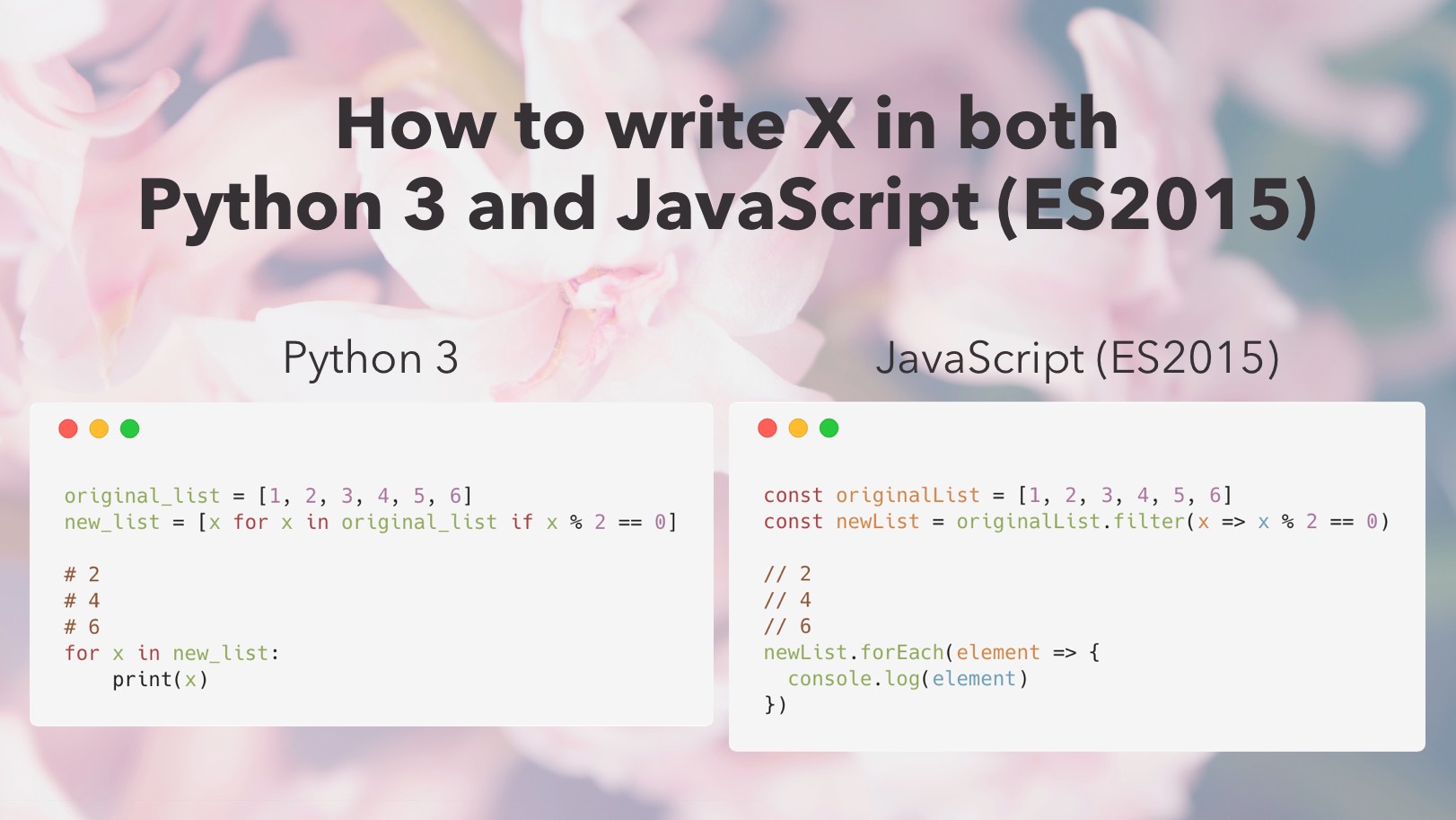
How to write X in both Python 3 and JavaScript (ES2015)
Saya
178 points · by chibicode · 8y ago · 78 comments
javascript:
  someList = [ 40, 2, 1, 3, 7, 99]
  someList.sort()
  Array(6) [ 1, 2, 3, 40, 7, 99 ]
  someList = [ 40, 2, 1, 3, 7, 99]
  sorted(someList)
[1, 2, 3, 7, 40, 99] someArray.sort((a,b) => a - b);
‘a-b’ is safe enough in JS if you always know the input will be within a safe range regarding integer sizes and types.
NaN can give you all kinds of trouble so I’d usually test for that in a real case, either before the sort or in the comparator—if necessary.
If `a-b` returns a negative number, the result will be treated as -1. If the numbers are the same, then you end up with 0, and so on.
I don't know what's faster in that case.
Edit: I'm actually truly grateful, I'm sure this bit of knowledge saved me some of my hair in the future.
I know all the syntax in them but I'll be damned if I can ever remember which language uses which until I've settled back in to things.
ikewise, I felt a little let down. On the flipside, it's an excellent opportunity to bring Rosetta Code to people's attention - a wiki with hundreds of example problems, each solved in many languages for comparison!
https://www.rosettacode.org/wiki/Rosetta_Code
I find it invaluable in that sort of mid-learning level of a new language, where I have the syntax sorted, but I need lots of programs small enough to hold in my head, but also large enough to show off all the features, to learn and read. Here's Dijkstra, for example: https://www.rosettacode.org/wiki/Dijkstra%27s_algorithm
Common Lisp: https://github.com/sharplispers/clx
Go: https://github.com/BurntSushi/xgb
Any others?
(Looking for implementations of the X11 protocol in $LANGUAGE, not bindings to the C Xlib)
Emacs Lisp: https://github.com/ch11ng/xelb
Now I'm kind of glad you responded in kind because I'd seen python-xlib but not the node one. That sounds like a bit of fun and punishment at the same time.
Cool site :P
I particularly enjoyed seeing that you used snake case in Python and camel case in JavaScript. Great attention to detail.
Although this is a case where idiomatic python is different from idiomatic js.
In js:
  // same:
  !! ""   // false
  !! 0    // false
  !! 1    // true
  !! null // false

  // different:
  !! {}  // true
  !! []  // true
  # same:
  not not ""    # False
  not not 0     # False
  not not 1     # True
  not not None  # False

  # different:
  not not {}       # False
  not not []       # False
not not tuple() # FalsePerhabs just personal preference but I'd use
    for(let element of someList){
    	console.log(element);
    }
    someList.forEach(element => {
      console.log(element)
    })
Example:
  var queryLondonCustomers = from cust in customers
                             where cust.City == "London"
                             select cust;
  for each(str from [list: "Ahoy", "world!"]):
    print(str)
  end

  for map(n from [list: 1,2,3]): n * n end
  # ==> [list: 1, 4, 9]

  for filter(n from [list: 1, 2, 3]):
    n >= 2
  end
  # ==> [list: 2, 3]

  for fold(sum from 0, n from [list: 4, 5, 6]):
    sum + n
  end
# ==> 15 Object.entries(newDict).forEach(element => {
console.log(`${element[0]} ${element[1]}`)
})
    for (const key in newDict) {
      console.log(`${key} ${newDict[key]}`)
    }
    for (const [key, value] of Object.entries(newDict)) {
      console.log(`${key} ${value}`)
}Second: I don't like seeing JavaScript code without semicolons. Maybe I am old, but it makes me nervous.
It's an IDE that lets you code simultaneously in several different languages https://ide.onelang.io/