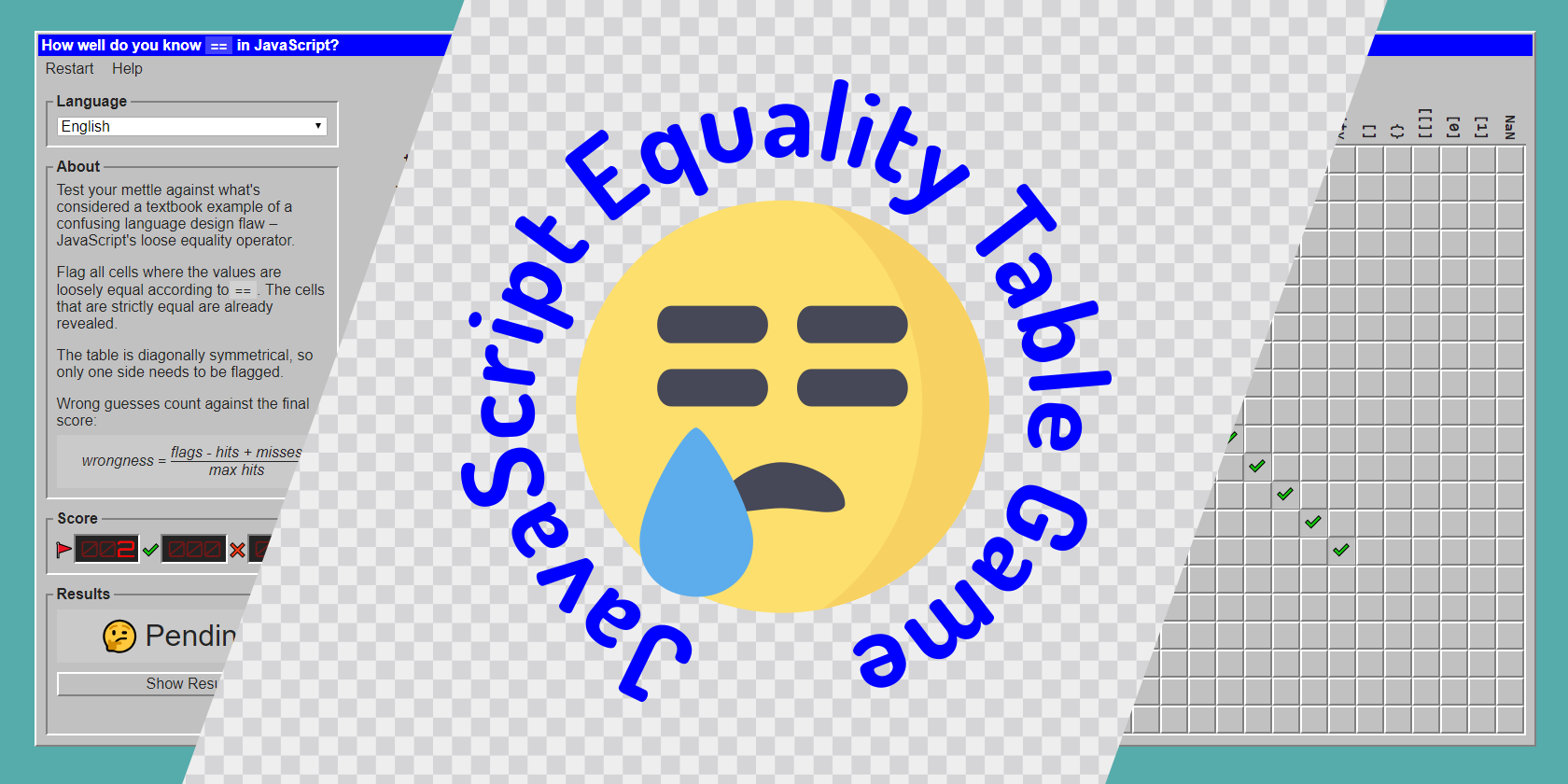
JavaScript Equality Table Game
Find out how well you know (or don
slikts.github.io
185 points · by bennettfeely · 8y ago · 112 comments
The alternatives are writing `x === null || x === undefined` everywhere (which might lead to people just picking one out of laziness, leading to bugs), doing things like `if (x)` (which we still do sometimes, but can lead to subtle falsy-related bugs if you're not careful), or to do careful bookkeeping of when variables might be null vs undefined. In my opinion, the null/undefined distinction is more cognitive overhead than the benefit it provides, so it's best to just check for both at the same time and never intentionally treat them as different. Given that mindset, I think the `== null` pattern is slightly unfortunate, but better than the alternatives.
`const isString = myVar => typeof myVar !== 'string'`
This is more reusable and more idiomatic in my opinion than null/undefined checks
See this example https://goo.gl/AyoC3T
For those not aware, you can specify a rule in [js/es/ts]lint to allow only these cases.
It's like every time you defensively throw in a nil-guard just in case: everyone now has to go "wait, can nils really get this far into the system?"
You just start wasting the time of the people experienced enough to identify it as a potential problem.
if (myNum === 2 || myNum === '2') {}
It's very easy for developers to mistakenly "see" the third equality symbol and get confused by the intent of the code.
if (Number(myNum) === 2) {}
* you don't actually see the case-space (value space) of all the comparisons that do work as expected, and
* you don't a sense of what is the likelihood that these sort of comparisons would happen in real world code
Some of them like the empty string are likely to happen from user input, but Typescript mitigates those by forcing you to e.g. use Number(inputField.value) to conver to number and complaining about the assignment otherwise.
Others pretty much never ever happen - instead of comparing 1 or -1 to true, you're more likely to use if (val) which casts to boolean, and the truthy table is different from the equality comparison table (it makes a bit more sense)
Most of the real world comparisons are to non-empty strings or numbers, and those are only equal to arrays in some cases - but its rare for an actual array to be produced by anything. Things you know are arrays already you don't compare using "==" to begin with.
So yeah, in practice the confusing rules of JS equality comparison don't really matter all that much.
I run into this all the time. Plenty of junior devs I work with do this. Unfortunately we haven't implemented typescript yet. Yea === solves this problem but I wish there was a deprecation path for ==. Why can't we figure out as a community how to deprecate horrible javascript apis? Why can't we as a community figure out how to have a good standard library?
IMO TypeScript fits like a glove on top of JS and largely gets rid of the language problems, leaving mainly library / ecosystem problems.
Dart did many things wrong, but one thing it did do right was the standard library. If we had a standard library like that in JS, that would change everything.
Another serious problem are modules. The fact that the ES6 loader is "open ended" just means that we don't really have a solution to the problem of distributing JS. The fact that HTTP2 push is somewhat broken means we can't rely on it to load ES6 modules either.
At the very least we need the concept of absolute and relative module identifiers. Even if the specifics are implementation-defined, e.g.
* whether module ids are used,
* or content hashes,
* or absolute paths (or maybe npm module names with the version?)
the ability to provide absolute modules via a DLL:
  provides 'lodash@2.0.5' {
    export ... // multiple things
  }

  provides 'other-module@version' {
  }
That, or maybe we can fix HTTP2 push.
I mean, JS definitely has serious problems, but equality coercion is not one of them :)
I’m not one to pride myself on ignorance, but the JS equality operator is ridiculous and therefore, IMO, not worthy of the mental energy it demands.
> How well do you know the rules for the == operator in JavaScript?
Well enough to use `===`. I’ve noticed in my code every time I’m tempted to use `==`, I always end up finding a better way. `==` is basically code smell that only really smart people should use.
And then cross your fingers that no one else ever has to look at or work on that code because they might not pick up on whatever "smart" reason the == operator was used.
So with TypeScript code, I've been continuing to use == as in most other languages, with the expectation that any odd comparisons will be flagged by the compiler. On the other hand, I've not verified myself that it catches them all, so I wonder if anyone has come across other edge cases with this that could cause problems down the line.
I can think of one instance where I needed identity instead of equality, and I took the time to refactor to ensure that equality would work.
If you are curious, please post some real life real working code where in your mind usage of === is absolutely needed and I try my best to explain how I would tackle that with ==.
That said, if you mix types between comparison operands or inside arrays then you probably have bigger problems than "==" semantics. :-)
A lot of people seem to have a perception of languages as being handed down by some language gods, and apparent problems with the language get explained away by "mere users" lacking knowledge, perspective, discipline, etc.
And the engine makes it as fast as === https://github.com/dperini/nwsapi/pull/11#issuecomment-38327... (Generally else == is slower than ===)
e.g.:
- say there are 100 or so blocks, 20 are checkmarks
- if I click on 40, and get 10 checks, 30 blank, that means I got 30/20 wrong
The only legit case to use == is if you are
1. Insane
2. The kind of person who changes Java 1 object to equal 2
I wrote tens of thousands of lines of JS (e.g. this library https://github.com/photopea/UPNG.js ), I never used "===" in my life :D
Also, from a brief glance at your code example, you don't seem to have caught up with other current best practices like linting or modules.
The type information simply is not there.
does it not make sense to just remove it from the language completely? who is deciding that?
  if (someValue != null) {
    // someValue is neither null nor undefined
  }
No, because you'd wreck quite a bit of the internet with that.
> who is deciding that?
ECMA TC39
The way syntax is "removed from the language" in JS is by introducing commonly-used lint rules that disallow them, and that has already happened with `==`: https://eslint.org/docs/rules/eqeqeq . As long as the community makes it so a standard project setup has a linter with good defaults, `==` can effectively be removed from JavaScript without having to break nearly every website in existence (which is what would happen if browsers decided to start crashing on `==`).
The best solution currently is to have linter rules enforcing ===.
I would say that's the defining characteristics of JavaScript.
It makes it fun to write JavaScript with its quirkiness and "dynamic" nature. And once you master it you become a ninja.
Compare it to Java or Golang where you are restricted by the language syntax and anything slightly creative and fun is either not supported or not idiomatic.
nope. none of that. there are plenty of fun, dynamic languages that aren't the horrible pile of shit that is raw javascript.
> And once you master it you become a ninja.
wait, was this sarcasm? hard to tell..
Sure! For starters, you can write
if (foo == null) { ... }
if (foo === null || foo === undefined) { ... }
There you have your JS ninja trick to handle two distinct null types^TM .
1. I was making a generalized statement around JS, not specifically '=='. That's a misinterpretation of my statement.
>"my programming language is perfect"
2. I did not say JavaScript is perfect. That's a misinterpretation of my statement.
>"if you don't like it you're just too dumb to get it"
3. I did not say "if you don't like you're just too dumb." That's a misinterpretation of my statement.
Yes, a ninja of the "undefined is not a function" wars.
In my experience, code that is "slightly creative and fun" is unreadable and not actually useful for creating working products as a part of a team.
NaN == NaN
But when I played the game, it looked to me like the game correctly claimed it is falsy. (Though I'm not 100% sure I know what the notation the game uses means.)
Wut?
    > true == 1
    -> true
    > false == 0
    -> true