Vivaldi 2.0 – Your browser matters | Vivaldi Browser
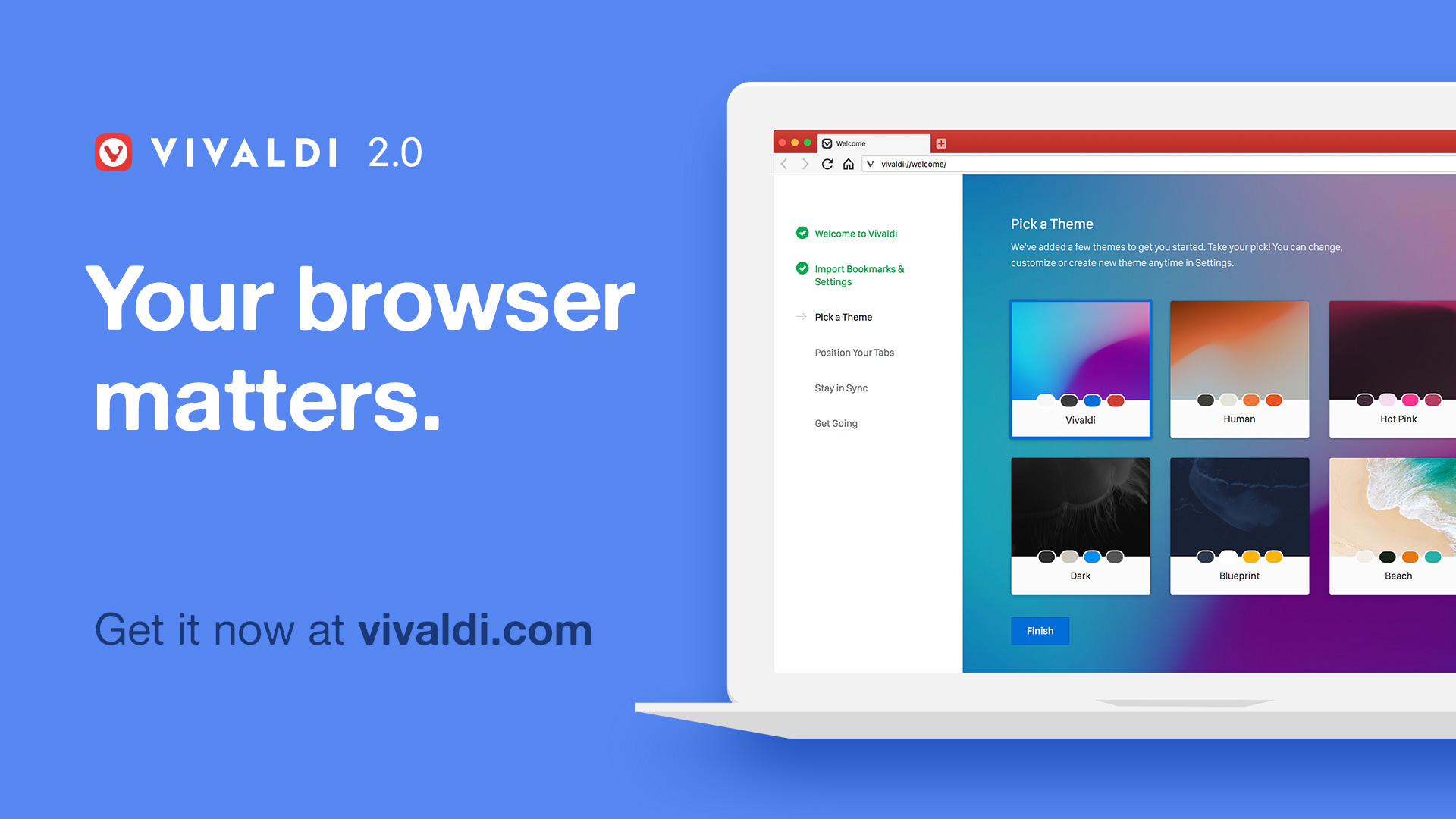
Launching the most powerful version of Vivaldi yet. Today’s update includes Sync and over 1,500 other improvements since the first version of Vivaldi.
Vivaldi Browser
187 points · by jonmccull · 8y ago · 143 comments
However, Vivaldi does nothing to improve the state of the web. It’s just another webkit, fostering the monoculture; and their business model and practices are basically the same as Google’s, just on a smaller scale.
As far as I understand it, it's paid placement for search engines and bookmarks [0], and potentially attaching aff links to some search results [1]. Isn't that pretty much the same model as Mozilla and Firefox? Kind of a far cry from being a data aggregator and an ad company, right?
[0]: https://forum.vivaldi.net/topic/20277/vivaldi-income/2 [1]: http://www.itpro.co.uk/desktop-software/29904/jon-von-tetzch...
I understand why they do it (people gotta eat), but to me that looks even less trustworthy than Mozilla, which at least has a certain entrenched culture that typically tries (not always successfully) to blunt the worst corporate decisions, and follows real opensource practices.
We’ve always taken data security extremely seriously. And we’ve long believed that everything you store in your browser belongs to you — which is why we’ll never sell your data, or willingly compromise your privacyGoogle is more than a browser manufacturer. Their business model is mostly ads. Things like Chrome feed back into that (collecting data on people and using it to personalize other experiences... like ads). How is Vivaldi's business model similar?
Sorry, I'm so oldschool that for me the two are still basically the same -- after all, blink was a webkit fork, which was a khtml fork.
> How is Vivaldi's business model similar?
See my other comment.
We encourage users to explore privacy-conscious options and educate themselves on the basics of web browser security. This year we integrated DuckDuckGo as our default Private Search, and added Qwant to the list of suggested search engines (which includes StartPage as well). All of these are great tools for taking back your privacy. We’re continuing to explore ways to protect Vivaldi users and this will always be a top priority."
Ignoring that Blink and Webkit are feature identical, what negative effects are there with an open source rendering engine monoculture?
Once the operating system is encased in amber, only a massive budget can break new ground -- this is why things like Plan 9 from Bell Labs will never take off. It's why Haiku is importing more and more BSD code instead of pursuing their own paradigms. It's why the only realistic chance for anything new is Google's Fuchsia; they're one of a very few organizations who can afford to innovate in this environment.
We are? Uhh ... not really?
We use FreeBSD's WiFi stack and drivers (same as the other BSDs), and have plans to import some of FreeBSD's work to get linuxdrm/gallium for hardware acceleration. That's it.
[1] https://help.vivaldi.com/article/is-vivaldi-open-source/
If it means privacy, one could just monitor network activity and see if it's making weird connections instead of going through gigantic source repo which most people can't even tell what's going on.
Unless it is Chrome, or Safari, or Edge, ...
Most exciting feature for me are the auto-hiding and floating panels. Auto-hiding as in they disappear if you click anywhere outside them and floating as in they don't resize the actual browser window but instead cover it, so they don't cause pages to reflow their content, which can be annoying at times.
Trying out Vivaldi 2.0, tab management is much better than Firefox, e.g. Vertical Tab View shows closed tabs, I can drag & drop closed tabs into a window to just reopen them.
Phoenix was a breakout browser from the Mozilla suite, before it was renamed to Firefox, and that was around 2003 I think.
I know they are both based on Chromium, but just wondering if Google adds some "Googliness" to Chrome?
As a web developer, if I just test my sites against Vivaldi, Brave, or other Chromium based browsers, can I guaranteed the rendering will be identical to Chrome? Or is it safer to also test in Chrome?
Also, do all Chrome extensions work on Chromium based browsers?
So far i observed that session restart is not reliable. Tab open by default takes you to the page and there is an option to open tab in background but its quite annoying that its not the default. Calling a norm as being out of place is quite a stand. Developers who normally have the tendency to open multiple pages at once from search results will find this feature bothersome when trying it out.
I don't think its a game changer but can be a worthy contender for a secondary browser option.
vivaldi --user-data-dir=...What's even nicer is having tabs grouped by topics I've been looking at where I collapse most of them to save visual space in the tab tree.
Bookmark sync was the last thing I needed to switch away from Opera. It helps to have shared bookmarks when I run separate profiles for work and hobbies.
That’s one essential feature I want from a browser, I’ve grown to desire more over the years, but for some strange reason, no browser I’ve seen out there allows you to treat sets of URLs as such.
There's no "sync", though; if you save the tabs to a folder, then open the folder as tabs, there's no link to update the folder again. Saving the new window as tabs will create another folder.
This plugin has "Copy all to clipboard" button which does that https://github.com/antonycourtney/tabli
Tabs Backup & Restore dehocbglhkaogiljpihicakmlockmlgd
But, this might have been fixed and i should recheck.
Firefox is likely to remain my default browser, but there's a lot to like about Vivaldi.
I feel that's how it should be.
OS > Browser > Browser Extension > Website
Using some sites(JIRA in particular) in Firefox is painful as they just capture every keypress/combo regardless of whether they need it or not. Yes, it's lazy on the website devs part but that is why I think they should be last in line.
Mozilla's Kinto could do the trick, though. I haven't dug inside but protocol-wise it looks quite good to my personal tastes. I believe this is what actually Mozilla wants to eventually switch Sync to.
And if sync can be done with dumb backend storing encrypted blobs, then WebDAV is the most ubiquitous and simple option. Although it lacks realtime notifications which are quite important for sync.
It's not that bookmark-sync is so important for most people that they cannot wait some minutes till a periodical checker fetches the updates.
I'd say it's quite desirable for one's phone to immediately catch up with their desktop. Open the same site using the tab list, have the password ready, etc.
1.5 is very different to 1.0.
Just consider the fact that to log in to Accounts and use Sync you need to use three auth protocols: HAWK, OAuth2 and BrowserID. And serve a webpage with some custom JS (that iOS version for some reason would reject to load).
And Sync alone is full of proprietary[1] stuff like X-Weave-Timestamp headers, application/newlines MIME type (seriously, not even a vendor extension), etc. It could've easily been WebDAV plus a few small protocol extensions where things didn't fit well. It is not.
____
[1] "Proprietary" as in "unique to this project, neither used by anything else, nor usable by anything else because it's poorly documented moving target without change warnings" not as in "non-FLOSS".
I am so happy to be using my favorite browser again!
Is there a way to get the Firefox autoscrolling behavior, i.e. middle mouse click to toggle auto scroll mode?
https://chrome.google.com/webstore/detail/autoscroll/occjjkg...
Still, first post from Vivaldi. Gonna give it a try, mostly for the tab management features included by default. Could never get any of the new tab group extensions to work quite right (or at all) in Firefox after quantum. Also built-in vertical tabs and hibernate background tabs option!
Even though I'll prob end up back at Firefox anyway since FOSS..
And FF should focus on the browser because this is their cash cow, and progress is needed. But as the declining usage numbers show, FF employes just do what they want, riding FF to death then jumping ship to raid the next project. As a longtime FF user (25y) you're just left in the dust.
I'm sorry you weren't around when Firefox (then called Phoenix) was really good, but most FF problems pre-date 2014. They are actually being addressed just about now.