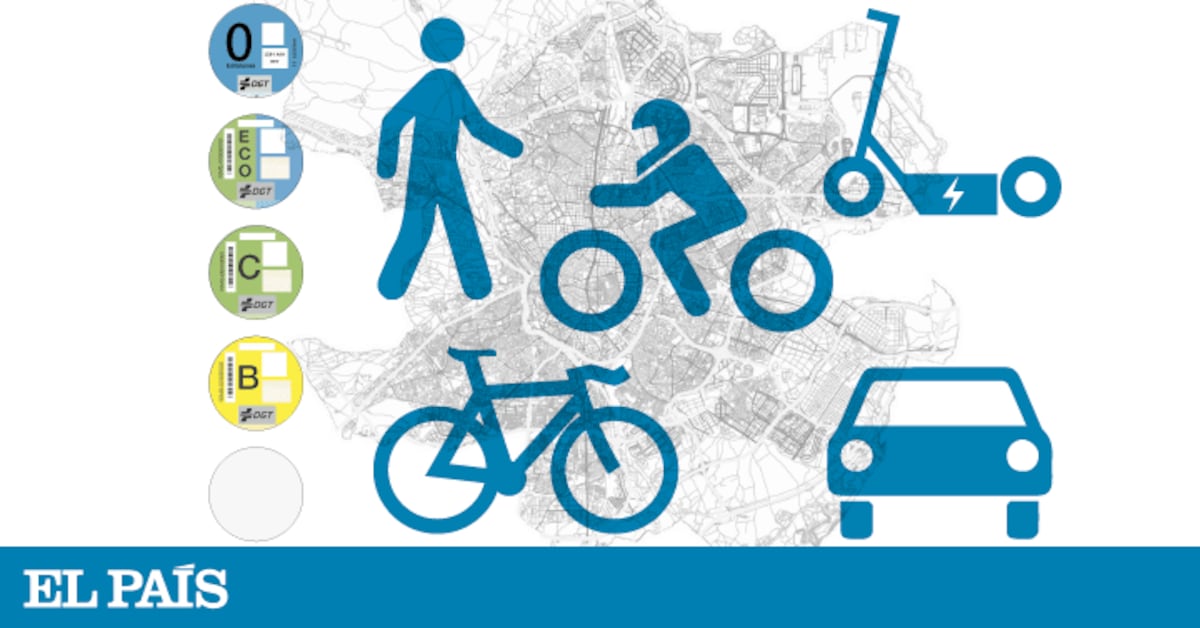
Madrid announces new rules of the road in bid to banish traffic from center
City is about to approve a raft of new regulations that will cover electric scooters, pedestrians, motorbike parking and bicycles
EL PAÍS English
161 points · by jseliger · 8y ago · 160 comments
No one wants to be anywhere near a 100km/hr road. It can sometimes be ok to walk next to a 50km/hr road but it's not nice and it's best to avoid it. 30 km/hr you can stroll or sit on a terrace and it's fine. But when it's 20km/hr or just closed everything changes.
When there's no chance your kid is going to get killed by a car, he can just go out and play. Your dog can sit off leash under your table while you eat. You can be absorbed in a conversation and not worry a misstep will result in serious injury or death.
We somehow just accept that the possibility of death or jury is just outside our door. Like live electric wires running down streets. When you take them away, everyone just relaxes a lot more.
http://mynorthwest.com/985398/seattles-next-homeless-encampm...?
I guess that this is circumstantial. That is USA's political system that is not working.
Because the headline is about a local government taking responsible actions to improve peoples lives while empowering public transportation as an efficient way of transport.
How different is "Metropolitan Transportation Authority" to "Consorcio Regional de Transportes de Madrid" [0]?
There is a pretty big need for a stronger, faster transit system spanning the region from Olympia to Everett. Housing price madness could be mitigated by fixing the ridiculous commute times over reasonably short distances that occur during rush hour.
Light rail is being built in King County, and the bus system in King County is actually pretty good in my opinion, but those don't cover a wide enough area to truly be effective. Given the geography of the region, I think the greater Seattle region needs a mass transit system most similar to NYC (though smaller)
So I'm really glad to seem them take this even further.
It would also be great to upgrade all Taxi's and buses to fully electric as well.
New double deckers are hybrid, and all new single deckers are fully electric. Again, big backlog (8000) but give it 20 years. (I wish it could be done faster though)
The buses should be solved much earlier, the average age is about 4-5 years. (Older buses seem to end up in Northern England...)
https://tfl.gov.uk/corporate/publications-and-reports/bus-fl...
Anecdotally, however, I think there is a huge number of delivery/construction vehicles along with Black Cab/Uber taxis etc that seem to make up the majority of the car traffic in Zone 1 (Central area).
However, I work in downtown San Francisco and live in Oakland, and I would NEVER drive my car over the bridge into the city, because of congestion. Banning cars outright seems to be a heavy-handed move and overly restrictive of individual choice, and you should just "price in the externalities" as the economists say. High tolls or expensive city driving permits for non-residents seems a better move to ease the transition as well as fund public transit options. They have to build up really, really good public transit infrastructure if they're going to make it more attractive than driving.
To me the plethora of rules reads overwrought and complex, and "occasional visitors" seems ridiculous.
Two of my grandparents drove everywhere for decades, retired, still drove everywhere, then had huge trouble with their joints etc. When my grandmother lost her license (worsening eyesight), she was very isolated.
My other grandparents had nice cars, but also made good use of their pensioner's discount/free transport pass. My grandma would take the train across a large English city to visit her sister or friends. She's in her late 80s, and still very mobile, although no longer independent.
I prefer a ban, as it's fairer to everyone. There are externalities that are very difficult to price (pollution, accident risk), and just being rich doesn't give people extra rights to poison the air and kill/injure people. It also ensures rich people use public transport, so they have some incentive to make sure the service is good.
I feel that if people are used to moving around their lives, they can continue to do so even in old age, like taking stairs every day on a 4th story walk-up with bags of groceries and goods.
Anecdotally, I feel the rise of the automobile coincided with the fall of general health and mobility of senior citizens.
You need a system which has at least a rational level of support for people who are elderly, infirm, or otherwise physically disabled.
That's a fair argument. I think a car-less future for urban centers is a good goal, but you need a huge transit infrastructure that I don't think most (any?) cities have right now to support it. Permitting is a transitional tool to enable a gradual phase out while letting the polluters/accident-causers etc. pay for the costs they're putting on the rest of us.
But turn around and do anything to take into account that SOVs are the most space-inefficient form of transit, and you are immediately labelled anti-car. Congestion charges or adding tolls? Anti-car. Parking restrictions? Anti-car (especially because people complain there's not enough parking spaces as is). Charge residents for parking permits? Anti-car. Add bus or HOV lanes? Anti-car. Spend a dime on improving public transit? Anti-car (why are you wasting money on public transit no one uses instead of the congested highways).
Yes, banning cars outright is one of the most extreme options. But the sheer sense of entitlement among drivers means that all the other options that have been suggested have been resisted with as much force. The only acceptable compromise is to cater specifically to their whims, and maybe in tandem help public transit at the same time. Of course, if there's any budget overrun on such a joint project, all of the transit improvements are the first things to get axed.
Even still, the extent to which our society has become subservient to automobiles simply blows my mind.
Nah, I'm not anti-car. I'm anti-car entitlement and think the expectation that others should bear the external costs of an automobile friendly society is silly.
Edit: I did, in fact, say "anti-car".
A tiny proportion of any US metro area's real estate supports this lifestyle. Usually either the most expensive, or the most hurt by gentrification and displacement. It's not a generalizable strategy without huge changes in zoning, public housing finance, and public transit infrastructure. I think we should make those changes, I vote for every pro-housing candidate and every transportation funding measure, but they are prerequisites. You can't turn off the old system before the new one is ready.
Somebody posting under your username did:
Lot of anti-car folks on here.
HOV - high occupancy vehicle
"Banning cars outright seems to be a heavy-handed move and overly restrictive of individual choice"
Allowing cars is overly restrictive of my individual choice to cycle safely, breath clean air and have my children grow up in a world without climate change.
There are obviously alternatives that do not involve banning cars outright - like barriers between cars and bikes, and electric vehicles.
I bet this will be something interesting to read about on future history books...
I don't think most Americans - who grew up driving since age 16 - realize just how weird that is for most foreigners. I was surprised the first time I tried to walk into a strip mall and I had to walk 200 meters to find a pedestrian path. It was also weird walking around places like San Jose and Sacramento where you don't see people walking on the streets.
I don't see how it's odd. It's the biggest problem with solving climate change - how much do you restrict everyone, and how do you properly balance the conflicting individual choices with people's ability to live their lives? Collective choices aren't really a thing. We approximate it with democracy, but obviously not everyone gets what they want (see Trump being in office).
Really though, public transit is vastly better from a heath, independence, financial, and safety standpoint for the elderly than driving.
A. Continue driving past the point they they are safely able to.
B. Become shut-ins due to lack of transportation, accelerating physical and mental decline.
In short: public transit alternatives to the Bay Bridge are already too popular. Shifting SF<->Oakland car trips to public transport is physically impossible in the short and medium terms. BART does not have space to accomodate the 270,000 daily Bay Bridge drivers, and there's a 0% chance of making that space in the next decade.
Sounds reasonable.
I'm not in favor of the current system, but your idea is wrong. It creates a centralized monopolized transportation system that serves well only a very small minority of people and might easily became a nightmare. There are other ways we could follow that would make much more people happy, support the economy and wouldn't make sick people stuck at home and everyone late.
One such system could be a real time optimized network of self driving and self owning (limited AI) electric vehicles with various sizes and operation modes (on demand like taxi/bus-like/...) - and non-self driving vehicles wouldn't be allowed inside.
And your comfort comes at the cost of massive amounts of space, clean air and thousands of deaths each year.
Sure, perhaps we need more gradual change, particularly in the states. But in Europe, especially the UK, we should be rolling out pedestrianisation to our busiest city centre streets and aggressively aiming for minimal traffic in the heart of city centres.
In the US at least, we already massively subsidize road infrastructure and gasoline, I think it's fair to let people who actually live in cities enjoy them, rather than bend over backwards to accommodate suburbanites who only come in for work.
Also, cars aren't a magic ticket to mobility. Elderly people often can't drive and end up stuck in their homes. They have to be purchased or leased, and maintained, etc.
Why do you say that? Have you ever lived in a city with good public transportation?
You should consider visiting Tokyo, the largest metro area in the world, with 38M residents. Almost no one drives there, public transportation is what pretty much everyone uses and it works. It's a clean and quite city where everyone can easily get around. Walking and biking there are really nice too.
Honestly, I think this is kinda what drivers get for fighting tooth and nail against bikelanes and public transit for decades.
I have lived downtown for 2 years myself and oppose this ridiculous "environment"-protection move.
Its very anti-social to ban traffic from urban areas. Technology and evolution should create opportunities and positive changes for people, not take away their rights!
Get rid of all of them, enable adequate public transport, add a whole load of trees, calming and removal of signage and markings. Then give priority to the pedestrian, bike, and perhaps limited motorbike before car.
Cities could be a nice place to live once again rather than somewhere to avoid.
That said, I feel no cars at all is the ideal we should aim for, and build our roads for - with the necessary investment in public transport.
That's quite a generalisation. People in major cities like London and Paris would obviously like to clean up the pollution and reduce the noise and disruption, but the simple fact is that the existing public transport systems are not even close to having enough capacity to replace private motor transport entirely, and there zero chance of them having it any time soon. And those are the ideal cases, where there is enough demand to make a reasonably efficient and close-to-24/7 public transport network viable. Those in smaller cities have much worse options in terms of efficiency, availability and reliability, as do those travelling between or outside the bigger cities.
You can't just ban cars to fix this, or price them off the roads with congestion charging or the equivalent. It would take a huge programme of investment in developing new mass transit alternatives and redesigning large parts of the overall transport infrastructure within cities to make forcible elimination of cars in favour of public transport a viable option, and any such plan would probably have to be implemented over a 50-100 year timescale, with those footing much of the bill never living to see the benefits. That's a tough sell for any political administration.
I personally think that making private transport less intrusive and damaging has far more potential to improve the situation in the short to medium term. Infrastructure for electric vehicles is one obvious move in the right direction, but more generally, our road systems are still designed around the idea that one person making a journey with limited cargo needs a car-sized vehicle, which is horribly wasteful in road space, parking space, fuel consumption, etc. We have some very basic infrastructure in cities these days for bikes and we make some allowances for motorbikes, but these modes of transport have serious downsides for a lot of people. Crucially, the changes needed to improve those downsides would also allow, for example, smaller electric vehicles that are still fully enclosed and having space for carrying small loads in addition to their human occupant. Combine that with increasing automation over the next couple of decades for better safety and general efficiency, and most of us might at least still be alive to see the benefits.
Paris is currently building more than 200km of subway (between now and 2030), a new suburban train line (RER E), 4 new tramway lines...
The reasons why existing public transport systems don't have enough capacity to serve everyone is that (1) under the dominant hypercapitalistic ideology, public transport is often seen as something that has to be economically profitable, or at least break even, and not as a right (as you can always take your car); and (2) it is hard for it to be economically profitable, or at least break even, when it has to compete with the convenience of the car (which is effectively subsidized), apart from competing for space.
If cars were banned, public transport would improve by leaps and bounds by simple market force. There would be much more demand and it would be much easier to make it profitable (and there would be a case to run it with taxpayer money even where it weren't profitable. With the savings on buying cars and gas, we could very well pay that).
In the 1920s, my city had about 80K people and there was a tram line to a town about 15 km away, which had 7K people. It was operated by a private company, and was profitable. It was removed when cars became popular. Now, my city has around 250K people, the other town has 15K people, more proportion of people work and thus need to commute, my country and area are much richer and prosperous than back then, but no one would even dream of building a tram line like that. It would be considered pharaonic, unprofitable, etc. Why something that was possible almost 100 years ago, with less resources and worse technology, cannot be done now? Because there are cars.
I live in the US, in a state famous for requiring a car. I genuinely miss when I could take the train to work, and my family visits me less now that they have to drive into the city rather than park at a train terminal and ride transit in.
Land, utilities and the environment aren't like human-made resources. They're finite. So there's some inevitable decision-making there. This may limit your absolute freedom, but no one promised you that anyways.
It seems to me like having a majority of residents and workers supporting an initiative for local civic planning has a lot more legitimate authority than, say, a national vote on the same subject. At some point, you have to accept being an outlier.
And in addition I would propose that approximately forty thousand people a year would be killed directly in vehicle collisions and that your children would be put in danger by you and your neighbors.
It is possible that you are talking about one of the very rare (and ever decreasing) rural areas which simply does not have enough population density to make public transport viable. But, we will worry about that after the dense suburbs, exurbs and downtowns have a modern transport system.
Spot on - and societies obsessed with cars effectively deny that right to people who cannot drive or cannot afford a car.