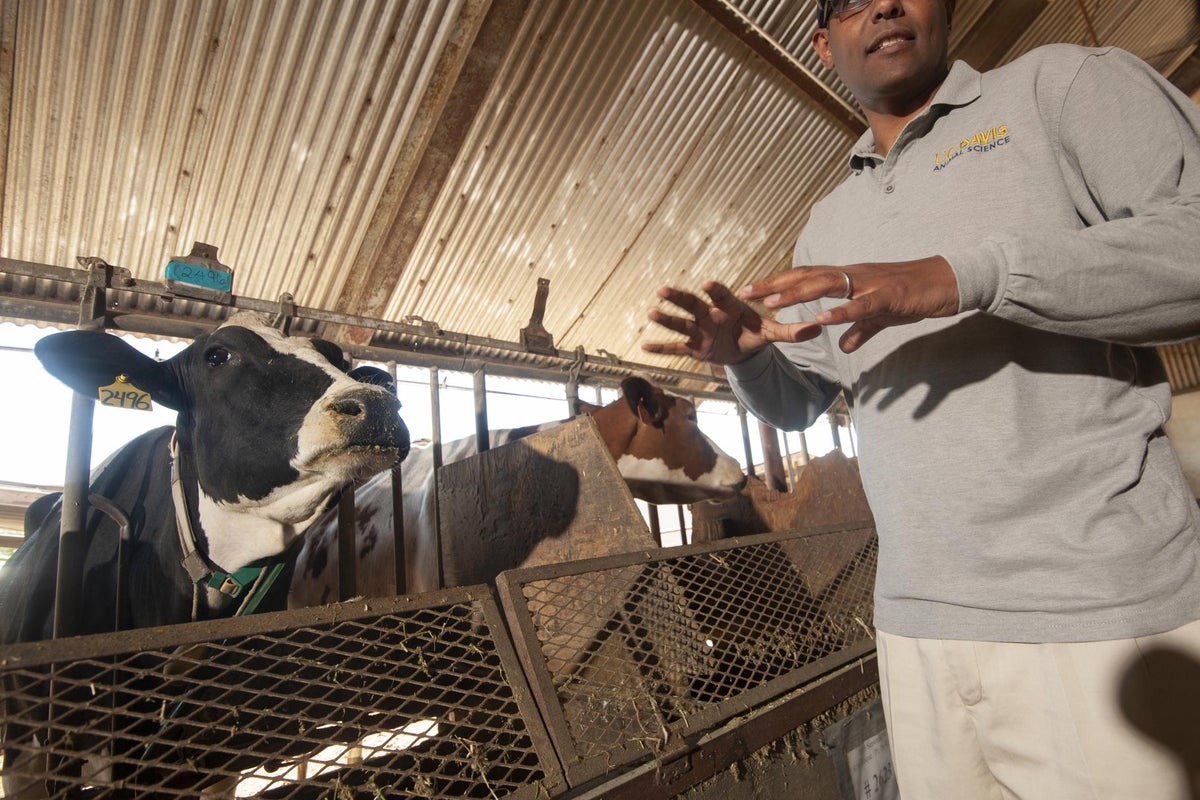
Methane from cow burps could be dramatically cut by feeding them seaweed
California scientists
The Independent
160 points · by Tomte · 8y ago · 82 comments
You need to tax the externality (greenhouse gas emissions), not an activity which currently causes such emissions, because then you don't have any incentives left (such as in this case) for industries to reduce those emissions.
1. https://www.theguardian.com/environment/2017/dec/11/meat-tax...
It‘s not just the environment that suffers from our industrialized way to produce meat
Taking your logic, I can extend your argument in the opposite direction towards humans. But I have a feeling no one would condone that!
I think your point just argues for pricing in more externalities, rather than abandoning the goal of pricing them and using even more opaque sin taxes instead.
I suppose you're saying we should tax usage of these things based on calorie produced?
This could also have a knock-on affect of encouraging _more_ cruelty (if that's even possible at this point).
If someone with cancer dies, their cancer also dies. Net result: less cancer. (Unless it is important to research, such as HeLa. In that case, the cancer can go on living with all expenses paid, and the human it came from can be forgotten, and their estate uncompensated.)
~ (Poe's law: insincere.)
-- The Tragedy of the Commons
I recommend the whole paper as a good think on the unintended consequences of not biasing the options of people away from collective irresponsibility.
You might not care about some health risk, but when you get sick, your family is going to be affected, your coworkers are going to be affected, and society has to pay for you to get well (by paying more for health insurance).
And we're social animals. We care about one another. And caring sometimes means that we nudge people into a direction that makes them healthier.
(I don't actually know if red meat is dangerous enough to justify a tax, but for the sake of argument, let's assume it is)
But secondly that WHO page is frequently cited by people who apparently haven't understood the numbers behind it. It's not worthwhile to tax meat as a cancer risk because the health impact is a rounding error.
According to the WHO:
> about 34 000 cancer deaths per year worldwide are attributable to diets high in processed meat.
That's the population of a village worldwide. To turn that into a death rate for the world population in 2015 is 34000/7400000000*100000 = 0.45.
That wouldn't even make it onto this table[1] of most common worldwide death rates. You can see rates like 15 for diabetes, and 115 for heart disease, both of which are strongly linked to diet.
If everyone in the world adjusted their diet so they wouldn't be overweight or obese, but kept eating processed red meat, then diet-related illnesses would be rare enough that nobody would even bother talking about them, as opposed to being the one of the leading causes of death in the western world.
Citing a WHO report which says that evidence of carcinogenicity is strong without context is correct but misleading. As that page points out you can have strong evidence but tiny effect sizes.
1. https://en.wikipedia.org/wiki/List_of_causes_of_death_by_rat...
I could just as well have said that red meat increases risk of heart attacks, red meat increases choleserol, raising cattle for meat uses lots of fresh water in areas that don't have enough, that a lot of feed is required to produce very little meat...
It just happens that one externality (methane emissions) is easily measured, but all the other externalities of meat consumption are not, hence a tax makes sense.
Joking aside, for the more curious, the article mentions work by Australian scientists exploring the idea in 2015: The red macroalgae Asparagopsis taxiformis is a potent natural antimethanogenic that reduces methane production during in vitro fermentation with rumen fluid
The same story for anything. The market pressure to precipitate this change isn't there yet.
- in ruminants, bacteria-assisted "fiber digestion" happens before protease-mediated "protein digestion": the rumen precedes the abomasum. (The other two stomachs, the reticulum and omasum, have an unclear function, but appear to essentially be large filters.)
- in other mammals, including most herbivores, bacteria-assisted "fiber digestion" occurs after protease-mediated "protein digestion": the stomach precedes the colon.
So while a human or other primate -- including leaf-eating monkeys -- expels most fermented gas via the anus, a ruminant will expel most of it from its mouth (eructation):
https://en.wikipedia.org/wiki/Rumen#Stratification_and_mixin...
The only thing missing is a profit motive...without taxes and regulations that internalize those external environmental costs, there's no motivation for cattle producers to add even this small cost.
(https://doi.org/10.1071/AN15576)
i guess that means they stay as co2 and hydrogen, but the paper also says that fermentation efficiency is decreased which ends up making the cows eat fewer molecules.
I don't think there's a lot of aerobic activity going on in the rumen, so at least we know that it isn't immediately turned into CO2 (even if that would have been a win, methane is 10 times worse a greenhouse gas).
> (https://www.landcareresearch.co.nz/science/greenhouse-gases/...): Measurements of methane emission rates on sheep and dairy cows have repeatedly shown that the variability of emissions between individual animals is large (e.g. for young sheep grazing the same pasture, emission rates varied from 9 to 35 g/day per sheep). While this variability may one day be exploited to reduce methane release by selecting for low-emitting animals, it is not well understood.
https://www.researchgate.net/publication/257589662_Methane_p...
so there's something to it that doesn't add up. either the economics of producing enough algae make it infeasible, or other factors come into play like milk/meat taste or even what to do with pastures if they aren't used for pasturing, it's not like you can grow stuff there.
This is the perfect place for government action to incentivize switching to this kind of feed, be it subsidy or tax break. Pollution is sadly profitable, and corporations need to be either fined for polluting or incentivized for reducing pollution; shareholders rarely see beyond quarterly profits, let alone the great economic consequences of pollution a century down the line.
It takes not government action, but global action. Why would producers in e.g. Germany put up with a carbon tax (or a methane tax) if producers in the US have their fingers in their ears, denying that climate change is a thing at all?
I believe the only way action will ever happen is if a global enforcement agency imposes environmental taxes on the world and backs it up with force. Its hard to even imagine what the world would look like as something like that comes to pass.
At the same time its a good thing to be preparing some solutions, e.g. carbon capture, seaweed eating cows. Just in case the world comes to its senses and decides to actually deploy/enforce said solutions.
You only need to add a little seaweed to the cows' regular food.
Grass fed meat is gamy than grain fed/finished, so I can imagine seaweed imparts an fishy taste to the fat and probably to the milk also.
All jokes aside, I wonder how they account for the extra salt that's in seaweed. I know cows usually have salt licks to supplement salt and other minerals; perhaps seaweed can supply all that's needed in terms of minerals?
https://ideas.ted.com/methane-isnt-just-cow-farts-its-also-c...
https://www.greenbiz.com/article/gassy-cows-facts-about-beef...
I had the impression that US milk has no taste but always thought it's just in my mind. But when I was in Colombia I met a guy from Switzerland who studied in Canada and said:"Oh wow, the milk here really tastes good like in Europe. Not like in Canada." So the milk in Europe and North America must indeed taste different. It is not just in my head.
It's grass fed; if you buy it in the farmer's market, it's a couple of days fresh; and they care about their cows. I bought a bottle once, which didn't taste as good as usual, and when I told the guy at the market (he actually raises and cares for the cows), he took notes to figure out which cow was unhappy/unwell.
Not affiliated, was just a satisfied customer until I moved out of NYC (and now have no good milk available :( )
In Northern California, Saint Benoit [2] markets Jersey cow milk and yogurt. The flavor of their milk is incomparable to all others I've ever tried stateside.
I'm not a vegetarian, but I live with one and I eat really small amounts of meat now compared to what I used to. I have no issues with that whatsoever, it's often even better and tastier this way, despite of me being a vegetable hater. I really can't see a reason why people so ridiculously defend their meat meals like they're addicted.