Life with China’s Shaolin Monks: Fact vs. Fiction - RADII
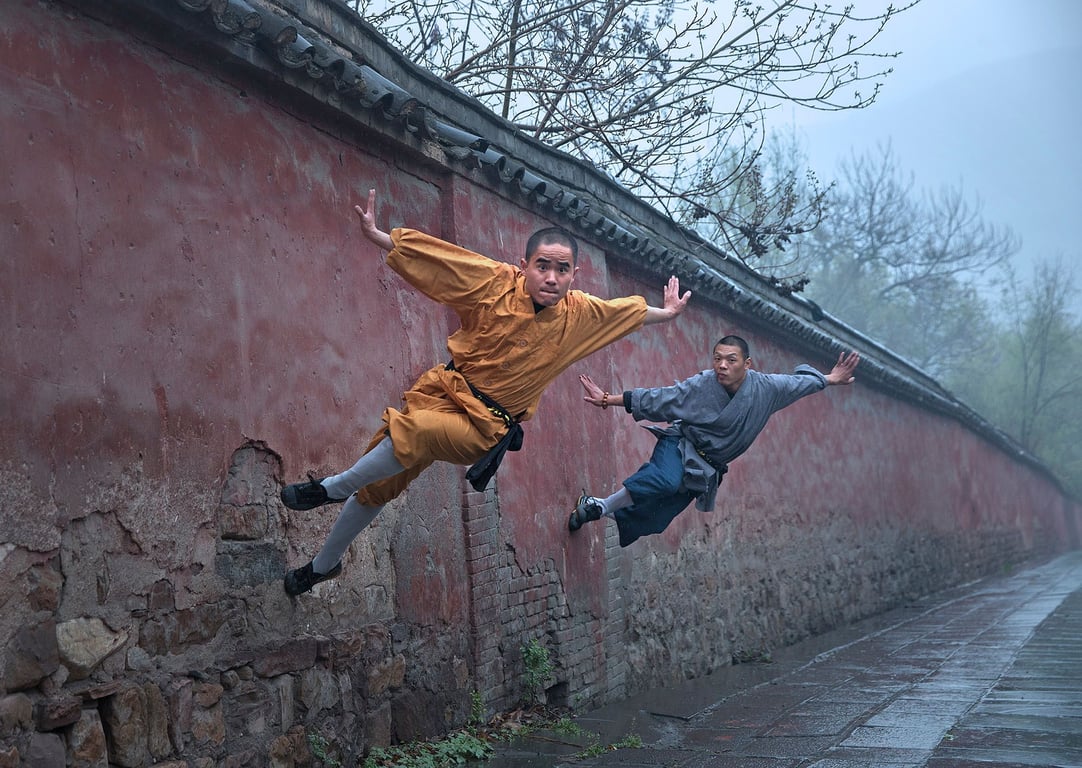
Shaolin monks.
RADII - Transcend boundaries
98 points · by jonnybgood · 8y ago · 95 comments
Really? The author learned Chinese, studied kung fu for years, then traveled to China to train -- only to decide that getting up early was simply too much effort?
I found this article informative (if someone erratic), but this part truly baffled me. Still, it's very interesting that a fifth century temple is still operating -- and making money! -- today.
And the physical disciplinary punishments are brutal.
Oh and you have to keep this up for 5-10 years. Very reasonable to see why someone would not want to commit to this.
Many of the warrior monks were trained as very young children so they had not much say in the situation and just had to deal with it.
This idea of skill through practice is one of those values that I am very grateful for because it was sort of drilled into my head at an early age and has been enormous beneficial to me throughout my life. It's become more valuable now that I'm older and don't absorb new information as quickly or easily.
"From Sato," Tõzan replied.
"Where were you during the summer?"
"Well, I was at the monastery of Hõzu, south of the lake."
"When did you leave there," Unmon asked.
"On August 25" was Tõzan's reply.
"I spare you sixty blows," Unmon said.
The next day Tõzan came to Unmon and said, "Yesterday you said you spared me sixty blows.
I beg to ask you, where was I at fault?"
"Oh, you rice bag!" shouted Unmon. "What makes you wander about, now west of the river, now south of the lake?"
Tõzan thereupon came to a mighty enlightenment experience.
If we can trust Wikipedia:
> In its original meaning, kung fu can refer to any discipline or skill achieved through hard work and practice, not necessarily martial arts.
Heck lots of celebrities get up at that time to do physical training for conditioning for movie roles.
I also want to know the material of that glass and needle...
NM, yt vid of an American magician doing it.
It makes sense to me. Going easier foreigner program was the plan the whole time. Just because you put a lot into training and commitment does not mean there is no line and you will put in infinite amount of all that. He wanted quality training, he did not wanted to become lifetime monk.
As a kid, my dream come true would have been to have been locked away doing nothing but martial arts training for years till I emerged a fighting machine who could win any fight.
As I grew up, I realize what a total waste of time and life that would have been. Far better to learn to read and write, or even dance (college I guess). Those skills make me far happier. Yet, as a kid, it felt awful to have to go to school rather than spend my time in Shao Lin.
You don't need to practice heavy, fight oriented figures to practice martial arts too.
I'm a Zen practitioner for ~4 years, and my master is also started to mix qigong into the practices. I also dance (tango), and there's awful lot in common with qigong about body control, movement and balance.
There's an old proverb: "A good dancer is a good fighter, and a good fighter is a good dancer."
If I was a physicist I'd say both are experiment teachings about time and space.
It's also striking how it teaches you complex limb chains efficiency, that's the only way to only use the minimal amount of energy per effort. It's all intertwined.
While we were chatting with our master, art and martial arts came into subject. It turns out that practitioners also practiced classic arts (music, painting, dancing, drawing, calligraphy, etc.) during their training. It's considered a catalyst and an essential part of the training, because it promotes calm, focusing and fine work. It also balances the more outward/powerful side of the energy.
As a developer, I consider coding as an art. Writing code with the same concentration and calmness both accelerates the development of the code and really settles some of the dust which practice inevitably stirs up.
Really, everything is much more connected than it seems. Please don't give up drumming.
I'm from Turkey, my tango teacher is also from Turkey, and my master is from Korea. You can reach me via http://bayindirh.io
The human body is capable of really amazing things, and schools like this have been honing their pedagogy for thousands of years. If only Westerners weren't so darn skeptical about everything, then we'd have way more of that sort of thing over here.
I think generally, evidence points to the contrary. It's amazing how quickly specific martial arts lose their fighting ability when realistic sparring/fighting is replaced with forms, meditation, light/no contact, etc.
See: 1993-1995 UFC competitions where traditional schools were destroyed by wrestlers, judoka, and BJJ.
I really don't think hardly anybody in the developed world is ever going to face a true combat situation where they can actually use their empty-hand skills. It means they couldn't run away, lost their gun, and couldn't find a improvised weapon. The actual military doesn't train it any more other than for confidence. When you train MMA, you're really training for MMA competitions, not for any kind of real-life combat situation, cuz MMA won't help you there.
We did do bare-knuckle, few-rules sparring in Merpati Putih and it was legit my favorite thing to do. We hit and got hit hard, but I didn't get near the amount of sparring time I wanted. Even so, I'd have put my MP skills against anybody else's in a typical bar fight. Not now of course, those days are long long gone. My survival strategy these days is to de-escalate, and if that doesn't work, submit, and if that doesn't work, go momma bear and hope I survive.
I disagree with this. It can certainly be true if you are in a situation where guns are common (eg. Texas). But the majority of people are in a situation where guns are not available. You should train with what you have available, and for self defense, with what you are likely to have in a normal day. Luckily for us where guns are not available, running away is the best option!
"When you train MMA, you're really training for MMA competitions, not for any kind of real-life combat situation, cuz MMA won't help you there."
Whilst I don't 100% agree (I think training mma will help a bit), you bring up a really good point. That there is a huge difference to learning to fight for a competition, and learning to fight for self defense. And like you said, de-escalation, and situational awareness, are the best course of action.
When I'm walking in a dangerous area, or even a safe area, I always look directly at all who approach in the other direction, from afar. I intentionally look friendly, but ready for a confrontation. Anybody who looks even slightly troublesome gets a head to toe scan, not because I intend to do anything with the information but rather to signal that I'm not going to be an easy victim.
Troublemakers, muggers, beggars, prostitutes, pushers are just like you and me: they are looking for an easy job. If you act - not look but act - like you would be difficult to handle then they will look for another victim.
Oh, and I should mention that vigilant situational awareness had saved me from many more speeding electric bikes than terrorists. Nice side benefit.
Spending 10000 hours palm fisiting a piece of steal in a quiet room after working on your breathing for 30 seconds has no practical application in these situations.
Spending 10000 hours properly escaping someone fully committed to strangling you while they have you mounted, or better yet preventing that situation from occurring with takedown defense / offense and effective clinching has a variety of practical applications in these situations.
(Biased BJJ practitioner)
I went to a very strenuous and traditional Tae Kwon Do school as a kid in a diverse semi low-income neighborhood. I had no delusions that it was teaching me how to fight well in MMA or a street fight. Situational awareness, lack of ego, and running are more important for self-defense anyway.
I got into great shape, became flexible, learned body awareness (forms are good at this), breathing, and it really helped me develop a lot as a person and forever recognize the importance of physical health and humbleness. It was a very welcoming family environment with people from all ages and ethnicity and everyone had so much respect for each other. I still visit my master when I see my parents and its such a blessing. I come back nearly 15 years later and it feels frozen in time in the best way. I'm a little sad to see MMA gyms take over, but I think this school was a rarity even when I grew up. My master spent his entire life doing Judo and TKD and had 30+ years of experience in each.
We sometimes practiced Tae Kwon Do the Sport. Its what you see in the Olympics. Its not about real fighting, its just a sport and a very small aspect of the rest of the training. The other bonus is you don't get CTE from practicing unlike MMA. (at more competitive levels knockouts do happen, but there is headgear and no head punching)
Nothing has made me sadder moving to the software industry then how I let it sever my connection to physical arts. I'm not blaming the industry, it was my own time management and habits. Now, I saved enough to take a year off doing cheap travel in the US and I plan to spend a few months going back to my home gym. I feel so grateful.
In a surprising turn of events, a tournament organized in large part as self-promotion by Gracie family "proven" the effectiveness of their martial art.
These are the only rational reasons. You'll maybe be in one or two violent situations in your whole life (maybe a few more if you don't know how to, ya know, run away from them) and it's a hundred to one that those situations will call for empty-handed fighting.
Spending multiple hours a week training for something you have maybe one in a thousand chance of actually using productively isn't the smartest thing to do with your time. If you think you're doing anything more than staying in shape and building discipline, you're fooling yourself.
This wasn't intended to be an argument, btw. Just hammering the point home for anyone else thinking empty-handed martial arts is a viable self-defense strategy.
The Chinese have become skeptical as well .
https://www.scmp.com/news/china/society/article/2119375/nobo...
I think the skepticism is pretty rational. There are plenty of people who talk about a bunch of rubbish that makes them invincible. Things have really got to be tried to be prove, you gotta walk the walk, not just talk the talk.
Modern martial arts has a great history of taking things that weren't initially thought to work, such as Brazilian Jiu Jitsu, Muay Thai, Judo etc, very seriously when they are proven to work.
To dream of a day when a society of humans all have such capability!
There is a huge political controversy in the kung fu world that this article doesn't address, which is the Chinese government's perceived hostility to the idea of letting its citizens train to really fight, for pretty obvious ideological reasons.
Essentially, the claim you will hear from some Chinese masters (often part of the diaspora) is that while the Communists discovered that the veneration of martial arts was too deeply engrained in the culture to eradicate, they could transform people's idea of martial arts itself into something more like dance or a gymnastic performance. They did this through the creation and control of various wushu institutions and the transformation of the Shaolin Temple into a training ground for a performance troupe (I said it's a controversial view).
In particular, according to this view, the ancient legends associated with the Shaolin temple allowed the government to create something totally new, that people would nonetheless perceive as part of an old "kung fu tradition."
There's only one really good, trustworthy book out there (that I know of) on the Shaolin temple. It's called The Shaolin Monastery, and it's by a professor of East Asian Studies named Meir Shahar. Definitely worth a read if you're interested in learning more.
More serious training can be had at Wu Dang.
Anyone have a mirror?
Albeit they include artificial such scenarios by having a very rigid environment which is stressful and one has to learn to adapt to it.
So, practicing being calm there, I am not sure how that will translate to "the real world". Would really like to know about stories of people who practiced such things in their childhood or for a long period and how they are faring post that.