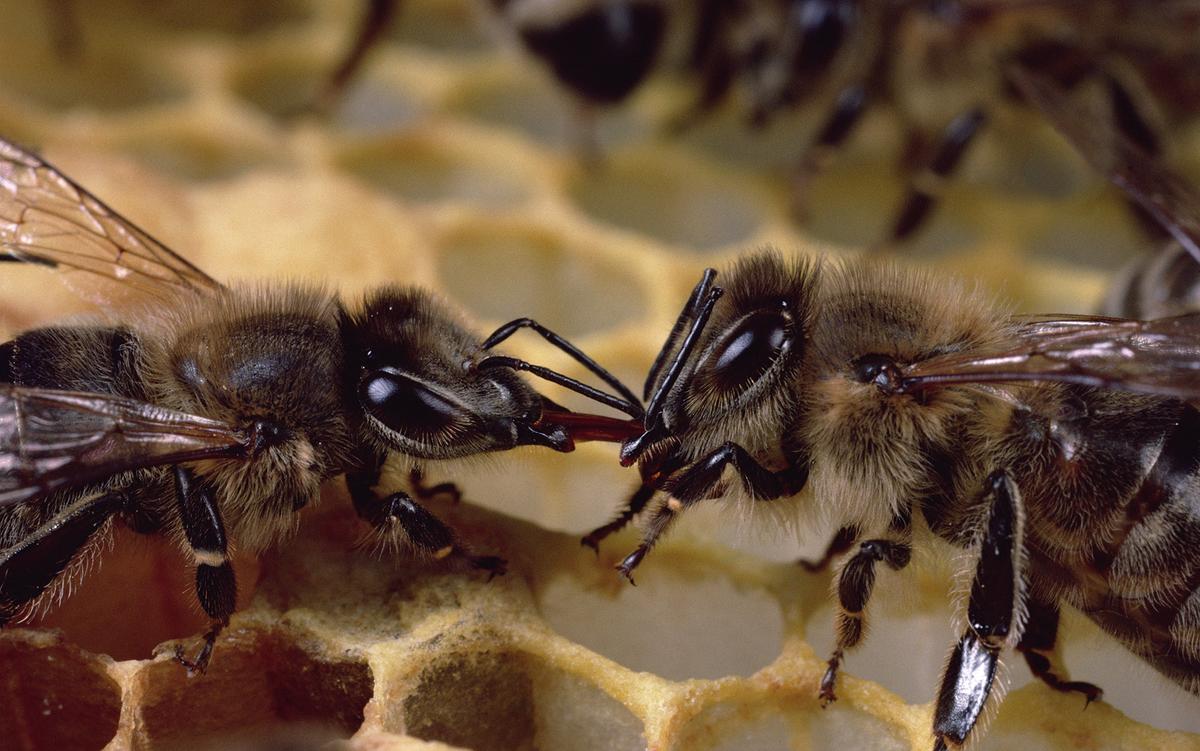
Inside the mind of a bee is a hive of sensory activity | Aeon Essays
Are insects ‘philosophical zombies’ with no inner life? Close attention to their behaviours and moods suggests otherwise
aeon.co
55 points · by howard941 · 8y ago · 41 comments
I wonder if someday we'll reach a point where we recognize consciousness in most animals and think it was ridiculous that earlier people didn't see such an obvious fact. Just like how "common knowledge" just a few decades/years ago was that babies and crustaceans couldn't feel pain, but it'd be bizarre for anyone to claim that today.
The only thing that makes the Homo genus unique is control of fire.
It amuses me when there's an article that recognizes a similarity between humans and other species, many jump onto the "see, they're _just_ like us" meme.
What I'd be intrigued by is if there is any other species (is there _any_?) that has, century over century, via pure self- and collective-determination, advanced their state of being, achieved new capabilities, live in ways completely different than their ancestors, etc. I'm not including genetic adaptation or evolution to suit an environment -- I mean self-driven advancement. Seems we're quite unique, in that regard.
The Homo genus evolved around ~2-3 million years ago; homo sapiens came about ~250K years ago. What's not to say that 2 to 3 million years from now, there'll be some other intelligent species from other genus branches? It always tickles my brain to think about this.
Also relevant: https://io9.gizmodo.com/5780020/if-humanity-went-extinct-wha...
Animals eat other animals. We're animals, so we do that, too.
If anything, religions largely promote treating animals properly, because they're some form of gods' creatures.
"Be fruitful and multiply, and fill the earth and subdue it; rule over the fish of the sea and the birds of the air and every creature that crawls upon the earth."
Of course people would do it anyway, especially when they had no other choice (nowadays we could live without exploiting animals, it would even be cheaper and more ecologic - but before we knew chemistry and biology we had at least some excuses).
But at least Bible-based religions clearly legitimize abuse of animals, and treating animals as mindless things that don't have feelings nor rights. Even now in my country ecologists/vegans are one of the groups considered enemies of "natural order" by influential religious media (Rydzyk media-empire in Poland for one example).
It's not an accident that animals don't have souls according to Catholicism.
Some advanced animals, like wolves, have something resembling a passing of cultural knowledge: they teach their young how to hunt particular prey, and this may differs seriously between packs and types of prey. But they lack speech, so they can't pass more complex ideas.
Cetaceans are said to have consciousness not unlike humans'; maybe they have speech and an advanced culture; we don't know. But they lack means of manipulation and live mostly floating above abyss, so they don't have a material culture and technology.
Quite possibly it's not an exceptional intellectual capability that singled out humans among comparably intelligent animals, but the (proto-)speech ability. The advances in intelligence then followed, being evolutionary beneficial.
You refuted your own argument. Sounds like it's more about the "material culture and technology", which started with control of fire.
No living species other than Homo sapiens harnesses fire.
What I mean that animals which did not develop technology may have other kinds of advanced culture, such as that we would recognize as culture, e.g. in social organization and explanation of the world ("philosophy"), and/or art — it they have a capability for structured communication and thus capable to pass more and more complex knowledge across generations.
Does it really matter whether a bee is better at any of those tasks than "average" or "best" humans?
Clearly, once flexibility is achieved, other capabilities can be improved upon iteratively, because that's exactly what happened in nature. And yet I don't see any researchers looking at how many different tasks their specific AI can accomplish, instead of how well it can accomplish a particular one.
I do agree with you that we still have much to learn in neural network design (or more generally distributed algorithms). For example distributed systems are notoriously bad at state machines (or sequencing in general). One of the ways biological systems handle sequencing is via multiple signaling layers with different time constants (e.g. pheromones vs neurons). On the other hand deep learning systems I am familiar with just throw more parameters at the problem, obviously this scales poorly with the sequence length.
The opposite, cognitive consciousness without qualia - a.k.a the philosophical zombie - or a computer which can argue the existence of it's thoughts without feeling them is, I gather, a more controversial state of being.
What I find interesting is that in separating the two 'consciousness's, the former ends up taking almost all of the importance and the latter none - anything which can be externally measured ends up in the first category (which is a computable logic process), which leaves very little of utilitarian/evolutionary/algorithmic importance in the second. However, in much discourse about consciousness the latter takes a disproportionate role (i.e fear of losing your unmeasurable consciousness when teleporting, etc, though the cognitive consciousness, being by definition a logical and measurable process is theoretically preserved)"
In this case although the article, to get quick views, appeals to our love for the mystical attributes of the 'conscious exprience phenomenon', the paper actually studies the (in my opinion much more) interesting empirical characterisation of the level of cognitive consciousness in insect 'brains' - i.e., how elaborately their software models its own processes.
"Consciousness" is something that we experience, but it's not required to explain anything at all that's observed.
As far as I understand it, a theory of mind is a hard requirement for consciousness - you understand that other beings have minds, then you model them, then you turn that in on yourself, and the loop is closed and voila, you develop tools and culture and anxiety.
That's borderline whitewashing his thoughts and actions on the matter. He did stuff like nail his wife's dog to a board and vivisect it to prove that it couldn't "truly" feel pain.
(because the author is convinced they have a real inner life)