108 points · by arto · 7y ago · 47 comments
For privacy issues you'd want to limit this to periods in time that are far back enough for most people to have passed though. So I could imagine the Second World War to be a (somewhat arbitrary) limit for now.
This limit would eventually need to be expanded, because I wouldn't want my photographs to be examined like this in 70 years time.
https://www.popdust.com/conspiracy-theory-thursday-keanu-ree...
It's even getting to be the case now that you can't just move to a new country and start over. Unless you've got skilled forgers close at hand, you're going to have a bad time immediately, and with facial recognition and biometrics, you'll have a worse time still.
It's perhaps the definition of a low-probability corner case, but if any alchemists happened to succeed, they're no doubt having a pretty depressing century.
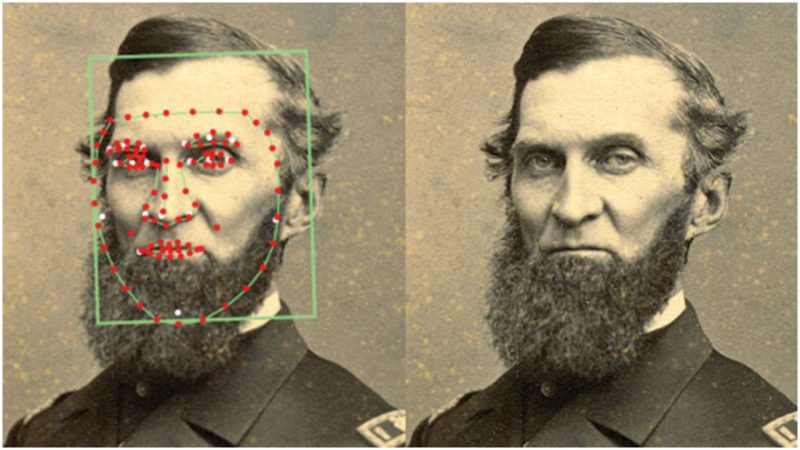
This is how we find the time travelers :)
Date the photo was taken.
Where the photo was taken (e.g. the annual family reunion in SmallTown, Illinois)
Photographer. They're likely taking photos of the same general set of people or in the same geographic area.
Time+location of other similar photos. Back in the days of the civil war, it wouldn't be possible for someone to be in to locations 1,000 miles apart in 2 days.
Side note: I recently saw a video from ~1910 in New York City. Everybody in the video had a similar physical build and would make the "average" person today look fat. I wonder how this would affect the confidence of photo grouping? Overall, did people look more homogeneous back then?
If your goal is explicitly to find something extremely rare - unexpected face matches in different places - you will be flooded with false positives even if the false positive rate is fairly low.
Give people access to all the other clues like "insignia and inscription" and probably a lot of reliable identifications can be made, and the remainder flagged as 'possible but uncertain'.
Wait, why are you fine with doing it with other people’s 70 year old pictures, but you don’t want people 70 years from now to do it with your pictures?
(sorry if I am missing the sarcasm or some such)
- live expectancy has gone up, so in 70 years it will be more likely that I am still alive
- there are and will be a lot more photographs of me than of the average person in the 1940s, probably in the thousands of times more, so the impact on my privacy of studying all my photographs is far greater than it would be for the off picture of someone in the 40s. "Here he is, dressed up, at his wedding and 10 years earlier as a child" vs "Here is a map with all the places where mosselman was seen with a social graph of all the people he was ever seen with"
Lately life expectancy has been dropping in this US. https://www.wsj.com/articles/u-s-life-expectancy-falls-furth...
I would also extend this to any technology available in the future. Facial recognition is interesting, but let’s think about more advanced biological things that could be available in 50-100 years.
My issue with that is faces aren't that unique, so you might get unrelated people identified as the same individual.
Isn't English so deliciously versatile.
Paraphrase: Faces aren't entirely unique. So, you could identify unrelated people as one person.
I'm sure the Hitlers and Görings of this world changed their names in due time and took steps to insulate themselves and their offspring from their forefathers' bad rep, but what if it turns out your pop-pop was a guard at Auschwitz?
Each time that you are in the background of a picture of an stranger. In the broad panoramic videos from sport stadiums. From fingerprinting you writing in all social media. From government documentation. From text of other people talking about you... all your digital traces to know who were you.
Now is happening with past pictures, even that there is no so much to mine compared with the present.
I'd say there's a huge difference between knowing that your (or someone else's) ancestors were terribly racist and knowing that they were involved in murders.
There are very few people still alive who were adults when there were large numbers of lynchings happening in the US.