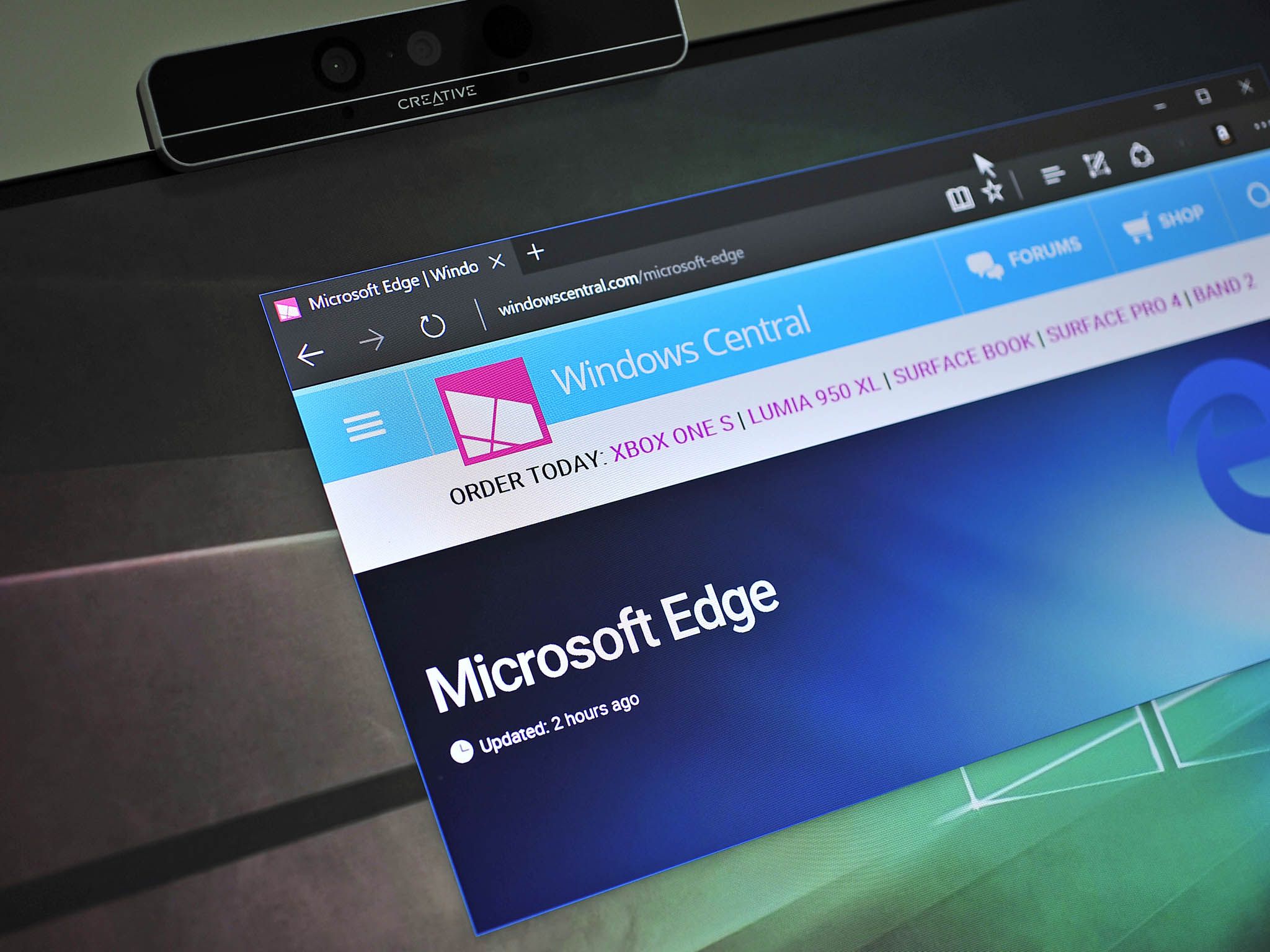
Microsoft is building a Chromium-powered web browser that will replace Edge on Windows 10
Microsoft is throwing in the towel with Edge and is building a new web browser for Windows 10, this time powered by Chromium.
Windows Central
1061 points · by rattt · 7y ago · 733 comments
I applaud the death of IE and Edge. One thing I'm worried about though is that Chromium may take over the market and we end up with websites working only in Chromium based browsers and other important browsers like Firefox and Safari get left in the dirt.
This will be especially true when Firefox inevitably shutters it's in-house efforts in a couple of years due to the amount of sites that won't work with it, and starts using Chromium too.
Staring into my crystal ball tells me Firefox will become "janky" in the eyes of users on account of how many sites don't load on it like they do Chromium (because developers will only test on the most popular browser, because THIS IS WHAT HAPPENS LITERALLY EVERY TIME).It seems very unlikely:
- Mozilla has been in a far worse uderdog position before during the IE6 era, with way more incompatible sites and less funding.
- Mozilla is not for profit. Fighting for the open Web is one of their goal. It always has been. They are not perfect, but their track record is damn good compared to almost any player of their size and impact in the tech world.
- Mozilla strongly invested in their own tech, including rewritting the browser rendering engine and taking huge risks such as create a bloody hole new language, rust, in the process. To my knowledge, the "oxydation" project has been a success so far, and rust is proving everyday that it's a positive force in the world as well.
- Firefox is the only decent mobile browser. I can't navigate the web without the ublock extension. I just can't.
- Mozilla keeps innovating. Their last brillant idea, the tab container, is worth switching on it's own.
- Mozilla has the hardcore geeks on their side. Even during the V30 to v50 transition period where Firefox was, at the time, clearly an inferior product, we kept using it to support it for the sheer ideal of it. We hoped it would come back from it, and it happened: Firefox is now a fast, lean and fantastic browser again.
- Privacy concerns are (FINALLY !) being taken in consideration from the crowd. And Chrome is terrible at this, so moving to a chromium core, while technically not related at all because you can set it up the way you like, would carry the stigma.
All in all, I'm incredibly optimistic about Mozilla et Firefox's future despite the market share taking a serious hit.
Although I would have loved even more choice (or MS championing the superb Firefox rendering engine instead), I think we're already well off with two fully featured and completely open source browser engines.
Watching Mozilla align Firefox's extension API with Chromium's, I'm a little surprised that they haven't already made the move. If browser evolution continues along the current path, I predict Firefox will switch to Chromium within 3 years.
> Staring into my crystal ball tells me Firefox will become "janky" in the eyes of users on account of how many sites don't load on it like they do Chromium (because developers will only test on the most popular browser, because THIS IS WHAT HAPPENS LITERALLY EVERY TIME).
It's already happening. Until a year or two ago, the only time I ever opened Chrome was when a page using some sort of experimental API ran slowly or not at all on Firefox. Now, the number of mainstream websites I see with serious glitches in Firefox is increasing by the month.
- Firefox Focus is switching from Chromium Engine to Gecko Engine.
- Huge amount of work in WebRender, they're starting to test it. If it lives up its promise Chromium Engine might fall far behind in terms of performance.
So maybe you're right but from what we can tell right now, the current trend for Mozilla is to remove the last pieces of Chromium and bet everything on a new generation engine which is not Chromium.
Let me explain: there is no true open standard (as explained at https://www.joelonsoftware.com/2008/03/17/martian-headsets/). You don't realize this until you make HTML5 games or apps, like when Google decided to break tons of HTML5 games with https://developers.google.com/web/updates/2017/09/autoplay-p...
So basically it is already really hard to support all web browsers out there, since there is no "standard". So what you do is you limit yourself to a few, and display "Best played in browser X", because browser Y has these strange issues, and might introduce others with a new update, and the same for browser Z and F.
So if you make rich web content such as games, the ecosystem will automatically push itself to a limited amount of web browsers.
That is Firefox. Shuttering that kills the project. It's like, I don't know, Tumblr deciding to ban porn or something.
100% agree here. I'd be way more worried about monoculture if any other browser would be discontinued, but the MS browser history was and is just a shitshow.
<rant>
I can't even remember how many years MS and even some people in my vincinity were going on about how amazing the new IE (or later Edge) were and that MS would totally be changing their ways now. Usually, if you used their browser for more than five minutes, that sounded more like a bad joke.
To this day, the (properly updated) Edge on my dev machine does user interaction orders of magnitude worse than FF/Chrome. Tabs frequently stop functioning properly and even won't reload anymore, until you find out that some subprocess crashed and you'll have to close and re-open the site to try again. The adoption of new web standards happens at a crawl.
Yet, at the same time, their "Edge is totally a next-gen browser! Promise!" rhetoric leads to actual companies prohibiting users from getting and using an actually useful browser like FF.
Their dev story sucks, too. The best of their jokes was when someone wanted to convince me on how cool VS2015 was for HTML/Javascript development. Yes, I totally want a 16GB+ IDE that literally can take minutes to load from an SSD and frequently freezes to do nimble HTML editing m(
The funny thing is: They actually arguably fixed that one in the mean time (VS Code), but their browser politics remained. Perhaps this signifies the same shift there?
</rant>
TL;DR: I actually wouldn't mind that much, but MS has been repeatedly overselling and underdelivering for years and just slows down everyone else doing it.
I know what you mean, but that is mildly amusing and not entirely false.
Disclosure: I work for Mozilla but not on webrender.
From a security point of view, I think that's true. What are other problems?
I think everybody using the same rendering engine would be a net positive.
If you don't have a large team of developers and a few millions in the bank you basically don't have a chance.
As Google keeps pushing more and more features in the browser the bar keeps getting higher and higher. I'm actually surprised that Mozilla still manages to mostly keep up, but since it's mostly running on Google's money it's still not quite a relief.
If edge dies, and FF shrinks further (both of which seem likely), FF will in effect be reduced to an alternative implementation of chrome; not a implementation of a web browser. Both Edge and FF already include chrome-quirk emulating features; you can expect those exceptions to become the norm.
Apple - for all it's wealth - isn't likely to bother bucking the trend here. The same forces pushing MS affect Apple too; and given their high-end only marketing and various political factors, they will be completely ignored in much of asia - and that's a lot of devs creating a lot of stuff that is likely to depend on chrome-only features eventually.
I presume you mean that Safari doesn’t support experimental standards that Chrome is pushing because they align with Google’s businesses strategy.
This is exactly the problem with a browser monoculture. If we’re not lucky Google will be the new Microsoft.
You mean the actual reliable standards -- and not just rushing to add shiny stuff before it's standardized?
Safari does tend to release features a bit later than Firefox or Chrome, but it’s also an open-source, standards-compliant browser that includes almost all modern web tech that the others support. In daily use, I rarely find anything that isn’t supported, with the one exception of issues around WebRTC that have been fixed for some time.
The comparison with IE is flawed.
Also Microsoft are victims of their own legacy, namely what they did with Internet Explorer. Changing the box model, not adopting standards, not fixing bugs, causing no end of headaches for people having to support IE and so on. Trust needs to be earned.
Apple had the same problem and briefly tried to have Safari on Windows but that didn't work out well and honestly I don't think they were ever that committed.
Firefox is a viable alternative bit they still do stupid shit. My favorite is prompting me to restart to install an update when I open it. Well I just opened the app to do something but sure I'll interior what I'm doing so you can install an update that you could've done when I wasn't using it (ie like chrome).
It's 2018. The era is office like updates is over.
If you install locally. Example downloading the nightly build to a local dir or installing in windows you may receive notifications of a new version when you open it but you can safely dismiss them with one click and update next Thursday if you like. At no point will it decide that its time whether you like it or not like windows update.
It's the best they can do. Windows carries a lot of baggage and bad decisions around its OS design. One of them is that when a file has an exclusive lock (eg an .exe file that's running) it can't be deleted. NTFS and Windows Kernel don't implement reference counting like a proper OS.
So Firefox (or any software package with in-place self-update functionality) needs to wait until the application is shut down to perform updates. Firefox team chose to do it before launching the app. They could have done it after closing it. Both approaches have their pros and cons so it's not easy to criticize them either way.
The situation is not very different from now with Chrome implementing unfinished proposals.
When new APIs are in development (in a standards body) by all means implement the incomplete/early version in your browser! Just put a warning somewhere for developers that changes will happen and that they should expect to have to update their code along with the standard as each iteration comes out.
Microsoft made a huuuuuuuge mistake by implementing an unfinished API and then refusing to make breaking changes later. Breaking changes are to be expected when you do stuff like this!
Back when MS did this they were still highly arrogant about their position in the browser market and probably still thought they could get away with their usual "embrace and extend" bullshit... Where they decide "the standard" regardless of what any standards body or the rest of the world/community thinks.
Coupled with an indiscriminate upgrade policy it is actually reasonable to deprecate features from chrome.
Most of the things you said I agree. But honestly the box model is one of these. The additive model standardized by W3C isn't really popular in the web designer crowd. I cut my teeth in an era where W3C and standard compliance were huge things, so I accepted the additive model without question. Nowadays though many designers opt for Microsoft's "broken" box model aka subtractive model through the box-sizing property.
- Edge is (kindof) available on Android. It uses the Chromium engine, but includes bookmark and password syncing with the desktop version.
- Firefox will (depending on platform support) update in the background and notify you to restart (Windows), or it will apply the update at app start (macOS).
Similar to how pacman (by default) removes all modules for the current running kernel, during an upgrade?
..which then breaks pretty much everything that relies on dynamic module loading, such as USB.
It's 2018. If you don't want to deal with updates like that, then stop using a shitty OS like windows.
I think everyone wants healthy competition in the web browser space, but I didn't want a closed-source browser that didn't run on Mac or Linux with a UI I can't agree with and an already disappointing track record. It only hurts worse that I humored Microsoft once when they forced my browser back to Edge only to discover that practically I still couldn't stand it.
Maybe we should feel bad here, but I don't. If I feel bad for anything it's for the good people at Microsoft that brought us this great piece of engineering delivered in such a disappointing fashion.
I don't use Edge (or Chrome) because I don't trust the companies that make them, and it's one small piece of my computing life I can withhold from them. So...there's nothing they could do to make Edge good enough for me, without fixing the lack of trust I have toward Microsoft, which I guess is a marketing problem, but also a behavior problem. (Surprisingly, though, I think I feel less animosity toward Microsoft than I do for Google these days. Which, is hard for me to believe about myself, given how long and how much I've hated Microsoft over the years.)
Don't release a browser which cannot be made to adblock. I suspect that 90% of the vaguely techy world laughed at Edge the moment it's clear they'd have to accept autoplaying videos on webpages again. And like it or not those reactions filter through family and friends pretty effectively.
Now they're starting to push it on mobile too. Swiftkey just added a non-removable bing search bar that also prompts you to install Edge for Android.
One of the things that pushed me away from Edge. Being pushy is not the same as being persuasive.
Tab Set-aside, the thing where you can suspend tabs and then bring them back later, instead of having a browser with dozens of open tabs all using up memory.
It integrates with OneNote and pen input, you click the "add notes" button and the open web page turns into a screenshot with a OneNote toolbar for highlighting and drawing on it, which can save or share the note.
It has that dropdown tab bar preview thing which FireFox has only recently sort-of-cloned in its alt-tab-with-previews feature.
It sends your browsing history to Microsoft by default.
for a tablet-style browser it is more tablet-y, large-buttons, touch-input focused than IE11 was, so even if that's not innovative or distinguishing it fits Microsoft's dreams for Win 10 a lot more than IE did.
You knowblike Google do if you access any of there services not in chrome "download chrome here", "this site works best in chrome".
If they are going Chromium based, its only to ensure everyone uses their chromium browser
A browser for a single OS? Talk about monoculture.
I appreciate that they have these, but it's a real annoying hoop to jump through, and I've long suspected the hope is you'll just have your company buy a cheap windows box for testing.
I can test the other browsers without doing this dance.
Microsoft could change the game by open sourcing Edge, but I guess the key goal is getting all that user data, not having the best browser. (But, Google manages to get all the user data and have a mostly open source browser that people unbelievably have a lot of positive feelings about.)
Then I stopped and none of my customers ever complained. Either nobody uses IE/Edge or the web applications I work on are too simple and render well in every browser on every OS.
Actually I remember a few complaints: somebody using IE7 (?) on Windows XP when it was already EOL (my customer decided not to support it), a bug of Safari we investigated and worked around (can't remember the details), something not working on Chrome because I tested on Firefox (my bad, one such a bug in 10 years.)
Am I sorry about the death of Edge? Not really. Safari next, but being Apple what it is, this is not going to happen. I wish we have only browsers that work across operating systems.
With Chrome/Firefox, I can test in any version, as well as the development versions. And I don't have to jump through any hoops to do it.
As long as that's the case, support for Edge/IE is always going to be a second-class citizen for me. Safari, too, since that's only on Mac OS, and God help you if you need to debug web apps for iPads. There is no good way, and the only tool you have is a shotgun (dev tools don't always work with BrowserStack & mobile Safari, and we currently have an iPad, but no Mac to debug it with.)
Working across different OS and devices has pretty much been Google's go-to strategy, and it's worked pretty well for: Web Browser, Office Suite, and Cloud Storage (not naming them all). In retrospect, I would say an F-up by Microsoft and Apple was fighting interoperability. It worked for years in a PC world, but as the world became more mobile-centric that strategy faltered.
The timing was right to deliver a browser that "works everywhere" for most people, while IE and Safari wanted to maintain the walled garden experience in their own domains. For a lot of people (and also generalizing in the non-technical population), being able to stick with a single browser _feels_ like a win because of the consolidation. Someone who owns a Windows laptop and an iPhone could now have their bookmarks and account synced across devices with the (nearly) same browser.
My main gripe with Chrome is that there isn't mobile adblocking built in, and there is no mobile extension support. (This is where mobile Safari + Firefox Focus for adblocking actually outpaces Chrome). If Google can address this, then that would be a game changer for Chrome on iOS.
Microsoft knows IE is a sinking ship, and their best bet in the browser market is to take a page out of Google's playbook. I'm not sure if Apple actually cares or if they have too much of an exclusive (maybe a better word?) mindset to want to open Safari up to Windows and Android.
From a business perspective, there's a lot to be gained by being a leader in the browser market. Chrome is a great way to lead people into Gmail, Drive, Docs, etc. (more Google services). If Microsoft is going to make a play, now is the time to do it to attempt to pull users. They are already losing the cloud fight to AWS and the browser fight to Chrome (and the mobile OS fight to iOS and Android). If we start to see more cloud-based desktops, such as an improved Chrome OS, then Microsoft is in trouble since Windows is their last bastion left. I am all for hopping on the dissing-Microsoft train, but there's actually some respectable forethought here.
Now the pressure is on Google to keep innovating Chrome, as they would love to have people signing up for Google accounts and using Chrome prior to pushing out a better Chrome OS (which I think will be the cross-platform Android successor). If desktops head in that direction, then I would expect a sizable amount of people to migrate away from Windows to Chrome OS (if it works on desktop/tablet/mobile).
Then, I honestly wonder what Apple will do. They are clinging to the iPhone and iOS for dear life. It makes up a ton of their business. Apple nailed it with creating the top UIs on mobile and desktop (my biasedly-objective assessment), and having cross-device syncing with Messages, Calendar, Notes, iCloud, etc. (Also, having a UNIX-based desktop is niceee). Now I wonder if they will do anything with their device prices. They really have a lot of potential to acquire Windows converts, but Apple is so tied to hardware manufacturing revenue it's a pseudo-Catch-22. At ~$1k for a phone, ~$500-$1k for a tablet, and ~$1k-$2k for a laptop, that's inherently not something a mass-adoption level of people could comfortably afford. There's a question of how price sensitive consumers are, and what Apple stands to gain/lose by changing from more products -> more services (revenue from digital/ads/data/subscriptions). I don't know these answers, but this is something Apple will need to address in the near future.
What things are approaching: AWS runs the internet, Chrome is the door to the internet, and iPhone is the foundation that provides utility to reach the internet (while Android phones do the same for more people). It equal parts interesting and unnerving.
I doubt this can/will ever happen, considering Google's (Alphabet's) main revenue stream is still advertising, they would be chopping their own legs off by including adblocking.
In practice Chrome is not that cross platform. WebGL is an example: Chrome renders differently due to its use of ANGLE, has bad performance due to its GPU blacklist, etc. If you want to support Windows you have to test on Windows, period, regardless of browser.
More generally this take was good back when IE was dominant. Now it's just terrible: Edge is resisting the monoculture, not propagating it. Chrome is working hard to make the OS irrelevant by defeating platform conventions. Standard Mac UI idioms like Quit and Hide don't even work properly in the latest Chrome. Eventually the platforms will become an undifferentiated soup with GMail key equivalents and innovation in OSes will end; why even bother to have more than one OS if it's just to run Chrome?
Unless you have SR-IOV setup this doesn’t tell you if the website is slow because of lack of GPU acceleration or something you could fix.
Still at least you can see if it actually works, unlike Safari.
Can't expect a small rag-tag group like Microsoft to compete with a rich corporate behemoth like Mozilla, I guess :)
Exactly, which was 2 updates in 2017 and 2 updates in 2018; Microsoft isn't even attempting to play in the same ballpark as their competitors.. which is doubly frustrating every time Windows 10 tries to convince me that edge is better and that I should give it a try.
I actually like this kind of stability that Edge offers.
This is at least partly self-inflicted damage by Microsoft. Edge only works on Windows 10, which not only excludes all of the regular Win 7 and 8 desktops that haven't been push upgraded, but also kiosk-type devices and at least some VDI (which use Windows Server with a "Desktop Experience" that does not include Edge).
So Microsoft ended up with IE11, which is supported but frozen, Edge that doesn't even run on all Microsoft platforms, and no browser for Macs (because IE for Macs is long dead). So if you are trying to deliver or support a Web application, Microsoft aren't helping, hence "just download Chrome".
Firefox didn't support enterprise Windows deployment as well as they could have (though they now seem to picked that up), and can't match the market power of Google. I would like to see a grass-roots move back to Firefox, but it's going to be up-hill work.
You can get free virtual machines for testing, but it's still a slow, annoying and irritating experience to test in a Windows virtual machine.
That and the fact that IE has always had terrible developer tools.
I'm sorry, are you developing for your own personal pleasure or for a business? If it is the latter, keep your opinions to yourself and do what is in the best interest of your employer/clients.
Bing is terrible, but I don’t think Edge is.
So instead of giving users more control over the update process and the telemetry settings, without dirty tricks to reset these and so on, they decide to use another browser. Fine, but that doesn't solve their basic problem with the perception of Windows 10.
Right now, I'm just happy that I am able to put IE behind me at work. TBH, I like having some competition. I think the single bigest miss with Edge is the fact that people search for "Internet Explorer" and many wind up running that in windows out of habit, and those that know better prefer Chrome or Firefox.
Beyond that, the fact that it's shoved in your face at every other turn. Chrome syncs my settings cross platform. And I just haven't liked IE/Edge UI any time I've tried either. Despite issues I have with Chrome, it just works more like I want it to than the alternatives.
Frankly, I'm happy to see MS making a shift. A lot of tools have been made using Electron from MS at this point, with more in the works. So it makes sense that they'd make a shift. For that matter, I'd like to see better platform support with Node style APIs for application development in general, which may be the final target for these changes.
The net effect is that, stuff that Google tries to pull (like auto logging in accounts in Chrome based on your gmail) will still be negative for Google and still cause people to switch; because you have options. On the other hand, devs can expect code behavior to match more closely now even in MS Anaheim because its underlying rendering engine is now the same as Chrome. It's not monoculture of product choice, it's monoculture of underlying rendering engine, which seems like a good thing to me.
Yup, because it doesn't have the market share to justify it.
Plus, for many years, IE compatibility was an extremely unpleasant aspect of my job, and I'm certainly not alone there. Mainly because they didn't really care about improving it or keeping track with browser standards after "conquest accomplished". Some people get what they deserve.
They can change the tech as much as they want. They can hire armies of engineers and make the browser 1000% faster than Chrome... but if they reuse the stupid logo it will fail again, and again, and again until they give up and forget that logo ever existed.
[1] https://www.zdnet.com/article/microsoft-edge-hit-by-many-of-...
At least in Germany the perception of Chrome is "Google spyware". That is also the reason why in Germany (and I think in many other EU countries, too) Firefox has a much larger marketshare than in the USA. Since Windows 10 already has its spyware image in Germany, this just reinforces the impression (right or wrong) that Microsoft wants to become an even more spyware company.
P.S.: Of course I test my work in Edge.
But to be serious, they are just the better browsers. Maybe the trident engine or whatever it is called right now does perform very well and I see no issues. I just cannot understand how anyone opening the settings of Edge would not get an instant aneurysm. I can't believe that people think this to be the "the new way" of structuring settings. It is just horrible and unusable.
But changing just the engine probably means the horrible things about Edge are here to stay.
I am no web developer, but if I have an application on the web, I do test compatibility with Edge.
Win10 does have serious issues, the engine of Edge was one of the things not relevant to the topic at hand.
Sorry for going off-topic on rant here, but yesterday I had a 3 months old win10 workstation refuse to start the built-in calculator app. It worked fine the evening before, and no updates were installed in between...
This is apparantly a common problem for many users. I found lots of possible solutions, but of course, none of them worked for me. I took ownership of install dirs, redeployed the appx, every hack I could find...
Eventually I gave up and copied calc.exe from a win7 computer -- of course it doesn't run on win10, that would be too easy. So I installed a third-party calculator and apologized to the user on behalf of Microsoft...
> Very urgently, I imagine, Microsoft is trying to change the perception of Windows 10
Nothing will change my perception of win10.
I also test in Edge, always looks good and then I close it.
Worse, you can’t even save from it. IIRC my first interaction with Edge was trying to grab one of my scripts or config files off GitHub. Opened the raw text file and couldn’t save it. Searched frantically for “how to save from Edge”, got joke answers like “you can print it”. What a disaster.
If Edge were multi-platform, then I'd consider it worth my time. But as Mac, Chrome OS, and Linux users continue to grow, I'm not going to waste my time making sure it works for a small amount of Windows users who barely even use the browser to begin with. Not to mention I'd need to dual-boot or run a VM just to test my work.
Encouraging the best-working alternative is the creation of monoculture?
C'mon
The thought of having to do anything remotely similar to that makes me shiver. Since MS made me go through that years ago, I simply will not go through that again. They did such a poor job with IE and it takes time for wounds to heal. Might sound a bit pathetic, but working life without having to develop for IE is much nicer. Chrome, Firefox and Safari generally behave in a similar manner. Yes, there are some inconsistencies, but nothing like IE. Especially the earlier versions (6!).
my last interaction with edge was that it crashed twice on the path to downloading chrome - as in, clicking the "X" to quit it wouldn't work and I had to kill it in the process manager. This was on a pristine Windows 10 that was just installed.
Very often when I had to use it (or didn't notice that windows opened it for some reason) I also could not close any tab.
The problem with Edge is it's missing features other browsers have had for years, including IE. Microsoft just needs to add those features, not reinvent their browser again.
I'd have loved to if it'd work on my development environment (! Windows) They should be focusing on porting IE to other operating systems and not leaving the control of a core component of their offering to somebody else.
They've been doing some good stuff lately, and I'm sure this is another honest attempt towards doing good to developers, but they got this one completely backwards.
Chrome out-innovated Firefox for a lot of years and won the demand for a web browser (and now sell to it).
The new Firefox, is similar to the new ground breaking features of a Chrome when it had come out. A few years of recommending Firefox will have an effect.
Today I use Chrome, Chromium and Firefox. Firefox is my daily driver and it is no slower than Chroumium
Multi-Account Containers let you keep multiple sessions, to avoid that problem: https://addons.mozilla.org/en-US/firefox/addon/multi-account...
Besides, we have already settled on Google, Linux in Cloud, Windows on consumer and corporate computers. Its simple process of elimination. Market is deciding what should get eliminated. Anything that doesn't have a steady or abundant flow of resources behind it will die eventually. Of course ethics and morals don't stand chance when it is survival of the fittest but that has been the case for billions of years.
I already know the results of my tests. It won't work so I won't even bother testing. Because Edge doesn't support WebGL2.
On a related note, Microsoft gave the NSA complete backdoor access to Skype years ago[0], not to mention Outlook.com and who knows what else the NSA "needed" to build Prism and other tools, which remote contractors in Bahamas apparently have access to (thanks Snowden!).
[0]: https://www.theguardian.com/world/2013/sep/11/nsa-americans-...
[1]: https://www.theguardian.com/world/2013/jul/11/microsoft-nsa-...
I doubt Browser's engine has much to do with application UI, which was the main issue of edge.
Especially after Mariani left almost 2 years ago to join Facebook. I assume everything went to shit shortly before he left.
It doesn't matter how good Edge would be. The damage is done.
It's like the old adage: You cannot un-kick someone in the face.
Then there is the rapid adoption of mobile platforms, which have become mass-market while at the same time evolving very rapidly, new versions every year. The result is a dispersive medium, a combinatoric sea of browsers, iOS and Android versions, and a crazy variety of form factors.
Simply attempting to adhere to web standards is not sufficient.
It is sufficient. The trick is to be good at marketing. What I mean by that is to niche your product properly and not to care about the rest.
Gives you a much better overall structure for you business in every regard as well.
I can discuss this point further…
The other point here is the question of wether we should force browser vendors to comply to standards. Like we did back then on the desktop to end the browser wars.
Again, I would discuss this point further…
(Obviously, MS will maintain their own fork and can permanently fork away whenever they want/need to, I guess, so it's not like they've locked themselves in forever, but still)
I actually wasn't aware of the problems with Edge. This is the first I've heard of them... I hadn't heard much about it from either devs or users, so I assumed lots of people were more or less happily (or at least uneventfully) using it as Windows' default browser.
Never thought I'd be sad to see Internet Explorer (or its descendant) bite the dust, given what a plague upon humanity IE was for so many years, but I'm not sure this is the happy ending we might've wished for.
Chromium != Google. Chromium is the FOSS project that Chrome is based off of.
Microsoft is of course free to diverge from it as much as they like but, like any other Chromium-based browser, they are either going to be joined at the hip to Google's decisions, or they'll be downstream consumers. The bottom line is that while MS will be contributors to Chromium they won't be in the driver's seat.
Same, but neither of us actually use Edge. Just like nearly everyone reading this comment.
I wouldn't be too sad if Firefox was switching to chromium either. Then developers would only need to worry about rendering into one engine, and users would have all their sites always working.
Keep in mind that, for quite a few years, developers welcomed the oncoming Microsoft browser monopoly; IE3/IE4/IE5 were generally better and faster than their Netscape counterparts and Opera was so niche as to be irrelevant. Then Netscape (the for-profit enterprise) folded and there was no viable competition to IE for a while, and the broken mess known as IE6 became a serious problem for years since it had something like 98% market share.
Trusting any company, even Google, to be the de facto sole steward of the web is insane. They are a for-profit company. That may not make them intrinsically evil, but they sure as hell aren't intrinsically good.
That would be a terrible day for the open web. Damn it, somebody inject some IE6 into these people stat.
Apparently I called for this over four years ago:
Regarding the problems with Edge, mainstream websites don’t face problems — but you hit the edge cases (no pun intended) when you try to use it for smaller sites — and especially sites meant for limited audience — e.g. internal websites built by enterprises. They are often tested for Chrome and Firefox only — and maybe Safari if there are significant number of Macs in use.
I can’t really blame the developers for not wanting to waste their time on a browser with limited usage and — especially since it often presents challenges not posed by other browsers.
What are your objections to modern Firefox? Most of the criticism I've heard is that it's become too much like Chrome. I'm quite happy with it personally.
Maybe someday they'll do that but it's hard for me to believe that's the plan they're starting off with.
IMHO, I personally think it's a good thing to consolidate on one engine to render HTML cross-platform for these two reasons:
1. Web developers no longer need to worry about supporting CSS and other edge-cases across various browser engines.
2. The Chromium engine itself is open source. There are other browsers (Vivaldi, Opera, etc) that run on top of it.
3. While I think it's great the engine underneath is the same, I think it's equally great that there is a variety of UIs and browsers built on top of the same engine - the innovation happens in the browser space, not the engine, anymore.
Being open source is a red herring in this instance.
Say that Chrome implements a web feature you don't like. You fork the browser and remove that feature. But websites expect Chrome, and they use that feature, so your fork doesn't work with those websites.
Say that Chrome refuses to add a feature you want. You fork the browser and add the feature. But websites expect Chrome, so they don't use your feature so as to not break for their Chrome users, and your fork is no better off.
The insidious part of a web monoculture is allowing Google to dictate the standards of the web platform. Being able to fork the codebase only gives one the power to change things that are strictly client-side.
Say that Chrome implements a web feature you don't like. MS use their own MSengine for their Edge browser that doesn't have that feature. But websites expect Chrome, and they use that feature, so MS Edge doesn't work with those websites.
Say that Chrome refuses to add a feature you want. MS use their own MSengine for their Edge browser that has that feature. But websites expect Chrome, so they don't use MS Edge feature so as to not break for their Chrome users, and MS Edge browser is no better off.
Web devs will have to build for the lowest common denominator so this change improves that slightly.
An actual downsides is it increases the power of the Chromium team to make defacto changes.
It might also reduces innovation but I can't really see Microsoft deciding to drop a feature because it would take them further from the chrome trunk.
Using the same engine across multiple browsers, open source or not, just doesn’t cut it.
Mozilla is Poland and is destined to get f*cked as their market share drops and any negotiating leverage they have to get Google TAC money disappears (they're more like Saudi Arabia is to the US, a vassal state, rather than a Great Power).
These are dire times for the web. Only Vestager can save us now.
Sometimes innovation is at odds with whatever Google's Chrome team feels like doing. That is why engine diversity is a good thing.
- Without competitors, innovation is dead. If there was only one web-engine, why bother improving it further? Given that it's open-source, it could theoretically be forked, but in that moment you again have two different web engines or more. Also, Mozilla would have to fork Blink from day one, because many things in it, they do not consider acceptable.
- A monoculture means one security problem makes everyone vulnerable.
- Multiple implementations challenge standards. You still would want a definition of a standard, or an API if you will, to point web developers to. But those are only going to point problems out after you've already implemented it, and likely also after other websites are already using the feature productively. They also can't point out stupid specifications that aren't going to allow you to update your browser engine in the future. So, you'd be much more likely to have to break compatibility, which doesn't play well with the web.
Not that I know that well, my work that forces my Windows usage still makes me use IE.
So, as the OP said - back to the bad old days of IE6 dominance.
I rarely see people saying that there need to be competing kernel projects with completely separate code bases but all trying to conform to the same ABI, etc.
(Yes, I know there are other kernels out there, but my point is that people don't complain that Linux is so dominant like they do about Chromium vs Firefox)
Google's motivations include learning everything about you, and how to serve you more ads.
Linus' motivations include writing solid code and flipping people the bird.
It's not just about the current situation, either.
When Linus finally goes to the bitbucket in the sky, there are so many companies, organizations and private individuals with an incentive to keep Linux operating and free from backdoors, we can somewhat rest easy at night.
But with Chromium/Chrome - there are only a handful of organizations in the world that can keep up with the rate of patches coming out of Google. Google de-facto controls the direction of Chromium.
I'm not saying that's worse than the alternative. Maintaining something like that is a hell of a lot of work. Unfortunately, things have become so complex and monolithic that there are only a handful of viable browsers.
At least two of them have source available, so we can start over if we absolutely have to.
Ultimately it's about the client driving the protocol. We don't want that. It means there will be only one client.
We have an ISO C standard and many different C compilers. We have a standard for C++, and many different C++ compilers. With things like Matlab and Go, you have an implementation. There is no standard. The implementation defines the standard. And there is only one implementation. That's not good for anybody.
If I had my way I'd test on Chromium and Firefox only. And only the latest versions.
I already don't bother with Egde. Safari is the only pain I still have to bother with. Apple should just make a Chromium browser as well.
https://twitter.com/SwiftOnSecurity/status/10697763353362923...
“This isn’t about Chrome. This is about ElectronJS. Microsoft thinks EdgeHTML cannot get to drop-in feature-parity with Chromium to replace it in Electron apps, whose duplication is becoming a significant performance drain. They want to single-instance Electron with their own fork”
"duplication is becoming a significant performance drain" == Every electorn app bundles its own browser engine (as opposed to a single browser engine for the whole OS, like a shared library), which increases system RAM usage and hinders performance.
"They want to single-instance Electron with their own fork" == MS wants to support electron apps but they want to use a shared browser instance for performance.
They rightly believe that doing so with their own browser engine is a huge pain in the ass.
Might as well just use the real Chromium for all browser needs throughout the OS including electron apps instead of trying to reimplement it.
I can see that it increases disk space, but everything on top of that is questionable. I believe DLLs will share/reuse memory pages even if they were downloaded in separate bundles.
I have no idea if this correctly interprets the SwiftOnSecurity tweet, but that's the best I can make of it.
A way to solve this is to make the JavaScript/html layer part of the OS, so that electron apps would ship as thin layers on top of a the system’s engine (The same way that java applications are thin layers on top of Java’s virtual machine).
Apparently, the way Edge is built doesn’t allow for replacing chromium in electron apps. So they need their own version of chromium instead.
I think it’s a better alternative to Apple's Marzipan.
It’s a tragedy for the Web but makes sense for Windows.
Anyway, as others have noted, this seems more and more prophetical every year:
https://www.destroyallsoftware.com/talks/the-birth-and-death...
https://twitter.com/garybernhardt/status/1069787375247622144
What MS is really doing is replacing HTA,WinStore apps, whatever with Chromium, because their own tech can't compete with Chromium as they didn't seriously invest in it. I'm actually starting to believe the people who are claiming that MS is rebuilding Office in JS from scratch...
Wasn't WebKit Apple's first? And before that KDE's KHTML and KJS. Funny how the narrative has changed.
Yes, but while Blink forked from WebKit, it isn't WebKit.
> Funny how the narrative has changed.
That's because the facts changed.
Office is C++, with 85-95% code shared between Windows, OS X, Android, iOS and Web; with a very tiny presentation layer on top.
dHTML FTW!
Well if it’s going to run on Electron, that’s a given.
[1]: https://docs.microsoft.com/en-us/microsoft-edge/progressive-...
The performance was really good, compatibility with standards was actually the best IMHO. Every thing (SVG) I tried that got past Firefox and Chrome worked on Edge without modification.
And yeah, we need the competition.
It's not like Microsoft is running out of money. Guess they need their most talented people doing something else.
Unfortunately it wasn't. See caniuse.com.
> And yeah, we need the competition.
This is the key point. Indeed. Google becoming the ultimate web monopolist seems scary. I just hope Mozilla is going to be able to keep competing (but I'm not sure how long will it stand, a neighbour post says "Firefox desktop market share now below 9%"). I wish MS could choose the Mozilla engine instead...
At least they could send some money Mozilla's way to ensure there is an independent competitor around.
If they wanted competition they should released it under Mac and Linux.
And the end of W3C standard development process. AFAIR it should be 3 independent implementations of the feature in order for Draft to reach Recommendation status.
So technically all that means that web standards will be written by WebKit team alone.
Sic transit Gloria mundi, sigh.
These are still three strong and independent voices; Chrome has substantial control on desktops, Apple has a stranglehold on their highly popular platforms, and Mozilla has both the hearts of the tech community as well as wide regard in bleeding edge technology with Rust, Quantum/Stylo, and Servo.
It's saying "oh no, now Webkit can block things", not "oh no, we don't have enough strong implementations"
WebKit's JavaScriptCore is the best performant of the big 4.
Also, Blink is only the renderer. Safari does not use V8.
Anyone is willing to invest in that?
or, webkit will become the equivalent of linux for browsers. Considering that there will be less incompatibilities , it's a good thing. The hope is that competition for users will lead to innovations that benefit them, and not wall them off from competing platforms.
Edge is brand new, and foolishly branded to look like IE, this might stop average users who know about getting Chrome from using it. But it shouldn't. It's extremely rare that I'm forced to swap over to Chrome. Mostly I use Chrome to keep my invasive work IT staff from having access to my private browsing info.
[1] sorry for the URL: https://netmarketshare.com/browser-market-share.aspx?options...
As it is right now I believe the IE 11 EOL is tied to the Windows 10 EOL...which is not happening anytime soon. Many frameworks are dropping support for it anyway so I guess it will end up being defacto desupported.
I feel ya. I keep having to stop myself from doing things the right way so that I can support my IE11 users.
Unfortunately, even after EOL, the ghost of IE11 will be around for a very long time. Heck, my November stats show 10% WinXP users.
It's utterly depressing how many red "No"s there are in the left column next to green "Yes"s -- all the features we could use if we could merely drop support for IE11.
The reason why IE11 will live for a long, long time is it's compatability modes. You can run apps all the way back to IE7 on it. And yes these still exist.
Wow, that would really frustrate me. One of the first things I do (or check to make sure it's done by whatever css library I'm using) is add
a { cursor:pointer; }
to my css file. The first time I tested a website in IE11, I would be pulling my hair out!! Or more likely I would google it, but still, it would be frustrating.
ES6/ES2015 - https://caniuse.com/#search=ES6
Every other major browser supports this natively aside from IE, but most people still transpile their modern code down to ES5 + polyfills for compatibility
CSS Variables - https://caniuse.com/#feat=css-variables
Again, widely supported, but instead we use tools like SASS/LESS
Web Components[1] (Shadow DOM[2] and Custom Elements[3])
Newer frameworks like Ionic 4 rely heavily and web components and see it as the future of all UI frameworks and the end of framework churn[4]. Once again IE 11 holds back the pack and has to be pollyfilled[5]
1. https://developer.mozilla.org/en-US/docs/Web/Web_Components
2. https://caniuse.com/#feat=shadowdomv1
3. https://caniuse.com/#feat=custom-elementsv1
4. https://blog.ionicframework.com/the-end-of-framework-churn/
5. https://blog.ionicframework.com/october-2018-a-big-month-for...
Proxy - https://caniuse.com/#feat=proxy
Vuejs is completely rewriting its observation mechanism[6] to be proxy-based in version 3, however it appears that cannot be polyfilled and so they will be providing a second, optional, not-fully-compatible build, specifically for IE 11[7]
> Most of the ES2015 features used can be transpiled / polyfilled for IE11, with the exception for Proxies. Our plan is to implement an alternative observer with the same API, but using the good old ES5 Object.defineProperty API. A separate build of Vue 3.x will be distributed using this observer implementation. However, this build will be subject to the same change detection caveats of Vue 2.x and thus not fully compatible with the “modern” build of 3.x. We are aware that this imposes some inconvenience for library authors as they will need to be aware of compatibility for two different builds
6. https://medium.com/the-vue-point/plans-for-the-next-iteratio...
7. https://medium.com/the-vue-point/plans-for-the-next-iteratio...
Imagine the number of hours that could be saved globally if all this work and testing didn't have to happen anymore.
Especially the second point isn't new. So in the past, MS has built compatibility modes into IE, where a modern rendering engine is used by default (or at least when a certain X-UA-Compatible header/meta tag is present) and a fallback engine is used upon certain triggers (explicitly via compatibility lists and X-UA-Compatible, or via heuristics, e.g. for intranet sites).
I don't understand why they couldn't do a similar thing now: use EdgeHTML in IE by default, and fall back to Trident via certain triggers.
Yes, it would have required using two different rendering engines, while IE 10 and earlier can be emulated by IE 11 Trident. I don't know how IE is built, but heck, in the early Firefox days, I used to have an extension that could seamlessly switch to IE rendering within the Firefox window. So I would like to believe that a better solution than making IE the new Walking Dead among browsers should be realistic for MS.
It sounds like Microsoft really just wants a platform to route people into using Bing and service ads on the new tab page, which they're more than capable of doing on a reskin for Chromium. From a cost standpoint it makes sense to use the existing tools available.
For developers, it's one less platform to target.
edit: Guess the pro-monoculture folks flagged this.
On websites like "caniuse.com", a site which checks for support of the latest JS/HTML/CSS features, Chrome consistently ranks 1st. These features are all official features of the HTML/JS spec, not arbitrary Google-specific extensions.
Ensuring that more people use a browser with the Chromium-engine will allow web developers to use the latest features.
WebKit is a form of harmful monoculture. I'm ok with Blink's monoculture because it is probably the best rendering engine out there and inferior engines can't compete. But Apple's is creating an artificial monoculture by only allowing WebKit on iOS. This allows Apple to not innovative on WebKit and deliberately cripple new web technologies, so that people are forced to make native apps.
Pointing out that there are competitors doesn't change that their presence doesn't overthrow the monoculture. After all, Gecko was around for a long time and Firefox did become very popular very quickly after version 2; but realistically, it took until Apple put WebKit on iOS for any real dents to be made.
Also, I think Konqueror still uses KHTML by default. I don't know if Konqueror tracks WebKit, but I think they're rather different these days.
KHTML was the only community driven browser engine and thank god for it. God knows what the browse landscape would've been without it.
That's the monoculture.
Edit: didn't realise you were responding to someone refuting what you had said, haha. so basically we agree, I just thought you were someone else.
Shocks me they aren’t considering that
The focus is electron "This isn’t about Chrome. This is about ElectronJS. Microsoft thinks EdgeHTML cannot get to drop-in feature-parity with Chromium to replace it in Electron apps [...]"
https://bugs.chromium.org/p/chromium/issues/detail?id=893460
Is there anything else to dig into to validate?
Abandoning EdgeHTML on the basis of that bug report would be drawing a long bow.
2018. “Fuck you, Microsoft, for bundling Firefox or Chrome.”
Hilarious.
To call W3C a standard and then have different implementations is no standard at all. That is the nature of guidelines. The fact that said "standard" so often led to a suboptional UX only poured salt on the wound.
Maybe this really is bad news? But there doea seem to be some upside, monoculture or not.
Since standards bodies these days are really documentation effots it seems silly to say that implementation defined standards aren't. It's practically where any 'proper' standard comes from these days where the market leader is essentially the reference implementation.
Precisely false. A standard must have different implementations to ensure it is robust.
It seems that with more interest in that, it's likely to improve.
> It probably won’t be as tied to the OS APIs as Edge was
What makes you say that? Seems like they could integrate it more or less exactly the same way.
I try to avoid Google as much as possible these days, thus it's funny because I never thought I'd consider using a Microsoft browser instead of a Google one. I think this is a potentially good move on Microsoft's part(the EdgeHTML thing turned out not to be).
Edge was mostly a UI remake of MSIE and it used mostly the same security model, rendering engine etc. It was never a real value add over MSIE.
Unless... they replace V8 in their Chromium build with Chakra. They already have a V8 API shim, so I guess that would be within reach.
> In addition, Microsoft engineers were recently spotted committing code to the Chromium project to help get Google Chrome running on ARM.
Unless I'm completely misunderstanding something, Chromium already runs on ARM SoCs. Raspbian even ships with it as the default browser.
Also, as to Edge and stability, I don't use Windows 10 for any serious work anymore in light of the recent update gaffes[1], but Edge has been consistently stable and fast in my experience. In fact it's one of the better things about Windows 10; it can correctly render certain websites that Firefox/Waterfox struggles with, and it's as fast as or faster than Chromium across the board.
[1] Even running Windows 10 Pro and deferring updates, I had stability issues with the OS from day one. I had relegated it to just gaming and went back to macOS and Linux for serious work at home, but lately I've decided to stop putting so much time into games and focus on learning and music again. Therefore, I no longer use Windows 10 at all apart from IT duties at my job.
AIUI, Chromium didn't run on WinNT/ARM64.
To increase Electron app performance on Windows, it's a good way to go about it. But I have to wonder if in time Electron will be around when wasm will be a better universal app platform to build around. Little to no performance issues to resolve there.
So some good and some bad. But I can't say that I think it makes as much sense as working hard on pushing wasm and releasing UWP-locked Win10 for any vendor to install or user to download.
I'd also like to see if there is any way the Opera source code could be opensourced.
Also, as a web dev who is trying to push the limits of what is possible given current web APIs, being shackled by edge's lack of compatibility is really a hindrance and makes really cutting-edge stuff impossible. So, it will be nice to not have to worry about that as much.
It didn't seem like microsoft was ever serious about advancing the development of the web with edge; they were just always trying to catch up (and doing so poorly). Microsoft is probably gauging the state of their browser now and coming to the conclusion that they're too far behind to make a realistic comeback without totally revamping their approach; lots of firings/organizational reshuffling, etc.
At least google is serious about the web APIs, even if its' only because it aligns with their financial interests—at least it does end up being a good user experience; i think that's what matters.
--
edit: Also, not trying to belabor the point, but this subject on the whole is especially important to me. Chrome has allowed me to do crazy-amazing things with SVGs for my dev agency (1) since, well, they actually follow most of the SVG spec. I think most browser vendors see the SVG spec as superfluous and don't follow the spec verbatim, and that stops people like me from doing more awesome things with it; I'll literally have clients pitch me awesome ideas and my response is; sorry, we can do that but it just won't work in safari! So it becomes a no-go for all.
If other vendors really were able to dedicate serious resources towards their browser implementations then yeah, I would also be unhappy about microsoft's decision here. Optimally they would shell out more resources to their Edge division; but since they don't care about web experience the way google does—I agree that deferring to the experts is the best case scenario for everyone (i.e. developers like me and then users). At least, until microsoft redefines their priorities.
[1] www.beaver.digital
It's already here, sad to see so many engineers I work with lately complaining so much at having to support anything other than Chrome and they're certainly not doing cutting edge work.
Find it pretty sad when really cross browser development is the easiest it has ever been in many ways, we're certainly not in the IE 5.5 days anymore yet there is less desire than ever to support anything outside their comfort zone and when real customers bring up something doesn't work in Safari their response it "Can't they just use Chrome?".
My first job in the industry was HTML/CSS for sites that needed to work in IE 5.5/6/7, Firefox, Safari and Crome had only just been released so maybe this bothers me more than it bothers most.
On Chromium being open source, and why that doesn't matter: https://news.ycombinator.com/item?id=18595978
Practically, I wouldn't guess that we'd see that, since chromium ends up being the closest implementation to true web standards; well, since they define the standards practically, anyways.
In the 2+ year timeframe, this will save independent SaaS and software vendors MASSIVE amounts of time and money. Thank you, Satya Nadella.
Hopefully this will resolve the Web Extension store headaches induced by having to distribute through the Microsoft Store.
I suppose those of us who sell to large organizations will still have to support IE11 and Edge for the foreseeable future. Or maybe MS could help us all out by pushing an update to put Rick Astley on the default home page for those browsers, as an encouragement to upgrade.
Here, again, we see Microsoft signalling surrender in a HUGE market. Why should I be troubled to run Windows 10, again? Where is the technical distinctiveness in rebranding Chromium? There is no advantage to Microsoft in doing that. It's less disgraceful to keep building out Edge than to rebrand Chromium.
I'm not claiming Microsoft has done a great job. Edge was another mixed bag in a long line of mixed bags on the Web front from Microsoft. But they did compete for a really long time with no shortage of technical distinctiveness. Active Desktop, in the right product manager's hands, could have been a really amazing system. IE6, when it came out, was technically very awesome, doing HTML5-like functionality 7 years before the other browser vendors.
I'd wager open sourcing Windows is next because they're not doing the brand any favors; they'll dump it and move on. Microsoft will focus on Azure and SaaS apps or whatever new market crops up and we'll all be poorer for it.
Windows 7 will be my last Windows unless some amazing direction change happens in the product. I'm just waiting for support to end. Debian Linux, here I come!
There's probably more value in it now than there was before, because all those iPhone users who don't want to or don't the choice to use a Mac would still want iCloud bookmark and keychain sync on their machines. Plus, eventually, it might become another glass of that proverbial ice water in Hell that iTunes and Safari for Windows were once touted to be.
Yes, I know Windows would still have Firefox and all that, but I don't think one competitor does competition make. You need many competitors to segment the market, because this is not a market where segmentation should be considered a problem; rather, it should be embraced as the way to drive standards forward. It's worked that way for us since 2007 up until the last couple of years, it'll work again.
There used to be many browsers. Not so long ago, it was mainly a choice between Chrome, Edge, Firefox, and IE. Now it'll be more like a choice between Chrome, Chrome, and Firefox.
See https://code.visualstudio.com/license
If you want a clean VS Code with MIT license and no spyware you have to build it yourself or use VS Codium : https://github.com/VSCodium/vscodium/blob/master/README.md
This pretty much the same idea as Chrome vs Chromium
The big thing that jumps out here is the repeated use of the term Chromium rather than Blink. That might just be a non-technical writer here, but what if it is not?
EdgeHTML has been working for years to be open source, and maybe even cross-platform. Could this project actually be the completion of that effort? Maybe they are using Chromium to host EdgeHTML (and ChakraCore) instead of Blink/V8? Edge for macOS and Linux, maybe?
They could have just let Netscape win. Later when Google demonstrated the value of search, Microsoft could have just shipped Firefox with Bing set at the default search engine. Microsoft wouldn't have had to pay for decades of browser development, and it wouldn't have been slapped with a huge anti-trust action by the US Department of Justice.
What MS should do IMHO is to package Edge as a component (like IE was in the old days), and let people build shells around it (like the Maxthon browser was).
I don't think I would use an Edge based on Chromium much, as I liked the UI itself not so much.
I'm excited about that project, but one big downside is that Chrome has to be installed. It would be great to write desktop applications that render through a browser, without having to either download Chrome (like carlo) or bundle it (like electron).
I think it's possible to build a significantly better browser than Chrome or anything else out there. And I think at least a few million people would pay more than $100 for it (there are 326 million people in the US alone). This would be a good time to do it.
I occasionally use Edge in my Windows VMs. It's just kind of... Well... I'm not sure, but I like Chrome better.
The irony is that I religiously used Explorer for years because I believed that the browser isn't an accessory; the browser provided with the computer should be good enough. I only switched to Chrome because the multiprocess model made it easy to kill that one misbehaving tab that was hogging CPU.
They previously tried to establish Chakra as an alternative to V8 and even maintained their own fork of Node.js running on it. It doesn't look like those efforts went anywhere.
If they're already throwing out their rendering engine, it seems odd if they want to keep Chakra, especially considering how Electron (which runs VSCode and GitHub's Atom) is already built on V8.
- The 1st problem I see is that open source is often meritocracy and so Google will always be deciding because there will be much more engineer from Google on the project than from other companies joining the project. And anyway Google has no interest to try to align with MS/Mozilla interests.
- The other problem I see is that you need some independence to make fundamemtal changes. WebRender would never exist if Mozilla tried to fork an existing engine. They wrote everything from scratch and now they are doing fundamental changes to Gecko to be able to merge Webrender in it. If they add to agree with Google, MS, and other companies they would still be arguing and trying to convince them, and Google would refuse because they think their solution is better (or more suited to their own personal needs) and Rust would not even exist
Browsers always were hubs of a number of technologies because loading markup language documents over network and rendering them onto screen with some dynamic programming abilities covers a lot of ground. While we sort of agree on the rendering, scripting, and styling of HTML5 by now this has just intensified with features like WebGL of WebAssembly which reach out to completely new domains. So, it's near impossible to compete in the scene unless you're a big, established player.
A modern browser is a lot more complex than operating systems these days and probably 10x more complex than old operating systems from the era where it was still possible for a small group of people to write a competely usable kernel and desktop in a relatively short time. In effect, the browser has become the operating system and to think, that's probably the very reason it's much easier to be a Linux or Apple user these days. As long as you can run Firefox or Chrome, 90% of your problems are solved. Even Windows is, for most people, just a platform to run your browser on. Then you use things like Google Docs or the web-implementation of Office to launch Word or Excel to do your work. But you don't need Windows to do that, and with a Chromium based browser that Microsoft must fully support for their web services you can just use any Chrome/Chromium based implementation.
In this light I'm amazed Microsoft would be giving power to Chrome and Google. Microsoft was and still is an operator in the operating system and platform space. How are they going to stay at all relevant if they just officially reposition Windows as a host for Chromium build? Surely things aren't as black and white but that's effectively how it is, giving up control. Microsoft can't reinvent themselves as the new Google because that's an uphill battle. They'd need to create a new space where they can thrive because operating systems don't matter that much anymore and the lock-in cash-cow that is Windows+Outlook+Office is gradually munched away by the web technologies.
I use 3 Windows computers and use Chrome Firefox and Edge on all three computers. My experience is that Edge is less stable than Chrome which surprised me at first since Edge is owned by the host OS having all the advantages of access to all the private code.
You can throw all the money and resources in the world, and something like a browser is too complex to quickly catch up.
It’s coherent with their recent investments in Electron.
Hence the need for MS to support PWA with excellent feature parity with chrome.
https://news.ycombinator.com/item?id=18379360
>I wish Microsoft would just accept that no one will use Internet Explorer and devote resources to breaking MS-DOS compatibility.
It makes total sense for them to concentrate the effort in Chromium and Blink, and just reuse it as their default Windows browser.
I think this is much more about Electron than it is about Edge.
All of them have to do with stupid Microsoft like decisions, like ‘you can’t avoid the internal pdf reader’.
I'm just waiting for the day Microsoft announces that they are dropping their own compiler in favor of Clang/LLVM.
But they have adopted GCC for Azure Sphere though.
Have there been any problems with Edge similar to Chrome’s suddenly logging people into the browser?
If Microsoft release a low power device like Surface Go or future ARM devices then reviewers and people open up Chrome and it runs jerky and laggy then they'll blame the device. If Chrome becomes the default browser and gives you bad battery performance then people blame the device.
MS has to ship a browser for the exact same reasons Apple insists on shipping a browser. It's the most used application on the OS and the app that's almost used 100% of the time the device is running therefore it can make a good device feel like a bad device if its optimized poorly.
Notice all Apples web battery benchmarks use Safari not chrome.
You do have some good points. I was thinking how bad it would look on their part if their OS doesn't even have its own browser. Even Gnome has a browser, which is pretty much FirefoxGTK.
I can't put my finger on why Microsoft should cease browser development. But adopting Chromium is definitely a good step in that direction. It's cheaper, normal people won't notice (or care), and they can keep branding.
Honestly speaking its good to have competition and apart from Firefox and Safari (partially due to being Apple sepcific), Edge was the only Browser (with an own engine) that could compete with Chrome.
if you look at desktop traffic only:
  Nov 2015: 16.01%
  Nov 2016: 13.27%
  Nov 2017: 10.33%
  Nov 2018:  8.14%
if you include mobile traffic (where Firefox is basically non-existent), then Nov 2018 is closer to 3.5%.
talk about bleak :(
There are over 2 billion iOS devices and every browser on iOS—Firefox, Chrome, Brave—uses WebKit.
Honestly asking...
It might seem like minutiae, but, safari also doesn't pay any attention to SVG specs. This makes the pages I build for beaver [1] like, impossible. They work beautiful in chrome; but they don't work at all in safari; and because of that, I can't really explore what potential experiences pushing the limits on SVG might have for my clients. Whatever you build has to work in all clients. It's a sad state of affairs, because if safari wasn't so far dilapidated, I would have been able to build some really impressive experiences; but, without safari support it's a no-go.
(1) www.beaver.digital
The latest version of Edge broke the "FormData" constructor. So you can't manually create FormData to post from a set of elements not already in a form element together.
And the failure is insidious, it would wipe the value, but still submit the key. Overwriting any previously saved data.
Reported it three months ago, assigned to someone, no progress.
If Edge is broken, I can't really tell beyond what I think were some quirks still present when I was trying to target it last year. It wasn't that bad, but it didn't seem like Microsoft was making as big an effort towards it as they could have.
What disappoints me is that, for reasons unknown, Microsoft didn't choose Gecko as its rendering engine, as it(and Firefox) could benefit from the extra attention and money from Microsoft.
EDIT: I initially said "Spidermonkey" when I meant to say Gecko.
From Webkit.org, June 7, 2017 [1]:
>Today we are thrilled to announce WebKit support for WebRTC, available on Safari on macOS High Sierra, iOS 11, and Safari Technology Preview 32. In this post, we will go through an overview of our implementation. We will have future posts that cover more best practices for developers.
[1] https://webkit.org/blog/7726/announcing-webrtc-and-media-cap...
For PWAs, you need Service Workers and some accompanying APIs and Safari seems to have those as well: https://webkit.org/blog/8090/workers-at-your-service/
Safari supports service workers but without support for the Web App Manifest, hence no "Add to Homescreen", PWAs are basically crippled on iOS.
https://webkit.org/status/#specification-web-app-manifest https://developer.mozilla.org/en-US/docs/Web/Manifest
Android Browser, Chrome, and Firefox all support this feature at this point but not Safari or anything that uses WebKit. So while service workers are supported on iOS Safari, PWAs are relegated to being mere cached webpages. The manifest is probably more important than service workers because without it all you have is a webpage that is treated no differently from other web pages. A progressive web app is supposed to share characteristics with normal apps by definition and be recognized as such by the browser, which is still not the case in Safari.
So yes, there is still virtually no support for PWAs. There would be partial support if some manifest features were implemented, but currently it's not supported at all.
Moreover, it's irrelevant to non apple people
This ain’t your father’s Safari web browser: https://webkit.org/status/#?status=under%20consideration,in%...
There’s a lot of stuff that’s already supported in the released Safari and lots more stuff in development and being considered.
Are you equating "apple land" with increased privacy for your users, then disregarding it?