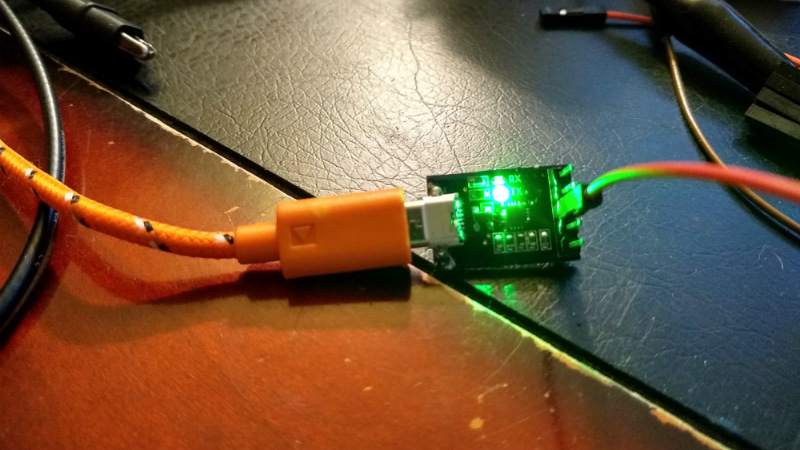
Your USB Serial Adapter Just Became A SDR
To say that the RTL-SDR project was revolutionary might be something of an understatement. Taking a cheap little USB gadget and using it as a Software Defined Radio (SDR) to explore the radio spect…
Hackaday
205 points · by walterbell · 7y ago · 87 comments
i.e., blast noise all over the spectrum. There's a reason why real transmitters are more expensive than a serial port adapter.
This kind of RF pollution is illegal for obvious reasons and if you manage to disrupt something important (emergency frequencies, mobile networks...), it's gonna be expensive.
Don't try this at home!
And if you're a newb (like me) interested enough to try this at home, you might have read to the end of the article where it states:
> DISCLAIMER: It should go without saying that you should never transmit on any frequencies or at any power levels for which you are not authorized by the local governing body, but I guess I just said it anyway.
It's very easy to build something that blithers all over the RF spectrum by connecting a digital signal to an antenna. Hook a square wave to an antenna and you're going to get lots of harmonics. This is generally considered a bad thing.
In the early days of digital electronics, a TRS-80 Model I home computer and a Milton Bradley Big Trak toy car would both crash if near each other. Strict regulation of RF emissions, and good protection on the input side, is why we can have so many digital devices without everything randomly crashing.
[1] https://www.ecfr.gov/cgi-bin/text-idx?SID=56381cb4f24a491e7d...
One of those is noise, the other one is a transmission.
I'm curious about the gain of the antenna and what consideration has been made re trasmit wavelength and the antenna wire length.
Has a Part 15 assessment been done yet? Have we analyzed power emission levels to assert that this thing is indeed 'breaking the law'?
Has this device been checked by the FCC for spurious emissions during normal operation? Did it pass, or is it chinese jank uncertifiable garbage?
Edit: C'mon downvoters. If you make a claim that it's "Illegal", you need to have some sort of proof that its the case. And I'm not immediately seeing it. Further research? Sure.
Same is possible with Raspberry Pi GPIO:
For anyone looking to do experiments like this - which are really cool to do - getting the ham technician licenses is pretty easy and very educational!
There is a project that uses a Raspberry pi to transmit from is GPIO
To use a home built transmitter you need amateur radio license, no matter what.
Instead: To use a home built transmitter you need amateur radio license, except in certain specific low power situations. To comply with those situations would be difficult without specialised test gear.
https://www.fcc.gov/media/radio/low-power-radio-general-info...
For any of the fun stuff, you need an amateur radio license :-)
IIRC you are generally permitted to use whatever frequency you wish within a very limited radius as long as it is for "research purposes"
Edit: this last point is wrong, as mentioned below exemptions seem to apply for certain frequencies with a low powered device https://www.fcc.gov/media/radio/low-power-radio-general-info...
While the user of these sorts of devices doesn't require a licence, the device itself needs to be certified, so that, among other things, it doesn't spew noise all over the RF spectrum. This device wouldn't pass.
There are also experimental licences that can be held by businesses such as RF equipment manufacturers that allow for using equipment that hasn't yet received FCC approval. They are usually band restricted, geographically restricted and power restricted, and you must take care to not have high levels of spurious emissions.
edit: Here's a PDF explainer on Part 15 devices: https://transition.fcc.gov/Bureaus/Engineering_Technology/Do...
Doesn't require factory built, does not require license.
Actually, this is a class D transmitter. Minus the usual output filter to eliminate the higher harmonics. Look at that spectrum chart. The second and third harmonics are huge!
It's quite possible to build something that will turn a square wave into a clean sine wave, and you need that. You can also generate waveforms digitally that have weaker higher harmonics, which means the output filter is simpler. There's something called a class E amplifier, which is like a class D but with an unusual analog tank circuit on the output end to clean things up.[1]
A device like this with no output filter is an annoyance, not a communications device.
[1] https://www.crarc.ampr.org/uploads/Main/Archives/July%20Clas...
https://www.kickstarter.com/projects/centerlinelabs/kickstar...
https://www.aliexpress.com/item/OUERTECH-5-in-1-AHD-CVI-TVI-...
https://www.aliexpress.com/item/HackRF-One-1MHz-to-6GHz-SDR-...
Anyway my point was that those cheapo DVR boards are just asking to be repurposed for other tasks, SDR is just one of them, that chipset specs are interesting. https://www.burglaryalarmsystem.com/pdf/Hi3520.pdf
Here are some firmware files for a few models, hopefully compatible with that one. Binwalk-ing them shows they're normal ARM Linux images.
https://domar.com/support/softwares-firmwares/ip-firmware-up...
By the way, it looks like a USB-VGA dongle can be manipulated in a similar way:
And as for SDR applications: most of modern radio devices use software defined radios and many modern radio interfaces cannot be reasonably implemented in any other way.
Amateur TV
Ham radio
Point-to-point communication
Radio telescopy
Receiving satellite signals
Lots of opportunities to reverse engineer existing signals
https://www.youtube.com/watch?v=jGWFg7EDnyY&list=PLZLsjPxmF1...
An interesting thing from reading about practical experiments in EM eavesdropping is that it's not just the obvious emanations that you have to worry about. Your sidechannels have sidechannels. In that paper, for example, the actual communication radiates and can be received in the shortwave band, but also a frequency-modulated version of it appears in the FM radio band. Presumably a bit of power-supply droop is modulating a local oscillator causing it to transmit a clear signal.
What about meter long wire that runs from the keyboard to the back of the tower.
Had to test ! :)
"Zooland is a new country where there are no regulations on electromagnetic transmissions.
Those regulations are from the past and stifle innovation and development in RF technologies.
They also encourage expensive communications.
Current RF regulations are a pure spacial and economic waste."
Not very impressed then as we are sitting there nights and days.
See: MacGyver
It's not.