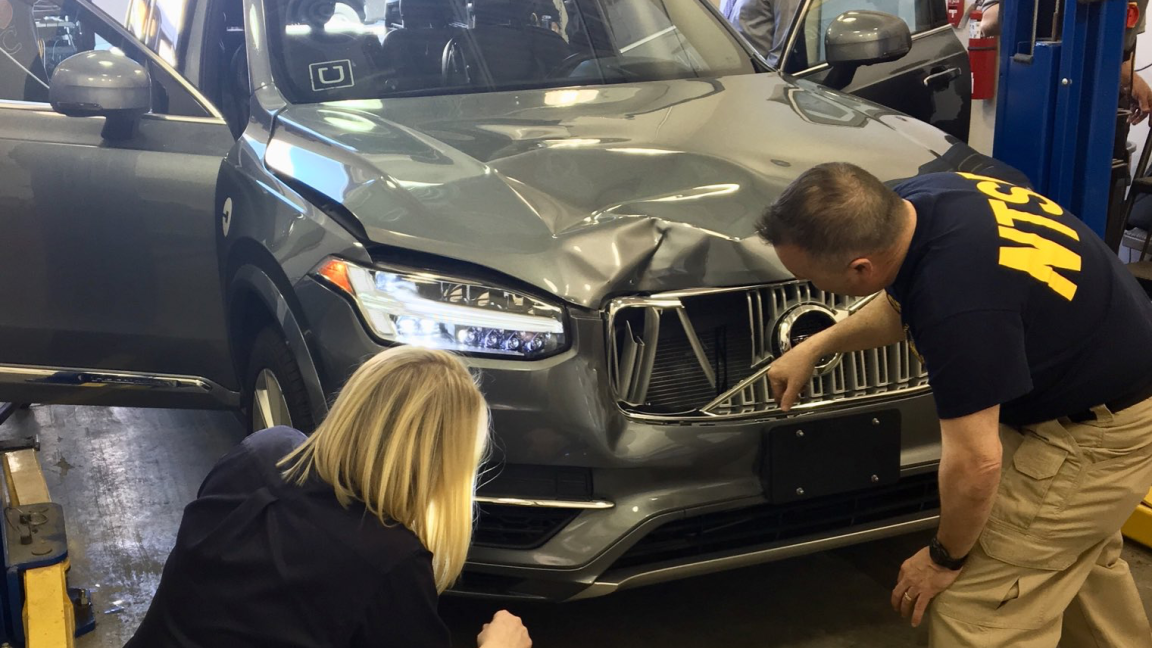
Uber manager in March: “We shouldn’t be hitting things every 15,000 miles”
They told me incidents like that happen all of the time," whistleblower wrote.
Ars Technica
83 points · by ProAm · 7y ago · 83 comments
This is tangential to your point, but in many (I'd guess most) parts of this country, that is not true. Unless you are under the influence, distracted driver's frequently kill others, and the cops don't press charges, chalking it up to "mistake".
Wasn't it proven that their system recognized the pedestrian and continued driving? That means business logic killed a person. Somebody, somewhere within Uber made the calculation that more miles of uninterrupted data was more valuable to them than public safety. If a jury could be convinced that I, as an individual, recognized a person and chose to purposely continue driving to save myself time, that's manslaughter.
So the question here has to be whether the creator of the machine acted reasonably in designing the machine as they did.
[1] This may be a fiction, but one at the heart of how we see each other morally accountable agents, and one that underlies all legal systems.
Seems more like murder, of either the depraved heart or plain intentional kind.
Besides, you basically just described most teenage/young adult or inexperienced drivers.
The best way to kill someone in America is with your car. As long as you're not drunk and can afford a lawyer you're going to get a slap on the wrist.
http://freakonomics.com/podcast/the-perfect-crime-a-new-frea...
It was only natural that the law-insulating aura that operating a vehicle provides in the US is extended to "self"-driving vehicles.
Grounding the fleet would have saved her life, but its arguable any other driver could have hit her and only applied the brakes for a short period of time, not enough to stop or slow to a less lethal speed before impact.
Sorry, but this is a human life we are talking about here.
The law is written such that the corporations can do more with less accountability than people.
The law is enforced such that the corporations can do more with less accountability than people.
It seems like a very small difference at this point.
It just seems that corporations can commit crimes with far less disincentives (i.e. punishments) than people.
The larger the impact on the network in terms of either magnitude or volume of souls owned, the greater the ability to get away with actions that forward individual gain over general good.
Shareholders and directors of many corporations do get prosecuted.
The disincentive for the government is always going to be the effect of removing an important node from a network. Especially when the government and people gain from the stability of the network, even if certain negatives happen.
Not to say the way we treat corporations isn't really horrible. It is. Adam Smith would roll in his grave if he knew we were justifying our corporatocracy on his writings.
I'm simply pointing out that large nodes are always treated differently because it is logical to do so. If 3 people do something and you take them out, the economy keeps up exactly the same.
But take out the head of a company that owns... er... hires 100,000 souls? Or maybe the company only hires 300 souls, but they are developing nuclear bombs, or maybe developing a new gene editing tech, or green fuel? Then we have magnitude instead of volume. You got yourself political backlash if you remove these nodes.
And that's exactly by design. Wealthy people own corporations and pay lobbists to stay above the law.
What? American employees never get held accountable for white collar crime in startups
Every startup I was a part of in America was engaged in fraud, and the co-founders would laugh about it in front of employees
Corporate liability only carries civil penalties, even when the corporation's behavior is well over the line of a constructive mens rea. A harmed individual is left trying to prove an essentially novel case against a well-funded company - compared to the criminal system where most defendants are presumed guilty and eagerly prosecuted by the state.
If an individual modified their car to develop self-driving software, and the car hit and killed someone, that person would likely be sitting in jail for gross negligence. Uber's insurance carrier will pay out, push Uber to do some "internal reforms", and the actual people responsible for the poor culture won't be affected. That is the double standard people are bemoaning.
I sure do. But I didn't when I was younger, growing up as a member of the lower class never exposed to business. That's why I find it so appalling. The concept of being able to run a business into the ground, maxing out debt, ignoring all reality while paying yourself a paycheck, then just walking away from it in bankruptcy and doing it again is just mind blowing to the blue collar, working class mentality. There's a whole class of people in our society who may or may not provide any benefit, but nevertheless get by making vast sums of money and working in prestigious high paying jobs who have no concept whatsoever of what it means to work for a living is like. The whole system is completely rigged against anyone who doesn't meet that threshold, and I'm increasingly convinced that this is the entire basis of capitalism.
Well perhaps those things should be illegal or made untenable. If you are publicizing risks in such a way that you are privately profiting from the public endangerment, you really don't have any moral or legal right to that money. Yet here we are again in a situation where people are killed, an executive says "we're sorry", and they continue pocketing the money.
The vehicles create a firehose of data for the engineers/devs to deal with when there's large fleets. Things are ignored, and you have to dedicate more and more time to create good tools to filter through anomalies, incidents, and disengagements. With a smaller fleet, they'd see less problems come up but perhaps be able to diagnose and act on more of them.
This sort of corporate malfeasance, pursuit of product in the face of a clear and present danger to the public, is the sort of thing plaintiff attorneys use to drain sad corporations of all their capital to operate.
In other words, either that woman watching hulu behind the wheel is responsible, or perhaps some other employee, but a person is.
The corporation is a legal fiction that was not driving any car for the same reason the tooth fairy wasn't riding a pink unicorn next to it.
Generally to get this sort of treatment it needs to be an employee that fucks up (meaning not the owner) and the company needs to guarantee it'll take civil responsibility (meaning pay up damages).
Right. If a group of people came together with a scheme that caused car accidents at the rate Uber does, they'd be held liable and they'd receive conspiracy charges.
Perhaps the same should happen to people who come up with such schemes behind the corporate veil.
There's even a specific crime in the UK of Corporate Homicide.
It'd help if lawmakers backed up educated advocates, but the lawmakers are at this point bought by lobbies.
I vote with my wallet as well, but I don't think the majority of people even consider that.
Even if I'm not making a difference, at least I feel better about what I'm doing.
The average driver files a claim for collision once every 17.9 years [2].
That makes human drivers 16 times safer than Uber self-driving cars. This is concerning for people who think self-driving cars are right around the corner! Improved algorithms would need to avoid 94% of the collisions that self-driving cars currently get into in order to have the same failure rate as humans.
[1] https://www.fhwa.dot.gov/ohim/onh00/bar8.htm
[2] https://www.forbes.com/sites/moneybuilder/2011/07/27/how-man...
Which isn't to say that self driving cars won't get there, just that the fact that it looks like we are almost there doesn't mean as much as you'd think; we still have the really hard bits in front of us.
While that's a difference large enough to make wide scale deployment of those cars irresponsible, it is not large enough to make one pessimist on self-driving cars existing soon. It's the kind of difference that often enough go away with a few years of engineering.
And I expect those to be the worse stats for all the self-driving car companies around, since others seem to be doing things in a less "move fast and break things" way.
That leaves open the question of how much damage that driver is at fault for on average.
I would theorize the opposite.