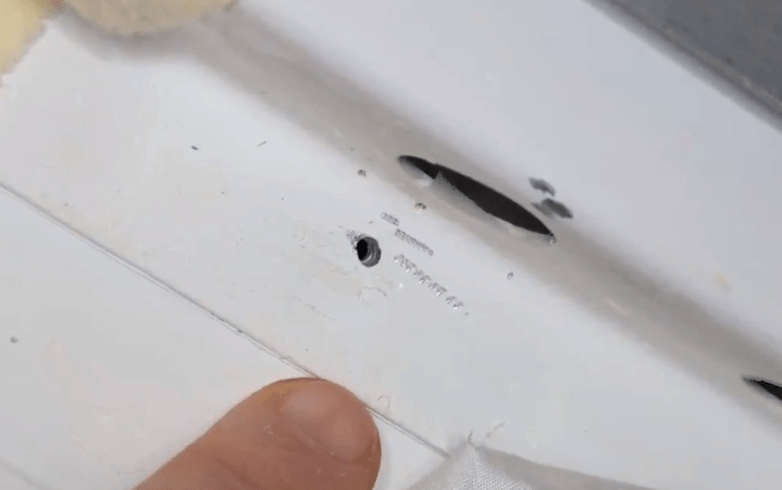
Russian Cosmonaut says that the Hole in the ISS was Drilled From the Inside
According to statements from cosmonaut Sergey Prokopyev, the hole found in the ISS was drilled from the inside and the cause remains unknown.
Universe Today
172 points · by tlrobinson · 7y ago · 130 comments
"So fasten x to y with a screw."
"Do I drill through and into the workbench too?"
"Why would you do that?!"
(In my mind) well I saw someone else fastening a work piece to the bench temporarily like that and why would the screw be this long then? Oh wait yeah that makes zero sense. My logic centre isn't working fast at all.
Learning how to suffer fools and survive foolish aggresses is a real thing in some jobs, and it will quickly make you abandon curiosity.
Your logic centre was working plenty fast enough. It's just hard for someone who already knows to procedure to appreciate just how open-ended the possible space of procedures is. It seems obvious to them, but only because their mental filters are already blocking out other possible solutions.
Still, at least in this first month, I wouldn't want to change methods.
Sometimes it's infuriating.
It is a bit like developers with a new js framework I suppose.
2. Drill was hand-held - again due to the marks where drill bit was trying to find it's way around.
3. No any markings from pen/pencil or anything that would show that any kind of measurements were done beforehand. Which means that the hole was not part of any specific fixture/attachment or construction element.
Which strengthens hypothesis that the purpose of the hole was the hole itself. Location and/or precision of the hole was not important as much as the hole itself.
At this point precise inspection is needed to find the tool used as well as determine which person's suit/clothing/outfit/personal belongings (astronaut's or technician) contain the traces of the metal that fall off as a result of the hole drilling effort.
When you hand hold a piece like this you rely on gravity and can put your weight down firmly against it so it doesn't move, even after punching through. Much tougher to do in space with no gravity, you need to use the frame itself to push against. If this was done on the ground it would have to be by a complete incompetent or drunk individual to make 8-11 damaging marks on the frame. Secondly in the second photo you see a padding that would partially cover this, it looks undamaged, meaning they lifted this padding for the explicit purpose of using that jig jog dead space in the frame as their 'punch through area.'
Lastly, since I've been in this situation many times, whatever they were drilling through would not fit on the frame in the orientation they needed for some of the holes they were planning on drilling, and thus this is likely why they missed their dead space safety area. The debris from this would now be floating where ever so impossible to use that to determine guilt from clothing. The only thing they can use is either preflight photos (the padding covered most the damage perhaps) or send every drill bit on the station back to earth for analysis; drifting your bit even on aluminum alloy will leave a signature. Correlate that with use records for component replacement times. You're also looking for components with holes in them that don't match the blueprints. When you're on a 'boat' though, sometimes these types of repairs are assumed and undocumented though (especially when you screw up.)
50/50 chance this was an astronaut or a very drunk contractor on ground. The most disturbing evidence here is the drift mark before the hole among the other bit tap marks. It implies the person drilling it did not have mental focus.
Then why did they seal it with glue (that later failed)?
We have established the hole was made very badly, so you can not also say the person making it knew exactly the right kind and amount of glue that would fail at just the right time.
This seems like an accident to me, and someone tried to cover it up.
I wouldn't be so sure about that --- "we need to mount an X, it needs to be roughly in this area", while possibly questionable in space, is not uncommon in other construction. It could be a similar scenario, except whoever was responsible identified the wrong area.
as well as determine which person's suit/clothing/outfit/personal belongings (astronaut's or technician) contain the traces of the metal that fall off as a result of the hole drilling effort
If it was done on the ground during construction, where many holes are drilled, I don't think that would work.
... and exactly why I'm not either ;)
Sure, but in the hull of the spacecraft that's leaking my air away, I'd still put a wad a chewing gum in the hole to patch it.
I understand space to be unbelivably boring.
My understanding is once there, you work 16 hour days non-stop.
I think most people would describe being on the ISS as anything else but "boring".
(The joke is based on Russian pun: slang word for policeman is literally garbage, the title of the painting is "space garbage").
Maybe?
I mean, surely there must be some kind of testing step where they test that the craft is completely airtight. And no one is going to be drilling anything after that point.
To me that excludes sabotage, and instead points of error that someone tried to cover up. It also points to someone low-level/unskilled since they did a bad job of sealing it.
Based on the tracks around the actual hole it looks accidental to me.
Yeah, makes total sense.
1. Done by a right handed person on space (crew) or on earth (builders/crew/other).
2. Done accidentally (a drill machine slips) or with a purpose.
3. The purpose can be seen as good or bad for the mission. The result here was neither good nor very bad, so can be neutral also.
4. A neutral purpose can still serve a role as a tool to alter the status of the cosmonauts either punishing them or improving their situation (like in: returning home faster or somebody drills a small hole to be able to fix it later as an hero).
They should look for shaving cream in trash and check it.
But that's without considering that the simplest explanation is usually the right one and the at-orbit sabotage is just not that.
>Sealed with epoxy and resin [from photo caption]
I'm kindof confused, was it resin-impregnated gauze?
I'm also curious: If the hole was in a more-critical location, like one of the station's modules, would that be the repair process? Or would they be doing welding in space?
> Fry: How many atmospheres can this ship withstand? > Farnsworth: Well it's a spaceship, so I'd say anywhere between zero and one