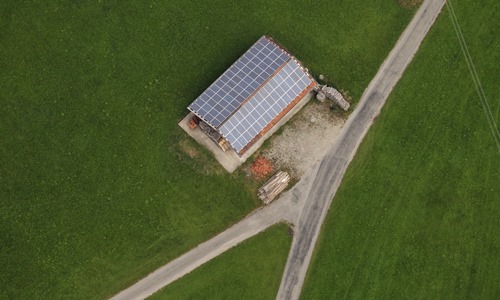
How much less efficient are north-facing solar modules?
By Paul Grana, co-founder, Folsom Labs It’s considered common knowledge that you want to point your solar modules south, toward the equator (assuming you
Solar Power World
72 points · by curtis · 7y ago · 41 comments
That's what lead me to this particular article, which examines the efficiency of putting panels on north facing roofs.
I explored the vertical panel idea in a blog post last year: http://curtisb.posthaven.com/the-solar-garage-door. I don't know if that idea would work, but I was trying to imagine an application of the idea so absurdly simple that a startup could easily use it to bootstrap into a more lucrative market.
Bifacial panels (where one side faces the ground) are almost on the market for solar plants. The ground is generally light colored sand, which is great for diffuse light, so they see ~30% extra insolation for the same silicon.
The garage door is a rather complex place to put them as their are a huge range of styles and you would need to either fit the opening and replace the mechanism, or design a door for each existing type sold. On top of that wiring up solar to your house is the tricky part not putting something on a roof.
Getting shade from other buildings on your roof is also unusual for 2 story buildings.
I think to be practical you'd need a manufacturing line that could build variable sized doors. Since I'm a software engineer and not a manufacturing engineer I don't know if that's economically feasible or not.
The south facade of Phoenix's downtown library has adjustable horizontal louvres. Make them out of solar panels for a power and shade two-fer.
https://en.wikiarquitectura.com/building/Burton-Barr-Central...
https://en.wikiarquitectura.com/building/Burton-Barr-Central...
Even so, if you can't have a south-facing module, the fact that you don't lose as much in many circumstances (roof slopes etc) is good to know.
Even when one wants to power their house, there's no need to go in an "all or nothing" approach.
It's the same as having to ROT6 any gardening advice or you'll be planting things at the worst possible time :)
[0] http://blog.comparemysolar.co.uk/wp-content/uploads/2013/03/... etc
Shaded or North facing panels in the northern hemisphere are almost never worth it. Put what you can on the south and look into a better AC unit, new windows, LEDs, and insulation first.
https://russell.ballestrini.net/fulfilling-childhood-dreams-...
Is 2/12 common anywhere? Certainly not in any place that gets snow.
(he does give some numbers for other pitches in his charts, but in the teaser paragraph, he uses 2/12)
Really, you should not complain if you’re badly skimming an article.
But you shouldn't have to get half way into the article before you find out that he chose the absolute best case for his example and you're not likely to see the same results in the real world.
Really, if he had started by showing a huge chart it would have been gibberish to most people.
In fact, so much so that the tracking systems rarely make sense with modern panels. You would usually be better off spending the money, weight, and space on more fixed panels than messing with the tracking systems.
But what about a simple wooden structure to hold fixed panels oriented optimally? That's a few thousand dollars at most, for a twenty to sixty percent efficiency improvement. It would kill me to mount panels facing North at a 45deg angle.
[1] https://earther.gizmodo.com/lawns-are-an-ecological-disaster...
I have 10k square feet total plot, most of it not occupied by garden, buildings and would still not prefer to have panels there rather than on the roof where the space is “free” because I can’t use it for anything else.
Even at 60 degs north lots of people do have solar on the roof here (but haven’t seen any north facing)
It is much more economical to just buy more panels and mount them at a fixed angle.
In a neighborhood in my city where a few large electric users have expanded, the utility has been subsidizing rooftop panels for residential users to minimize summer peaks and avoid having to upgrade the old undersized grid. So far it has worked pretty well - peaks usually line up with the hottest sunniest days.
Utility scale has largely abandoned tracking as not cost effective.