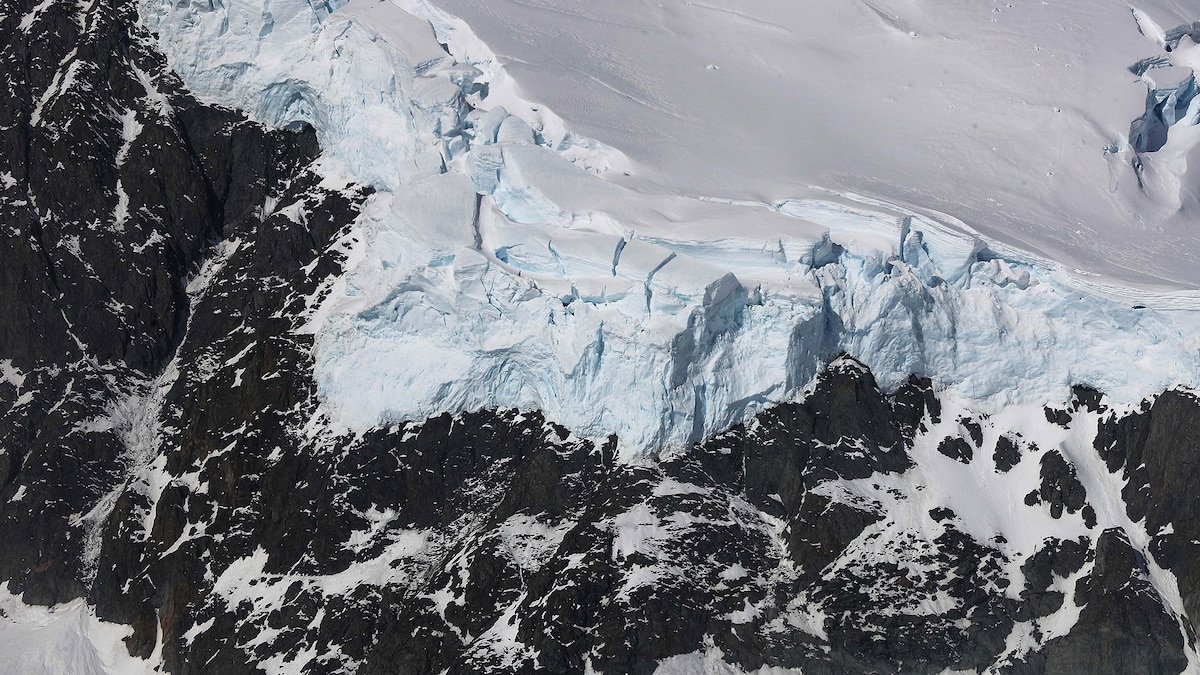
Earth is missing a huge part of its crust. Now we may know why.
A fifth of Earth’s geologic history might have vanished because planet-wide glaciers buried the evidence.
Science
183 points · by gricardo99 · 7y ago · 62 comments
>Although it’s likely down to a number of factors, one possibility is that Snowball Earth’s erosion was so significant that there wasn’t much topography left to erode when all was said and done. The planet simply needed to forge more land first, and that takes time.
The balance of earth is so interesting. The process that forges new land (volcanism) is the same process that beats back snowball earth and re-balances the atmosphere with more CO2.
It's a bit old and cheesy, some of the info might be outdated, but this is a great episode on this topic: https://www.youtube.com/watch?v=XEiu611KsUo
That's a good question. I'm the first author of the new PNAS article discussed here (open access at https://doi.org/10.1073/pnas.1804350116). This does raise some questions about preservation bias and taphonomy, but there are areas we know escaped Neoproterozoic erosion (mostly at actively rifting continental margins) and we can find continuous sedimentary sections from the Cryogenian to the Cambrian -- and in these sections we still see a pretty rapid rise in complex shelly fossils in the early Cambrian. That said, when people first started talking about the "Cambrian Explosion", we didn't know much anything about the Ediacaran biota [1], the Ediacaran extension of the "Small Shelly Fauna" [2], or the Doushantuo Formation [3] -- so the evolutionary problem's not quite as bad as when Darwin first worried about it.
One new point to add is that erosion and comminution of this much crust may be expected to free up a lot of phosphorus stored in the igneous crust -- arguably the key limiting nutrient on geological timescales. This seems to be be consistent with previous observations of an increase in phosphorus abundance in sediments around Cryogenian times [4].
[1] https://en.wikipedia.org/wiki/Ediacaran_biota
[2] https://en.wikipedia.org/wiki/Small_shelly_fauna
[1] https://en.wikipedia.org/wiki/Polynya
[2] https://en.wikipedia.org/wiki/Cryoconite
[3] https://onlinelibrary.wiley.com/doi/abs/10.1111/gbi.12191
So, while apologizing for hijacking with an OT comment, do you have any docs you can recommend on the topic of geologic formation/periods of the Earth?
As an aside: I think that ML and RNNs would be a great tool for paleontologists to use for fossil hunting. Not just for automated drones scanning the lonelier places on Earth, but just to identify potentially 'rich' areas in the first place. Via petroleum studies, we know a fair bit about the Earth and the layers of sediment under it. Using that data, I think it may be possible to help narrow down the areas where good fossilization may have occurred and then send the armies of grad students out to those places, helping increase the percentages for finds.
And I believe volcanism, at least the sort that is most common today (that from ocean-margin subduction zones, rather than that from spreading zones like Iceland or hotspots like Hawaii) results from subducted sediments melting into magma, with their melting points reduced by the presence of subducted water. If so, then do we have the large amounts of sediment, created by the snowball-earth glaciation, setting the stage for the volcanism that ends it?
There are fossils of Precambrian, post-snowball multi-cellular life, but they are not very much like, and nowhere near as diverse, as what appeared in the Cambrian, so I think the explosion still looks like a real event and not just an artifact of an imperfect record.
Since the erased part of the geological record starts 100’s of millions of years before the climate event that froze everything, do we even know that some earlier civilization didn’t force the climate off balance with e.g. greenhouse gasses, which ended up obliterating all multicellular organisms, and wiping the geological evidence?
Other recent news about ocean current disruptions, and methane melting feedback loops in the artic suggest we might be headed that way too...
Whether "snowball earth" is accurate or not, what appears in outline is an earth that would have been uninhabitable for humans under most of, and even in relative recent, geological history.
It begs the question of how we might deal with the situation where the globe once again becomes uninhabitable (if we survive that long): terraforming or cocooning. The latter seems the best bet.
It sounds easy enough, objects in space, large structures, unnatural concentrations of radioactive materials, sure, but over millions of years with kilometers of the top crust simply shaved off and recycled through the core of the planet?
It's amusing our notion of "glacial" loses meaning over such time-spans. How can it do anything, since glaciers just lie there. But over millions of years, it's a high-speed efficient grinding machine the size of a planet.
Conversely, as to how we might deal with the situation, ludicrous though it might seem with our advances and technology, maybe we simply can't. Even a passive beacon on the moon which wouldn't have suffered from Snowball Moon; it seems plausible enough, but it has to withstand at least 250 million years of the moon's night/day cycles. Is there something we could build right now that could withstand that?
Maybe? Probably? But for now I'm content the Snowball Earth hypothesis spices up a lot of Lovecraft stories. "And with strange aeons even death may die” indeed.
https://en.wikipedia.org/wiki/Natural_nuclear_fission_reacto...
One option would be to put in one Lagrange point some high quantity of radioactive material. You'd need to pick quantity and material well tho, because material with short hair life would cool off to get and become just a rock and materials with too long half life would be very hard to detect due their low emissions.
Give it a shape nature would have had time to replicate like an empty cylinder and it would likely be the best way to leave artifact for million years into the future. Won't be able to store any meaningful information beyond "someone was here" and future people coming to bertrand teapot style of argumentation against God would have a hell of a shock upon rediscovery
No, a base on the moon would still be there.
It starts out as a hypothetical between a couple of researchers that resulted in a paper on the longest-lasting effects of human civilizations.
It's a good read, but the summary is that human civilization has resulted in atmospheric changes which will be detectable 100 million years from now, and we've got that much atmospheric evidence buried in geology without similar evidence for a past civilization.
I like your thinking :-) It's the kind of fantasizing that I'm convinced is at the core of human progress, based on hardly more than a number of currently unknowable "what if"s.
It is, as you point out difficult to know if such a species could have existed. But if they did and if they tried to survive, we might be fairly certain that they failed barring something even more fantastical, currently only to be found in the darkest corners of youtube.
The real utility of this line of thought is IMO how we might try to survive the same conditions, since there is no real assurance that it could never happen again. We don't have the answer yet, agree.
This remind me of "the ice people" https://en.m.wikipedia.org/wiki/The_Ice_People_(Barjavel_nov...
Plus, while the narrative that "evolution increases the complexity over time" isn't as strong as some may suppose, it does provide a ceiling to complexity over time, and I'd say most of the evidence that we have would strongly suggest that there isn't any feasible way that the biology of a billion years ago could have supported intelligent life, because that ceiling is just too low. Today, there seems to be several possible feasible lines for intelligent life (birds, sea mammals, octopus) in the "short-term" multi-million-year future, with homonids getting there first, but a billion years ago I don't think that was the case. I suspect your average ant nowadays is more intelligent that much of what was around back then.
Oh, and, yes, we could build something that would survive on the moon. In particular, we're not obligated to put only one thing on the moon; that's an artifact in thinking with the exact precise technology of today, where's it's really expensive. In another 50-100 years it's quite plausible that putting up such a momument would be considered on the scale of an ambitious art project, and it's not hard to imagine dozens and hundreds of such monuments being put on the moon over time. Local materials can be used for bulk, and the only upper limit on the size of such a momument would be the energy available for whatever it is you wanted to do with it. Moving around local materials and building the equivalent of a pyramid would be almost feasible today ("almost" here being "less than a factor of magnitude of development away"), for instance, and melting & refreezing mass quantities of lunar surface for some visually-obvious effect is eminently practical if you have fusion. (And if you have fusion that can use the He3 on the moon, downright cheap.) It's not hard to conceive of monuments miles in size, or if you assume self-repairing or -replicating machinery, you can make something visible from Earth feasibly. Even with only solar power, that just slows the project down. Had that been done billions of years ago, some of them (or some of it) may have been destroyed by meteors but the vast majority would still be there. In another 100-200 years of reasonably-projected technological advance we'd be able to consider completely resculpting the effective appearance of the surface of the moon, for any number of reasons and in any number of ways. The moon shows no evidence of this, which would be enough to say that if there is a sentient civilization in Earth's past, it would put the Great Filter back in front of us again. (Albeit much more weakly, since only one civilization may have died before resculpting the moon.)
It's still faintly possible that we'll explore the moon in more depth that we have today and find "something" interesting. The fact that it's soooo untouched at a bulk scale suggests to me it's not likely, but it's possible some civilization got to where we are today, +/-50 years, and then died back, leaving just a trace on the moon, just as we have so far.
(IMHO, the most recent paper on the Fermi paradox from a couple of months ago puts the Great Filter behind us fairly firmly, by showing there's no compelling reason to assume the sky should be full of civilizations.)
[1]: It is well-understood that you need at least some time for complex elements to develop, and in enough quantity to form useful planets and such, so you do need at least some time for some stellar generations, but there is no currently-known reason that I'm aware of that the sky should not be inhabited by a multi-billion-year old civilization. On a cosmic scale, Earth isn't that late to the party in some sense, but looking at its history it still seems like you could shave some billions of years off of its history and still get an "Earth-like planet" somewhere else.
Do you have a link to the Fermi paradox article you mentioned?
I went down the rabbit hole and learned a bit about Geochronology: https://en.m.wikipedia.org/wiki/Geochronology
It is interesting how they “break up” dating depending on the time frame, for example some dating is only measured by “eon” (half a billion years), whereas the “finest” measurement seems to be “age” which corresponds to single digit millions of years.
A bit humbling to think that all of humanity can “fit” in the smallest geological measure of time.
Obligatory John McPhee:
> Numbers do not seem to work well with regard to deep time. Any number above a couple of thousand years—fifty thousand, fifty million—will with nearly equal effect awe the imagination.
> Consider the earth’s history as the old measure of the English yard, the distance from the king’s nose to the tip of his outstretched hand. One stroke of a nail file on his middle finger erases human history.
Perhaps Earth’s previous inhabitants triggered runaway global cooling, effectively hitting the reset switch back to single-celled life. Perhaps they escaped to Venus and vowed not to let the same thing happen there, but got it wrong in the other direction.
My default assumption is that history has only picked up, at best, the latter cycles on big time scales.
Baalbek is a good place to see 1000+ ton milled stones: https://youtu.be/jo-oEk8itlo
Cuzco also seems to have some pre-Inca constructions that can’t be explained: https://youtu.be/66x9VLwZaDQ
It seems very hard for life to survive under those conditions, let alone complex life, let alone advanced life / civilizations.
Maybe a better word for what is at risk is “diversity”. At this time there are still wild ecologies with incredible diversity in all three phases of water on Earth, the frozen, the liquid, and the steamy.
And there are also partly dead places. The American Midwest is largely ecologically dead, although we know before the European settlers came there was stable soil and incredible biodiversity there.
But balance and biodiversity are connected. In a diverse ecology, you can remove any species, or turn any dial slightly, metabolism will dip, and then roar back into full power because there is so much latent genetic material in the ecology ready to go.
That’s been destroyed in a place like the Midwest. If you stop putting oil into that ecology, the metabolism would plummet, and it would take a million years to return to anything close to what it was before European settlers.
In a so-called “balanced” ecology, metabolism would rebound on a scale of decades or even seasons.
The moral assumption underlying this is that the most metabolism per square foot of solar energy is the most good.
But it is hard to imagine a culture having sufficient technological capability to cause climate change without also achieving space flight.
Moot point though because the pre-Cambrian fossil record lacks anything that could have evolved into intelligent life so quickly.
A million years gives a pretty long time for unlikely events to occur that could finish the job of wiping them out. Wars and engineering accidents and diseases and such.
Like you I tend to be of the opinion our human civilization will survive any kind of global cataclysm that Earth could throw at it... But I am less convinced a population forced under a million individuals could survive - million years just under the normal chaos of existing.
I suspect there is a minimum population and geographic diversity required for our long term survival. Not sure where those red lines are though.
What does that get you? You can’t orbit Earth for a million years without refueling. And the rest of the bodies is pretty inhospitable. What’s the best case there, a million people on Mars with a few decades of preparation? What’s the probability of such an outpost surviving?
Isn’t the idea that the intermediate fossils were ground away by glaciers?