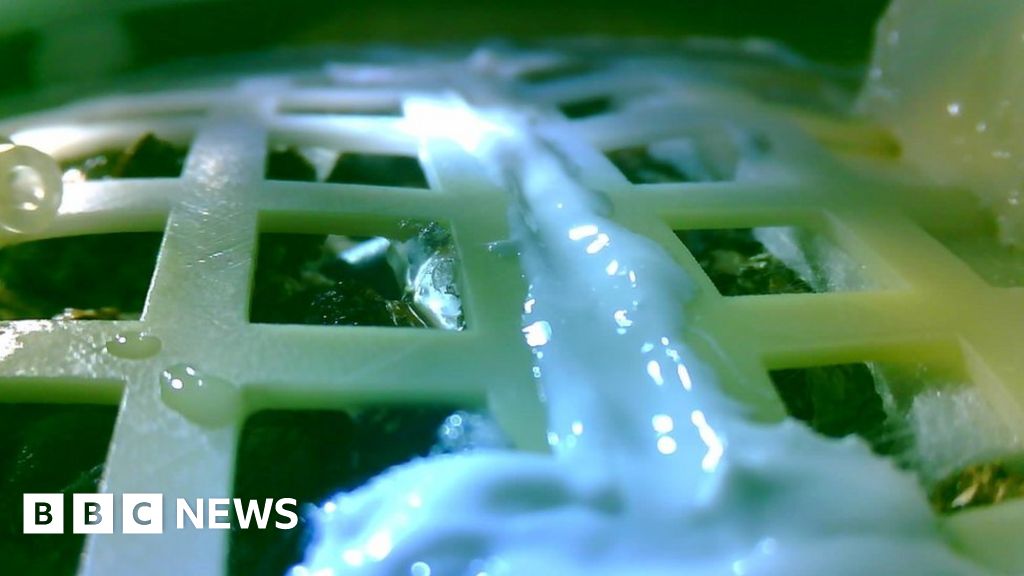
China's Moon mission sees first seeds sprout
The seeds, inside a sealed container, are the first plants ever grown on the Moon's surface.
bbc.com
248 points · by echevil · 7y ago · 153 comments
You'd need extremely small scale factories that can build everything needed for a modern civilization.
I wonder what that would take. What the smallest amount of shipments and time would be. Would guess that electronics would be one of the last things you'd learn to make yourself.
The main obstacle a colony will have is the initial buildings/bunker with all the life support and safety tech, plus extra redundancy and a backup plan if something bad happens there or on Earth .
If the colony would manage to generate enough oxygen,food, water and energy for itself that is the important first step. Next step would probably be producing the heavy parts they need for expansions like metal or similar solid materials for walls and machinery, the lighter parts could be sent from Earth.
SpaceX BFR has about 100t capacity to Mars. While the total cost of a Mars mission has not been publicized, I suspect it would be fair bit more than $20k.
Biggest container ships these days carry about 20k TEU, or about 500000 tons of cargo. You can try putting that number to the rocket equation just for fun.
While we don't have SpaceX numbers, Zubrin said in 2012 that if given to NASA Mars Direct (A Mars proposal from 1990-1991, updated in 1996 in Zubrin's book The Case for Mars) would cost 30-50 billion but a private company could do it for around 5bn. That still put you at several million dollars per metric ton delivered to the Martian surface BUT that included all design and administrative costs.
You can see some of the Mars Direct figures here http://www.astronautix.com/m/marsdirect.html
We also know what SpaceX quotes 90 million dollars for 16.8 metric tons to Mars with Falcon heavy which puts us at 5.35 million dollars per ton which is already quite a bit cheaper than the most optimistic Mars Direct figures. https://www.spacex.com/about/capabilities
BFR should be able to do way better than that if it ever becomes a viable system.
There could also be facilities for experiments that can't be done on Earth, like things that can grow better on low gravity, there may be materials/gases that are rare on Earth and we could grab from asteroids so having space stations and bases around the solar system would be helpful.
If nothing else, there is real estate. Might not be worth much, but there is a lot of it.
So you first make something the rich people want. Like luxury residences in spaces, Elysium like. Like really really affluent neighborhoods for ultra rich. Tourism is another part. Make people go to space, stay for a few earth-days, have them see some spectacular astronomical phenomenon. Sky size theaters, Toy space shuttles like we have dashing cars, Disney land like attractions etc etc.
The other part of course is permanent science labs, where you do high quality research and development. Something like the Large Hadron Collider takes a lot of real estate and resources on earth to build. Eventually that kind of work can be done in space. That will make a lot of smart people want to work in space.
Of course since resources are plenty in space, and energy is just pointing you array of panels at sun. I'm guessing due to the economics of it, a lot of other people might want to stay and work there. Like electricity strapped countries, might want to manufacture in space.
The use cases are endless that way.
Eventually you extend it to everybody else.
Also it might be worth it for gold.
The moon is just a few days away.
The costs are not a given. With new better tech, then can come waay down.
Also note that the freight ships need not be manned.
In that frame, a colony that can't survive (or has a reduced chance of survival) is of lower utility than one that can be effectively independent.
There may be refining steps which you would want to do on the surface vs in orbit, and getting the raw ore down and refined product back up would be substantially cheaper on Mars.
Probably it wouldn’t be worth building a colony in the first place for just this economic benefit, but once you have the colony, you can exploit this advantage?
Queen Elizabeth the Second, by the Grace of God Queen of this Realm and of Her other Realms and Territories, Head of the Commonwealth, Defender of the Faith &c. To ALL to whom these Presents shall come, greeting:.....The Moon Trading Company : )
They need a way to get pure vitamins, fat etc and then mix them on the Moon. Live on shakes or something at least until all is solved.
I don't think reproduction of vertebrates has ever been tried in space. Definitely not humans. It simply isn't known how growing up in moon gravity or no gravity at all affects people. They most likely would never be able to visit the Earth, but maybe they can live healthy lives regardless. Or maybe it's impossible and the fetus dies in the womb. It simply isn't known.
In the process of colonising other bodies and planets we'll learn how to be more sustainable here. In other words we would use the promise of new resources and exciting new worlds to learn how to avoid destructing our own.
Also, what better way to get kids on board from a young age? "Susie, if you really want to be an astronaut, you must learn to manage your downstream recycling better!"
But, profit margins.
The project to put even a couple of people on the mars surface, let alone let a couple of hundred live there, is currently too demanding to even attempt. Only vague plans exist.
Big questions:
1. How to make wafers in low/no gravity? Without convection, you can't purify silicon. May be you will rely on an entirely chemical process to grow a crystal?
2. Expensive gases will have to be recycled, not neutralised and disposed.
3. How will you do wet etch in zero/low gravity? Will you go plasma only?
Your gravity vector will have to be uniform, otherwise your crustal will turned curved.
Your centrifuge will have to be either very large, or you will have to find out how to do that without convetion
(Contains some handy tables of relative abundance of substances at the end. Oxygen is really plentiful, it's just attached to all that silicon and iron.)
Zubrin's estimate of this in The Case For Mars is a half million people. That's an estimate for the minimum size of the population which can support the knowledge base required to make everything to sustain a modern industrialized civilization.
You'd need extremely small scale factories that can build everything needed for a modern civilization.
It's been demonstrated that a single person can build up the infrastructure of an 1800's colonial village all by himself, up to and including a blacksmith's shop. That guy from Turtle Island Preserve could do it, dropped into a forest with a single knife. There's a YouTuber who does all that sort of stuff without the knife to begin with.
It will be harder to do such bootstrapping on Mars, of course. I'm not sure that the half million estimate above included chip fabs. I somehow doubt it.
If I recall correctly the number quoted from E. Musk on an early Mars colonization presentation was 2 cargo ships per full colonist ship. But that's only for being water/air/food/energy self-sustained. The assumption is that large shipments of high-tech products will continue for a while. Maybe something like solar panels/basic air turbines can be produced on the spot provided with either the raw material or mining equipment. The same probably goes at least for simple electronics( like e.g. various sensors for monitoring the colony), lots of appliances can be made in a crude way( think stoves, furnaces, maybe fridges?).
It's not as much as you'd think, specially if you can survive on the first couple of decades with regular shipments from earth, mostly for very advanced materials and electronics.
A lot of manufacturing capacity in our society is redundant and focused on non-essential items. In addition, some manufacturing processes are complex because of the scale of our society but could be made simpler for a small colony, especially if you are not worried about details or finishing quality and approach it from a more utilitarian perspective.
That's not to say they wouldn't be useful. I really like being able to sketch out whatever bracket, holder, candy dish, etc that I want and print it. That would be very useful on a world without a huge economy providing every little thing you might want or need.
https://en.wikipedia.org/wiki/Health_threat_from_cosmic_rays...
One of the first mass products of a colony is likely to be Methane and simple hydrocarbons like ethylene which can be further used to produce polyethylene, an excelent shielding material that can reduce the radiation to earth levels if applied in thick blankets.
Of course it would help to develop better treatments for radiation exposure.
No, they didn't. They came up with transporters to save money not having effects shots of ships taking off and landing, and replicators are basically the same, a prop meant to save a bit of money while looking "futuristic". Replicators and transporters violate physics (thermodynamics, the uncertainty principle, E=MC^2) and cannot exist as depicted in Star Trek. They spent zero time working out the science because they're television writers, not scientists.
The best you could do in the real world is 3D printers and fabbers. But directly converting energy into complex physical structures in a way that isn't insanely less efficient than physical manufacturing or agriculture? No.
It has nothing to do with violating physics. Its just about being part of hyper-connected systems where incremental change, is happening in a thousand different places along the entire assembly line that add up to huge gains that nobody can imagine individually.
Are we going to see things materializing at button press in an instant? No. But we are going to get damn close.
This is from the university that lead the experiment. A control experiment was done as well
and thought.... what a won-der-ful world :D
Is this such big news because it's an ongoing step in living in space or am I missing something.
Not trying to take away from the achievement but just curious why this is such a big story. I'd thought there would be more news focus on the dark side of the moon updates or astronomy potential of being there type thing.
Space is the next frontier of humanity's existence. A moon base is a logical, achievable next step in man's space exploration. The technology developed and lessons learned would have broad implications far beyond simply "We have a base on the moon."
Newt Gingrich talked about this idea in his 2012 campaign for president. Despite being a fountain of bad ideas in general, the press seized upon this particular issue as a primary source for mockery of Newt.
This is not to belittle any of the other work NASA has done, much of which is also extremely important. Space research is not a zero-sum game. But a moon base is a concrete, achievable (and still awe-inspiring!) goal that both the scientific and political classes could coalesce around. I hope to see it during my lifetime.
The USA military got what it needed under the cover of a civilian space race.
The US didn't chill after that. It put even more money into rockets but those were funded through the military for ICBMs.
This sort of cynicism is very popular but largely unfounded. In terms of rocket technology, the moon missions were following in the wake of ICBM tech, not the other way around. The Mercury/Redstone, Mercury/Atlas and Gemini programs were all using rockets that were designed initially as ICBMs (well, the Redstone was an SRBM.) Those rockets were already developed and paid for by the time a civilian applications were found for them.
Consider this timeline of launches: https://upload.wikimedia.org/wikipedia/commons/6/67/USAF_ICB...
'Atlas D' and 'GLV' are the Mercury and Gemini programs, respectively. They both came after the majority of ICBM tests for their military siblings. The military wasn't using rockets built for NASA; NASA was using rockets built for the military.
Then there is the Saturn V itself. A massive purpose built cryogenic liquid propellant rocket first flying in the late 60s. ICBM technology had moved on, cryogenic liquid propellant ICBMs were already discontinued by that time. In 1962 you had the introduction of solid fuel Minutemen and in 1963 the storable fuel Titan II's were brought into service. Both of these rendered cryogenic propellant ICBMs like the Atlas family and the Titan I obsolete, and both were finally fully retired in 1965 (and subsequently recycled as satellite launchers, roles that they served for many years following. The last Titan II launched a weather satellite in 2003.) This is years before the Saturn V ever flew. The Saturn V simply was not an ICBM program.
Now, the Space Shuttle is another matter entirely...
There's not much profit in sending things beyond Earth orbit as Earth is where all the strategic targets are. So other than satellites there's not much to do in space from a military-industrial point of view.
Sending a drone to shitistan at 7.8 KM/second is impossible to do in Earth's atmosphere with today's technology. Likewise for keeping an object airborne for more than a few tens of hours. In space, things can move quickly and stay up there for quite some time.
See also the high Delta-V experimental craft, such as the X-37, which allow an asset to be in space for extended periods of time but also to adjust their orbit for short-notice action (presumably reconnaissance) at a specific location.
The USA lost the original space race, then redefined it as "race to the moon", eventually accomplished that and then dropped the ball.
I don't want to denounce the amazing accomplishment of the Apollo programme, but Americans have a tendency to undersell the groundwork laid by the Soviet Union by focusing just on the moon landing.
"They say once you grow crops somewhere, you have officially 'colonized' it. So technically, I colonized Mars."
Challenge is with respect to maintaining temperature which swing wildly between -173C and 100C or more.
It would have been another thing if they used parts of moon soil and the like.
And this wasn't the first time biological material has grown on the moon. The American astronauts brought plenty of growing biological material with them, too.
From the Apollo missions we do know that humans can survive for three days on the Moon, but given that humans can survive for months in orbit this isn't a surprise. But what are the effects on animal gestation? On plant growth? As far as I'm aware there weren't any plants on any of the Apollo missions, though I believe they did experiments with lunar regolith on Earth.
For a moment I thought they were in the open... Since they are enclosed is there a reason why they should not sprout? The gravity is less but that should not make a difference.
Also, the sun is brighter in space than an Earth under the atmosphere.
The long days and nights lasting 12 Earth days each might also be problematic.
Test one thing at a time.
Depressurisation is somewhat survivable: https://www.newscientist.com/article/mg20927953-500-vacuum-o... but dehydration starts to happen. Vaccum is a very effective dessicant.
That's the theory, indeed, and this experiment proves it - science!
Organ-specific remodeling of the Arabidopsis transcriptome in response to spaceflight
https://bmcplantbiol.biomedcentral.com/articles/10.1186/1471...