The Perils and Pleasures of Bartending in Antarctica
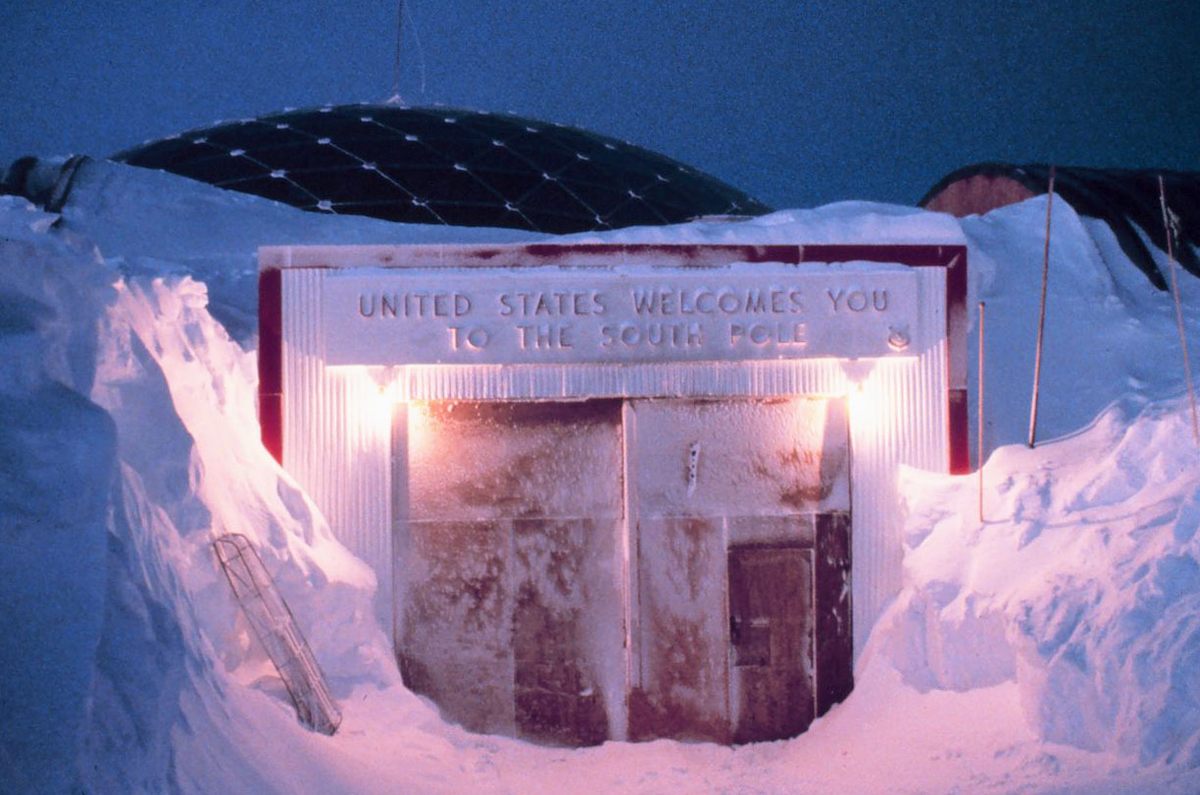
At the South Pole, the freezer is just a hole in the wall to the ice outside.
Atlas Obscura
124 points · by mpweiher · 7y ago · 44 comments
All other bars in the Antarctic only serve alcohol to base staff, as they import their stocks, and they’re limited. Understandable. They’ll still happily sell you a coffee at McMurdo, but you’re SOL for a drink unless you BYOB.
The drinks menu at Vernadsky is somewhat limited, offering Zamagonka or Samogonka, depending on how you want to spell it - the guys there make it using their potato rations, and it’ll knock your socks off.
So yeah, if you ever find yourself in that neck of the woods, stop on by, have a few, shoot some pool, admire the pound coin embedded in the bar for which the station was sold to Ukraine, chat gravity waves and atmospheric phenomena with the researchers, and then go hang out with the penguins.
https://www.jeffreydonenfeld.com/blog/2014/12/mcmurdos-gener...
http://passporttoknowledge.com/lfa/background/NSF/mc-stay.ht...
It’s also not a “store”, it’s a store - they even take cards!
Another friend in our social group had a job freeing trapped porpoises from tuna nets. As a programmer, my work life seemed tame compared to my two friends.
I’m assuming she wasn’t sexually active 100% of the weeks in her tour, so 500 seems like a lot even if the tour was for a year. Were they distributed among colleagues? Were they used for some other interesting reason (like when the Top Gear presenters took viagra when driving over a volcano)?
Or is there really nothing else to do in Antarctica than have sex all day?
http://www.60south.com/about/faq.htm
I also really enjoyed this quote from the same page:
"The first time you come down for the adventure. The second time for the money. And the third time because you can't function anywhere else anymore."
> About the only thing the dispensary ever dispenses is advice. Drinking is officially sanctioned, condoms are freely distributed and sledding is against the rules, which gives you some idea of the managing philosophy.
Also, this line made me giggle:
> Just don't come down here expecting a good love life (unless you're a woman, in which case the odds are good but the goods are odd).
Is less glamorous than it sounds
I guess she knows best, at some point it does take a toll on you :)
> https://en.m.wikipedia.org/wiki/Encounters_at_the_End_of_the...
Surely they need to do some important experiments to see how cold affects the performance of a software developer, when it comes to typing and bug levels. :)
https://jobs.antarctica.gov.au/
The US government does a great deal of its hiring through Lockheed Martin, which took over from Raytheon Polar Services in 2012.
A downside for working at McMurdo is that your only day off is Sunday, and the hours are long. Due to safety restrictions, there are very few outdoor opportunities. There's only a few relatively short hikes near town that are allowed. Fortunately, there's plenty of social opportunities (three bars) and a lot of culture. The people down there self-select to be rather interesting. I've only been there for a few weeks at a time before going out into the field, but I enjoyed it. I don't know about a full season, though. As support staff, you would be hired for an entire summer. There's 200-300 people who overwinter as well (compared to ~1000 in the summer). But, for God's sake, do not do that. You will lose your mind.
https://www.irs.gov/individuals/international-taxpayers/fore...
I know a developer through the local meetup who has done a couple of tours for British Antarctic Survey, he's mostly a dev but he's experience with electronics and some other stuff so he can cover a lot of ground.
To the GP: I started off as a sysadmin / dev many years ago, but always wanted to work in unusual places like Antarctica. Trouble was I couldn't see how I could get there or what use they might have for me. Turns out, of course, that the bases also need all of the logistics and support services that any modern office needs. I spent a while following blogs of the IT / radio support guys who were working down South and eventually realised that I could do everything that was involved in their jobs. I applied and got in, and have since been to Antarctica three times. I got to see and do some _incredible_ things down there and meet some awesome people.
It can be done.
The question sounds probably a bit stupid, but if safety regulations prevent you from exploring much, I would imagine that mostly picture taking is the interesting part.
Aside from meeting people, what are other kinds of things you can do there?
Any that you particularly recommend? Or have all the ones you followed then now all finished up and gone home?
Source, which is worth spending some time exploring: http://www.southpolestation.com/trivia/igy2/igy2.html
https://hightimes.com/news/world/smoke-weed-antarctica/
https://www.theaustralian.com.au/news/world/tales-of-rampant...
https://www.nytimes.com/1981/11/30/world/drugs-are-an-issue-...
It grew out of the author's blog. Sadly, he took his own life in 2012.
http://www.albedoimages.com/blog/2012/12/06/death-of-antarct...
The problem with the liquid nitrogen enhanced drinks is when people drink them before the LN2 has evaporated. You then have that -196 degree liquid in your stomach, and that's what freezes sections of it. Safety regulations require that the bartender not give you your drink until all the LN2 has evaporated.
I used LN2 to cool gamma-ray detectors for a while, and it is really fun stuff. Like driving a car or cooking raw meat, you just need to know what the dangers are and how to avoid them.
edit: It also helps that ethanol is likely going to stay liquid in your stomach, liquid nitrogen boils off; that pulls a lot more energy from the environment.
https://www.nsf.gov/geo/opp/support/southp.jsp
> The station has an Atmospheric Research Observatory, the Martin A. Pomerantz Observatory for astrophysics, and computer systems for research and communication including Internet access. It has collected the longest continuous set of meteorological data from Antarctica's vast interior ice plateau, and it is well located for studies of the cusp region of the magnetosphere. Astronomy and astrophysics have flourished in recent years, taking advantage of excellent optical properties of the atmosphere (resulting from its high elevation, low temperature, and low humidity) and, for neutrino detection, the extremely clear and homogeneous thick ice below. A small biomedical research facility is present. Other areas of interest include glaciology, geophysics and seismology, ocean and climate systems, astrophysics, astronomy, and biology.