64 points · by jger15 · 7y ago · 141 comments
The amount of misinformation around this issue has been remarkable.
1) No you can't just say "let's spend that $3B on fixing the subway". This money comes from tax rebates. It means that you only get this $3B to give away when you get more tax revenue.
2) This wasn't some "backroom deal". The NDAs were a stipulation in Amazon's competition meant to prevent bidding wars. If cities could react to other cities, it would have created an escalating race to the bottom. Ironically, Amazon probably did this to avoid bad press. Go figure.
3) This wouldn't have put more strain on the subway. During rush hour, trains to Manhattan are packed, but trains to the outer boroughs are empty. This would have allowed NYC to step away from the high-maintenance hub and spoke model which strains the MTA.
Source: the New York State Budget Director's statement https://www.governor.ny.gov/news/open-letter-new-york-state-...
---
Let's do some back of the envelope math. What's 25k (minimum number of jobs) * 150k (the average salary) * 11% (income tax for NY state + NYC)? 412M. That means that $3B would be paid off from new income taxes alone over ~7 years.
That's not even considering:
- State / city corporate tax
- The new taxable income that would go to local businesses
- The effect it would have on increasing taxable income for other tech workers in the city
So yes - this was still a really good deal.
From NYC's perspective this was exactly a backroom deal, done out of sight up in Albany.
It's important to note that in order to build the LIC Amazon campus the state employed a somewhat controversial land use procedure known as a GPP - General Project Plan. This was used as a way of circumventing the city's rezoning process which would have required greater city council input.
Using a GPP ensured that the Empire State Development Corporation had final say. And locally it was seen as an end around on Queen's LIC Councilman Jimmy Van Bramer and his district.
It's striking just how mismanaged the local perceptions and local politics of this whole deal were from the beginning. LIC and Queens in general is one of the most diverse places in the world. The overwhelming majority of which are people who have never heard of Hackernews or even work in tech.
Further this comes amid a time when New Yorker's have watched the fabric of the city change in rather concerning ways. The city has been blighted by a mix of both empty store fronts and endless retail bank branches on every block. Up above them a hyper construction machine builds endless glass tower "luxury condos" that are little more than safety deposit boxes for people who will not live there the majority of the year. All of this is a backdrop of great anxiety for many people. Our local governments have far more responsibilities than just generating tax revenue. These purely financial and technocrat armchair analyses never bother to take any of this into account.
(Disclaimer: I work for Amazon, but have no knowledge of or role in this process. Opinions are my own and not of the company.)
2) It was a back room deal in the sense that it was negotiated in private without input from stakeholders such as city residents.
With respect to your math, the goal of government is not to maximize tax revenue, but to provide benefits for residents. Moreover, even if it was, the proper comparison is to alternative development plans and not to zero. If the goal is to redevelop LIC, why not have a competitive bidding process to redevelop that area? Many companies and developers would be interested and would bid against each other. When you negotiate with one party in secret you lose all your leverage.
I don't understand why any deal is necessary. Google, Facebook, etc. all seem to be doing fine in NYC without special treatment.
This is not about being against Amazon or tech, it is about being again crony capitalism.
--NYC Resident
2) Who cares? Do we need a popular referendum for every business moving to New York? That's insane. There's a reason why we're a republic and not a direct democracy.
> With respect to your math, the goal of government is not to maximize tax revenue, but to provide benefits for residents.
That remaining tax money would improve infrastructure around LIC.
Also, as someone who used to live in LIC, who gives a shit? It's mostly yuppies and luxury housing until you get to Court Square. Sure, you have Queensbridge up north, but if public housing can survive in Manhattan, it'll survive in LIC. This is as low impact as you can get.
- Also a NYC resident
[1] http://gothamist.com/2018/11/13/amazon_queens_nyc_subsidies....
Wouldn't it be better to have a competitive process with multiple bidders to redevelop LIC? Let's see what the market clearing price would be. I'd bet it would not involve subsidies.
It's just capitalism.
The entire thing was a race to the bottom.
> So yes - this was still a really good deal.
It wasn't. No giveaways to Amazon.
And as my math just showed, you pay this off in very little time.
I'm tired of giving money to multi-billion dollar companies, even if it does make fiscal sense. We have a poverty problem, and a shrinking middle class problem. Adding 25k jobs at $150/year would only make the housing crisis in NYC worse.
So why bend over backwards? All towns should band together and just stop coming to the table. Companies have to locate themselves somewhere. I don't want my state or city to try to attract more businesses that will raise my taxes if they're not going to do anything to fix my infrastructure and my tax rate.
I'm not sure I follow. How does rejecting business development and turning away thousands of high paying (and thus, paying high taxes) jobs help reduce poverty? How is rejecting well paying job opportunities supposed to help grow the middle class? Housing crises have everything to do with supply. San Francisco has a fraction the population of NYC but also has a housing crisis.
You seem to be operating under the notion that the presence of wealth somehow causes poverty. This is just plain wrong. How are we supposed to help the impoverished and build the middle class if we destroy job opportunities?
Your post comes off as putting more emphasis on "wealthy people stay out" rather than trying to come up with ways to help the poor
Because allowing this kind of behavior creates a race to the bottom, where the end state is that no company ever pays any tax. The only way to avoid this situation, if you don't have a higher-level government entity banning it entirely, is to grow a backbone and say no. And it isn't as if NYC is hurting for jobs.
> How are we supposed to help the impoverished and build the middle class if we destroy job opportunities?
I can just as easily flip this question on its head: how are we supposed to help the impoverished if we allow companies to play hostage-taker with jobs and ultimately drive their tax rate to 0?
San Fransisco has a housing crisis BECAUSE of all the $150k jobs. How are the $65k people supposed to find an affordable place to live? You've got thousands of wealthy people, tens of thousands of high-end places to live, and hundreds of thousands of middle class people that can't afford rent. Meanwhile you've got renters who can't make a buck off poor people, and can't find any wealthy people to move in!
The presence of wealth doesn't CAUSE poverty. It exacerbates poverty. It's just incompatible in the same ecosystem.
You don't see any problems with the nations capital for homelessness handing $3,000,000,000 to a company that's already worth $1,000,000,000,000? Keep in mind that NONE of those homeless people will be getting job offers to work at Amazon. Amazon will truck and fly (already wealthy) talent into NYC to hire. You're not "improving" NYC poverty, you're just diluting it with existing wealth from elsewhere.
This should have been put to a popular referendum. Present the people with three options:
1. Invite Amazon to NYC for free. 2. Invite Amazon to NYC with subsidies. 3. Do nothing.
My gut tells me most people would have voted (1) as an affirmation that Amazon is ultimately free to come to NYC or not, with or without the subsidies.
A resolution asking "should tax breaks be part of the incentive options allowed to be given to?" would be ok. But I think the resounding "no" that vote would get is why it won't happen.
The election process along the same lines is certainly less than perfect. But is is way better than having referendums and letting people decide all issues by popular vote.
Because they're all bought and paid for by lobbyists.
You're assuming New York has democratic elections, which is a reasonable assumption if you don't live in New York, but is unfortunately very incorrect.
New York government is not a democracy; the ruling parties have constructed a series of arcane, layered laws which allow the parties to essentially appoint people to nominally-elected positions, which bypasses the entire spirit of democracy[0]. The parties are controlled by local private clubs, which have hefty membership fees (my local club starts at $1000/year, which I could technically afford if I wanted to, but many of my neighbors could not).
Unlike most states, we don't have the right to have direct ballot initiatives. We don't even have the right to vote against unopposed candidates if we don't like them - if a candidate runs unopposed in a primary[1], the primary is cancelled altogether. So, for example, Kirsten Gillibrand literally did not have a primary election in 2018 - she won the nomination with a total of zero votes.
[0] as just one example, just the tip of the iceberg: https://www.nytimes.com/2017/09/18/nyregion/new-york-politic...
[1] and remember, the party gets to approve whether a candidate receives a primary challenge in most state races
This makes sense. Primaries are internal party business. It's totally up to them to decide how they select their candidates.
The general elections are where the citizens get their say.
The options you list mentions no implications and therefore, you'd get responses where each individual will vote for what they think the implications are. This might lead to people voting for misleading options(for example, Brexit). One way to incorporate that is to ask for people's feedback on the implications. In such a model, you do not ask the final question but post the down the sets of implications posed as a question. For ex, Q1 : On a scale of 1-5, what do you think about XYZ? etc. The city council can have a discussion about these questions before heading to vote. You then give these questions to the people and solicit answers. Once you get the answers, you compile it and discuss how these answers could be addressed.
It's a cardinal sin to reduce complex multi-objective optimization into a simple Yes or No question based on popular vote.
Most want Amazon in NYC, but (locally and nationally) most are also angry at how the HQ2 shit show went down. Amazon was never going to open an HQ2 in the Midwest or the South. No, Northern Virginia is not the South. The tax breaks are a red herring.
We didn't, because under New York state law, if the party doesn't approve a challenger (which they rarely do), the election is literally cancelled.
Popular votes got us Brexit and Prop 8. I'd much rather issues like this be worked through by experts than by my peers.
The options are two and three and I also live in NYC and I would have voted for 2. It makes no sense what’s happened with this thing, while Amazon has some fault by making a spectacle of all this, NY politicians believing they are “saving” us deserve the bulk of the blame.
Would that option include canceling the city and state programs Amazon was going to take advantage of?
You should make sure you have the right people in the system to make the right decisions.
Manipulating majority is not hard. And wrong politicians even from outside the system will do it just for the sake of taking power and their own interests.
Indeed, so far their predictions appear to have been more accurate than those of the so-called "experts". For instance "experts" claimed voting to leave would destroy 500,000 to 800,000 jobs. The Brexit campaigners said it wouldn't. The experts were wrong.
Be very wary of assuming that:
a) The people claiming to be experts on a topic are experts
b) Experts on a particular topic exist at all
c) Experts will make better decisions than the people in aggregate
There are all sorts of reasons to doubt all three of these propositions.
You need to invest money to make money. I have almost no issues with the subsidies and I have voted Libertarian since the 2004 election. I viewed the deal as NYC partnering with Amazon. No amount of small business can bring what Amazon would have brought. None.
Back to your point, I did not like the fact that everything was hidden until the end, but I also disagree with the referendum. Look at Brexit. A bunch of people simply did not understand the issue. Look at the fools that blindly follow AOC. Same thing.
How is 1 different from 3? You buy a nice card from Papyrus and write an invitation with calligraphic letters?
Google has offices here but didn't need a formal invitation to do so.
Since they aren't obligated to move their business there, they don't owe you that money. That's not your tax discount money to spend on other things, it's their tax discount money that they no longer potentially owe you.
The underlying flaw of all of this is that Amazon should "be a good corporate citizen" (do what we want with their money), that tax credits are made of money otherwise spendable by governments (when in fact they're otherwise spendable by the corporation, because it's their money until they owe the tax debt), and that we should be able to beat and shame billionaires into giving us their money and providing these opportunities. Good luck with that strategy, but I think it's unwise.
So while the college students can proudly stand there and talk about how they won with their ideals, the people who would actually benefit from it (families, struggling people who could use additional services paid for by additional tax revenue) are given not the benefits but the warm and fuzzy feeling that the collective nose has been cut off to spite the face.
They don't owe anyone jobs. They hire people to do work, they make money off that work. That is how this works. Job creators are not noble or good or generous merely because they create jobs. It is a self-serving act.
They owe tax revenue on profits earned.
> that we should be able to beat and shame billionaires into giving us their money and providing these opportunities
We should be able to do that. Exterminating the billionaire class (by taking their money) would be a great thing for society.
I feel like you're going out of your way to phrase that as offensively as possible. I would refer to this as some kind of dog-whistle for advocating violently putting people against the wall, except dog-whistles are supposed to be subtle. There's no reason to use words like "exterminate" unless you're explicitly trying to normalize murder as a political tactic. It's like saying we should "exterminate Muslims" by converting them to Christianity.
If you weren't trying to imply a threat, then I'm sure you won't object to my retort--that we should "exterminate" people like you by patiently educating them until they see reason and change their minds. Or maybe by forcibly confiscating their voting rights so they can't impose their desired "exterminations" on others.
I can hold out longer than your patience.
> Or maybe by forcibly confiscating their voting rights
I don't have voting rights.
Billionaires shouldn't be allowed to exist in our society. That kind of wealth hoarding does no good, it's a massive waste.
I suppose a class of actual slaves would be a great thing for society, too. It's easy when you define slaves, or billionaires, as being outside society and therefore subject to depredation.
Fortunately, advances in the theory of human rights as extending to all people have put an end to such thinking.
That's not slavery.
Historically, weak private property rights are used to hurt the poor, the vulnerable, the weak, the unpopular, the racial minorities, and the immigrants. My fellow members of the left make a grave mistake in assuming that private property rights are only important to the wealthy.
I will predict that assailing private property rights to accomplish societal goals will be seen as a major unforced error by this political movement because it will end up being used to harm non-billionaires FAR more than its used to rob the rich.
Not to mention that just like wiretapping and anything else, it's a lazy shortcut to just suspend rights to achieve your ends rather than doing the proper work within the system and without violating anyone's property rights. We need to put more thought into things than these kinds of facile solutions.
If you're defending billionaires, you aren't on the left.
Ignorance? Wishful thinking? Marketing? I'm honestly not trying to be political, just wondering where they're getting that from.
Edit: clarification, since it seems my question as misinterpreted. Is there a citation for the $0 in federal income tax?
I think it'd be difficult to measure their employee tax footprint, I haven't been able to find good numbers on that, a Fermi estimate makes their numbers seem plausible if they went according to plan.
https://ir.aboutamazon.com/static-files/ce3b13a9-4bf1-4388-8...
[1] https://www.bloomberg.com/news/articles/2019-02-22/tax-law-d...
[2]https://www.bloomberg.com/opinion/articles/2019-02-26/amazon...
You want "jibe" here not "jive." For some reason this malapropism seems to be on the rise, not sure why. Jive is never correct in the context of "in agreement" or "in accordance."
See:
The entity that is charged the tax has nothing to do with who's actually paying the tax (in the real sense - the person who bears the burden of the tax). A sales tax that's added to a point-of-sales bill versus a sales tax that's invisible to the consumer and charged to the supplier has the exact same economic impact on both of them.
For example, FICA taxes are nominally paid 50% by the employer and 50% by the employee, but over 90% of the actual tax incidence falls on the employee. Even if we changed the law so that 100% of FICA taxes were paid for by the employer, employees' after-tax wages would be the same.
For the record I'm an LIC resident and generally opposed to Amazon under the proposed plan
Answer: $1186
Question: If I buy 100 of them can you give me an x% discount?
That's what Amazon did with the elected NY leaders. If I bring 25,000+ employees that might generate as much as $28 BILLION in taxes, can we get $3 billion in discounts? If we don't get the $3 Billion in rebates you will NOT be getting the $28 Billion in taxes.
It was a yes or no.
These states' policymakers are hostile to business in the form of taxes and regulations. Cuomo himself said 'America was never great'.
All states collect taxes and have laws and regulations, so I guess they're all "hostile to business."
>Cuomo himself said 'America was never great'.
I don't see what relevance that should have to Amazon's tax strategy, but if you think Amazon should only do business in pro-Trump areas, you should probably look into Jeff Bezos' politics first.
For example, with individuals, Washington State does not charge income tax but has a sales tax. On the other hand, California has a state income tax, along with a sales tax.
So you can see, tax policy is not binary. Some states are more favorable for individuals, and by extensions, businesses.
-
As far as the quoted local politicians comments, it is important to understand their mindset when potentially doing business in their state.
For example, I'd want to know if they sounded entitled, naive, or arrogant when it comes to business (or anything for that matter)? Do they think business owes them something for breathing the air, for example? Do they hold a world view where there are bad guys, good guys, and nothing in between?
I could go on, but personally, Cuomo's comments (and actions) would make me think twice about doing business in his state.
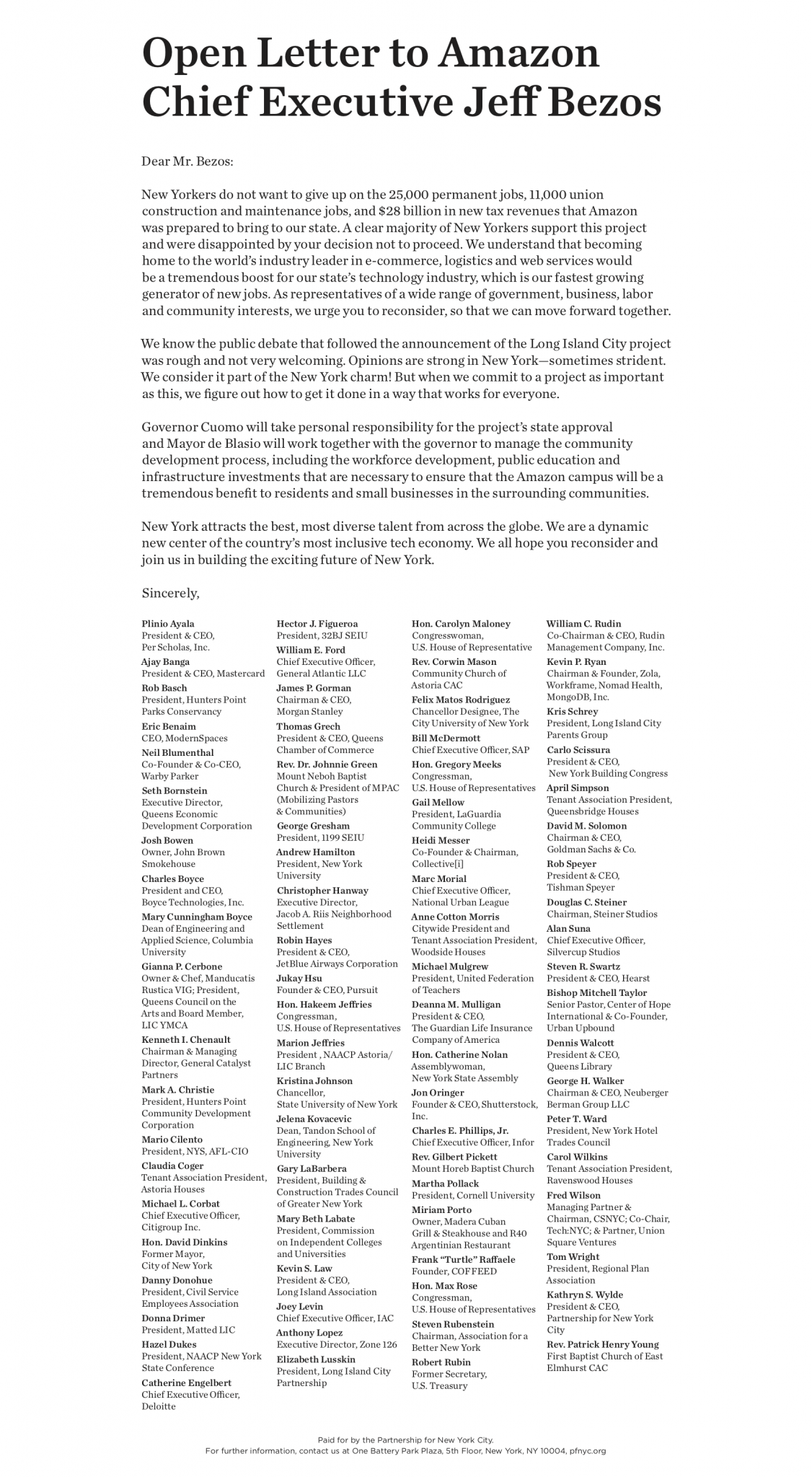
The rest of that $3B figure was from _existing_ programs that are also available to other companies, should they meet the eligibility requirements. The Excelsior program at the NY state level made up $1.2B. The other bits are ICAP and REAP, which are NYC programs. The city projected that Amazon would be eligible for $897M from REAP and $386M from ICAP through 2038. I say 'projected' since AFAIK, these are incrementally granted credits based on what is incrementally delivered by the employer.
The city/state projected 107,000 total direct and indirect jobs, over $14 billion in new tax revenue for the State and a net of $13.5 billion in City tax revenue over the next 25 years. And $186 billion in Gross State Product for the New York State economy over the initial 25 years.
This was a tremendously positive deal for NY/NYC and despite multiple polls showing majority support among constituents for the deal, it got tanked by a vocal minority of far-left socialist activists/politicians. Governments and companies need to develop a stronger spine, ignore the social media outrage machine, and learn to sift out/ignore loud voices who have the time to engage in a visible/disruptive manner (which incorrectly skews opinion away from silently-held opinions that are equally valid).
Sure. Amazon comes in. They don't get any tax breaks. They do business and make money and pay taxes. NY actually uses those taxes for things people need.
> The result: 56 percent of voters statewide approved, while 36 percent didn’t.
> In New York City, 58 percent of registered voters backed the plan, while 35 percent were opposed.
https://nypost.com/2019/02/12/majority-of-new-yorkers-want-a...
The political divide in this country is insurmountable. Just listen to Ben Shapiro's opinion on events, and then NPR's. Stark, polar opposites. It is impossible for the average American to take an informed position on something in so polarized a climate.
I'd rather shoot myself
> and then NPR
I'd rather just sit in silence staring at a wall.
And to donors.
Fuck amazon
Really all that providing this in image format accomplishes is:
1. makes it blurry on high-res monitors
2. makes it so that it can't be zoomed effectively
3. makes it so that it can't be searched
4. makes it so that it can't be indexed by search engines
5. makes it so that it can't be copy/pasted easily
6. makes it cost exponentially more data to transfer
This isn't some check to Bezos. This is a rebate off their tax bill. These are taxes that you will not get unless the business moves to New York.
Taxes incentives are incredibly common, so common that the deals that NY offered Amazon work within existing programs like Excelsior.
Finally, it's not a backroom deal. Part of Amazon's competition was for each city to sign an NDA in the process so cities can't see the bids of other cities. This would have created a bidding war that, surprisingly, Amazon didn't want.
Yes, because our society is corrupt by design.
> This isn't some check to Bezos. This is a rebate off their tax bill. These are taxes that you will not get unless the business moves to New York.
At which point he gets to earn an extra 3 billion that should be going to the state.
> Finally, it's not a backroom deal. Part of Amazon's competition was for each city to sign an NDA in the process so cities can't see the bids of other cities. This would have created a bidding war that, surprisingly, Amazon didn't want.
That's a backroom deal. Giving it a (flimsy) reason for being a backroom deal doesn't change the way it was done.
Who benefits from this information asymmetry?
And it is a backroom deal in that there was no competitive process to redevelop LIC, which would allow other companies and developers to compete with Amazon, as well as no input from city residents and those affected. The NDA is for Amazon's benefit and was clearly done at Amazon's behest.
So, it's a backroom deal. Opacity in this process benefits Amazon and hurts the cities, so people got pissed off and rejected it. This isn't hard to understand.
"Everyone else" would have received the same breaks for that location and scale of project (less the $500MM you already mentioned).
> including Google, which is buying whole city blocks without second thought and with no handouts
Is there evidence for this, or is it just speculation based on silence (because Google is smart enough to keep their mouth shut and not start patronizing national dog-and-pony shows)?
Amazon left the impression with their year long spectacle they were getting a special deal. They really have nobody to blame but themselves.
Sure, if you dig for it. New York is notorious for burying records under obscure bureaucracy.
> As far as I understand, Google, Facebook, and Amazon's already existing 5,000 NYC jobs have been achieved the good old fashioned way, sans bribery.
Just because a reporter hasn't decided to go digging for evidence (and succeeded) doesn't mean these companies didn't get breaks and subsidies. There are programs that cover certain areas of Lower Manhattan, though generally south of 96th St. there are not many city incentives. The state incentives that Amazon qualified for in LIC they certainly already qualify for, at least in part, as do Facebook and Google.
And this 500 million dollars is kind of a really big deal. To the average NYC resident who has watched their transit system languish in a perpetual state crisis and disrepair this is 500 million dollars in "real" tax dollars woefully misspent.
Second, the $500MM was coming from the state. It would not, and will never, see the coffers of the MTA.
Third, if $500MM is such a big deal then the $2.5B in non-special incentives are a much bigger deal, and are getting completely lost in the misinformation that the entire $3B was a special deal for Amazon and that they would have got $0 without the dog-and-pony show.
I'm sure that the government chose Google as an occupant for those buildings just as much as Google's money did.
Most recently, Amazon threatened to pull out of a large skyscraper project if the head tax went through[0]. It didn't, and a few days ago they announced that they would not be moving into the building anyway.
Even if you are a small-government libertarian, you should be opposed to these policies, as they are blatant handouts to powerful players. Small- and medium-sized businesses don't get this kind of treatment. This is a race to the bottom among states and municipalities. It is oligarchical, crony capitalism.
[0] https://www.geekwire.com/2019/amazon-backs-massive-seattle-o...
It did, after months of debate and planning.
Amazon and a few others got it scrapped almost instantly.
> It is oligarchical, crony capitalism.
Our society is built to fuel the interests of the wealthy.
It's just capitalism. No special modifiers required.
They probably oversell the economic benefit, and it's pretty foul the way a corporation can push around politicians. But the bottom line is, these jobs wouldn't go to existing New Yorkers in large part, and that makes the economic benefit to New Yorkers thing difficult to reason about.
In lower Manhattan they might be unnoticed, but that is not New York. Queens, is not Manhattan. You're talking about a major gentrification event. Can't handle is bad wording, but it would seriously exacerbate the wealth distribution problem here, which is already the worst in the country.