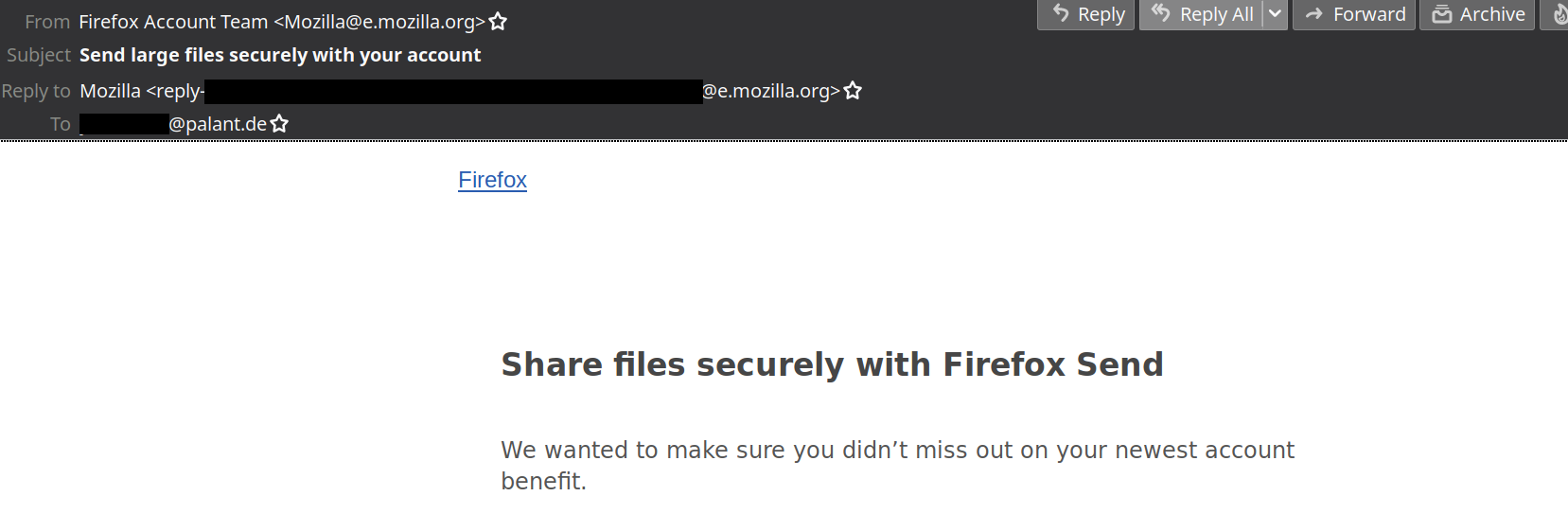
Dear Mozilla, please stop spamming!
Detailing Mozilla's failures to send newsletters only to users who actually opted in.
Almost Secure
179 points · by justthisone · 7y ago · 117 comments
The other config settings I'm going to be less charitable about considering there would be no rational reason for an update to ever change those values.
(And here's a popular preconfigured user.js https://github.com/pyllyukko/user.js )
If you configure Firefox to not automatically update, and then use, say, a package manager to update it, automatic updates will get re-enabled.
That isn't what the bug report says - package managers don't use the Firefox installer. Are you talking about a real bug (if so, is it logged?), or are you spreading FUD?
After a certain point, plausible deniability isn't plausible anymore.
They are doing it on purpose.
The creators probably had good intentions, but Recommended by Pocket seems almost like a dark pattern.
Some of the comments here remind me of when my users think everything is deliberately implemented and if something doesn't work perfectly, it's because I'm incompetent/malicious and designed it that way when it's just a bug or oversight.
But anyway, "optout" ought to take priority IMHO.
But that doesn't explain how or when it was set.
I don’t see how signing someone up to a newsletter is a security vulnerability.
What is it with all Firefox/Mozilla hating as of late? They don't seem to be able to do anything right in the eyes of some people, and seem to be held to a ridiculously high standard (far higher than anyone else).
While I generally think there's lots of overblown criticism of Mozilla and that Mozilla is still far ahead of the others in these regards overall, it's worrysome that they get basics like this wrong.
Firefox remains configurable and privacy-enabling to a large extent, but it is becoming harder and harder, especially for non-technical folks, to realize that default Firefox settings are not necessarily user or privacy friendly. See the ruckus last year about defaulting to Cloudflare's DNS servers.
Something went wrong and the author (that's the ABP-creator, right?) is just making a mountain out of a molehill.
Reports like this spamming thing confirms my lack of trust was on point. :)
OK, so I just did this, and I don't really see what the issue is. Looking at Wireshark, I see requests for:
* detectportal.firefox.com, which is used to detect whether you're connected to a captive portal network and need to sign in before you can connect to the internet. As far as I'm aware, no personal information is transmitted as part of this request, and there's apparently a pref to disable it [0]
* A couple of requests for OCSP certificate validation [1], which seems like a useful feature, and is also pretty easy to disable if you really don't want it.
* A request to download.mozilla.org and another one to download.cdn.mozilla.net, which looks like it's checking whether an update is available.
I don't really see a problem with any of these?
[0] https://bugzilla.mozilla.org/show_bug.cgi?id=1307867 [1] https://en.wikipedia.org/wiki/Online_Certificate_Status_Prot...
You seriously don't have an issue with being fingerprinted and tracked every single time you open an application on your computer?
The point is that there should be zero. I should not have a single outgoing network request triggered by opening a web browser to a blank page until interacting in some way. The fact that we've lost this as a standard is terrifying to me.
I think you're looking in the wrong direction. Try the closed-source (or partial closed source) operating systems you interact with on a daily basis: Windows, Android, macOS, iOS- that's where you'll find the "fingerprinted and tracked every single time you open" sort of thing you speak of. :)
The hell of it is that with the way ad tech has eaten the web, I'm not sure they're wrong.
The least resource-intensive way to provide attack-resistance near the level provided by Google's Chrome team would probably be to notify the user when a vulnerability is disclosed so that the user can either switch to Chrome or restrict their browsing to safe sites till the binary provider can get a security update out.
I know of no one doing that or providing timely security updates however except Google, possibly Opera, possibly Brave and probably some day soon Microsoft.
The also have a guide for enhancing privacy in Firefox
I mean no offense by this but I consider myself a privacy wonk and that website is a bit too tin foil hat even for me.
I think we're in a bad way as far as choices go for browsers these days, but Firefox seems like the best of a bad situation to me. If people are still concerned, they should take a look at the changes made to Firefox for the Tor browser.
I've also started to make use of text browsers. Links and Links2 are two that I use. Links2 is a nice halfway option as it will support images too.
I find them great for websites where I want to read info, but the interface is ironically designed to make that harder than it should be. News sites are a perfect example. Text browsers turn them from bloated billboards back into a readable format.
Edit: I know it's chromium-based, but still wondering!
https://www.mozillapulse.org/profile/410
New Knowledge is the organization that setup a fake Russian botnet, and then tried to push a narrative about how the Republican candidate in an Alabama Senate race was being assisted by this "Russian election interference"... anybody involved with that organization is a scumbag - it has zero redeeming qualities. Renee has been making the rounds lately on Youtube, informing everyone about how much of a threat these operations are (not her organizations fabricated ops, the totally real ones). I haven't yet found the prime mover in this, but her activities are well aligned with those of the DoD ratcheting up the scaremongering about the (according to them) active Chinese operations against the US population. So there is a pretty strong push for further internet lockdown measures being made right now by these people - and Mozilla is associated. At this point I would not be at all surprised to hear Mozilla announce RealID browser integration.
At least one person from New Knowledge was involved in a small experiment designed to explore how the sorts of tactics used by the Russians worked, which attempted to convince Republicans that Mr. Moore was receiving Russian help, but it was designed to be too small to actually affect the outcome of the election (as the goal was to explore how the tactics worked, not to produce any effect). This is a little shady, but as long as it didn't actually affect the outcome I see no harm in a group of people trying to better understand how the Russian social media tactics work.
This is a delightfully concise summary of Mozilla today. I was a Mozilla contributor in the "scrappy" years and became one of those listed on /about/owners.html. But Mozilla today is basically unrecognizable. A few years ago, even after I'd stopped contributing, it made me sick to my stomach to think about where things have gone, but I can process it better nowadays.
Mozilla's done worse than what's written in OP, but the absolute worst they can do is continue getting people to believe they're the same scrappy organization fighting for good.
If you believe in the Mozilla mission, then use Firefox, I guess, because there's not really a better option. (Although I suppose a WebKit-based browser should be an acceptable equivalent.) But please don't give Mozilla any money or tell people that Mozilla is their friend. It sort of tarnishes how things were around the time when you could say that and it was actually true all the way through.