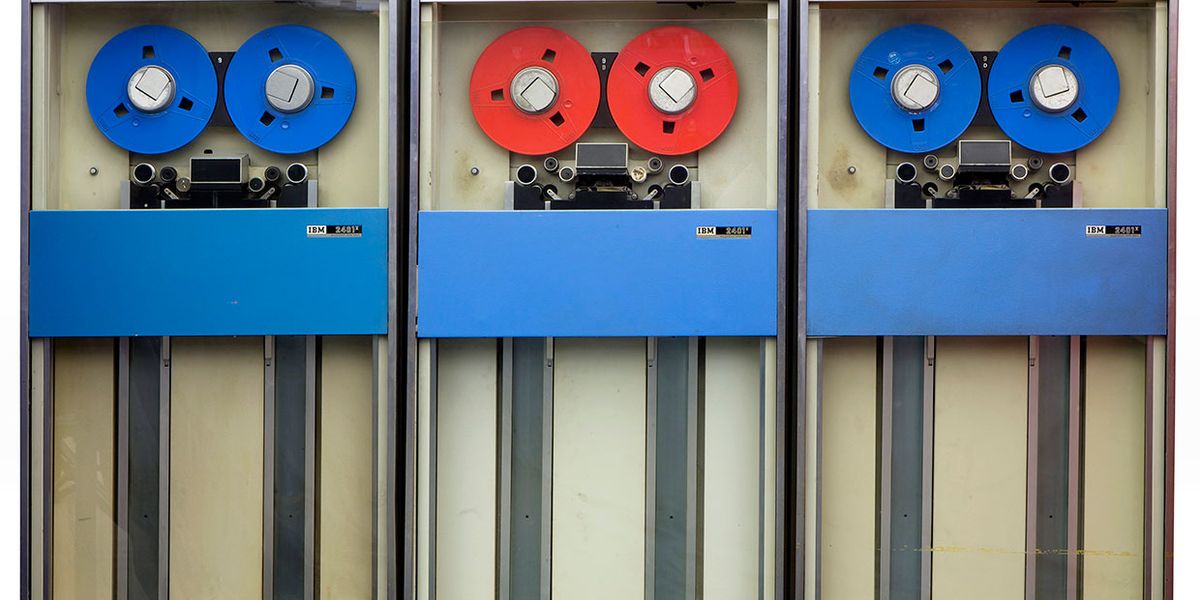
Building the System/360 Mainframe Nearly Destroyed IBM
Instead, the S/360 proved to be the most successful product launch ever and changed the course of computing
IEEE Spectrum
87 points · by headalgorithm · 7y ago · 27 comments
Having a specialized tool maker doesn't seem very common either, it seems like in most places everyone is there own toolmaker with little to no sharing, or that there are no toolmakers.
From those photos I can see how only 20 years before IBM had been able to retool its factories to make machine guns for WWII. Nowadays such a radical retooling seem inconceivable to me.
Fun fact I just learned: some of the software written for these machines can now run alongside Node.js on the same hardware. That's some impressive legacy support.
> Years later, when asked whether IBM would ever engage in such a massive project again, one executive barked out, “Hell no, never again.” Watson tilted toward a similar reaction. Commenting in 1966, he said, “At our size, we can’t go 100 percent with anything new again,” meaning anything that big. After the 360, Watson made it a policy “never to announce a new technology which will require us to devote more than 25 percent of our production to that technology.”
Yet if IBM had had the balls to hold onto that "bet the farm" spirit, then they might not be quite the sad husk of a formerly great company they are today.
Seems to me that pure software emulators (like the one written in BAL, mentioned below) would not be subject to any particular kind of Y2K problem.
I think it was more of a problem of having very old 'working' legacy code that nobody wanted to touch anymore. If one had the expertise, one could in principle do Y2K fixes to (original) 1401 autocoder code.
There is excellent work by Ken Shirriff e.g. http://www.righto.com/2019/01/accounting-machines-ibm-1403-a... that has much 1401 detail.
By 1999 there were so many generations of 360 programs that read and wrote the same files as the 1401 code that any changes to record formats (e.g. 4-digit years) would have been very impractical. The worse date rollover for the 1401 code came in April of 1983, when months since 1900 reached 1000. Stuff like that mostly got fixed with overpunches, but some of the record layouts were running out of places to overpunch.
I read that page by Ken Shirriff when it was posted somewhere a few weeks ago. Very informative.
> multiply and divide hardware was optional on the 1401 Weren't both floating point (wobbly precision) and packed fixed decimal each extra-cost options on the first 360's?
Orders equal to 5 times the installed base in US, US, EU, and JP, at a development cost of $50k/order [5 billion $/100k orders = 50k in 1965 USD, ~400k in 2019 USD].
From a software perspective, Brooks’ book was educational, but from a business perspective, the order numbers are inspiring.
Where did that number come from? How many were model 20's? That would be 100 mainframes for each company in the Fortune 1000. How many of the 100,000 were installed and paid for? At even a low $50k per machine, that would be almost double IBM's total annual revenue in the mid 1960's, and they sold lots of punch cards, tabulators, sorters, collators, printers, minicomputers (1130's machines would have taken and 1620's, right?), calculating card punches, disk drives, tape drives, data cells, YNI. I toured the IBM mainframe production line at Poughkeepsie in early 1967, and it did not move quickly nor was it a beehive of activity, maybe 5 machines in process, and none of them moved in the 30-60 minutes I was there. I did not get the idea they could churn those things out in the 1000's.
Afterwards they were hiring something like 1000 new people per month...
Does anyone know did IBM invent microcoded control stores then? This is pretty fascinating.
https://reason.com/archives/1974/04/01/ibm/print
"the 1956 consent decree (which settled the 1952 suit) placed significant restrictions on IBM's computer business [4], and is responsible for the very existence of some segments of the computer industry. It required that IBM sell its machines as well as lease them—there are now over a hundred firms whose sole business is leasing IBM computers! They buy from IBM, depreciate the machines over a longer lifetime, and charge lower rental fees.[5] (Recently some of these leasing companies have expressed their desire that IBM be forced out of the leasing business altogether.[6])
Another provision of the decree aided the growth of the computer services business. It required that IBM operate its services business as an independent (wholly owned) subsidiary, Service Bureau Corporation (SBC), and that any equipment and services provided for SBC be on the same terms as for any other company. Ironically, as part of the settlement of the CDC suit last year, CDC bought Service Bureau Corporation from IBM, and since CDC is not under any antitrust restrictions, it expects SBC to be much more profitable! [7]
The 1956 decree also required IBM to train personnel and provide technical manuals for anyone who owns, repairs, maintains, or distributes IBM electronic data processing equipment. The decree also ordered IBM to grant unrestricted licenses to companies desiring to use its patents, and enjoined IBM from instituting any suits for patent infringement which occurred prior to the date of the decree.
The aim of these provisions was to cut IBM's share of the market and to "enhance" competition."
At the time, the computer industry was known ato be made up of "snow white and the seven dwarfs": "Snow White was IBM and the seven dwarfs were Burroughs, UNIVAC, NCR, Control Data Corporation, Honeywell, General Electric and RCA"
'in the day' I don't ever remember seeing a GE or RCA box, but the others seemed to thrive in their niches.