216 points · by blockmarker · 7y ago · 142 comments
(2) Nature is an extremely high impact factor journal. However, it's ... not really a medical journal. Nor a psych journal. Nor a developmental peds journal. It's a basic sciences journal. What I mean to say is, even if this were Nature, it'd be a super high-impact journal that isn't actually read by clinicians who would be best positioned to criticize the study.
(2a) For instance, their bowel transfer prep involved a clean-out with a two week course of vanco. The only bowel bugs it's used for are c. diff colitis and staph aureus enterocolitis. The reason it's really only used for that is because it really doesn't touch any other common bowel inhabitants. It's useful for those because it doesn't absorbed very effectively, so if you've got C Diff sitting in the bowel lumen, great, send a wash of vanco down the pipe. But, uh, for any other bugs in the gut? It's not even second line. So, how weird that it would be used to knock out pre-existing gut flora and "suppress pathogenic bacteria." C Diff and MRSA are not the leading pathogenic gut bacteria. The pre-existing flora are predominantly anaerobes.
(3) An unblinded, uncontrolled trial of a disease whose symptoms are highly subjective in measure? Excellent. I'm sure they took measures to ensure they weren't influenced in their subjective analys-
(3a) Oh. The senior author has a bunch of patents out trying to commercialize probiotics for autism.
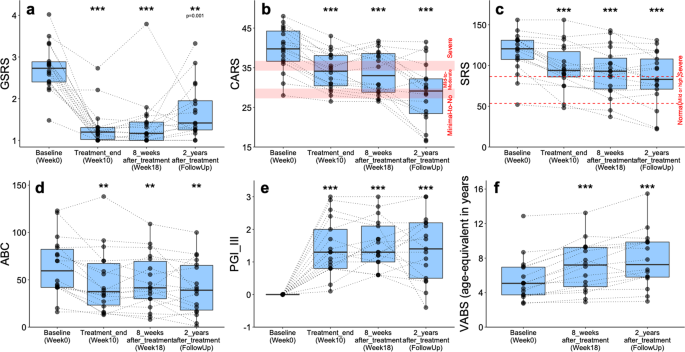
(3b) Oh, they used the PGI3, CARS, SRS, and ABC scores. I guess if you fill out enough bubbles you can overcome the fact that those are still subjective enough that they're shit for an open-label trial. Whoops.
I don't mean to be overly dismissive. It's a fine pilot. The results are interesting enough that I'd want to see a real study tackle this. My comments are mostly aimed at the prevailing sentiment here taking this at face value.
> Further research with a placebo-control arm is warranted
IIUC they don't have a control group. They don't have a control group!!! Reading again your comment, you wrote this in point (3) and (3b), but it needs a few more exclamation marks.
Again, parent poster mentioned this but as you say, more exclamation marks are needed.
More importantly, the peer-reviewers are likely scientists, not physicians. This can make a subtle difference in how and what they review.
But you did a great job listing out some of the shortcomings!
As for one of the senior authors filing a patent for commercialize probiotics for autism, shouldn't there be a mandatory disclosure in their papers that have a conflict of interest?!
In this article the patent applications are disclosed in the Competing Interests section. The readers can draw their own conclusions from those. It would be very unusual for a journal to not demand a declaration of conflicting interests.
Also I know SciRep is fairly new but isn't it still under the Nature umbrella? ie. There's still some peer review; the study is likely to be legitimate.
The authors are pretty explicit about the weaknesses in their study and I think that the flaws are reasonable for a pilot study. I'm surprised the authors didn't say anything about their conflict of interest though.
Showing a link between autism and the gut microbiome would be incredible. Obviously more work needs to be done before anything is concluded but this is a really interesting result.
The publication incentives are extremely messed up and in favor of exciting results that aren't true.
Thus, this paper is saying what the scientific method should test next.
The number of subjects was small. They even added: "We note that due to the open-label nature of this initial trial, all of the assessments are subject to placebo effect..."
Step 1: Observation
Step 2: Hypothesis
Step 3: Test
Also, what exactly is SciRep?
tl;dr: "In this other observational study, many subjects with autism didn't improve over time on a different metric, so the improvements in our metrics were probably because of the treatment and not spontaneous. Also, we asked the parents if there was any regression to the mean, and they said no."
there are remarkable parallels to Andrew Wakefield's paper about autism, vaccination, and his hypothesis about the gut.
Perhaps this should have been published in the Lancet[1]
https://www.thelancet.com/journals/lancet/article/PIIS014067...
I say "I think" because I'm not sure if I would like losing the things that make me "me". A friday night just reading all kinds of odd books to learn new things is totally fine by me right now and even though I have problems regulating my emotions I can now, after decades of coping, channel them into passion to get stuff done. I do however think my childhood would've been much easier if I was somehow treated as a young child; the years of being bullied and not making friends have taken its toll on me, something I struggle with to this day in business settings when I have to deal with unfamiliar people.
It is easier doing it now at 29 than it was at 19, though. Maybe 10 more years of practice is all I need.
That's simply a hallmark of intellectualism, not autism.
I think that's just you(nothing wrong with that), a man i used to know has it he'd rather just party(nothing wrong with that either).
I am a dev and probably had quite similar experiences to yours in meetings in my first couple office jobs. What made a profound difference for me was adopting empathy as an intellectual practice. I have never once "experienced someone's feelings as if they were my own" so I long regarded myself as being naturally deficient in empathy, but it also didn't seem very important to my engineer mindset.
The habit I cultivated was to simply compile lists of rules, not written, just in my head. Things to say, things to not say, and how to say what you need to say and when. How people react, etc. It meant paying close attention and making guesses in a way that did not come naturally to me at first. It took a lot of effort to build up these habits. I did not realize just how self-focused and self-centered I was as a human being.
After doing this for a while, without really trying, general principles emerged from my compiled rules. These, combined with my efforts at paying attention to people, really turned things around for me in a profound way. People really began to warm up to me, and most importantly, my interactions almost completely stopped being surprising and painful, due to me knowing a lot more about how to get along unselfishly. I avoided learning this for a long time, because I think I assumed I would end up spending my days just pleasing other people. A silly worry in the end.
The rules I compiled were an important middle step. It was applying the rigor and attention I usually reserve for interesting codebases or videogames, to getting along with humans. In hindsight it is perhaps not so surprising that with diligent effort I acquired a skill, but I cannot overstate how much I wish I had done this sooner.
I don't want to oversell it. It wasn't that I became an amazingly charismatic wunderkind, yet for the impact it made on my life, I may as well have. With great effort, in my mid 30s I reached the social starting line where most people (from my perspective at least) were lucky enough to begin.
It could be that I only managed this because my autistic behaviours had a different root cause or milder expression than someone else's. It could be that some forms of autism are purely viral and other ailments merely resemble it. In short, I don't know that anyone else can benefit from this, but am inclined to think that many could.
Also, FWIW, I wouldn't attach too strongly to this idea of "me" that you mention. I have had similar feelings in my journey, and the answer I found was to trust that whatever nebulous merit exists in this "me" concept, it will survive my efforts to improve myself towards a more healthy sociability. Your "me" might be holding you back.
Incidentally, per the main topic, as a result of my other health issues gut flora had entered my radar and I've encountered a lot of similar, potentially promising, claims about the brain gut connection. I personally think there's something important there to be found but we haven't had the right studies done to really sort it out. If this study was an important step in that process, great I guess, but like others have said, I would have preferred they had done a more useful study on the subject, that would propel our knowledge further, faster.
For all the mystery surrounding ASD, one thing I feel absolutely certain of, is that it is causing a lot of suffering that will become unnecessary once it is more thoroughly understood. The sooner the better.
I really struggled to find appropriate outlets for my humour for a lot of years...
"When people you know say "hello" what they are really saying is "are you still friendly since the last time I've seen you?" so just say Hi with a hint of warmth if you can manage it, because people are never going to stop greeting you anyway, there is no way to recoup the cost so might as well let them know "yeah, we're still cool""
For a while, I had the charming habit of refusing to return greetings, because I felt they were bothersome, inefficient and unnecessary.
The rules themselves are each tailored to some particular misstep I have made. The principles that emerged really were kind of basic stuff good parents, teachers or Mr. Rogers teaches you. That being less selfish is wise, paying attention to people is rewarding, and that there is a very big difference between listening to someone and waiting to speak. The principles are only words, and the rules are too specific to my own experiences to really translate. What matters is the intuition I had been building up from the moment I decided for myself that this problem was worth the effort.
I hope it helps.
Just adding context.
Those that you see able to 'mask' their symptoms are generally on the opposite end of the spectrum, sometimes referred to as 'high-functioning'. That requires a level of self-awareness that many of the lower functioning spectrum seem to lack.
One of the major problems with autism diagnoses is that there are lots of people who see the higher-functioning members of the autism community as the norm, whereas there are a fair percentage that are essentially permanently disabled that will likely be unable to contribute to society in a measurable way.
Having worked with autistic youth before, that's simply not true. First, autism is not a disorder that can be cured but worked with. Second, it doesn't do it by itself, but _can_ get better, with different approaches, and most of them involve hard and persistent education work. Lastly, the part of the spectrum that can look as if they were "normal" is a rather small proportion of the whole ASD.
It depends on how they selected the subject of the study [1] and how accurate is the evaluation at the beginning and the end of the study [2].
That's why they need a control group, that is selected at random, so you hope that the cure rate in the control group is the same than in the main group if they didn't get the treatment.
Also, the groups must be double blind so when the doctors evaluate the results don't know if the patient has been treated or not, and they use the same criteria.
[1] Did they select only the mild case? Did they exclude the mild cases? Average age of the group? How much personalized help they can get to interact with other persons? Did other part of the study affect them? (Something like a minimal medical attention when they visit a nurse each month for minimal checks.) And a few more, that probably nobody know ...
[2] Some symptoms are crystal clear, and some are more fuzzy.
This is absolutely not true for the vast majority of those diagnosed with ASD
Could this be an additional factor (next to better diagnostics) in the increasing prevalence of ASD?
This begs the question, is any other treatment known to produce such strong results?
I have two children with combinations of these symptoms and it's staggering how many of the symptoms could be interpreted either way depending on the classifying doctor's specialty.
Great, so we have a study showing that either the treatment or the placebo effect is very strong. Wait, that's not very useful, isn't it?
No need for a control group the effect is so strong!
Studies of psychological conditions are notoriously hard because much of the quantification is subjective, but this study wasn't even blinded and had no control.
Any study attempting to show or imply causation needs to control for confounding variables; this is statistics 101. Usually you do this with an aptly named control group.
If you don't have that control, you're left with "either my results are meaningful or else (very likely) there is a confounding factor." Great, that's not very useful.
So either, vaccine studies are "not good ones" as you say, or you perhaps have overlooked something?
[1] https://www.epilepsy.com/learn/treating-seizures-and-epileps...
[2] https://www.cell.com/cell/fulltext/S0092-8674(18)30520-8
"Doesn't this imply that being neurotypical is the actual disease and we have the means to deploy a cure for it?" Not a serious position but one to hopefully get people thinking about norms.
Don't jump to conclusions so quickly.
Things that appear genetic could be related to family traditions that children follow when parents, environmental issues that are common along family lines, bacteria shared among parents and their children, ect.
That sort of behavior suggests that they already know the answer is more likely than not genetic but they refuse to accept it because they don't like the implications. There are many things which should have broken said links but haven't - otherwise they would have played out already.
Autism can be genetic for sure. But I think many are diagnosed on the spectrum to hastely.
>> Many studies have reported abnormal gut microbiota in individuals with Autism Spectrum Disorders (ASD), suggesting a link between gut microbiome and autism-like behaviors.
When I was a child everybody thought I was autist when in reality I was just malnurished because I had a single mother who was up over her head in responsibility. If you dont eat right and maybe even live largely off sugar, you are bound to have attention span problems and blood sugar and mood like a roller coaster.
> Can't wait to see hysterical autism moms doing home enemas with feces, hopefully some anti-vaxxers stories as well trying to mitigate having to get their kid vaccinated for kindergarden.
Not fun for the children, but any case like this would bring it over the top and hopefully create a bigger uproar.
Jokes aside there has been plenty of research around insulin spike and how it is dependent on the gut bacteria and food you eat.
Btw Freud was wrong and his model of child development have been disproven for a hundred years now. Don't pay attention to stuff like "anal retentiveness", it's an inaccurate model of real psychology.