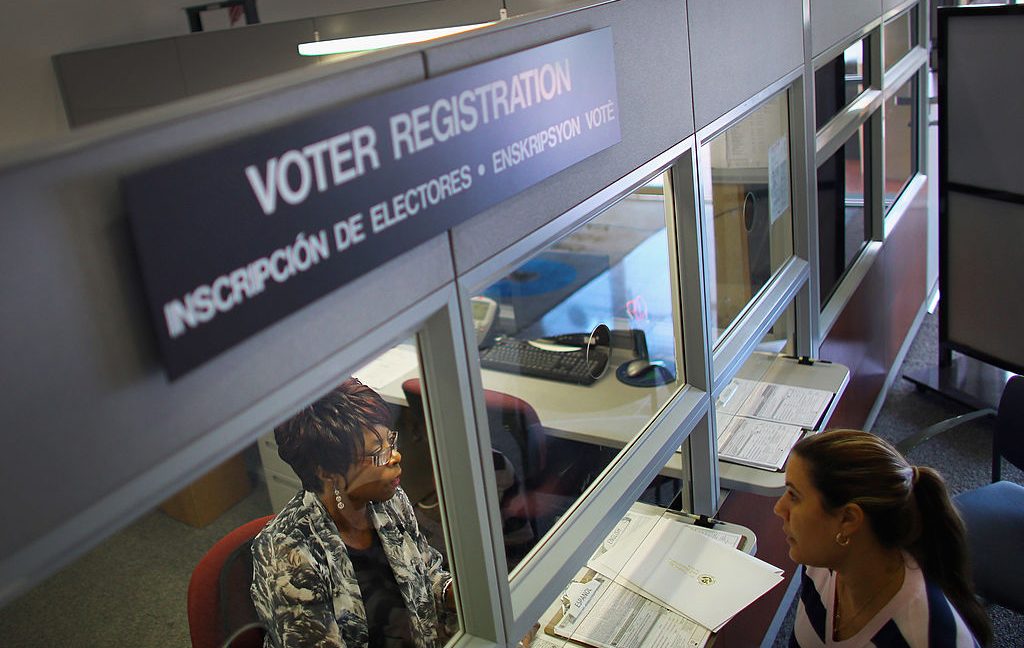
DHS, FBI say election systems in all 50 states were targeted in 2016
Joint Intelligence Bulletin issued in March says Russian hacking efforts were wide-ranging.
Ars Technica
161 points · by howard941 · 7y ago · 124 comments
Everybody knows this now and the effects are so predictable it brings into question the motives of people who have an interest in both undermining and discrediting the democratic process by using these machines.
As I once saw someone point out here, the crucial thing is that they be verifiable by the average person.
Imagine a technically perfect electronic voting system, immune to tampering, preserving anonymity, etc. It's provably perfect - but only to the handful people who can understand the proof.
Average people could not have confidence in such a system, so it undermines democracy. (This may also be a barrier to using vote counting systems better but more complex than "first past the post" unless they can be explained clearly.)
"Put your paper ballot in that bin everyone can see and we'll all count them together at the end of the day" is a process that anyone can see is legitimate. So that's what we should do.
We need the equivalent of a moped to do what we need done, but are being sold on F1 racecars which end up being built by equivalent of rednecks in a scrapyard to line the pockets of the scrapyard owners.
Yeah, no thanks. We had that in The Netherlands. The NEDAP voting machines were running on m68k machines. With very weak cryptography. In mid '00s.
What we need to do, is keep this last part of technology out of our democratic process. When people count ballots, there are many eyes, and you do not know of each other which candidate or party you represent. Hence, the system works. It isn't broken. Why fix it with a worse solution? A solution not everyone understands? Yet everyone age ~5 and higher understands manual counting.
I've volunteered 3 times thus far (end of may is gonna be my 4th time) as ballot/vote counter in my country (NL). I can highly recommend to just try it once, to learn what it's like. Its also (mostly) fun to work in a diverse team with people of different backgrounds and ages. You never know who you're gonna get beforehand. One footnote: do not discuss politics while counting ballots. Its inappropriate (since you're supposed to be neutral and not know each other's preference) and pointless (won't affect the outcome anymore in any way).
Even that's too complicated to be trustworthy. That's why I think optical scan ballots are the way to go: even a totally unskilled, untrained regular person would feel fairly confident that they could count them.
IMHO, all the technology investment should be put into processing and validating ballots after they've been filled out. Personally, I like the idea of a voter being able to feed their optical-scan ballot into a machine at the voting booth that will let them verify it will be read exactly as they intend. Then they carry it over to the ballot box to be tallied by a separate machine there.
But that undermines the purpose of moving to a black-box system.
No, seriously. Every cash register can spit out a receipt; the idea behind audit trails has been around since Hammurabi. The fact that voting systems have none for something as important as the foundation of democracy betrays their purpose.
Every successive society insists on subjugating the plebes by imposing some new barrier to understanding the rules that govern them.
* You can't read the written word of God because you're illiterate. You have to come to church.
* Oh, but you learned to read? Well, only the priests can actually talk to him. You still have to come to church and talk to God through the priest.
* (Who the hell does this Martin Luther guy think he is?)
* Now we have complex tax and legal codes only accountants/lawyers can understand and negotiate. What started as a goat theft escalates to 20 other charges you don't understand the nuances of to successfully defend yourself in court.
* We have voting systems only the administrators have visibility into. Does your vote matter? Was it even recorded in the first place, or did it get wiped out by convenient Russian floating-point rounding errors?
* Our understanding of the world around us is no longer driven by dogma, but personalized algorithms administered by a handful of corporate gatekeepers hell-bent on driving engagement and consumption. If the Faceless Oracle of Google doesn't want you to see it, you'll never discover it organically.
* Freedom of movement is being replaced with self-driving cars, powered by math and code only its engineers (supposedly) understand.
* Soon our personal assets will be governed by the blockchain, another technology understood and exploited by its administrators (and their scammer buddies).
It's a classic hustler and cult-leader tactic. The less someone understands, the easier it is to fleece them.
I don't think anything has changed since those days.
I think part of the problem has got to be that non-experts cannot judge how good a security solution is, so local governments are ill equipped to view it with a skeptical eye. There might also be in some way a downside of federalism here - if the states pooled more resources perhaps they would be able to solve the problem once instead of 50 times.
Then again, in the bush election the judiciary decided floridas votes and not a peep was heard. American poltical machinery is far from perfect
I'd guess that 50+% of 3rd world leaders are supported by some foreign government financially or militarily which keeps them in power.
But yes, it doesn't feel good when a foreign government tries to pick a winner in our elections.
No, I do not think those are remotely equivalent.
I totally agree that vote rigging would be particularly egregious. However, I'm not sure that backing a regime with money / weapons / training, etc. that then goes ahead and rigs the vote is that much better.
I think it's more like one scenario is stealing money and the other is investing in a gang that steals money.
I just find it interesting that we openly try to pick political winners and losers in other countries.
I believe this is the most up-to-date publication on the subject: https://cse.sc.edu/~buell/Public_Data/2019_VotingMachines.pd...
I would also recommend the documentary "I Voted" (https://www.imdb.com/title/tt4081950/).
These aren't about the 2016 election in particular, but it would seem that there is strong evidence that the security practices in place by many US states are inadequate, and there is often no "paper trail" to verify that results were tallied accurately after the fact if a recount is needed.
Considering the poor security, if the 2016 election was targeted, it is likely that the attacker(s) succeeded.
> The "actors" performed their research "in alphabetical order by state name," the bulletin states, "suggesting that at least the initial research was not targeted at specific states." The research focused on Secretary of State voter registration and election results sites, but it also drilled down on some local election officials' webpages. As they accessed sites, actors "regularly attempted to identify and exploit SQL database vulnerabilities in webservers and databases."
Voter registration information is public (although not technically to Russian citizens!).
Visiting the front end websites of the state election authorities and attempting SQL injection on the web forms is not what some downthread are calling a military attack.
However, I think it’s great to be sent such a wake up call in the form of a “tap on the shoulder” because these systems should be heavily monitored and better protected.
The true election systems should require feet on the ground to compromise in any form. And they should not be electronic without a proper auditable paper record.
If your party is the minority (in votes, not representatives), but you need votes to win, gerrymandering, vote suppression, unaccountability, and fraud are all welcome tactics. Majority party does it too, but doesn’t rely on it quite as much
It's interesting to hear what those "certain groups" think about that: https://www.youtube.com/watch?v=odB1wWPqSlE
It sounds like a just-so claim: it’s not really a problem, and the people complaining are just bad people!
As far as I’m aware, not only is there not accurate study — jurisdictions like Washington intentionally make it difficult to track whether non-citizens are voting by issuing them IDs and offering to register them to vote sans additional proof of citizenship. This is why WA has to have enhanced ID — they don’t meet the federal standards of ensuring people they issue ID to are here legally.
It seems strange that people refuse to even talk about it and resort to nasty ad hominems if there genuinely is no issue.
By contrast, insulting the motivations of people genuinely trying to stand up for the law and act with integrity because you decided to employ force and just override them is deeply, unrecoverably immoral.
However, what happen in North Carolina was 1) ballot harvesting 2) alteration of the harvested ballots. They picked up the ballots and then changed the ballots they collected
Did that happen in California?
The results in NC-9 are also incredibly suspicious even back down to the Republican primary.
There are other kinds of fraud that are pervasive (like harvesting absentee ballots and modifying/discarding them) and those should be policed, but voter ID laws historically do literally nothing except punish people who don't have access to ID - like people whose birth certificates burned up in a fire, or people whose nearest DMV office is hours away.
We have decades of evidence that voter ID is a waste of time and money. It has one very obvious reason. It also seems to be pretty close to illegal, if not illegal.
Both will easily flip on war, justice, tax reform, voting, etc. as needed.
Part of the problem is it's easy to complain and spitball ideas when you're out of power, it's a lot more complex to gain consensus and implement policy when you're in power.
Whether it's removing polling places where demographics work against them [0], purging voter rolls with a heavy bias against black voters [1], placing polling places in gated communities [2], cutting down polling places in cities, onerous requirements to obtain a voter ID [4](essentially becoming a poll tax), or refusing to renew and update the Voting Rights act, it's clear the Republican party is not interested in allowing every legal citizen the right to vote.
[0] https://lawandcrime.com/civil-rights/gop-removes-sole-pollin...,
[1] https://www.snopes.com/fact-check/georgia-black-voter-regist...
[2]https://www.wtsp.com/article/news/politics/elections/south-f...
[3] https://www.texasobserver.org/election-identification-certif...
[4] https://www.nbcmiami.com/news/local/Amendment-4-Former-Felon...
[5] https://www.thedailybeast.com/republicans-have-a-secret-weap...
[0]: https://www.npr.org/sections/thetwo-way/2017/05/15/528457693...
Unfortunately there is no way that Republicans would agree to it. I don't know if Democrats would or not.
> Russian cyber actors in the summer of 2016 conducted online research and reconnaissance to identify vulnerable databases, usernames, and passwords in webpages of a broader number of state and local websites than previously identified
This makes it sound like just election-related state websites.
> a Russian campaign seeking vulnerabilities and access to election infrastructure
For me, the term "Election infrastructure" sounds like it would include voting machines, voter registries, vote counts, etc.
They do not list the numerous internal attacks that were reported too. These actually modified the votes. These votes can only be changed via physical access. But this is probably not politically interesting, and it involves corrupt staff members and such.
I have been following a lot of this kind of security news. But let's follow the money. Homeland security has already prepared a plan to take over the election system in all states (from before 2016). It seems to me that these accusations are used to push to take over the voting system.
Such a change would theoretically be good, but who watches the watchers? And why does DHS not report on the internal problems that actually changed votes?
The idea that our election infrastructure is "targeted" is scary but not very surprising. Every web server on the internet is "targeted", so why wouldn't something as valuable as election infrastructure?
Like, okay? Here's my state's website. Have fun?
https://www.michigan.gov/sos/0,4670,7-127-1633-49313--,00.ht...
Reports of attacks that aren't repelled corrodes trust in the integrity of elections. http://time.com/5510100/risk-limiting-audit-election-securit...
I guess this is what I'm asking. Were the attacks repelled, or did the hackers actually hack/break/change something? What was that thing? I'm genuinely asking.
Behind a single user/pass form with a 12 char pass. Would be stupid to not target these states.
This was in September 2018.
Lots of use of the word "probably" and "likely" in this article.