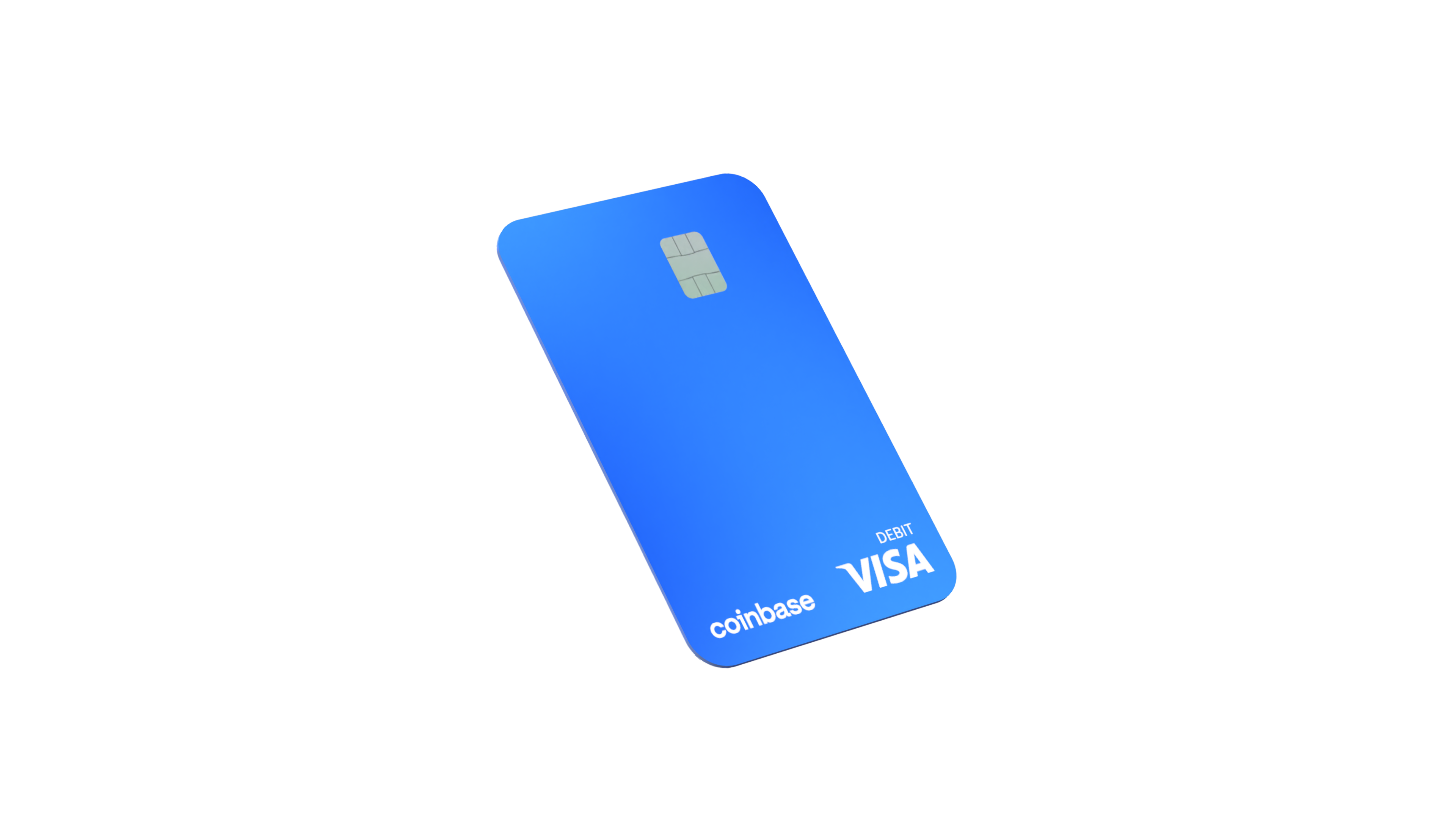
Coinbase Card: The Visa® debit card that rewards crypto
US users can earn unlimited crypto rewards from everyday spending. Enjoy zero spending fees and no annual fees. Cards accepted at 40M+ merchants worldwide.
coinbase.com
223 points · by agrinman · 7y ago · 207 comments
On the other hand, I have always considered one of the main concepts with cryptocurrency to be the potential ability to avoid third parties taking a cut of all of your digital transactions. This turns it into just another way for big companies like Visa or Coinbase to get rich just on the basis that people need to exchange money.
The basic idea for me with cryptocurrency is that since it's our money we shouldn't have to give control of it to third parties just for basic usage. We have math, the internet, and plenty of computers. We should not need Visa or Coinbase.
So paint a picture for me. How do I otherwise conveniently pay off my credit card bill with crypto? (Honestly, I would like to know, and such information would be a benefit to the general public.)
How does this give them control? As long as it still use/depends on the Bitcoin network, you still have control.
If anything, this show how cryptocurrency are amazing. Both the little guys and the big guys can use it, even you.
Cryptocurrencies has the potential to solve 2 things I believe is extremely essential this day in age. - Everyone can use them - Every amount can be used
I simply can't do a Visa transaction of 1 cent... simply can't... A child can't use Visa either. Both situations will happens more and more with the internet.
I don't see how I have more control if coinbase hold my crypto and sell it for me when I buy something compared to just having money at a bank.
Can you transfer it using the Bitcoin network? That's when you get your control back. Personally I consider that you should also always try to keep the least amount of Bitcoin possible, and to always keep it to yourself, not on an exchange.
To me also cryptocurrencies aren't a way to keep something either, it's a way to transfer value.
Why not just having money at the bank? Funnily enough I would say that you should actually keep it there and if you actually need to make a payment using Bitcoin, simply find a quick way to transfer that money to Bitcoin.
Cryptocurrencies are amazing to transfer value virtually. They aren't there to replace cash, they are there to allow you to transfer value outside of real life. It's there to allow you to do what you do in real life with cash, but on the internet. Sure Venmo allow you to do it, but I can't have a Venmo account, but everyone can have a Bitcoin wallet and exchange from it.
If you don't believe me, our team hacked together https://ln.pizza as a demo of the tech.
I agree with the premise that we shouldn't need to convert to fiat but unfortunately we have to follow the pace of adoption. You could create a POS device tied to a service that accepts crypto-only via chip and pin or magnetic for the business. I'm doubtful many businesses are hearing from their customers that they want crypto only payments, however.
I lead the development of a crypto debit card in the US. If anyone has questions, shoot me a message.
And then I was thinking of making a simple transfer app for direct crypto but then you think people are going to use it for illegal stuff and you'll get in trouble for facilitating drug dealing etc.
Or you have the Coinbase/Visa route where it's all KYCed and regulated but not much advantage over regular Visa. Dunno.
We need them because of legal limitations, not technical ones
IMHO, at the end of the day the biggest challenge is not technical, but rather it's to change the laws which were made to support the current system, to protect established actors, and to protect their interests
You are better off selling manually on an exchange (0.1-0.25% fees) and transferring to a sane bank with debit cards and minimal fees like N26(EU) or Charles Schwab(US).
Have a fiat buffer, but control your holdings and don't get milk by fee-vampires like Coinbase.
I'm not sure why people want to make it harder (and more expensive) than necessary.
I moved 95% of my savings into cryptocurrencies years ago, and it's been orders of magnitude better than the silly 1-2%.
Kind of like advising putting your savings in naked options plays because it worked for you that one time.
* Bitcoin is not guaranteed to go up and has so much volatility that you are essentially gambling.
* Bitcoin is inferior as a payment system, even when they use debit cards to interface with mainstream PoS.
* Bitcoin has probably topped out and we are nearing the end of it's hype cycle.
seemingly this is a US thing [1]
[1]https://support.coinbase.com/customer/en/portal/topics/79653...
Can't that model be expanded to include any tradable commodity? Why can't I get a 'Gold debit card' or a 'Nasdaq Debit card'?
Would there be a market for this?
Brokerages love this product, because being a debit issuer is a great business to be in. From an optimizing-your-personal-finances perspective, most HNers should probably get a rewards card from their bank of choice; you can trivially arrange the credit card to pull from a bank account and your brokerage to push to the bank account, in the case where one's spending is materially backed by one's investment portfolio (which feels like not something people should make a habit of in most cases).
Is there a particular tax advantage that I'm not considering? I'd love to know as this sort of stuff is like crack to me.
It's also the cheapest possible credit you can obtain as a consumer. TBH it's so cheap that you can reasonably expect your investment returns to at least match it in the long run, so as long as you aren't drawing so heavily as to get an unhealthy leverage ratio
Not saying there might not be some way to make it work, but it probably involves a lot of unnecessary risk and high transaction costs.
Seems like it's just too much headache without any of the purported benefits that bitcoin has over traditional money.
Gold is hard to sell in tiny fractions as well.
n.b. Not true; a lot of retail brokerages are happy to deal in fractional shares. A common use case is implementing dividend reinvestment, where you might have the 10 shares you own issue a dividend entitling you to .005 shares; many retail brokerages can trivially support this.
The "How?" is potentially interesting: over the entirety of a broker's book of business, there are a lot of holders of e.g. SPY, so the broker (or their internalizer) just buys (pick a number) 713 shares, assigns fractions correctly, and keeps a tiny bit of the last share on their own account. This comes out in the wash, because retail customers are extremely lucrative to service at scale, and having to be ~$100k long various publicly traded equities to keep the tollbooth running is cheap at the price.
But also, Coinbase owns an exchange, so they don't have to commit every transaction to the blockchain, so it's peanuts for them.
The provider could either eat the change in price over the day, or pass it back to the user by first presenting an estimated amount and then a final amount when the transaction is completed when the market next opens.
Obviously there could be some sane defaults. By default aggregate all card spending against user's margin account, every day/week/month sell the cheapest stock which covers outstanding balance (so if you spent $150, it would first sell 1 share of Apple, it wouldn't start selling Amazon until you run out of Apple shares).
I’d assume they don’t see a market, more than they don’t see a practical way to make it work.
Presumably this would work the same way Coinbase will choose whether to sell some of your bitcoin or some of your ethereum (i.e. you choose)
Of course when both parties are clients of Coinbase or Goldmoney respectively then the ownership of the bitcoins/gold can be directly transferred.
20 years ago I could write a check against my Vanguard mutual funds and I'm pretty sure they weren't the only brokerage that offered it.
The inverse (_not_ paying capital gains on this) would be very weird
Do you know what would be even more crazy and innovative? If I could skip the middle part and just exchange my dollars directly for goods and services!
You're paying 2.49% on every transaction, and the fee rises for certain kinds and volumes of transactions.
Heck, I even used it to pay my back taxes to the IRS.
So it solves the usability problem of cryptocurrency by... working like a regular bank, more or less? And mostly getting rid of the actual blockchain to use off-chain transactions while having the convenience of the centralized Visa system?
This might be the killer product for cryptocurrency, but in a more literal sense. It shows that the market seems to inexorably converge towards the good old solutions, and the cryptocurrency ecosystem slowly (and rather inefficiently) reinvents the modern banking system.
I wonder when Coinbase will start doing fractional-reserve banking with they off-chain "cryptocurrency" accounts.
This is no more "cryptocurrency technology" than if I set up a script to sell some of my Bitcoins to replenish my bank account when its balance reaches a certain value.
What are the benefits if you relay solely on existing payment networks for transactions?
I accept this kind of uncertainty when I use my existing card abroad (although in some cases, the POS terminal offers to do the currency conversion up front); but I don't much care for the idea of introducing such price volatility into all my everyday purchases.
Sounds like you're a price-conscious kind of person. Be aware that POS terminal conversions are usually the worst rates you can get, with the POS terminal taking a large % cut on each transaction in exchange for your peace of mind knowing exactly how much it's going to cost you.
If it helps you to see that conversion amount, that can be useful, but generally speaking, you don't want to accept that price and instead be charged the local currency. The amount you get charged will always be significantly less (subject to you not having absurd fx fees on your card, of course)
At a functional level - No 3DSecure support, unexplained failures, little insight from the vendor into paysafe infrastructure. I'm very surprised Coinbase launched on this mickey mouse platform. It's like launching a clothing brand with cafepress.com as your product provider
Ill stick with Monzo thanks
Same goes in general for Cryptocurrency related services. If Coinbase were to directly provide Visa/Mastercard cards, they would never get approved for the appropriate license. Hence why they are partnering with Paysafe.
> card providers going bust every other week
Any citations? No comment on this issuer but I’ve been using debit plastic from Wirecard for 5+ years with no acceptance issues and Payoneer doesn’t show signs of going bust.
That should change within the next few weeks as PSD2 requires that.
Barclays is one of the only banks slowly accepting Crypto related transactions.
Most people I know dealing with Crypto are using Revolut as they are not a proper bank. However, they recently blocked transactions to Coinbase's account (this is most likely because they are applying for a UK banking license).
High valuations has been a double edged sword. On one hand, it brought attention, interest and such. OTOH, it sucked all the energy into trading/speculation and all but forced the like of coinbase to specialise in it, neglecting everything else.
I have to say, crypto has been (and still is) an interesting look into what money is and how it might evolve. It seems that possibly inevitably, getting paid for work and paying for goods and services is "naturally" an extreme iceberg... The tiny piece of the whole that's visible. Below the surface is most of the "ice," the enormous volume of currency trading and other high finance uses.
No one wants to spend their crypto. It's better money than dollars.
People aren't spending their crypto because it isnt' as easy/economical to use, and yeah it's more likely to retain/grow in value than a stack of cash. And that's probably what you meant :-)
Seems to completely work around the reasons why Bitcoin etc. were interesting in the first place as a technology.
I respectfully disagree. The original goal of Bitcoin was to create a new financial system and instrument which ultimately enables people to pay for things.
> Crypto Liquidation Fees: 2.49%
https://support.coinbase.com/customer/portal/articles/296991...
Though, i'm curious about the fees/tax side, and I'm wondering if they will be implementing some sort of rewards program in the future
And here I am with my "old tech" SEPA bank account and Instant Payments that take 15 seconds max...
edit* also, checkout other services like Wirex, they're great
I have thought about this many times in the past: How are big companies able to steal these ideas so fast?
Actually, “steal” may not be the correct word, but I don’t think this was a coincidence. Knowing how secretive Apple is, I am surprised that Coinbase was able to work on this project (also in secret?) without them noticing. Or maybe they noticed but didn’t care? Which is even more bizarre considering how sensitive Apple lawyers are with their unreleased projects. There must be some underground market of corporate secrets that I am not aware of because I cannot explain how two companies can work in the same project more or less at the same time without it being the product of a stolen idea.
I had the same train of thought just a few weeks ago when Google announced project Stadia [3] and then Apple announced Arcade [4]. I know what you are going to say, “These two projects are very different”, well yes, they are, but they seem to have the same ingredients: big-4 creates platform for games. Maybe these are really simple coincidences, and I’m just paranoid.
[1] https://www.apple.com/apple-card/
I mean, accusing Coinbase of stealing the idea is ridiculous.
With Apple Arcade - I think it is purely a coincidence, but Apple definitely wants deeper into the gaming market now - even being there for quite some time and quite some share with iPhone and iPad.
  they should be just as secure (or insecure)
  as any other bank
The hot wallet insurance covers Coinbase itself getting hacked, but not someone breaking into your account. For account security you have 2FA, and can require confirmations from multiple email accounts for any withdrawals.
Fiat is FDIC insured, crypto has different insurance.
https://support.coinbase.com/customer/portal/articles/166237...
I'm guessing that's a reason why something like this won't arrive in the U.S. anytime soon...at least one blessed by U.S. regulators.
> We hope you enjoyed using the Shift Card and truly thank you for your loyalty. We, unfortunately, will be retiring the program in April of this year. All Shift Cards will be officially deactivated on April 11, 2019.
For example: Square.
A hedge strategy could help me on this, but this is more work. It's easy to transform it into a more stable currency.
Credit cards don't even charge you that
Also does Visa or Coinbase then make a server side log of all the transactions?
Isn't Coinbase only for US citizens?
Who is the target of this card?
For example you've been sitting on a pile of bitcoin with massive gains and spend it straight out of the account.
The US is kind of complicated with different rates for short term and long term gains.
I declared UK crypto gains recently. It can get complicated if you try to follow all the instructions properly.
Not innovative.
Yes, they already do. (https://support.coinbase.com/customer/portal/articles/292444...)